Saturday, October 24, 2015

A New FIFA Whistleblower Emerges


With three Tweets yesterday, Scott Burnett, a former FIFA employee, alleges that while he worked at FIFA and had responsibility for writing the minutes of FIFA ExCo meetings,he was instructed to "misrepresent discussions."

Burnett's name appears on FIFA documents, such as this one from 2004 (in PDF), where he is identified as a translator. He later worked as an assistant to FIFA's Secretary General, Jerome Valcke. Overall, Burnett was a FIFA employee from May, 2001 to July, 2010.

If his allegations bear out, then it would implicate in some degree of wrongdoing every FIFA ExCo member of the period who voted to approve official minutes which misrepresented ExCo activities. The exact nature of any such wrongdoing, as is often the case with FIFA, is likely to be complicated by the fact that FIFA had various ethics guidelines during the period and is incorporated as an association under Swiss law. Under US law for non-profits organizations, accurate meeting minutes are an important part of an organizations fiduciary duty (see, e.g., this blog post).

With his three Tweets, Burnett has called the attention of the world's media and various FIFA investigators. Other FIFA whistleblowers have not had it easy, and he is likely not the last one we will see.

Stay tuned . . .

(HT @sportingintel)

Wednesday, October 21, 2015

Wall to Wall Coverage of PTG 2015

Starting Sunday, you can find wall-to-wall coverage of Play the Game 2015 here at The Least Thing. Requests and comments welcomed.

Here is the detailed agenda in PDF.

#ptg2015

FIFA ExCo 2010: Where Are They Now?

Updated, based on recent events (with Twitter help of Simon Evans, Dan Roan and Bonita Mersiades - Thanks!).

Click on to embiggen.

Tuesday, October 20, 2015

USADA Should Appear Before Congress Once a Year

Well out of the public eye, the U.S. Anti-Doping Agency or USADA faces a crisis of confidence. USADA operates under special recognition by the US Congress and most of its funding comes from the US taxpayer. USADA has lately been pressing for the US government to broaden its mandate into horse racing.

The crisis of confidence stems from USADA's involvement in boxing and other combat sports, which goes beyond its Congressional mandate. USADA contracts with individual athletes to provide anti-doping services, much like a private company. This secondary activity, unlike its role providing services to Olympic athletes, has been accompanied by various allegations of missteps and even wrongdoing by USADA.

The crisis of confidence in USADA is not simply that these allegations might be true, but rather, that we have no way of knowing whether they are true, and USADA has adopted a fortress mentality inconsistent with a public agency.

Here is just one example.

The most prominent boxer with whom USADA has contracted with is Floyd Mayweather. Rumors have dogged Mayweather and USADA for years that he failed three doping tests for which USADA after-the-fact granted exemptions.  This matters because anti-doping tests are supposed to mean something, and not offer simply a fig leaf of due diligence. If Mayweather was in fact granted such exemptions, it would raise some important questions about the integrity of USADA's forays into boxing. If Mayweather was not granted these exemptions, then it is important to dispel the rumors with facts.

This was the line of thinking that Michael Woods, a reporter, had when he approached USADA asking for clarification. He asked USADA a simple yes or no question, whether Floyd Mayweather tested positive three different times.

USADA refused to answer the question, and instead pointed Woods to a 10,000 word response to an article critical of USADA, which was non-responsive to Woods' query.

This is, to put it mildly, both remarkable and unacceptable. USADA requires that athletes under its purview (except those that it contracts with independently) disclose their whereabouts 24/7/365. These athletes are required to be 100% open. It is not too much of a logical leap to think that the agency that demands such individual accountability follows with accountability and openness in its own practices.

Sports bodies have been criticized of late for leadership that is too entitled, not transparent and unresponsive to public or athlete accountability. USADA has given the public impression of adopting these imperious ways. If I had a dollar for every time that USADA officials mention Lance Armstrong, I could fund my own anti-doping agency. Catching Armstrong was important, to be sure, but it does not mean that the agency does not still have a job to do and a public to serve.

One recommendation is that in exchange for the almost-$10 million in public support that USADA receives, and before Congress expands its mandate, that the agency adopt some common sense governance reforms. Among these might be leadership term limits, an independent external board comprised of elected officials and other independent individuals, and a requirement that the head of USADA testify before Congress at least once a year, under oath.

It is true that boxing is a niche sport followed by a few and even then fewer still care much about USADA's role in boxing. USADA has avoided greater scrutiny because it mostly flies under the public radar. But this issue should be of importance to all athletes, especially those who, in principle, USADA is supported to serve first.

To read more:

Thomas Hauser on USADA's failings (here)
USADA response to Hauser (here)
Hauser rejoinder to USADA (here)

Me on USADA's accountability problem (here)
Frank Short's response to me on behalf of USADA (here)
My rejoinder to Shorter (here)

Tuesday, October 13, 2015

Distance Between Germany and USA in Soccer

The graph above shows the distance in ELO points between the US and Germany from 1990 and 2015, based on ELO rankings in June of each year. (the y-axis values represent Germany minus USA, Data)

In the early 2000s, the USA had just about caught up with Germany (due in part to Germany slipping, but also the USA improving). Since that time, Germany has surged ahead.

Tuesday, October 6, 2015

CU-Boulder Screening of DOPED and All-Star Panel Discussion

Register here!

The Sports Governance Center at the University of Colorado-Boulder’s Department of Athletics will be hosting a screening of the documentary DOPED:  The Dirty Side of Sports on Tuesday, October 13. The one-hour film will be followed by a panel discussion, which will include the film’s director, Andrew Muscato.

The film discusses the real-world challenges of addressing doping – the use of prohibited performance enhancing drugs – in college, professional and international sport. Several recent studies have indicated that among elite athletes as many as 40% may engage in doping. Yet, anti-doping agencies routinely sanction about 1% of athletes. The difference between these numbers is troubling.

Also on the panel are, Maureen Weston, professor of law at Pepperdine University; Shanon Squires, coordinator of the Human Performance Lab at CU Denver’s Health and Wellness Center; and Walter Palmer, former NBA player and advocate for athletes’ rights.

The event begins at 7pm on Tuesday, October 13 and will be held in the Champion’s Center auditorium of the new CU Athletics facilities.

The event is free and open to the public. Because seating is limited, advance registration at this link is required.

The screening is the first public event of the Department’s new Center for Sports Governance, an initiative led by CU-Boulder Professor Roger Pielke, Jr. and Athletic Director Rick George. Pielke says that the SGC “intends to create a safe space for difficult conversations, in which people do not necessarily have to agree on everything, but are willing to openly and respectfully share different points of view.”

Pielke adds, “The issue of doping in sport is not only challenging, but it is one where people have strong feelings and deep emotions. We hope to add to the conversation by engaging some of leading experts on the topic, in the open, among the Boulder community.”

The SGC will be holding more such events on a range of issues where sport and governance meet.

Soccer in Boulder

From last week's Boulder vs. Fairview soccer game.

Via @PanthersBHS

Monday, October 5, 2015

Masking the Pain: Denver Fox31 on Toradol Use in College Sports


This investigative piece takes a close look at Colorado university athletic programs and their use of a potent pain killer - Toradol. The drug is not in wide use here at CU-Boulder.

Chris Halsne of Fox 31 followed up on the original report in a piece that aired last night. He reports that Oklahoma extensively uses the drug:
New records from the University of Oklahoma prove that since 2012, student-athletes were given 4,086 doses of Toradol. The distribution covered athletes in nearly every men’s and women’s sport: baseball, track, gymnastics, tennis, basketball, wrestling, rowing, softball and volleyball, with football players receiving the most (1,490 doses.)
Last spring, the University of Southern California settled a lawsuit with a former football player over alleged Toradol abuse leading to his health problems.

Halsne reports that the head NCAA's chief medical officer, Dr.Brian Hainline, says that things must change:
“We must shift the culture on painkillers. I think the culture now that it’s too easy to give a pain medicine. It’s too easy when an athlete is sore, to say well, why don’t you take this, you’ll feel better before the game.”
I think it is safe to conclude that we should be expecting to hear lots more about painkillers as performance enhancers in the near future.

Sunday, October 4, 2015

Frank Shorter Responds to my Op-ed on USADA

Frank Shorter, the Olympic gold medalist and Boulder hero, has written an op-ed in response to mine on accountability in anti-doping agencies.  I encourage you to read his piece in full here at The Denver Post. It is an important conversation and I am glad that Shorter is engaged.

Below are my responses to Shorter's piece, embedded as italics within Shorter's op-ed.
A guest commentary writer in the Sept. 20 Perspective section made an inaccurate and misinformed assertion that the United States Anti-Doping Agency (USADA) is "falling down on the job."
The "falling down on the job" quote does not come from my piece, but from The Denver Post headline writer. 
As an Olympic gold medalist and passionate advocate for clean sport, I was directly involved in the creation of the USADA. Having remained involved with the group and the anti-doping movement in general for the last 12 years, I feel compelled to correct some of the misperceptions. USADA conducts its work with the highest level of integrity.
Effective mechanisms of accountability will help us move away from attestations of integrity. I assume that everyone in USADA works with integrity. That does not make accountability unnecessary.
In 2000, the USADA stepped into a sports-testing world rampant with conflict of interest, and was tasked with independently and without bias enforcing the global anti-doping rules of the U.S. Olympics and Paralympic Movement.

The USADA was created with the goal of having absolutely no conflict of interest. Its sole mission is to protect the integrity of clean competition and the rights of clean athletes, and its carrying out of this mission is directed by an independent board of directors specifically created to be free from conflicts of interest.
Saying so doesn't make it so. USADA has placed itself into a clear situation of conflict of interest in boxing. More broadly, WADA also has some challenges with following its own COI guidelines.
Imagine that a big part your job each day is to hold America's sports heroes like Lance Armstrong and Marion Jones accountable, and to protect the integrity of clean competition by making sure everyone plays by the same rules, no matter how famous.
The recitation of superstar athletes who were caught breaking rules is not a magical elixir that means that institutional accountability is unnecessary.
Then imagine receiving death threats against you and your family because some fans are unwilling to accept that sometimes sports figures are not actually heroic at all. For the hardworking USADA staff, this unwarranted backlash is a reality, because they must stand up for what is right regardless of what is popular.
Tell me about it. I've been in the climate debate for years. 
The opinion piece claims that "taxpayers provide the USADA with more than $10 million per year." This is false. The government grant to the USADA is less than that and is easily verifiable by checking USADA's website.
Here is my math.
It also implied that the overall money USADA receives is an immense amount. This is not true. In fact, the amount provided to USADA to carry out a national anti-doping program is less than half of the yearly earnings of many professional athletes.
It is common fallacy to assert that a relatively small amount of public funding means that accountability is unnecessary. That is wrong. USADA is an institution recognized under an international treaty by the US Congress and is overwhelmingly publicly funded. Therefore, it should be accountable to the public. Full stop.
The opinion piece also implied that the USADA has stepped outside its authorized role by assisting non-Olympic sports with anti-doping programs. The suggestion that there is something unethical about the USADA accepting such engagements, and the attempts to belittle this work as "moonlighting," demonstrate a fundamental misunderstanding of anti-doping and the important role that the USADA serves as a resource for sports entities wanting to implement similar anti-doping programs.
"Implied" -- "suggestion" -- "belittle" I'll focus instead on what I wrote.
I did ask USADA some questions that can help observers to clarify its roles and responsibilities. After several weeks, I am still awaiting a response.
I am exceedingly proud that the agency has chosen not to turn its back on athletes in non-Olympic sports. Because of that, athletes in a growing number of sports have the opportunity to compete in sport played fairly.

Congress provides the USADA with an annual grant, subject to renewal. The continuation of that funding recognizes and affirms the overwhelming success the USADA has achieved. If the USADA earns any money by taking on additional responsibilities to help advance anti-doping in other sports, these funds are channeled right back into the organization's efforts.
Greater transparency, rather than assertion, will help to resolve these questions.
There will always be conflicts of interest whenever the promoters of a sport attempt to police the athletes they represent. This is why the USADA is a much-needed, shining example of the model anti-doping solution.
For better or worse, sports institutions do not have the best reputation these days. That is unfortunate for those who are doing everything right. But that is the way that it is. Consequently, in such a context, public trust will be reinforced by openness and transparency, and not defensiveness at being asked challenging questions.
Frank Shorter is an Olympic gold and silver medalist and former chair of the USADA board of directors.

Tuesday, September 29, 2015

Marathon Increments

On 28 September 2014, a new men’s marathon record was set at 2 hours, 2 minutes and 57 seconds by Kenya’s Dennis Kimetto. With a reduction of only 2.4% the record would drop below 2 hours, a round number in the marathon that has taken on the significance of the 4-minute mile in earlier generations.

Looking back in time, it took almost 15 years for men to advance the world record by 2.4%. Does that mean that the 2 hour marathon might be forthcoming in the next 15 years?

Maybe not. The previous improvement of 2.4% in the men’s marathon world record took more than 30 years, from 1969 to 1999.

On the women’s side, the marathon world record improved by 2.4% on average every 23 months from December 1974 to April 1985. It did not see another 2.4% improvement until October 2002, when Paula Radcliffe set a new world record. She advanced the record by another 2.4% just months later.

So are the men on the verge of breaking two hours? That depends on whether you think that the men’s rate of improvement is similar to what it has been since 1969. In that case, no.

Alternatively, if you think the men are comparable to where the women were at in early 2002, then the men are just a Paula Radcliffe away from not just breaking 2 hours, but shattering it.

Data cannot resolve these options.

Sunday, September 20, 2015

Op-Ed in the Denver Post on Accountability, USADA and Sport

I have an op-ed in the Denver Post on recent issues involving conflicts of interest and sport. In particular, I high light the controversy that USADA found itself in over the past few weeks. here is an excerpt:
This was not the first such controversy the USADA has faced in its moonlighting for money in boxing. Boxing, of course, has a shady history. Why should anyone care if it skirts the rules? After all, the Mayweather-Paquiao fight earned a reported $500 million.

We should care for several reasons. One is that the USADA, while ostensibly an independent organization, is recognized in law as the nation's official anti-doping agency. Taxpayers provide the USADA with more than $10 million per year, which pays Tygart nearly $400,000 per year, the same as President Obama. Yet, the USADA has little accountability to Congress or the public.

Should a taxpayer-funded, public interest organization really be contracting directly with professional boxing? The USADA makes almost $2 million per year through such moonlighting.

A second reason is that elite sports — both in the U.S. and internationally — are currently awash in controversies centered on conflicts of interest. The unfolding FIFA scandal is just the tip of the iceberg. The International Association of Athletics Federations, headquartered in Monaco, is facing allegations of systematic doping among track and field athletes from around the world. Its newly elected president, Sebastian Coe of Great Britain, is on the payroll of Nike, which has recently been associated with alleged complicity in prohibited performance-enhancing drug use among several of its sponsored athletes.

The spectacle of actual or perceived conflicts of interest cast a pall on both the USADA and the IAAF, which have public interest mandates to enforce the rules of sport. 
On the USADA budget, last year the organization received about $9 million from the US government and Congress last December authorized more than $80 million in support over the next 6 years (the actual funding will depend upon appropriations, and will likely be less than authorized. So $89 million over 7 years I turned into a round number of $10 million per year to be conservative).  Travis Tygart's salary (2013) comes from the organization's IS 990 form (here in PDF). The $2 million in USADA income in contracted services (2013) comes from the organization's annual report, and since I wrote this I have learned that in 2014 USADA received $2.6 million for such services.

I did send USADA some questions (unanswered as yet) about these issues:
 1. Could you send me the revenues generated by USADA services provided to sports other than those which are "amateur athletic activities recognized by the United States Olympic Committee" (e.g., MMA, professional boxing, etc.) for the past 10 years, by year? Is it possible to provide this by client or event?

2. When USADA charges for such services, does it charge at cost-to-provide or are the charges otherwise variable? (Does USADA ever make money on these services above and beyond the cost-to-provide?)

3. Under what Congressional or other authority does USADA perform contract services?

4. What is USADA's preferred budgetary balance between services to Olympic sports vs. non-Olympic sports?

5. Who holds the ownership of USADA IP?
I'll report back the USADA response. The issues at play here are not really about a dispute over facts between USADA and the media, but go much deeper. Those are the issues I raise at the op-ed here.

Wednesday, September 16, 2015

Remarkable FIFA Reform Proposal from UEFA 1995 (!)

A colleague sent along a document from UEFA from 1995 proposing wholesale reforms in FIFA governance. The proposal, called VISION I, includes some of the reforms today being considered as necessary for FIFA to improve its governance. You can see the entire document here in PDF.

Among the report's recommendations:
  • FIFA governance would be modeled on the Swiss federal government;
  • The FIFA presidency would rotate among 4 confederations [Note: VISION I proposes 4 rather than 6 confederations, almost identical to what I explored here];
  • The FIFA president would also be of the region hosting that quadrennial World Cup;
  • The World Cup would rotate among the 4 confederations every 16 years;
  • The ExCo would have 15 members.
The proposal is short (6 pp.) and does not get to far into details, which is proposes to be worked out under a subsequent VISION II.

Under the VISION I proposals, the ability of the FIFA ExCo to cash in on their roles would have been dramatically reduced. There would have been no Chuck Blazer, no Jack Warner, no Sepp Blatter (after 2000). My how things could have been different.

The document clearly shows that UEFA was aware of many of the organization flaws that characterized FIFA 20 years ago. It also shows that significant reform of FIFA has been articulated for a very long time. 

Decisions matter. FIFA missed an opportunity 20 years ago. Will it miss one again today?

Tuesday, September 15, 2015

A C+ for Scala's Eight Point Plan for FIFA

FIFA's Domenico Scala, Chairman of the FIFA Audit and Compliance Committee, has released an Eight Point Plan for reforming the organization (here in PDF).  Here are the eight points:
  • enhanced and centralized integrity checks
  • introduction of term limits
  • direct election of FIFA Executive Committee members by the Congress
  • disclosure of individual compensations
  • increased efficiency and enhanced independence of Standing Committees
  • introduction of higher standards of governance at Confederation and member association levels
  • revised World Cup bidding rules and procedures
  • improvements regarding FIFA's organization and structure
Overall, the plan merits a grade of C+. You can see my marks on the scorecard at the top of this post. For FIFA, any passing grade in reform efforts is to be applauded. 

The plan is missing some key things recommended by others, such as Transparency International, like non-executive directors. Other issues, like the notion of "independent/autonomous bodies," are somewhat muddled.

Even so, the proposals are much closer to best practices than those proposed by FIFA's IGC. That probably means that the plan has no chance to be implemented. However, it is a valuable addition to the growing calls for wholesale reform, and it comes from inside FIFA, which is significant.

Thursday, September 10, 2015

USADA's Flawed Response to its Moonlighting Problems

USADA has responded to the allegations that it failed to follow its own rules while entering into a contract with Floyd Mayweather and Manny Pacquiao to provide drug testing services. The dispute centers on whether USADA was acting properly in granting Mayweather a "therapeutic use exemption" for the use of an IV in advance of his fight with Pacquiao.

The contract that Mayweather and USADA entered into stipulated that USADA was to follow the rules that it has a mandate to follow, specifically those of WADA (The full contract is here in PDF).
The contract clearly states that "Mayweather and Pacquiao agree that WADA [policies] set forth the procedures for which Mayweather and Pacquiao may apply to USADA for a theraputic use exemption."

However, in USADA's response to allegations today it cited not the WADA policies referred to in its contract with Mayweather, but those of the Nevada State Athletic Commission:
Mr. Mayweather applied for and was granted a Therapeutic Use Exemption (TUE) by USADA for an IV infusion of saline and vitamins that was administered prior to his May 2 fight against Manny Pacquiao.  Mr. Mayweather’s use of the IV was not prohibited under the NSAC rules at that time and would not be a violation of the NSAC rules today.  Nonetheless, because Mr. Mayweather was voluntarily taking part in a USADA program, and therefore subject to the rules of the WADA Code, he took the additional step of applying for a TUE after the IV infusion was administered in order remain in compliance with the USADA program.
This makes no sense on several levels.

First, USADA is not governed by NSAC rules nor does it have any authority to implement the rules of NSAC.  Bob Bennett, executive director of the NSAC made this clear in the LA Times today;
"I have specifically articulated and memorialized to USADA that [NSAC] is the sole authority that can authorize a therapeutic-use exemption for a fighter in the state of Nevada."
USADA, somewhat bizarrely, is invoking rules of another organization as if they were its own. They are not.

Second, the logic makes no sense. If NSAC rules supersede those of WADA in this case, then there would be no cause for Mayweather to further apply for a TUE under the WADA Code. The WADA Code makes no exemptions for the State of Nevada or any place else. But Mayweather's contract with USADA makes no mention of deference to NSAC rules. Thus, what USADA is claiming makes no sense.

The bottom line is that USADA appears to be freelancing here. They signed a contract with Mayweather under which he agreed to comply with the WADA Code. Upon being found out not to have followed that Code, USADA after-the-fact claims that a different set of rules apply, those of the NSAC. But NSAC, rightly, explains that USADA has no jurisdiction and no authority when it comes to enforcing their rules. USADA is clearly in the wrong here.

It is a mess an an embarrassment for USADA. The easy solution here would be for the US Congress to simply stipulate that as a recipient of more than $10 $9 million per year of taxpayer money, USADA should focus on its Congressionally-directed mission, and leave the moonlighting to others.

USADA's Moonlighting Gets it in Trouble Again

At SB Nation, Thomas Hauser has an excellent long-form essay on the hot water that USADA (the US Anti-Doping Agency)  has itself into after contracting with Floyd Mayweather and Manny Paquiao earlier this year to provide drug testing in advance of their big fight.

The gist of the story is that Mayweather violated USADA's rules in advance of the fight by being administered an IV at his home, but USADA did not notify Nevada boxing authorities until almost 3 weeks later, when it retroactively granted Mayweather an exemption (a "therapeutic use exemption" or TUE) . This led Bob Bennett, the head boxing official in Nevada to comment:
“The TUE for Mayweather’s IV - and the IV was administered at Floyd’s house, not in a medical facility, and wasn’t brought to our attention at the time - was totally unacceptable. I’ve made it clear to Travis Tygart that this should not happen again. We have the sole authority to grant any and all TUEs in the state of Nevada. USADA is a drug-testing agency. USADA should not be granting waivers and exemptions. Not in this state. We are less than pleased that USADA acted the way it did.”
This is not the first time that USADA has gotten into some hot water over its moonlighting for money with boxing. I wrote a longish piece back in 2012 about USADA's role in a previous debacle, and I concluded then:
So USADA finds itself in a situation where it is being paid directly by a fight promoter to test an athlete who does not fall under USADA's jurisdiction. Nonetheless, USADA announces sanctions and finds itself embroiled in a messy public spat. However this situation works itself out in the boxing world, the fallout for USADA could be much broader, now that it is much more in the public eye.

For USADA the lessons are clear. First, practice what you preach. Second, do not engage in a contractual relationship with individual athletes. Third, stick to your formal obligations under the mandate provided by the US Congress within the Olympic movement. If that mandate is to be expanded, request that such changes be formally adopted in the USADA governing charter.

USADA scored a big victory with its Reasoned Decision against Lance Armstrong. However, that does not mean that USADA is free from following rules or good practices. The mess that USADA finds itself in related to boxing suggests that the organization has some work to do to shore up its practices.
I've just submitted an op-ed on this issue, so will reserve further comment until that gets placed. This is an important, if complex issue. I highly recommend Hauser's piece here and a summary at Deadspin.

Wednesday, September 9, 2015

UK Parliament Publishes Suppressed WADA Doping Prevalence Study

The UK Parliament held an evidentiary hearing yesterday on doping in athletics. The big news that followed was British marathoner, now retired, and world record holder Paula Radcliffe issuing a statement denying that she had doped. (That is Paula above in 2001, protesting Russian runners who had failed a drug test.) Apparently, Radcliffe appears in the leaked IAAF blood data with suspicious values.

The UK Parliament followed up the hearing by releasing a 2013 WADA study on the prevalence of doping (here in PDF). The headlines of that study were reported in the NY Times in 2013. The release of the full study is important nonetheless.

Here is the study's conclusion, with its bottom line (click to zoom in):
The values here are consistent with more recent research that suggests that as many as half of elite athletes have doped. These two studies together suggest that doping in endemic in elite sports.

Monday, September 7, 2015

What Does a Merged CONCACAF & CONMEBOL Look Like?

The ongoing FIFA scandal has centered on two of FIFA's 6 confederations, CONCACAF and CONMEBOL. That is not to say that the other four have corruption-free records, only that the North, Central and South American confederations (yes, the Caribbean is in there too) are the ones most likely to use the US banking system, and thus expose themselves to the Feds.

In this short post, I ask a simple question. Letting imaginations run wild, what if CONCACAF and CONMEBOL were just razed to the ground, and a new confederation integrating both were to be created from the rubble?

Here is how FIFA's confederations look today (or according to most recent data from the UN):
You can see that there are huge disparities in number of members, economic size and population. This unevenness does not set itself up for effective governance.

What would it look like if CONMEBOL and CONCACAF were merged into a new "Football Confederation of the Americas or FCA)? (And I'll add OFC to the AFC, just for fun too). Here is that answer:
There would be much greater balance in membership among confederations as well as in economic size or population. FIFA could, for instance, set required criteria for a "confederation" to have either a combined population of 1 billion or combined economic size of >$20 trillion (2015 US$ at market exchange rates). Or it could be something else fairly objective.

This little thought experiment suggests that while the corruption scandal makes the idea of demolishing CONCACAF and CONMEBOL appealing, there might be other reasons why it makes sense.

Thursday, September 3, 2015

Another View: Age Progression of sub-10 Second 100m (Men)

The graph above (work in progress) shows the same data on male sprinters who ran sub-10 seconds 100m as I showed last week. This time, I have connected the dots representing the same individual. Every once in a while the lines are do not have a slope of one, because birthdays and track evens don't always align neatly. The various blue dots show runners who did not break 10 seconds in successive years. The source is IAAF.

The graph shows (again) that increasing longevity helps to explain the record number of fast sprinters. I'll have a full set of comparable graphs for women up before too long.

Here is that original graph and post.


Rothenberg Vanishes

A few days ago I wrote a widely read and circulated post about conflicts of interest at US Soccer, as related to the ongoing dispute they have with the NASL over league designation criteria. You can read about it here.

I noted in the post that Alan Rothenberg was a member of the US Soccer committee that proposes criteria for league designation within the US soccer professional leagues. Rothenberg is closely tied to the MLS and continues to have substantial financial relationships.

Today, a commenter (thanks @sportsfrk!) pointed out that Rothenberg has disappeared from the committee, as listed on the US Soccer website.

Here yesterday, gone today. Unfortunately, US Soccer's COI problem persists. And it looks like they also have a bit of a transparency problem too.

Wednesday, September 2, 2015

What is a Conflict of Interest?

In an interview with The Guardian, IAAF president Sebastian Coe offers a three-part test for having a conflict of interest:
For a conflict to exist it needs [1] not to be registered, [2] you need to not be able to stand behind processes and procedure and [3] thirdly you have to behave badly.
Unfortunately, Coe's COI definition stands in stark contrast to those used in governments and businesses. In fact, none of Coe's three criteria are actually relevant to the existence of an actual or perceived conflict of interest.

Let's look at some examples.

From the world of medicine:
A conflict of interest is a set of conditions in which professional judgment concerning a primary interest (such as a patient’s welfare or the validity of research) tends to be unduly influenced by a secondary influence (such as financial gain)… The secondary interest is usually not illegitimate in itself, and indeed it may even be a necessary and desirable part of professional practice. Only its relative weight in professional decisions is problematic. The aim is not to eliminate or necessarily to reduce financial gain or other secondary interests (such as preference for family and friends or the desire for prestige and power). It is rather to prevent these secondary factors from dominating or appearing to dominate the relevant primary interest in the making of professional decisions.

Thompson D. F., 1993. Understanding Financial Conflicts of Interest. The New England Journal of Medicine, 329:573-576.
From the world of science (US National Academy of Sciences, PDF):
The term "conflict of interest" means something more than individual bias. There must be an interest, ordinarily financial, that could be directly affected by the work of the committee. Conflict of interest requirements are objective and prophylactic. They are not an assessment of one's actual behavior or character, one's ability to act objectively despite the conflicting interest, or one's relative insensitivity to particular dollar amounts of specific assets because of one's personal wealth. Conflict of interest requirements are objective standards designed to eliminate certain specific, potentially compromising situations from arising, and thereby to protect the individual, the other members of the committee, the institution, and the public interest. The individual, the committee, and the institution should not be placed in a situation where others could reasonably question, and perhaps discount or dismiss, the work of the committee simply because of the existence of such conflicting interests.
From the United Nations:
Risks of conflicts of interest can generally be found at two levels:
  • as organizational conflicts of interest; and
  • as personal conflicts of interest.
An organizational conflict of interest arises where, because of other activities or relationships, an organization is unable to render impartial services, the organization's objectivity in performing mandated work is or might be impaired, or the organization has an unfair competitive advantage. A personal conflict of interest is a situation where a person's private interests — such as outside professional relationships or personal financial assets — interfere or may be perceived to interfere with his/her performance of official duties.

As staff, we should always strive to avoid situations where we benefit personally or allow others to benefit personally from the decisions we make for the UN. We need to be aware of how our actions, in the absence of an explanation, may appear or be interpreted by others. Sometimes, the perception of a conflict of interest raises as much ethical concern as does an actual conflict of interest. Conflict of interest situations do not necessarily imply wrongdoing. However, if they are not identified and managed appropriately, they can compromise our work and the Organization's integrity. When each of us avoids the perception and the reality of a conflict of interest, we can help preserve our independence and impartiality. One of the key steps in avoiding or resolving a conflict of interest is to ensure that we place the UN's interests above our own.

The UN is sensitive to the ways in which a staff member's private financial affairs could create potential conflicts of interest. Staff must refrain from managing or holding financial interests in any business if either the individual or the business has the opportunity to benefit from such an association by way of the staff member's position with the United Nations.
From the world of sport (IOC, here in PDF) :
In the following non-exhaustive list of examples, the circumstances in which a conflict of interests could arise are:

– personal and / or material involvement (salary, shareholding, various benefits) with suppliers of the Olympic party concerned;
– personal and / or material involvement with sponsors, broadcasters, various contracting parties;
– personal and / or material involvement with an organisation liable to benefit from the assistance of the Olympic party concerned (including subsidy, approval clause or election).

It is the personal responsibility of each person to avoid any case of conflict of interests. Faced with a situation of a potential conflict of interests, the person concerned must refrain from expressing an opinion, from making or participating in making a decision or accepting any form of benefit whatsoever.
The IAAF actually has a reasonable COI policy, consistent with those examples listed above. The real question for Sebastian Coe is whether or not he thinks it applies to him. If not, how can he credibly complain about athletes who dope because they don't think that the rules apply to them?

Let's end the examples with another COI policy, this one from Nike (PDF):
Conflicts of interest arise when an employee uses his or her position at NIKE for personal gain or when the employee’s personal interests conflict with NIKE interests. All employees must avoid any actions or relationships that could conflict with, or appear to conflict with, the interests of NIKE. For example, having a substantial investment or position in any business that deals with NIKE, doing NIKE business with close friends or relatives, supervising family members, relatives, or those with whom you are romantically involved, using NIKE’s name or reputation to gain personal favors, and accepting or offering payments, gifts or favors from or to companies doing business with NIKE are situations that could result in an actual or the appearance of a conflict of interest. 

Tuesday, September 1, 2015

A High Wire Act by US Soccer

Yesterday the Financial Times reported that the North American Soccer League (NASL), a second tier US professional league, has sent a letter to US Soccer complaining that it was engaging in anti-trust violations that placed obstacles before the NASL moving up to first tier professional soccer.

The New York Daily News explains:
The allegations come from the North American Soccer League, a smaller rival to MLS that consists of 11 teams, including the New York Cosmos.

Noted sports attorney Jeffrey Kessler, who represents the NASL, aired his concerns in a July 23 letter obtained by the Daily News. The 13-page letter is addressed to U.S. Soccer Federation leaders Sunil Gulati and Daniel Flynn.

Kessler says in the letter that the USSF creates unlawful hurdles to ensure that MLS soccer remains America’s only “Division I” league.

“It is only through the removal of these anticompetitive requirements that the USSF can come into compliance with the law,” writes Kessler.
Yes, this is the same Kessler who is representing Tom Brady in the ongoing 'Deflategate" saga involving the NFL. Here are some of the relevant details of the NASL letter.

The NASL wants to be a top tier US league, as defined by US Soccer, the governing body for the sport in the United States. The MLS is the only league that meets those criteria. You can see the criteria for what is called "Division I" status here in PDF. It is pretty turgid stuff, focused on things like entry fees and stadium sizes and so on.

The issue, according to Kessler, is that US Soccer is proposing to change its criteria for attaining Division I status in a way that would leave the NASL on the outside looking in:
The letter complains of several proposed changes the USSF has made to its standards for recognizing professional soccer leagues. To qualify as a top division, a league would need 16 teams, 75% of them based in cities with more than two million people.

“Doubling the population criteria now is an anticompetitive bait and switch, with the purpose of entrenching MLS’s monopoly position at the very time when the NASL is threatening to become a serious competitor,” Kessler writes, noting that the requirement regarding the population of markets where teams are located is “so unreasonably high that even the National Hockey League could not satisfy it.”
The use of the the word "anticompetitive" is a not-so-subtle signal that a lawsuit is probably in the works if US Soccer does in fact make the proposals into policy.

So far, this is just a normal sort of dispute about policies and procedures. What makes it less normal is the fact that US Soccer appears to be doing its business in the absence of an conflict of interest policies. You can check for yourself: Here are the US Soccer Bylaws in PDF. A search of the US Soccer website finds nothing. If US Soccer has such a policy, it is well hidden. I would love to be corrected on this.

It is remarkable that US Soccer appears to operate without the benefit or protection of COI policies. Such policies are standard in modern organizations. The NFL has a COI policy. So too does the NBA. As does the USOC. In fact, you'd be hard pressed to find any big business or sports organization that operates without COI. Its like walking a high wire with no net. Sure you can do it, but at some point there are consequences.

Disregard for basic principles of corporate governance is exactly the sort of behavior that has FIFA and CONCACAF in hot water with the Feds, and US Soccer is tempting fate by apparently following these same practices.

So, why might this matter?

US Soccer has long faced allegations of deep COI with MLS. For instance, Sunil Gulati, president of US Soccer, was a long time employee of Robert Kraft, a MLS owner and beneficiary of many US Soccer decisions (like the hosting US national team games in his stadiums). Gulati's academic CV still lists him as being on the Kraft payroll (here in PDF), but according to Grant Wahl of Sports Illustrated that may have ended late last year.

Now back to the NASL vs. MLS.

US Soccer has a committee called the "Professional League Standards Committee" which is responsible for the criteria which determine league designation (details here in PDF). Presumably this committee is the source of the proposed changes to US Soccer rules for Division I designation that motivated Kessler's letter on behalf on the NASL.

That committee has four members. One member is Alan Rothenberg, a giant in the business of US professional soccer, who helped start the MLS. That alone might suggest a strong bias in favor of MLS.But far more troubling that Rothenberg chairs a company that is working on MLS expansion (in Atlanta) among many other financial ties to the MLS.

Thus, a US Soccer official is involved in proposing rules that, allegedly, hinder the expansion of the NASL to the benefit of the MLS which just so happens to have a significant financial stake in the MLS. In short, Rothenberg looks to benefit financially from his decision making for US Soccer. Boy, that sure doesn't look good.  If US Soccer had COI policies in place, this sort of unseemly thing probably would be untenable and would have saved everyone from what might be an ugly legal fight between NASL and MLS. The set up is probably not great for US professional soccer either.

NASL has its own governance problems, of course, and for all I know they too may lack COI policies. However, that does not excuse US Soccer from what looks from the outside to be the practice of boys-club-style-pocket-lining. While we've been distracted by the remarkable goings on at FIFA, it turns out the US Soccer also desperately needs to get its house in order. Putting in place and then enforcing basic policies for managing actual and perceived conflicts of interest would be a good place to start.

Monday, August 31, 2015

A New Sports Governance Center at the University of Colorado

CU-Boulder Department of Athletics explores creation of Sports Governance Center

August 31, 2015
The University of Colorado Department of Athletics is embarking on an ambitious new initiative between academics and athletics – the proposed creation of a Sports Governance Center (SGC), which would be among the first of its kind in the nation.

If approved, the SGC would be an innovative academic unit within Athletics, with a mission that would focus on teaching, research and service. The goal is to conduct leading research, education and outreach related to the governance of sport, including college athletics and professional sports.

A proposal for the center will be submitted in the spring to the Graduate School for approval, said CU Professor Roger Pielke Jr., who is spearheading the effort along with Athletic Director Rick George.

Public lectures and events related to the center are being planned in the fall and a 2000-level, three-credit course called Governance of Sport is in the works for spring. Pielke taught a similar course in the spring 2014.

The vision for the center focuses on the implementation of rules and the exercise of power as related to the governing of sports. The subject matter would run the gamut from concussion studies, to doping in sports, to the ongoing FIFA scandal and the role of the NCAA and big time athletes at the modern American university.

The center concept is the result of an initial collaboration between the athletic director and Pielke, an environmental studies professor whose research in recent years has focused on sports governance.

“This is another collaboration between athletics and our faculty,” George said. “Given the topics that are going on nationally in the NCAA with governance, it’s really the perfect time for us both to work together to better understand the issues.”

Pielke, who in 2002 led efforts to create the Center for Science and Technology Policy Research within the Cooperative Institute for Research in Environmental Sciences (CIRES) at CU-Boulder, said the Sports Governance Center will further the goal of “better integrating athletics and academics on the Boulder campus.”

“The new SGC will also represent a significant step nationally in the currently-evolving role that college athletics play on major university campuses across the United States,” Pielke said.

Center organizers plan to announce affiliates from across the CU-Boulder campus including faculty members in business, medicine, law, engineering and social sciences, along with members of an external advisory board, in coming months.

Pielke said numerous faculty members and researchers across campus are already engaged in scholarship related to sports and the Sports Governance Center would help to support their work and foster new collaborations.

Pielke said one of the reasons the center’s creation is so exciting is because it is so interdisciplinary and would draw on the natural and social sciences, as well as the humanities. It is also very international, due to the fact that sports take place in every nation and are overseen by international organizations, such as the International Olympic Committee.

“Like any issue that is societal in nature, no single university department can adequately capture the complexity of this topic,” Pielke said. “We are focusing on a topic then using the resources of traditional disciplines to assemble the expertise we need.”

Contact:
Roger Pielke Jr., 303-735-3940
pielke@colorado.edu

Julie Poppen, (O) 303-492-4007 (M) 303-503-4922
julie.poppen@colorado.edu

- See more at: http://www.colorado.edu/news/releases/2015/08/31/cu-boulder-department-athletics-explores-creation-sports-governance-center#sthash.yCbNIotT.dpuf

Concussion Movie Trailer

Friday, August 28, 2015

Sebastian Coe's Conflicts of Interest at IAAF

Sebastian Coe is the recently elected president of the IAAF. His relationship with Nike, as a potential conflict of interest, has been well documented. Coe is reportedly paid in the "six figures" by Nike, which is presently linked to the ongoing FIFA investigations and under investigation for its Nike Project.

The Daily Mail provided further reason why there is at least the appearance of a conflict of interest:
But the association with Nike is more of an issue when there are other areas of concern. For instance, the decision by the IAAF to award Eugene — close to Nike's headquarters in Beaverton — the 2021 World Athletics Championships without a formal bidding process.

The president of European Athletics, Norway's Svein Arne Hansen, complained of a 'complete lack of process' on behalf of Gothenburg, who at least wanted the chance to bid.
I discovered this morning that Coe is also associated with Mondo SpA, the Italian company responsible for installing virtually all track surfaces for the Olympics and World Championships. Under IAAF ethics rules for conflict of interest, such a relationship with a supplier to IAAF is prohibited (here in PDF).

Coe's COI situations -- as unambiguously defined by the IAAF - provides a great test of the meaningfulness of ethics rules at IAAF. Are they there for show? Or are they taken seriously?

The full IAAF COI guidelines can be seen below.

Not Just More Fast Sprinters, It is Greater Longevity

This week I have been exploring a question. Why is it that more men (& women) are running faster times at the elite levels of sprinting? Data can provide some insight to this question, but probably cannot answer it definitively.

So far, I have established that there are more fast sprinters than ever and the age distribution of sprinters has increased dramatically (note: we have processed these data for women also, and will post in due course). There is also a notable break-point in 2007 when it seems clear that something changed in sprinting. But what?

The graph at the top of this post takes this analysis one step further by asking how many men broke 10 seconds in the 100m for the very first time (IAAF data readily available since 2002). For most years the data are fairly constant at 3-6 runners, with the exception of 2004 (1) and 2008 (10) and this year, 2015 (12). There is not a consistent World Championship or Olympic signal.

So part of the story in the record number of fast sprinters this year are that there are simply more fast runners in the mix for the first time. However, even accounting for the upsurge in fast runners in 2015 (say, 6-9 extra), there are still more fast runners than ever.

The other part of this story can be seen in the graphs below. These graphs take this pool of runners sunning sub-10 for the first time, and asks what their average ages are and shows the age distribution. Here is the data since 1999:
You can see that there is little change in the average, trending a bit younger, and also with the range across first-timers becoming a bit younger. The graph below looks at the period of the rapid increase in fast runners since 2007 and shows little evidence of change.
This tells us that another part of the story of more runners running faster than ever is greater longevity of runners. More runners who broke 10 seconds for the first time prior to 2015 are continuing to run at that speed than was the case in the past. So the total number of sub-10 runners accumulates.

Bottom line: The record number of fast runners in 2015 is partly due to more fast runners but part of it is also due to more fast runners running fast for more years.

So what explains this?

Better training and conditioning? Better use of legal supplements and performance enhancing substances and technologies? Undetected use of prohibited performance enhancing technologies?  Faster track technologies?  Other factors?

It is likely impossible to tease out the quantitative role of the various contributors to the record number of fast runners, which I'd speculate may each play some role in the observed trend since 2007.

Thanks to David Epstein (@davidepstein) and Ross Tucker (@scienceofsport), who I've learned a great deal from and whose analyses have helped to inspire this series. Thanks also to Torie Duke, student assistant extraordinaire for patiently responding to countless data requests. More analyses to follow. Comments welcomed.

Thursday, August 27, 2015

Why is Kazakhstan in UEFA?

I have had this same question myself before. More generally, why does UEFA, the "European" federation, not resemble the EU? The EU has 28 members and UEFA 54, including Turkey, Israel, Russia and, yes, Kazakhstan.

My search for an answer took me to this neat paper:

Dietschy, P., Ranc, D., & Sonntag, A. (2009). Parallel Myths, Popular Maps: The Europe of Soccer. Journal of Educational Media, Memory, and Society, 1(2), 125-144.

Below are the relevant passages. In short, blame Charles de Gaulle.

and also...

Scale of Doping - Simple Math

For my later use, posted here so I can find it easily.

Wednesday, August 26, 2015

Widening Age Distribution of Fast Sprinters (Men)

The graph above is an initial follow-up of yesterday's post on the intriguing increase of the number of men and women sprinters running exceedingly fast times. The graph shows the ages of each sprinter which appeared in yesterday's graph (note that some data points might represent more than one person). Note that the age data is available from 1999 (and for some reason 2001 is missing from the IAAF website - which is excellent for these purposes), and obvious 2015 is to date.

What is interesting about this graph is that the age distribution of sprinters running the 100m is less than 10 seconds has expanded. You can see this a bit more clearly in the graph below, which shows the average and +/- one standard deviation values for the data in the graph above.
What does the data show?
  • From 2002-2007 100m men's sprinters became younger and the distribution of ages contracted.
  • From 2007 to 2015 sprinters became older but the distribution of ages expanded (more so at the older end).
This is work in progress. 

We are asking and answering a few other questions of the data, and for women also. I'll post those up as they become available. There is nothing (yet) said here about causality, and I am fairly sure that this data will not lend itself to any firm conclusions. However, it can help us to ask some smart questions. Meantime, comments, questions welcomed.

Stay tuned more to come!

Tuesday, August 25, 2015

More Fast Sprinters than Ever

The graphs above show the number of athletes in IAAF competitions that ran under 10 seconds (men) and 11 seconds (women) each year since 1997. I picked 1997 as the starting date because that is when an initial version of the "athletes whereabouts" program was put into place under the IAAF.

From 1997 to 2007 there was a sharp drop in the number of men and women running under 10 seconds and 11 seconds respectively. But since then, something remarkable happened. The number of men running under 10 seconds increased from 6 to 27 (so far this year) and women from 4 to 20 (so far this year). I've added a linear trend (in red) to each graph.

You don't have to run any fancy statistics to see that the world of sprinting is qualitatively different from 2008 to 2015 than it was from 1997 to 2007. What it is cannot be gleaned from the numbers alone, but it is interesting.

This post inspired by posts at track-stats.com and John Mulkeen. Data courtesy IAAF.

Monday, August 24, 2015

Richard Conway Interviews Sepp Blatter


This is a very revealing interview with Sepp Blatter. It seems clear that he just does not understand what good governance actually entails. He sees himself as the head of a state. Really interesting and worth watching for FIFA followers.

Caffeine and Cycling


It should be obvious, but often isn't. The use of PEDs is not against the rules or norms of sport. The use of prohibited PEDs is.

See the video above for cyclists in the Vuelta a España 2015 talking about their coffee consumption. It is a lot. Cyclists drink coffee because it is a proven PED and its perfectly legal.
Monday, August 3, 2015

UPDATED: Qatar Gets a Bad Report Card on Human Trafficking from US State Department

UPDATED 4 Nov 2015 (to reflect the possibility of an action plan that adds two years to the Tier 2 Watch List status).

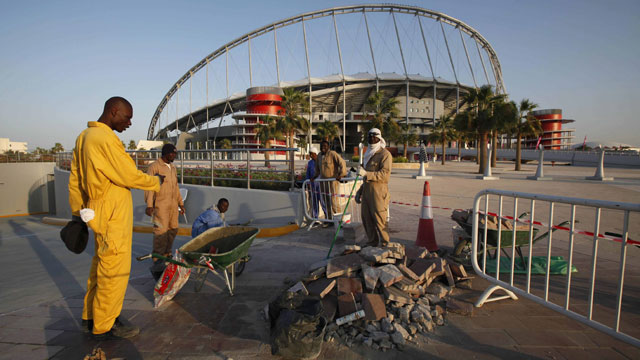
Every year the US government releases a report card of sorts on human trafficking around the world. The 2015 report is just out from the State Department and they do not have good news for Qatar, which has been dogged by continuing allegations over its treatment of workers who are building the infrastructure for the 2022 FIFA World Cup.

The State Department ranks countries in of 4 tiers, as illustrated in the graphic below. For the second year in a row, Qatar received the second to bottom ranking, the "Tier 2 Watch List." The State Department gives Qatar some credit for some positive steps (at p. 285 here in PDF) but faults the nation on its implementation and reporting. Thus, Qatar remains near the botom of the rankings.
What that means under US law is that next year, 2016, Qatar will have to either produce an action plan, or if they don't, move up or move down. A country can be ranked as Tier 2 Watch List for only 2 consecutive years, which can be extended to 4 years if they produce an action plan. A country placed in Tier 3 may see US sanctions (source: US State in PDF):
[G]overnments of countries on Tier 3 may be subject to certain restrictions on bilateral assistance, whereby the U.S. government may withhold or withdraw non-humanitarian, non-trade-related foreign assistance. In addition, certain countries on Tier 3 may not receive funding for government employees’ participation in educational and cultural exchange programs. Consistent with the TVPA [Trafficking Victims Protection Act], governments subject to restrictions would also face U.S. opposition to the provision of assistance (except for humanitarian, trade-related, and certain development-related assistance) by international financial institutions, such as the International Monetary Fund and the World Bank. 
It is unclear what, exactly, a Tier 3 designation would mean for Qatar and its preparations for the 2022 World Cup, but it would clearly not be a good thing for the tiny nation, or for FIFA.

The US president can waive the ranking if it is determined to be in the interests of the United States. Anything is of course possible, especially in a lame duck presidency, but I think it hard to imagine that President Obama would give Qatar a pass if it does not show marked improvements in 2016. It does seem logical that Qatar would produce an action plan. On the other hand, Reuters reports that the Obama administration forced the State Department to change some of its 2015 rankings to help with its proposed trade agreement.

The bottom line here is that Qatar has effectively been given no more than 4 years year to improve the situation facing workers, or face considerable negative publicity (at least) and possible US and other sanctions. That will only make the World Cup 2022 more controversial than it already is, if you can believe that.

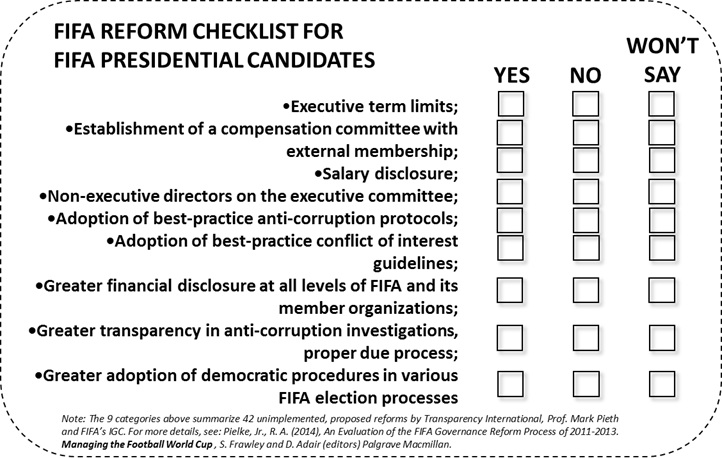
FIFA Reform Checklist for Aspiring Presidents

My latest contribution is up at Sporting Intelligence. In it I discuss the checklist (above) that I prepared to help put some substance into the FIFA presidential horse race.

Comments welcomed!

Sunday, August 2, 2015

New, Explosive ARD Documentary on Doping

A new documentary by German broadcaster ARD provides further evidence of widespread doping in athletics. ARD, along with The Sunday Times, gained access to a trove of suspicious doping tests from a whistle blower:
The data, which belongs to the IAAF but was released by a whistleblower, reveals that a third of medals (146, including 55 golds) in endurance events at the Olympics and World Championships between 2001 and 2012 were won by athletes who have recorded suspicious tests, with the newspaper claiming none of those medals have been taken away.

WADA president Sir Craig Reedie said: "WADA is very disturbed by these new allegations that have been raised by ARD; which will, once again, shake the foundation of clean athletes worldwide."
You can view the documentary, in full and in English, at this link.