Saturday, February 27, 2016

Post-FIFA Election Readings


"WE WILL RESTORE THE IMAGE OF FIFA."
The new FIFA President Gianni Infantino makes a pledge to the world of football, moments after his election.
Posted by FIFA on Friday, February 26, 2016
Yesterday Gianni Infantino was elected president of FIFA. ABove is a short video of him speaking after the election (courtesy @AlexStone7) Who is Infantino and what's next for FIFA? Here are some of the best post-election pieces I've come across. Feel free to add suggestions in the comments.
Lots more to come as FIFA takes on a full plate of reforms and its goal of restoring credibility.

Tuesday, February 23, 2016

FIFA on FIFA Reform


The above is a short promotional video on how FIFA sees the organization's reform effort. It is well worth watching.

Monday, February 22, 2016

How Tough is the US Group in Copa America Centenario?

I saw a fair bit of hand-wringing on Twitter yesterday as the Copa America Centenario group draw took place, which landed the USA in the most difficult group. Such complaining is unwarranted in my view - well, at least of you want USA men's soccer to join the global elite. I'll explain . . .

Here are the average 2016 Copa Centenario Group SPI rankings (courtesy @PCarrESPN), in order from highest average ranked to lowest:

  • Group A = 22.75 (USA)
  • Group D = 31.5
  • Group B = 32.75
  • Group C = 33.5

Here is the same average SPI ranking for the 2014 World Cup groups:

Group D = 14.0
Group G = 15.25 (USA)
Group B = 17.5
Group E = 18.25
Group C = 19.75
Group F = 20.5
Group A = 23.5
Group H = 33.25

While the USA indeed in the most challenging group in the Copa Centenario, that group would have been one of the easiest in the 2014 World Cup.

Want to be the best? Then play the best.

Wednesday, February 17, 2016

College Sports as an Agent of Change: Diversity Summit Panel at CU-Boulder

UPDATE Feb 19: Here is a report by the CU Independent on how the event went. 

At CU-Boulder tomorrow there is a "Diversity and Inclusion Summit" taking place. We are opening up my class (Introduction to Sports Governance) to a discussion about "College Sports as an Agent of Change," with a distinguished panel of former CU football players dating back to the early 1960s.

Here are some details:
College Sports as an Agent of Change - 11:00am-12:15pm Champions Center
Room 328
facilitated by Prof. Roger Pielke, Jr.

This session explores the governance of university athletics, specifically Black/African-American athletes before and after sports integration. It will raise questions about the power of athletics as an avenue for social movements and social change and will explore the demystification of the “Great Black Athlete” in an educational arena. Former University of Colorado Football players Bill Harris, Estes Banks, Lance Carl, Medford Moorer, Chidera Uzo-Diribe and a current student-athlete will examine the role of athletics at CU-Boulder in an ever-changing world.   
If you are on campus or in Boulder, please come for what will be an interesting and lively discussion.

Monday, February 15, 2016

Some Good Looks at FIFA


The upcoming FIFA election is prompting some good media coverage. Above is a short 60 Minutes story on FIFA, which does a nice job on a hugely complex issue.

The BBC also has a nice short video feature. I'll show both in class tomorrow, as we wind up FIFA Week in Intro to Sports Governance.

Goucher on Salazar: "Justice Will Come"

The video above shows an interview with Kara Goucher after she finished 4th in the US Olympic marathon trials over the weekend. In it she discusses the on-going investigation of the Nike Project by USADA.

ESPN did a story on the interview today, and here is an excerpt:
Kara Goucher, who fell one spot shy of making the U.S. Olympic marathon team in Saturday's trials, said "justice will come" out of an ongoing U.S. Anti-Doping Agency investigation of her former coach Alberto Salazar and his Nike Oregon Project group.

Goucher, a 2012 Olympian in the marathon and a two-time world bronze medalist on the track, and her husband, Adam, a former distance runner, were the most high-profile named sources in a 2015 investigation by ProPublica and BBC that alleged Salazar flouted and manipulated anti-doping regulations. Salazar issued a 12,000-word open letter in response, denying any wrongdoing.

After Saturday's race, in an interview by reporters that was filmed by letsrun.com, Goucher calmly said, "I've done all I can do at this point. I believe in Travis [Tygart, head of USADA]. I don't wish them ill will. The first time I went to USADA I said, 'All I want them to do is stop doing what they're doing.'"
The story is worth a read and the video is worth a look see. Watch this space.

Thursday, February 11, 2016

The Boise State Robbery

UPDATE: The Mountain West Conference has released a statement acknowledging that an error occurred at the end of the game, based on erroneous information provided to the refs by the replay technology. Here is an excellent analysis of the elapsed time at the end of the game. The error appears to originate with DVSports, the firm that provides replay technology to the MWC and NCAA. One question would be whether or not Boise State might have any actionable claim against DVSport for the loss (e.g., if the loss contributes to missing the post-season). I'll ask around.

In class today we discussed the controversial ending to yesterday's Boise State-Colorado State basketball game. Have a look at the ESPN video above for the details.

The short story is that Boise State made an incredible, improbable last second shot (actually last sub-second shot, the inbounds play began with 0.8 second remaining in the game), which the officials ruled did not occur because the clock did not start at the right time.

Here is what the game official later said:

The NCAA Rulebook says (p. 62 here in PDF):
When an obvious mistake by the shot-clock operator has occurred in failing to start, stop, set or reset the shot clock or when a shot clock has malfunctioned, the mistake or the malfunctioning problem may be corrected in the shot-clock period in which it occurred only when the official has definite information relative to the mistake or malfunctioning problem and the time involved. When a timing mistake or malfunctioning problem occurs that gives a team more time than that team is entitled to, any activity after the mistake or malfunctioning problem has been committed and until it has been rectified shall be canceled, excluding any flagrant foul or technical foul.
A lot hinges on the phrase "obvious mistake" here, but it seems clear from the ESPN replay and timing in the video above that there was no obvious mistake.  In fact, there was no mistake at all.
Perhaps Boise State should protest the result?

The NCAA has that covered (p. 62 of its rule book):
The NCAA Men’s Basketball Rules Committee does not recognize or allow protests.
The referees botched this one pretty good. Although Boise State will not get an earned victory, hopefully the Mountain West or NCAA has some way to sanction to officiating crew.

HT: SB Nation for the Tweets above.

Tuesday, February 9, 2016

Do National Teams with More Big 5 European League Players Rank Higher with FIFA?

I was curious about the on-again, off-again debate over whether US players should try to play more in Europe as a way to improve the US men's national team. So I have created the graph above.

It shows on the X-axis the percent of minutes played by each national team of players who are with club team in the Big 5 European leagues, that is, the English Premier League, the Spanish Liga, the Italian Seria A, the German Bundesliga and the French Ligue . Data comes from Figure 11 here, courtesy CIES. The Y-axis shows the current FIFA ranking, courtesy FIFA.

The red line shows the least squares fit, and in the upper left is the line's equation, showing an r-squared of about 0.25. The relationship is not particularly strong, but there is an apparent relationship.

Perhaps more interesting? The USA (highlighted by the blue dot at about coordinates 30%, 800), is right about on the trend line. So too is England at 100%, 1100.  Way above the trend line: Germany, Spain, Argentina, Belgium. Way below: Italy, France, Ivory Coast, Senegal.

I reckon there is a bit here for everyone. But it does look like the USA is right about you'd expect it to be given the minutes played among its national team players in the Big 5 leagues. There is also some evidence to suggest that having more players with more minutes would be beneficial, but much more matters than just Big 5 minutes. (And yes it'd be nice to have this same data minus goalies.)

Thoughts?

Tuesday, February 2, 2016

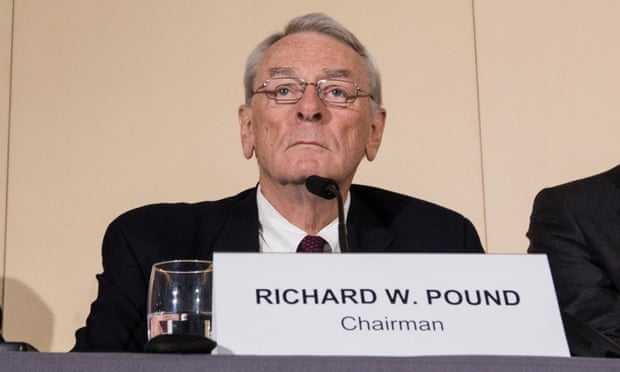
More Contradictions from Dick Pound

Richard "Dick" Pound is a giant in the international sports movement. He has been outspoken, at times, and has led numerous investigations into sporting corruption, including the Olympic bidding scandal of the 1990s and most recently into the corruption in the IAAF. Sport is invariably better for his long term service.

But at the same time, Pound's recent statements related to IAAF are puzzling, not least because what he is saying in interviews is directly contradictory to the WADA  Independent Commission reports on the IAAF that he recently led. An interview published today with Athletics Illustrated raises all sorts of questions. (Last week Ross Tucker @scienceofsport and I explored another, more technical, angle to the contradictions.)

In that AI interview Pound states:
“It cannot seriously be suggested that members of the IAAF Council were aware of the special arrangements with Russia that were entered into by the IAAF president and his inner circle.”
Yet, WADA IC Report #1 finds exactly that. Valentin Balakhnichev, the IAAF Treasurer, and thus member of the IAAF Council, from 2011 to 2014 (when he resigned, following the ARD documentary that aired claims of corruption) was at the center of the Russian doping cover-up and extortion of athletes.

Perhaps then Pound was referring to other members of the IAAF Council?

WADA IC Report #2 suggests that more than one person one the Council had knowledge of funny business going on in IAAF:
"At least some of the members of the IAAF Council could not have been unaware of the extent of doping in Athletics and the non-enforcement of applicable antidoping rules ... The IAAF Council could not have been unaware of the level of nepotism that operated within the IAAF."
In his Athletics Illustrated interview, Pound refers to knowledge of doping among the Council, but neglects to mention the alleged knowledge of nepotism and the laxity of rules enforcement:
"What the IC did note was that members would have been aware that there was a serious doping problem in Russia (plus in other countries).”
 The WADA IC Report #2 goes even further, saying that "far more" IAAF staff were aware:
"It is increasingly clear that far more IAAF staff knew about the problems than has currently been acknowledged. It is not credible that elected officials were unaware of the situation affecting (for purposes of the IC mandate) athletics in Russia. If, therefore, the circle of knowledge was so extensive, why was nothing done? Quite obviously, there was no appetite on the part of the IAAF to challenge Russia."
Pound completely undercuts this particular finding of the report when he tells Athletics Illustrated that the IAAF should be excused not not having acted - thus answering the question posed above by the WADA IC Report -- because nothing could have been done:
“I think there was probably a general awareness that there was a lot of doping going on in Russia (among other countries), but there was an absence of proof to enable sanctions to be imposed, other than positive tests, of which there were many. You cannot suspend a country on the basis of suspicion, even strong suspicion. Even the IC would have been essentially powerless, but for the whistleblowers and confidential witnesses.  We had documents and we were in the fortunate position that one of the whistleblowers was the victim of the extortion scheme. Without that evidence, we would have been in the he said – she said conundrum, in which everything would have been met with flat denials."
Say what?!
  • Pound's WADA IC: "Quite obviously, there was no appetite on the part of the IAAF to challenge Russia"
  • Pound's AI interview: "there was an absence of proof to enable sanctions to be imposed [by IAAF]"
Does. Not. Compute.

Pound introduces even more contradictions when he claims that the IC reports did not identify individuals responsible, but rather found that mistakes were made:
“In the IC Report, you will see that no individual “blame” was attached to any individual member of the IAAF Council.  We found that there was an institutional failure to ensure that principles of good governance were in place and that this failure contributed to the problems the IC was mandated to investigate.”
This too is contradicted by the WADA IC Report #2:
"While acknowledging the cooperation received from within the IAAF administration in connection with its investigation, the IC cannot refrain from observing a tendency on the part of the administration to attempt to sever the corruption from the IAAF itself. The fact of the matter is that individuals at the very top of the IAAF were implicated in conduct that reflects on the organization itself (as well as on the particular individuals involved)."
Pound ends his Athletics Illustrated interview with another full scale defense of Sebastian Coe, explaining that the fact that Coe was duly elected by the IAAF means that the media should leave him alone: "The IAAF has had its election.  It has chosen its officers and Council.  Now they should be given a chance to do the right thing.  I fully agree that anyone is entitled to suggest what that “right thing” might be, but I do not agree that this includes attempting to nullify the outcomes of properly constituted elections."

Of course, using that logic, Sepp Blatter would still be running FIFA.

 It's not at all clear to me what is going on here. What is clear is that Dick Pound, the decorated senior statesman of international sport, is up to his ears in contradictions and now finds himself as the most vocal champion of an institution that he has found to be corrupt, unaccountable and suffering from poor governance.

If you figure why this is so, let me know, will you? (Here is one interesting attempt to answer this question.)

Tuesday, December 15, 2015

The Edge

I'm in the final stages of completing my new book -- The Edge. It'll be available right before Rio 2016.

Blogging will be occasional to light. But much more coming soon!

Thursday, December 10, 2015

Does "Education" Work as an Anti-Doping Strategy?

"Education" is often held up as an important tool of anti-doping polices. But does education actually work? The evidence is actually very, very thin. More generally, efforts to influence behavior through education are not often very effective.

For instance, USADA explains:
Education is an extremely important pillar of an effective anti-doping program and is the first line of defense in protecting the rights of clean athletes. USADA provides extensive anti-doping education to thousands of athletes each year, helping athletes and support personnel understand their rights and responsibilities in regards to the drug testing process. 
WADA says something similar:
WADA believes that a long-term solution to preventing doping is through effective values-based education programs that can foster anti-doping behaviors and create a strong anti-doping culture.
We'd all like to believe that education leads to changed behavior. I've come across this issue frequently in areas of science studies, where the assumption that more education leads to changed behavior has been pretty well debunked for a long time.  There is actually an enormous literature on this topic. Education doesn't necessarily change behaviors in predictable or desired directions.

Thus, given this broad understanding, it is a bit surprising that the anti-doping community relies so heavily on a claim that education is an effective anti-doping strategy. It is almost an article of faith in some circles.

But the evidence that is available doesn't support such claims or faith. In fact, 2007 WADA published the result of a sponsored study which reviewed the literature on the effectiveness of education in anti-doping (drawing upon work related to bullying, illegal drug use, etc.). That study concluded (PDF):
Educating athletes about the effects of drugs, and specifically the adverse effects, may be a means of deterring drug use 53. However, this contention is not supported in the present review. Studies that employed interventions designed solely to provide subjects with information regarding drug use (anabolic steroids) in either a balanced format 40 or with an emphasis on adverse consequences 39, were not effective to altering subjects’ attitudes or intentions. Whilst providing information on drug-related issues and improving knowledge is necessary, an effective programme must also address the myriad of other variables that impact upon the decision to use performance enhancing drugs, such as alternatives to drug use, peer and media resistance training and decision-making skills.
More broadly, there simply isn't much evidence of effectiveness:
There are several limitations to the existing research. Firstly, whilst a number of studies successfully modified attitudes or intentions related to drug use, they were less effective in reducing drug use behaviours. Too few studies have conducted long-term follow-up to determine whether intervention effects persist over time and whether they translate into reduced drug usage. Secondly, all studies to-date have employed self-report questionnaires to gather data, without corroboration by other methods. Because the issues addressed in this research relate to illegal or taboo practices, or indeed social desirability favouring exaggeration, the validity of findings may be compromised due to under and over-reporting. Research in this field has primarily targeted college or university athletes, with programmes co-ordinated primarily within the athletic department. College and university athletes differ from other athletes in that they are subject not only to the pressures of sporting performance but also expectations regarding their academic achievement, which may create a unique set of circumstances surrounding the decision to engage in drug use. Accordingly, it is not appropriate to generalise the methods and findings of these studies to other settings and populations. Research has mostly been confined to prevention of anabolic steroid use, with less attention paid to other performance enhancing and recreational drugs, such as growth hormones, amphetamines or cocaine. 
The more fundamental problem of course is that there is very little evidence about the prevalence of doping in sport, much less on the sorts of approaches that are more likely to influence that prevalence. Anti-doping efforts have a long way to go to become more evidence based.

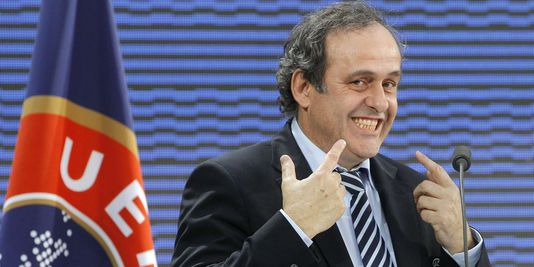
The Platini Decision

Tomorrow at 4AM Eastern time (10am CET) the Court of Arbitration for Sport will release its decision in the case of Michel Platini. This is a huge decision however it comes out.

Platini is the president of UEFA and FIFA presidential candidate who has been suspended from football-related activities by the FIFA Ethics Committee for a period of 90 days. The ban, which was announced October 8 means that Platini cannot campaign for the FIFA presidency during the period of suspension, which FIFA has said could be extended another 45 days, essentially up to the election, which is February 26th.

Platini has gone to CAS to ask for a "stay" of the suspension which is in effect a lifting of the ban until the full case is heard. If CAS rules in Platini's favor then he would be able to resume his UEFA duties and a campaign for FIFA president. If the CAS rules against Platini, then the current ban would continue, and he would be prohibited from football-related activities, including his presidential campaign.

Here is how the situation might play out.

1. Platini wins at CAS.

Then, follow proceedings next week, FIFA is expected to render a judgment on whether Platini (and Sepp Blatter) will face a longer suspension, perhaps 6 years or longer. No doubt that judgment, if against Platini (and Blatter) would be appealed to the CAS. If Platini wins tomorrow but loses with FIFA, it would mean a bit of chaos over the next week as Platini reinserts himself into the campaign and then is forced out again.

2. Platini loses at CAS.

Then everything shifts to the FIFA Ethics Committee hearing next week, which provides the second-to-last chance for Platini. A subsequent appeal to CAS would be his last chance.

Given the short time between the request for a stay and FIFA's Ethics Committee hearing, it would seem logical that CAS might simply defer any decision by rejecting the stay in anticipation that it will receive this case anyway, if FIFA rules against Platini. Were I a CAS arbitrator, I would likely make such a (non) decision.

The only exception I'd make here is if there is clear exculpatory evidence in Platini's favor that would suggest that the FIFA Ethics Committee will be ruling in his favor. If so, then there would be no reason not to grant this stay immediately.

However, were I to make a wager, I'd bet on the CAS not issuing the stay and simply letting the FIFA process take its course, in expectation of a chance to review that judgment in a few weeks.

But we shall see very soon.

Wednesday, December 9, 2015

A War on Football?


In last weekend's New York Times Dr. Bennet Omalu (played by Will Smith in the forthcoming Concussion movie) calls for an end to youth football (the American kind) and other contact sports that involve blows to the head. The article is essentially an invocation of the so-called "precautionary principle" - better safe than sorry when it comes to kids brains and contact sports..

I'll be using the op-ed in my spring course on the Governance of Sport where we will be discussing and ebating this issue. This post will serve as a running resource for this emerging debate. I have not yet seen a coherent response arguing the other side to Omalu's op-ed. But there have been a few interesting responses, an more is sure to come

Danny Kannell, former NFL quaterback and current ESPN commentator, took strong exception to the debate itself:
Last year the NYT suggested that football might be the source of a partisan split. Looking at the data, there is a case to be made, but it does not appear to be a strong one. Yesterday, Forbes also engaged this theme. Both Kannell and the NYT/Forbes seem a bit over-the-top, but perhaps they are just premature. We shall see.

Dr. Julian Bailes, who is also portrayed in the Concussion movie (by Alec Baldwin) argues that the state of concussion science, full of uncertainties, does not outweigh the various benefits of organized youth football. In effect, he takes the other side of the precautionary principle - arguing that the risks to eliminating football outweigh the possible health benefits. In effect, better safe than sorry means keeping football.

He does have a point, over 1 million boys play football in high schools, a number that hasn't changed very much over at least the past decade and longer (data). This suggests (using rough math: 250k per high school class over the past 50 years), that there are 10-15 million American adult males for who football was a part of their cultural experience. That is a big number. In the US, football is king of sports.

In a 2014 article, FiveThirtyEight (owned by ESPN) has also cast doubt on the relationship of concussions and health impacts on football players (professional). FiveThirtyEight also explored concussion rates in youth sports, which (if the data is reliable and meaningful, big ifs here) suggests a pretty low rate across sports, but with football in the lead.

Far more important than any partisan divide in the debate over concussions in sports, at all levels, are the financial interests at play. The NFL has a lot of money and influence. It also has a $15 billion plus contact with ESPN. ESPN pays the salaries of both Danny Kannell and FiveThirtyEight. I don't believe that either Kannell or folks at FiveThirtyEight have their views because of NFL funding, simply that interests align in predictable ways. This is a common challenge in policy debates relate to science and culture, and one that I have written a lot about.

Coming up with balanced analysis of the concussion problem, a shared understanding of what that problem may be, as well as alternative options for the future will depend upon hearing from a diversity of voices, including those that are independent of the NFL, ESPN and the debate so far.

The issue is still emerging. Watch this space.

Sunday, December 6, 2015

It's Time to Ask Some Hard Questions of US Soccer

The latest DOJ indictments lead to some hard questions for US Soccer. It's president, Sunil Gulati, is the only one of 9 members of the 2009 CONCACAF executive committee who is not under indictment, previously suspended or accused of improprieties in the media.

Gulati may yet be indicted, he may be an informant or he may be the only CONCACAF official of his era untouched by scandal. Who knows? What is becoming increasingly obvious is that it would be wise for the US soccer community to start thinking about and openly discussing the future of US Soccer, just in case change is right around the corner.

The US media has been remarkably silent on Gulati and US Soccer as the scandal has unfolded. It i time that changed. Some questions to start with:

What happens if Gulati steps down, by choice or due to events?
Who should next lead US Soccer?

I've got some thoughts, which are coming soon. Stay tuned.

Data: 2009 CONCACAF ExCo, DOJ Superseding Indictment of 4 Dec (PDF), Burrell FIFA suspension, Austin FIFA suspension, and White allegations.

Saturday, December 5, 2015

The Case for Sepp Blatter as DOJ Unnamed Co-Conspirator #14

The latest round of FIFA arrests were accompanied by a superseding indictment (here in PDF), in effect an update to the charges that the US Department of Justice is levying against various FIFA officials and their partners.

In the superseding indictment there is the tantalizing possibility that both Jerome Valcke (former FIFA general secretary) and Sepp Blatter (suspended FIFA president) are included as "unnamed co-conspirators" numbers #17 and #14 respectively.

Here is the evidence.

Unnamed co-conspirator #14 is described as "At various times relevant to the Indictment, Co-Conspirator #14 was a high-ranking official of FIFA." And #17 in the same terms, "At various times relevant to the Indictment, Co-Conspirator #17 was a high-ranking FIFA official."

This doesn't give much to go on, but the document provides a few more details.

On #17 (p. 93):
"on January 2, 2008, January 31, 2008 and March 7, 2008, a high-ranking FIFA official, Co-Conspirator #17, caused payments of $616,000, $1,600,000, and $7,784,000 - totaling $10 million - to be wired from a FIFA account in Switzerland to a Bank of America correspondent account in New York, New York, for credit to accounts held in the names of CFU and CONCACAF, but controlled by the defendant JACK WARNER, at Republic Bank in Trinidad and Tobago." 
This description is consistent with media reports describing the role of Jerome Valcke in facilitating the alleged $10 million bribe involving South African officials.

On #14 (pp. 91-92):
"Charles Blazer learned from the defendant JACK WARNER that high-ranking officials of FIFA, including Co-Conspirator #14, the South African bid committee,  including Co-Conspirator #15, and the South African government were prepared to arrange for the government of South Africa to pay $10 million to CFU to "support the African diaspora." 
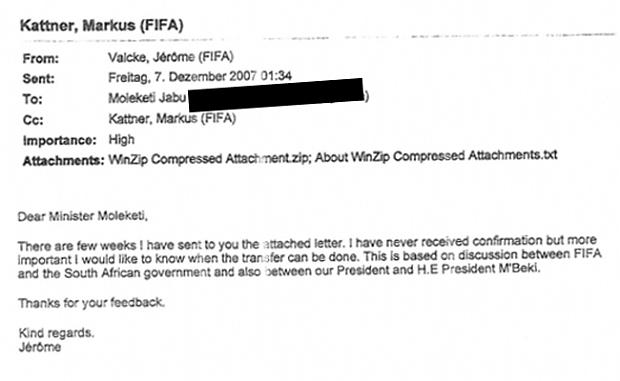
This description is consistent with a report in the Sunday Times (of South Africa) that Sepp Blatter had corresponded with then-South African president Thabo Mbeki about the $10 million payment. The key tell in the superseding indictment is the phrase "the South African government" which is highly suggestive of the relationship revealed by the Sunday Times (SA). Here is one of the emails referred to in that article:

So, is #17 Valcke? And, is #14 Blatter?

It is not 100% certain, but it seems highly likely. I'd bet a beer on it. If this turns out to be correct, then we might expect formal DOJ charges against Blatter and Valcke before this investigation is over. Stay tuned.

Thursday, December 3, 2015

FIFA Still Doesn't Get "Independence"

There is a lot of good potential in the various reform proposals advanced today by FIFA's Executive Committee. However, it's press conference was shaky, with its acting secretary general refusing to reveal his salary and its acting president refusing to engage questions about his sanction by the IOC for taking bribes.

But perhaps the most revealing evidence that FIFA just doesn't "get it" is its newly proposed definition of what it means to be "independent" of FIFA. One can receive up to $125,000 from FIFA, or related organizations, per year and still be considered "independent."

The new definition is found in Appendix 3 of the material released today and here it is in full:
 The $125,000 threshold for "independence" is likely a reflection of the incredible amounts of money sloshing around in international football. For many who participate in this world, $125,000 probably is not a big deal. Consider that the members of the FIFA ExCo receive a reported fee of $300,000 for attending a few meetings per year.

But for most individuals who might be considered for independent roles with FIFA, $125,000 is going to be of the same scale or larger than their primary salaries. The new definition has some other problems too, in that it defines business owners (e.g., 10% equity) as having a "material financial interest" but apparently not FIFA's own Council Members or employees of companies or other entities that have relationships with FIFA.

In principle, there is absolutely no problem with compensating independent individuals for services to FIFA. Time is valuable and individuals should be compensated for services. But to maintain true "independence" from FIFA, this compensation cannot come from FIFA or its subsidiary bodies.

A far better strategy for retaining independent advice would be for FIFA to provide a grant (e.g.,FIFA could apply a small fee to each member association -- $5,000 each raises $1 million -- which could be subtracted from their FIFA allocations). This money could then be given to a well-established, legitimate neutral third party, like Transparency International or UNESCO, with a request to set up a mechanism for identification and compensation of "independent" voices participating in FIFA governance.

In that manner FIFA would not be directly responsible for paying these individuals and their compensation would be subject to truly independent oversight and appropriate market-based fees.

FIFA should also consider outsourcing the criteria of "independence" to others with more experience and perspective. Trying to keep this in-house defeats the purpose, and as we have seen, reveals that FIFA isn't quite ready for what true independence implies.

Wednesday, December 2, 2015

More COI: Nike and the IAAF Ethics Commission

Much attention has been paid to the relationship that Sebastian Coe, president of the IAAF, has had with Nike and the conflict of interest that it represents with his role leading the IAAF.

Yesterday, the IAAF Ethics Commission issued a statement praising Lord Coe and stating that he could retain his role with Nike if he wished to continue in that position. Coe announced that he would not. Either way, it is odd that the IAAF Ethics Commission would allow such an obvious conflict of interest to continue.

So just for fun I thought I'd explore whether IAAF Ethics Commission members have any relationships with Nike.  It didn't take much searching.

In his role as President of the Rio 2016 Organizing Committee for the Olympic Games, IAAF Ethics Commission member Carlos Arthur Nuzman oversees a significant partnership between the BOC and Nike. Upon announcing the partnership, Nuzman said:
“Brazil is one of the most sport-obsessed nations on earth and Nike and Brazil have the same DNA in sport. Now we’ll be able to work together in a partnership that will certainly be significant for both partners.”
According to SBD, "sources valued the deal in the $25 million to $40 million range."

Nuzman is one of the members of the IAAF Ethics Commission. He appears to have a major conflict of interest, as clearly defined by the IAAF. He may be the greatest guy ever, but that is besides the point. If COI guidelines are to mean anything, then they should be enforced, not flouted.

I also get that Nike is big and important in sports. But I'd guess that there are probably a few men and women left in the sports world without multi-million dollar personal or business relationships with the company.

Bottom line, this second case of clear COI within IAAF leadership, on the Ethics Commission no less, provides further evidence that the IAAF doesn't understand the concept or understands it and thinks that its doesn't apply. Either way: not good.

Sunday, November 29, 2015

IAAF on the Scientific Value of Blood Tests: 2011 vs. 2015

The IAAF, in a "response to allegations of blood doping in athletics" posted on Friday, alleges that the blood values of athletes obtained by a German documentary film maker have "no scientific value." Thus, the body argues that there is no case to be made against the IAAF for failing to act on what the data seem to show -- that there were hundreds of athletes with suspicious values whose cases were not properly followed up by the IAAF.

Specifically, the IAAF argues that very strict scientific protocols must be followed in order for the blood data to have any practical meaning, and these protocols were not introduced until 2009: "any apparent differences in results from one sample to the next have no scientific validity. Those standardised procedures were only introduced in 2009." Consequently, the conclusions that have been drawn based on the pre-2009 data are simply invalid.

However, the IAAF published a peer-reviewed paper in 2011 using the same or very similar data, where IAAF made a contradictory claim, that the blood data could in fact be used to estimated the prevalence of doping among elite athletes. The changing interpretation of validity of blood testing science by the IAAF is notable.

Here is what the IAAF said on November 27, 2015 (at 4.10, p. 14, emphasis added):
[A]ny competent expert would refuse to consider the values from the blood samples collected by the IAAF prior to 2009 as reliable evidence of blood doping, and would certainly have refused to compare the values from one sample in a profile to other samples in the same profile, because those samples were collected before WADA finalised and published the mandatory requirements for collection, transport and analysis of ABP samples that are set out in the WADA ABP Protocol, and so did not all comply with all of those requirements. This did not mean the values were worthless. To the contrary, they could be used to identify athletes who should be targeted for testing, in an effort to collect a urine sample with rEPO present in it, and when (as often happened) rEPO was found in the urine, that adverse finding would then be competent evidence of doping. But it did mean that the pre-2009 blood values could not be said to be reliable evidence of doping in and of themselves, for the reasons just explained.
Yet, in a 2011 peer-reviewed paper (Sottas et al. 2011 here in PDF) the IAAF said almost exactly the opposite. Specifically the IAAF noted that in blood testing, "the standardization was rigorous enough for drawing sound conclusions." That 2001 paper looks at the overall data to estimate the prevalence of blood doping among elite athletes, and found a rate of 18-19% among elite track and field endurance athletes, an estimate consistent with a 2011 study buried by WADA and recent research.

Here is an excerpt from that 2011 IAAF paper (emphasis added):
Let us present through a simple example how the prevalence of blood doping can be estimated thanks to hematological data. The hemoglobin of a population composed of undoped Caucasian male endurance elite athletes living at low altitude is well described by a normal distribution, with a mean of 146 g/L and an SD of 9 g/L. If a blood sample is collected from 200 of these athletes, between 1 and 9 of them (4 on average) should present a value higher than 164 g/L. If 30 of these athletes presented a value higher than 164 g/L, then between 21 (11%) and 29 (15%) presented a value that was too high. Only an external cause (doping or a medical condition) can explain this discrepancy. If the prevalence of the medical conditions is known to be low, then doping is the primary cause. Although this simplistic example is biased— superior methods that use or do not use population statistics of the relevant cause (here doping) have been described elsewhere (3, 10 )—it shows nevertheless that it is not necessary to have a test able to easily identify identify drug cheats to estimate the prevalence of test results attributable to the cause “doping”: A biomarker of doping with a known discriminative aptitude and the knowledge of the prevalence of confounding causes is enough. Today, the high standardization of the blood tests makes possible the estimation of the prevalence of blood doping by using epidemiological measures of occurrence.
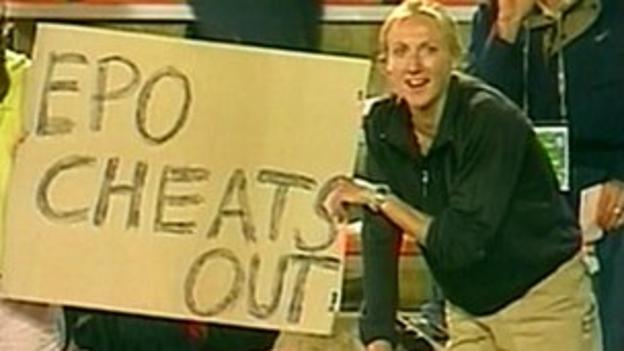
The case being made by the IAAF in 2015 is apparently that the leaked (or perhaps stolen/hacked) data obtained by the German documentary film maker (ARD) is unreliable because it contains too many false negatives - that it athletes with seemingly suspicious blood values which have an entirely innocent explanation. The IAAF singles out Paula Radcliffe as an example of such a case.

While the case of Radcliffe is interesting, and worth a future post itself, as anyone familiar with statistics knows, arguing about a large data set by picking out specific cases is not a good route to robust interpretation of evidence.

Here is what IAAF can do to prove its case of many false positives: Apply the population-based statistical methodology that it used in Sollas et al. 2011 to the leaked data obtained by the ARD. If there are numerous "false positives" in the leaked data then the population-level analysis should show an incidence of doping that is statistically significantly higher than that reported in Sollas et al. 2011. This is just a logical point, easily addressed using mathematics.

If the population data is not distinguishable between the two datasets, then the IAAF has no case to make about the lack of robustness of the data set.

This is simple mathematics, and could easily be conducted by an independent party with all relevant identification metadata stripped from the data sets. In fact, to conduct the statistical analysis, which data set is which would not even have to be identified to the independent statistician.

Until IAAF resolves its internal inconsistencies on blood doping between 2011 and 2015, and applies simple and obvious statistical tests on the blood data, the organization will have a hard time convincing outside observers that it is worthy of any degree of trust in its claims.

Math can go a long way here. Use it.