Tuesday, July 31, 2012

Did Ye Shiwen Dope? Evidence Says No

UPDATE: At Science of Sport there is an excellent discussion of the technical aspects of Ye's race and the questions that it raises.

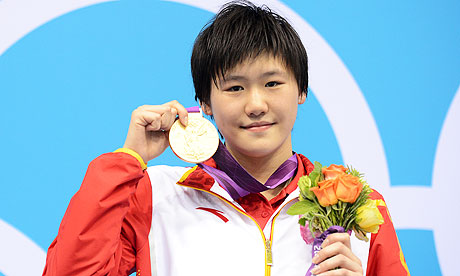
Chinese Olympic swimmer Ye Shiwen has been at the center of controversy since her impressive gold meal-winning effort in the 400 IM on Saturday. Sky News explains:
An international row has erupted over Ye Shiwen, 16, after she took five seconds off her personal best and more than a second off the world record in the 400m individual medley.

She completed her final 50m in 28.93 seconds, putting her 0.17 seconds quicker than American swimming star Ryan Lochte in the men's 400m medley earlier on the same evening.

John Leonard, the US executive director of the World Swimming Coaches Association, described the schoolgirl's performance as suspicious and "disturbing".

In comments that sparked rumours of doping, he branded the lightning-speed swim "unbelievable". Meanwhile, previous world record holder Steph Rice said it was "insanely fast". As China reacted with anger to the suggestion of foul play, Ye denied taking performance-enhancing drugs and said her results come from hard work and training.
Does data from the history of the 400 IM in the Olympics suggest anything odd? Have a look for yourself in the graph at the top of this post which shows medal-winning times in the event since 1964 (data: here 1964-2008, and here for 2012).
Ye's improvement over Stephanie Rice's 2008 gold medal time in Beijing was 1.3 seconds. But Rice's improvement over Yana Klochkova's 2004 gold medal in Athens was a much larger 5.3 seconds. Nothing odd there.

The dataset is nonetheless interesting with a rapid decrease in times from 1964 to 1980, with the massive improvements in speed in 1976 and 1980 coming from East German swimmers, later implicated in a broad pattern of government-sponsored doping. In 1998 the NYT reported:
[In 1976] the East German women dominated the Olympic swimming in Montreal, winning 11 of a possible 13 gold medals and drowning the formidable hopes of the American star Shirley Babashoff. The East German women had not won a single gold medal at the 1972 Games in Munich, but when the Americans voiced suspicions in 1976 that the East Germans were using performance-enhancing drugs, they were dismissed by many as being poor losers.

Since the fall of the Berlin wall, however, documents and court testimony have established the existence of what was long suspected: that East Germany operated a state-sponsored system of providing performance-enhancing drugs to as many as 10,000 athletes from 1968 to 1988. For East Germany, a country of 16 million people, the illicit system gained it scores of Olympic medals, and with those medals considerable stature for an otherwise isolated Communist state.
Then from 1980 to 2000 the winning times did not improve, with the tainted East German record standing until 2000, when 17-year old Ukrainian swimmer Yana Klochkova won the gold medal. Olympic medal-winning times have steadily declined since then.

My reading of the history of times in the 400 IM suggests that there is nothing obviously apparent from the data to suggest anything suspicious about Ye's performance. Obviously something changed sicne 200 to enable improvements after decades of none. Ultimately, such data can only suggest suspicion. The only judgment on doping that matters is that determined by the World Anti-Doping Agency.

As Sky News reports, WADA has found Ye to be clean:
Olympic officials, other swimmers and former athletes have also hit back, insisting that any competitor should be considered innocent until proven guilty.

British Olympic Association chairman Lord Moynihan said: "We know how on top of the game Wada (World Anti-Doping Agency) are and Wada have passed her as clean. That's the end of the story.

"And it is regrettable there is so much speculation out there. I don't like it. I think it is wrong. Let us recognise that there is an extraordinary swimmer out there who deserves the recognition of her talent in these Games."

Mark Adams, communications director for the International Olympic Committee (IOC) added: "These are the world's best athletes competing at the very highest level. We have seen all sorts of records broken already all over the place."

He stressed that a "very, very strong drug testing programme" was in place. "We are very confident that if there are cheats we will catch them, as we already have done," he said.

Asked if he was disappointed that talk turns to doping when a world record is smashed, he added: "It is inevitably a sad result of the fact that there are people who dope and who cheat but I equally think it's very sad if we can't applaud a great performance. Let's always give the benefit of the doubt to athletes."
If WADA says she is clean, then that is good enough for me. Congrats to Ye Shiwen -- 2012 IM Olympic Gold Medal Winner!

Monday, July 30, 2012

Skill in Prediction: Olympic Medals Edition

Not long ago I offered a critique of a statistical methodology used to predict Olympic medal outcomes. In my critique, I explained that a naive prediction -- the medals won in the previous Olympic games -- outperformed a sophisticated statistical model, as shown below.
What the graph indicates is that the statistical model had no skill -- it provided no value-added to the naive forecast.

At the FT, Martin Stabe is tracking four such models as follows:
Here I will follow along the FT medal-tracking exercise and evaluate the model predictions against the naive forecast based on the outcomes of the 2008 Beijing Olympics. My aim is to evaluate the predictions, which is a bit different that the purpose of the FT exercise, which I take is to evaluate country performance versus expectations.

However, to evaluate country performance appropriately, one needs to know the fidelity of ones expectations. Otherwise you won;t be able to distinguish a country's outperformance from just poor expectations. Stay tuned as the games progress for the quantitative analysis.

Wednesday, July 25, 2012

bin Hammam vs. FIFA: A Victory for Sports Governance

The Court of Arbitration for Sport has released its full decision in the dispute between Mohammed bin Hammam and FIFA (available here in PDF). The dispute centers on FIFA's lifetime suspension of bin Hammam for allegedly bribing Caribbean football officials in May, 2011 in his effort to win the FIFA presidency.

In a nutshell, $1,000,000 was distributed at a special meeting of Caribbean football officials -- that is, representatives to FIFA with a vote in the FIFA presidential election. The money was distributed in cash in brown paper bags in $40,000 allotments to 25 individuals. The disbursement was done by Jack Warner, then head of the Caribbean Football Union (since caught up in his own series of scandals). Of note, the CAS judgment says that "Mr. Warner appears to be prone to an economy with the truth." You can actually see a video of the disbursements being made here.

Almost immediately bin Hammam was accused by FIFA (and coincidentally Sepp Blatter supporters) of violating FIFA's ethics rules. An investigation took place, incidentally led by Louis Freeh who also led the recent Penn State investigation, which concluded that circumstantial evidence implicated bin Hammam in the bribery.

The result of all this was that bin Hammam was forced to step aside in the FIFA presidential election, leaving Blatter to run unopposed, and ultimately was given a lifetime ban from FIFA, which was upheld on appeal. For bin Hammam, the next step was to take FIFA to the Court of Arbitration for Sport, which has jurisdiction over such disputes as described in the FIFA statutes.

Here is where it gets even more interesting. (Yes, more interesting than cash in paper bags!) The defense offered by bin Hammam was not that he was falsely accused, but rather that FIFA volated his due process rights in its decision making process that ultimately led to his suspension. From the decision:
79. The Appellant challenges the Decision.

80. He alleges that FIFA has disregarded the principle of due process in reaching its decision to sanction him.

81. The Appellant submits that, from the very beginning of the proceedings (i.e. the letter dated July 14, 2011, to the FIFA Ethics Committee), he demanded that the FIFA Ethics and Appeal Committees should apply the standards of due process as guaranteed in the European Convention of Human Rights (hereinafter, “ECHR”), Swiss law and general principles of sports law.
The decision further explains bin Hammam's argument:
83. The Appellant considers that the principle of due process set forth in the ECHR applies to FIFA, even if it is not a state, since it is the private regulator of football in many countries that are signatories of the ECHR, including Switzerland, where FIFA is based. The Appellant states that the European Court of Human Rights has ruled that a private body, such as FIFA, that undertakes the role of a tribunal to the exclusion of state courts, must comply with Article 6 ECHR. In this case, FIFA took a decision affecting Mr. Bin Hammam’s civil rights, and adjudicated on a criminal charge, namely bribery. Thus, FIFA is bound to apply ECHR principles.

84. Further, the Appellant alleges that CAS jurisprudence has long recognized that it must apply the standards of the ECHR. Moreover, it considers that the relevant provisions of the ECHR form part of the lex sportiva or lex ludica recognized by the CAS. Therefore, by rejecting the principles of Article 6, the FIFA Ethics and Appeal Committees committed a grave violation of the principles of the lex sportiva which CAS jurisprudence demands that they apply.
The decision then goes on at some length to describe in detail the substance of what it sees are due process violations in FIFA's decision making.

In response FIFA focused on bin Hammam's alleged guiltiness of the charges and decided to punt on the issues of due process. The decision explains that FIFA argued,
... CAS panels should not in such circumstances consider arguments alleging the violation of due process. The Respondent sees no reason to address in any detail the Appellant’s complaints on those items.
Wow. It is telling that FIFA appeared to believe that addressing questions of due process would be unnecessary.

The CAS found, in a 2-1 judgment, in favor of bin Hammam, noting that their judgment was not a statement about the likelihood of his innocence, but rather a statement about FIFA's failure to prove its case. In fact, the CAS suggested that bin Hammam was likely guilty of the charges.

The verdict offered a series of stinging rebukes to FIFA. Among the conclusions reached in the CAS judgement:
201. It is readily apparent that the investigation carried out by FIFA was neither thorough in respect of the matters that it did address, nor comprehensive in its scope. Of great concern to the Panel is the decision by FIFA to terminate the investigation of Mr. Warner when he resigned from FIFA (see FIFA press release quoted at para. 160 above).

202. The Panel is bound to note that there was apparently no requirement to close those FIFA Ethics Committee procedures, as it is plain to it that FIFA would continue to be able to exercise jurisdiction over acts occurring whilst Mr. Warner was a FIFA official. Mr. Warner is at the heart of the events of May 10 and 11, and there is every possibility that if the FIFA investigations of Mr. Warner had continued at least some of the missing facts that have hampered the work of this Panel – facts that go to the heart of the gaps in the events - might have been clearly established, one way or the other. By closing the Ethics Committee procedures, FIFA disabled itself from pursuing a proper, thorough and complete investigation of Mr. Bin Hammam’s role in the matters that give rise to these proceedings. In effect, the paucity of the evidence is connected to FIFA’s own actions and inactions. In this regard, the Panel notes that Mr. Blatter declined to answer its questions concerning the circumstances of Mr. Warner’s resignation and the termination of disciplinary proceedings against him, as well as the relationship between these two events.
The CAS in effect has told FIFA to clean up their decision processes and try again:
208. By lifting the ban of Mr Bin Hammam, the Panel does not necessarily consider that this matter is concluded. FIFA is about to set up two new ethics committees, one to undertake investigations, and the other to adjudicate cases that may follow an investigation. In the event new evidence relating to the present case is discovered and without prejudice to the principle of res judicata and other principles of applicable law, it would still be possible to re-open this case, in order to complete the factual background properly and to determine if Mr. Bin Hammam has committed any violation of the FCE.
This judgment represents a victory for the rule of law, for due process and for the notion that FIFA must conform to such norms rather than operate in an ad hoc manner. Of further note is that bin Hammam's victory in this dispute, which certainly does nothing to change his status in world football (as he is being investigated under other allegations of violations), reinforces the need for a jurisprudence of  sport consistent with the widely accepted norms of jurisprudence which comprise democratic governance.

That, in the end, is a victory for sports governance.

Tuesday, July 24, 2012

Inside Play the Game 2011


Here is an excellent overview of some of the themes discussed at Play the Game 2011 and some of its most colorful participants. The 30 minute documentary was produced by students at the German Sport University Cologne, and has just been released in English.

Of note, at 15:00 and following the video shows some of the details from the debate between Walter DeGregorio, FIFA spokesman, and investigative journalist Andrew Jennings.

Enjoy!

Friday, July 20, 2012

Meet the Superhumans

Meet the Superhumans from Stitch Editing on Vimeo.

Actions Speak Louder than Words

News reports from Japan and Australia tells us a lot about sports culture, and how slowly things actually change. From Japan courtesy the IHT:
It was precisely a year ago that the Japanese women’s soccer team won the World Cup, beating the United States in the final and giving a boost to the spirits of a nation that had been battered by an earthquake, a tsunami and a nuclear disaster.

But when they flew to Europe on Sunday along with the men’s team, the women were in coach seats while the men were up in business class. The Japanese Football Association said the teams had left Tokyo together on the same Japan Airlines flight.
From Australia courtesy the SMH:
Australia's women basketballers have confirmed they also had different travel arrangements to the men's squad for the journey to London. While the Boomers flew in business class, the Opals made the long-haul trip in premium economy - and that was an upgrade.

The Opals have never protested publicly about this longstanding treatment of national teams and players would not comment on the record today, but they do not like it and say such inequality has been a long-standing source of contention.
From various perspectives -- equity, team spirit, pubic relations -- what a boneheaded set of policies. The tone-deafness to it all speaks volumes.

Australian basketball officials dug their hole a little deeper when excusing the policy as a matter of average height, which make no sense, as Samantha Lane in the SMH pierces through immediatey:
"For example, the average height of our male basketball players is 200.2cm. The average height of our female basketball players is 183cm."

But Basketball Australia was unable to confirm if flight arrangements had ever been based on individuals' heights given Opals rising star Liz Cambage is 203 cm tall, while Boomers players Adam Gisbon and Patrick Mills stand 188 cm and 183cm respectively.
Here is some friendly policy advice, if you are unable to justify a policy in public in a way that is compelling and makes sense, then it probably is a policy worth rethinking.

Thursday, July 19, 2012

FIFA Executive Committee: Exactly What Changed?

A Guest Post by Davin Larkin of @ChangeFIFA

"The new-look ethics panel was of the main recommendations of Pieth's committee, ...Pieth's report slammed the FIFA ethics committee's handling of a spate of bribery allegations that engulfed over a third of the Ex-Co and led to a lifetime ban for Mohamed Bin Hammam in the biggest crisis to hit FIFA in its 108-year history. The Independent Governance Committee said FIFA's management of the corruption was "insufficient to meet the challenges of a major global sport governing body. This has led to unsatisfactory reactions to persistent allegations."In particular, the IGC has identified a lack of proactive and systematic investigation of allegations. In some instances, allegations were insufficiently investigated and where sanctions were imposed, they are at times insufficient and clearly unconvincing." - Mark Bisson
So the old Ethics Committee was terrible, but exactly who is new? 

Key: ((N)) = New

Appointment of the following persons as members of the investigatory chamber of the Ethics Committee until the 63rd FIFA Congress 2013: 
  • ((N))Chairman: Michael J Garcia 
  • Mr Robert Torres (Guam) 
  • Mr Les Murray (Australia) 
  • ((N))Mr Ronald Jones (Barbados) 
  • Mr Jorge IvĂĄn Palacio (Colombia) 
  • Mr NoĂ«l Le GraĂ«t (France) 
  • Mr Ahmed Ould Abderrahmane (Mauritania) 
= 2 New of 7

Appointment of the following persons as members of the adjudicatory chamber of the Ethics Committee until the 63rd FIFA Congress 2013:
  • ((N)) Chairman: Hans-Joachim Eckert
  • Mr Petrus Damaseb (Namibia)
  • Mr Juan Pedro Damiani (Uruguay)
  • Mr Burton K. Haimes (USA)
  • Mr Abdoulaye Mokhtar Diop (Senegal)
  • Mr Jack Kariko (Papua New Guinea)
  • Mr Yngve HallĂ©n (Norway)
  • Mrs Thi My Dung Nguyen (Vietnam)
= 1 New of 8

COMPARE: Ethics Committees

OLD...14 people
NEW...12 same people...3 new people
CONCLUSION: Almost nothing has changed.

Wednesday, July 18, 2012

Mark Pieth on FIFA Reform: One Third Way Done

Mr Pieth welcomed Fifa’s decisions, although he said his recommendation of war crimes prosecutor Luis Moreno-Ocampo to chair the investigatory chamber had been overlooked in favour of Mr [Michael J.] Garcia. However, Mr Pieth said he considered Mr Garcia of equivalent calibre to Mr Moreno-Ocampo.

Mr Pieth also welcomed the appointment of his choice for the adjudicatory chairmanship of Mr Eckert, who has presided over a number of high-profile corporate trials, and the decision to do away with a time limit.
“Anyone who has doubts that they [the investigators] can look at the past can see now they have the ability,” Mr Pieth said.

But he added that the Fifa decisions represented only a third of the changes Mr Pieth and his colleagues had recommended. The other recommendations include cataloguing potentially critical payments, term limits for officials, campaign financing for presidential candidates, conflict of interest regulation and greater transparency over financial contributions by Fifa to member countries for developing football.

“Will they do the rest, or will they say, ‘thank you’? Will they take out what they like and detach the rest?” Mr Pieth said.
Back in March, Pieth anticipated how FIFA might respond:
“I’m at the moment pretty optimistic. But it’s very open. If it works out I’ll be patted on the back. If it fails I’ll be an idiot. I think we will know by mid-April whether they are serious.” And if they aren’t? “If we are unsuccessful, we would have to walk away. ‘We’ve had it, goodbye.’ This would be a dreary result. Sponsors, the media, everybody would be left with something they couldn’t really digest, and Fifa would just carry on. Who would force Fifa?”
Are the one third of reforms, by Pieth's count, an indication of seriousness? Of course, if one uses Pieth's commissioned report from last fall as the basis for evaluating reform, FIFA scores far less than a one third success rate, as I showed here.

It does look like Pieth and the IGC is moving ahead, indicating that they have some faith that the process is generating positive results.

What it Means to be a Woman in the Olympics

In my latest column for Bridges I discuss the newly adopted regulations by the IOC which determine who is eligible to compete in the woman's events. Arbiters have turned to science to draw a bright line, but unfortunately science paints in shades of grey.

Here is an excerpt:
[I]t turns out that the science of gender is not so straightforward, and human evolution has not made us all so that we easily fit into binary categories. The IOC recognizes this and explains that human biology "allows for forms of intermediate levels between the conventional categories of male and female." Recognizing this ambiguity, the IOC explains: "Nothing in these Regulations is intended to make any determination of sex."

Instead, it has tried to implement a regulation that uses science as a proxy for determining sex. Writing in The New York Times, a medical geneticist who advised the IOC argued that science could resolve this issue: "Let's forget for a while about gender identity politics" and focus on "one parameter that ... could entirely explain why men did better than women in elite sports." The proposed candidate parameter is biological levels of testosterone, admittedly imperfect but apparently serviceable.

The IOC explains that female athletes with levels of androgenic hormones that "fall into the male range" that confers a "functional" competitive advantage will be disqualified from competing in women's events. The IOC makes an explicit comparison between those athletes who have doped by taking steroids and those athletes whose bodies produce excessive levels of hormones. Such athletes can now be considered naturally doped – an oxymoron that betrays the illogic of the regulation.

Not only are the proposed regulations ambiguous – what is "the male range"? How is "functionality" determined? – but they are based on a selective reading of the science of sex and athletic performance. Despite a widespread belief that testosterone is the "one parameter" that determines athletic performance, the science is far more ambiguous. Writing in an academic paper published earlier this month, a team of researchers criticized the IOC's focus on testosterone, arguing: "The current scientific evidence, however, does not support the notion that endogenous testosterone levels confer athletic advantage in any straightforward or predictable way."

Like so many areas of decision making, the science of gender does not provide distinct lines that can make politics go away and render decision making straightforward. And gender is not the only such issue facing the IOC. The case of another South African athlete, Oscar Pistorius, who runs on artificial legs, has raised questions about the boundary between the Olympic Games and the Paralympic Games. . .
Read the rest here.

Note: About the image above, from The Guardian:
In the 1936 Olympic games in Berlin, Adolf Hitler wanted to show the world the supremacy of the Aryan race - and he needed German athletes to win. Ratjen, notable for her deep voice and her refusal to share the shower room with the other female athletes, was Germany's entry for the women's high jump. She came fourth. Britain's competitor, Dorothy Tyler, who won a silver medal, remembers her. "I had competed against Dora and I knew she was a man," she says. "You could tell by the voice and the build. But 'she' was far from the only athlete. You could tell because they would always go into the toilet to get changed. We'd go and stand on the seat of the next-door cubicle or look under the door to see if we could catch them." Tyler held the world record for the high jump, but when officials wrote to her telling her that Ratjen had broken it, she wrote back. "I said: 'She's not a woman, she's a man,'" she says. "They did some research and found 'her' serving as a waiter called Hermann, so I got my world record back again." Dora, who had been born Hermann Ratjen, had in fact been a member of the Hitler Youth and said that the Nazis had forced him to enter as a woman.

Monday, July 16, 2012

Not the Droids You are Looking For

Sepp Blatter and FIFA have been rocked by the release last week of a Swiss court document revealing a huge bribery scandal and cover-up related to the so-called ISL affair.  In response Blatter has gone on the offensive with a campaign of "change the subject."

First, he has proposed that he may stand for re-election when his term is up:
Blatter has insisted he does not condone bribery and told the newspaper [Sonntagsblick] he could run for another term in 2015.

"Let's see how my health is,'' he told the paper. "I've just been for a checkup and I lost four kilograms (eight pounds).''

Last year, Blatter was elected for a fourth, four-year term as FIFA president. He was the only candidate.
Second, he has suggested that Germany won the rights to host 2006 World Cup via bribery:
When asked by the paper about rumors of corruption surrounding the decisions to award the 2018 and 2022 World Cup tournaments to Russia and Qatar, respectively, Blatter responded: "World Cups being purchased…. I am reminded of the World Cup allotment for 2006, when someone left the room at the last moment. And instead of 10:10, the vote was suddenly 10:9 in favor of Germany…. Perhaps in that situation I was also too well-meaning and naĂŻve."
The old Jedi may have turned to the dark side, but his powers remain strong ... these are not the droids you are looking for ...

Thursday, July 12, 2012

Jens Sejer Andersen on FIFA ISL Case

Writing at Play the Game, Jens Sejer Andersen has an extremely hard-hitting appraisal of the significance of the dossier released yesterday by a Swiss court on the FIFA-ISL bribery case. Here is an excerpt:
Play the Game has consistently argued that a fight against corruption in sport should not focus on persons, but on structures and systems. This position is no longer tenable.
So FIFA does have a range of inconvenient questions to answer, and so do other sports organisations including the International Olympic Committee:
  • Can FIFA be governed by a person who knowingly and over many years has allowed tangible values to disappear in a massive, carefully orchestrated system of corruption?
  • Can FIFA have an honorary, life-time president whose greed and bribe-taking is now established by court documents?
  • Can FIFA live with the fact that more than 100 million Swiss Francs paid out as bribes from its closest business partners are not accounted for, or will FIFA open its archives and the memories of its chief officials and be honest about the past?
  • Can other sports federations with business relations to ISL, like ATP in tennis, IAAF in athletics, FINA in swimming and FIBA in basketball, accept that some of their present leaders may have been part of this corruption system?
  • Can the IOC tolerate that Blatter has flagrantly violated its code of ethics, or should he be shown the back door like Havelange?
Read the whole thing here.

A further comment: I have seen nothing in the media from any of the members of the FIFA Independent Governance Committee chaired by Mark Pieth. Of course, I may have missed something. However, given the magnitude of the revelations, a sustained silence from this group would speak volumes.

The Freeh Report on PSU and the NCAA "Dealth Penalty"

Earlier today the Freeh report on the Sandusky scandal at Penn State was released. What did it find? From p. 127:
For the past several decades, the university's Athletic Department was permitted to become a closed community. There was little personnel turnover or hiring from outside the University and strong internal loyalty. The football program, in particular, opted out of most of the University's Clery Act, sexual abuse awareness and summer camp procedures training. The Athletic Department was perceived by many in the Penn State community as "an island," where staff members lived by their own rules.
This description could be applied to many university athletic programs, and I recently made a similar complaint against the University of Colorado athletic program for a lack of transparency in a cocoon-like atmosphere (as related to budgets, not anything illegal as at PSU):
Decision making related to athletics is typically kept far from the faculty, and operates from within its own cocoon within the university bureaucracy. I am surely typical of most of my peers on the faculty in learning of the most recent gift and loan to the athletic department via the pages of the Daily Camera. This separation may make sense as big-time college athletics -- specifically men's football and basketball -- today have far more in common with their professional counterparts than with faculty in various departments on campus.

Yet, even as we recognize the tradition, uniqueness and importance of college athletics, it is precisely because of these values that the enterprise should be opened up to a greater degree of transparency and accountability in the broader university environment. CU is far from alone in this regard, but like others across the nation, has a long way to go.
Issues of institutional control are a frequent topic when it comes to athletic programs. If PSU cannot properly oversee its athletic department then what sort of sanctions might be appropriate?

Writing at ESPN, Andy Staples provides a strong defense of Penn State against calls for the so-called "death penalty" for its football program:
Think of it this way: If Sandusky was a recently retired surgeon, Paterno was the chief of surgery and Curley was the dean of Penn State's College of Medicine, would you be asking the Liaison Committee on Medical Education to make it impossible for Penn State to continue training physicians 11 years after the fact? Of course you wouldn't.
In making such an analogy, Staples may want to familiarize himself with federal regulations for the conduct of human subjects research, which does indeed have provisions that include the forbidding of that institution from conducting further research.  Specifically, according to the regulations of the Department of Health and Human Services, if oversight,
... determines that there is noncompliance with the HHS regulations and, as a result, recommends to appropriate HHS officials: (a) that an institution or an investigator be temporarily suspended or permanently removed from participation in specific projects, or (b) that HHS scientific peer review groups be notified of an institution's or an investigator's past noncompliance prior to review of new projects...
... determines that there is noncompliance with the HHS regulations and, as a result, recommends to appropriate HHS officials that institutions or investigators be debarred in accordance with the procedures specified at 45 CFR part 76. Debarment is a government-wide sanction.
Would the abuse of children constitute a "human subject" violation under federal statutes? If they were brought into the relevant program under the guise of the research activities, it is certainly plausible. And if so, the equivalent of a NCAA "dealth penalty" would be among the possible sanctions applied to the University.

Once again the question is whether an athletic department should play by the same rules as the faculty. Whether or not Penn State deserves the death penalty is unclear, but it is certainly the conversation that we should be having.

Friday, June 29, 2012

Expansion Happens

Writing at his Forbes blog Stefan Szymanski identifies some key similarities bewteen US college football and European club football (soccer).
1. In both cases regional leagues have evolved over a long period of time and command intense loyalty among fans (in Europe these are national leagues, in the US they are regional conferences- Big 10, Big 12, Big East, Pac12, etc).

2. The regional leagues generate highly uneven contests which has worked for the big teams (who can dominate) and for the little teams (since they get exposure to a high level of play).

3. TV has made a significant impact relatively recently compared to other sports (the 1984 antitrust case in the US opened up college football to blanket coverage, European leagues only really achieved significant exposure with the advent of pay TV systems in the late 1980s).

4. Now that it has, casual fans have started to ask the obvious question- what would happen if the big team in league X played the big team in league Y? The traditional league structures give relatively few opportunities to answer this question.

5. The potential TV revenues are driving realignments. For once, European football is ahead of American football. The European Cup, which was really an extended version of NCAA basketball’s March Madness (or vice versa) morphed into the Champions League in the 1990s, to generate an increased number of match-ups between top teams from different regional leagues.
The news that US college football has adopted a limited playoff system in coming years has motivated much discussion over the past week.  It is a subject I'll return to before long.

For now I'd point to the graph at the top of this post which shows the history of the expansion of the NCAA college basketball tournament. It shows that tournament expansion is the norm. Much the same can be said about the European club championships and the European championships, which are going to expand significantly in Euro 2016 in France.

How long will the college football tournament stay at 4 games? My guess is not as long as the NCAA stayed at 8 games.

Tuesday, June 26, 2012

An Olympics Qualifying "Rules Hole"

One of the distinctive features of sport is that action on the field is governed by a set of laws or rules that are expected to cover every contingency. This is certainly not the case for governance of sport off the field, where it seems that anything is possible.

The expectation of comprehensive is a key difference between on-field sport jurisprudence and the rest of society. So it is as notable as it is rare to encounter an on field situation that falls outside the rules. It is notable for jurisprudential reasons, but also for reasons of probability, as the vast on-filed experience afforded by competition typically tests rules in all their dimensions.

Earlier this week a "rules hole" was revealed in the procedures of USA Track & Field, the national governing body, which has responsibility for overseeing the track and field athletes who will represent the US in the upcoming Olympics.

In the finals of the 100m on Saturday Allyson Felix and Jeneba Tarmoh (pictured above) finished in a third place tie. With the top 3 advancing to the Olympics, a third place tie is problematic. It turned out that the USATF had no procedure for resolving a third place tie, and needed to come up with one quickly.

The resulting policy, designed and implemented in a hurry, can be seen here. As Oliver Wendell Homes said, hard cases make bad law, and this situation appears no different. The new policy has already been panned and the participants are already gaming the new rule in hope of some advantage. I'd expect that it will be revisited after the Olympics and after the spotlight of a single case has dimmed.

Other examples of "rules holes" and fillers:

Many, but not all, of the "rules holes" are actually the result of technological innovation. For instance, the NFL "tuck rule" and other rules that define fumbles and catches are the result of instant reply that allow the game to be seen with much more precision than was previously the case. Perhaps ironically, the dead heat in the 100m race this week may have been resolved in earlier years with less precise technology.

"Rule holes" show us that even in the most contrived situations unforeseen contingencies arise. How we deal with those contingencies -- in sport but also broader society -- is a hallmark of good policy making.

Monday, June 25, 2012

An EU Convention on Match-Fixing?

Play the Game reports that the Council of Europe has recently resolved to as one of its subsidiary groups to initiate coordination of "a possible new international legal instrument relating to manipulation of sports results."

The full resolution, which was passed in March says the following (available here in PDF):
--Welcome the work performed in the framework of the Feasibility Study on a possible new international legal instrument relating to manipulation of sports results, and notably match-fixing, based on the Recommendation CM/Rec(2011)10;
--Invite the Enlarged Partial Agreement on Sport (EPAS), where appropriate, in co-operation with the Group of States against Corruption (GRECO), the European Committee on Crime Problems (CDPC), Moneyval, and the Economic Crime Division (Cyber crime), and in coordination with the European Union :
  • to launch the negotiation of a possible new international convention against manipulation of sports results and notably match-fixing, that could establish an appropriate framework of commitment and co-operation to fight this scourge;
  • to involve in this work all interested EPAS members and observer states (which are or are not parties to the European Cultural Convention), with a view to developing an instrument that may be opened for signature to non European states, as well as by states, which have not yet joined EPAS guaranteeing a broad participation in the discussions and a broad support for the possible outcome(s);
  • to report to the Committe of Ministers on a draft instrument that may be eventually finalised as a convention or as another instrument;
  • to take into account in the negociations the possibility of setting up a platform of co-ordination and follow-up that will rely, as far as possible on existing bodies and structures and that will ensure co-operation with the betting operators and the sports movement;
  • to continue to implement the Recommendation CM/Rec(2011)10;
--Propose to the Committee of Ministers of Council of Europe to invite the CDPC, in co-operation with GRECO and EPAS to consider, as a separate issue, the feasibility of an additional protocol to the Council of Europe Criminal Law Convention on Corruption (ETS no. 173), that could expand to the sport sector the scope of application of its provisions;
--Invite EPAS to explore the possibilities of the establishment of an international network of national authorities in charge of the policy regarding the betting market, in order to address sport integrity issues;
I see that neither Italy nor Turkey are members of the EPAS, which raises some interesting questions about the process of initiating a convention, as both countries are sites of recent major match-fixing scandals. I will make some inquiries about the significance of that fact, and report back.

The actions by the EPAS and the COE are most welcome and add additional evidence that the resolution of vexing sports governance problems lies with governing bodies and not sports organizations alone.

Tuesday, June 19, 2012

Ukraine's Goal That Wasn't

As if more evidence was needed why goal line technology makes sense.

European Patriotism and Nationalism

Nationalism and patriotism are important concepts in political culture which are also expressed on a daily basis in sporting competitions. The Stanford Encyclopedia of Philosophy discusses the concepts as follows:
Discussions of both patriotism and nationalism are often marred by lack of clarity due to the failure to distinguish the two. Many authors use the two terms interchangeably. Among those who do not, quite a few have made the distinction in ways that are not very helpful. In the 19th century, Lord Acton contrasted “nationality” and patriotism as affection and instinct vs. a moral relation. Nationality is “our connection with the race” that is “merely natural or physical,” while patriotism is the awareness of our moral duties to the political community (Acton 1972, 163). In the 20th century, Elie Kedourie did the opposite, presenting nationalism as a full-fledged philosophical and political doctrine about nations as basic units of humanity within which the individual can find freedom and fulfilment, and patriotism as mere sentiment of affection for one's country (Kedourie 1985, 73–74). 
George Orwell contrasted the two in terms of aggressive vs. defensive attitudes. Nationalism is about power: its adherent wants to acquire as much power and prestige as possible for his nation, in which he submerges his individuality. While nationalism is accordingly aggressive, patriotism is defensive: it is a devotion to a particular place and a way of life one thinks best, but has no wish to impose on others (Orwell 1968, 362). This way of distinguishing the two attitudes comes close to an approach popular among politicians and widespread in everyday discourse that indicates a double standard of the form “us vs. them.” Country and nation are first run together, and then patriotism and nationalism are distinguished in terms of the strength of the love and special concern one feels for it, the degree of one's identification with it. When these are exhibited in a reasonable degree and without ill thoughts about others and hostile actions towards them, that is patriotism; when they become unbridled and cause one to think ill of others and act badly towards them, that is nationalism. Conveniently enough, it usually turns out that we are patriots, while they are nationalists...
My attention to this subject resulted from a column in this week's FT by Simon Kuper who argues that the Spanish national football team has served as a powerful means of integrating the nation.  He writes:
When Spain won the World Cup in 2010, many fans celebrated even in Bilbao and Barcelona. These people were not binning their regional identities. Rather, they felt both Basque and Spanish, or Catalan and Spanish. Xavi himself again showed the way: after the World Cup final, he ran around the field waving a Catalan flag. This was a new sort of nationalism, one that Franco would not have understood. . .
All over Spain, people are watching. Meanwhile, the government battles to stay in the euro. But even if it fails, Spain will surely keep exchanging cutting-edge knowledge with other European countries and retain its improved emotional relationship between regions and centre. The new Spain still exists, and this team exemplifies it.
If it works at the national level, then a logical next step would be, why not use sport at the European level as a means of fostering "europatriotism"? Indeed, some have argued that the entire European project has been an antidote to nationalism on the continent, and an extsention to sport would seem to make sense.

Writing in 2006 Kuper readily dismissed such thinking in a discussion of the Ryder Cup, the only pan-European team competition in major sports:
The "European" veneer at Ryder Cups is thin. Daniel Keohane, senior research fellow at the Centre for European Reform, a London think-tank, says: "It's interesting that in the last few holes, when a European makes a putt, they take out their national flag and go off to celebrate with their national supporters."
And yet Europatriotism exists. A "Eurobarometer" survey for the European Commission last year showed that 63 per cent of Europeans felt "proud" to be Europeans. Britain scored lowest, with 44 per cent. However, proud Europeans are almost all proud of their own countries. Europatriotism doesn't replace national pride. It supplements it.

And although Europatriotism is a widespread sentiment, it's a weak one. Nobody has ever run drunken out of his house waving the EU flag. That's why Romano Prodi, then commission president, got nowhere with his suggestion that European teams in the Olympics fly the European flag besides their national ones.

Even the players in the Ryder Cup seldom lose themselves in Europatriotism. Asked "what is patriotism to you guys?", Ireland's Padraig Harrington replied: "I think we are playing for our tour." Italy's Costantino Rocca said of the Americans: "They are more attached to this cup than we are because they are from one nation."

Brussels will have to accept that Europatriotism is a weaker emotion than real patriotism. Then it might consider adopting the Ryder Cup as a model. Keohane notes that the European team was created not out of love but out of pragmatism. It was accepted as the only way to compete with the outside world. That is probably how most Europeans regard the EU.
With the EU and the Euro Zone facing a massive political crisis of identity, it may again be time to rethink Romano Prodi's suggestion of using sport as a means of cultural and social integration. Pan-European elections would have a similar, and much more significant, effect of focusing attention on Europe rather than on its member states.

Of course, such reflection might only serve to rue opportunities missed. Developing a sense of patriotism for an institution only a few decades old is always going to be a mountain to climb in the context of nationalist passions stoked for centuries and longer.