Wednesday, April 17, 2013

UCI Impeaches its Credibility

The Union Cycliste International (UCI), the international body which governs cycling, released a 9-page statement today (here in PDF) seeking to justify its behavior in an important episode in the Lance Armstrong affair. Instead, UCI gives more reason to call for a deeper investigation of the organization.

In what is now well understood and accepted by Armstrong and his accusers, in 1999 Armstrong used a prohibited steroid in a race prior to the Tour de France, which was detected in doping tests at the Tour. The USADA Reasoned Decision explains (here in PDF):
On the first day of the Tour Lance seized the yellow jersey by winning the prologue. A few days later the USPS team was notified that Armstrong had had a corticosteroid positive. According to those who were there, Armstrong did not have a medical authorization at the time to use cortisone and the positive drug test result set off a scramble. Tyler Hamilton remembers, “a great deal of swearing from Lance and Johan, and Dr. del Moral repeating, ‘¡Qué lío!’”Tyler said, the “general understanding was that they were scrambling to come up with something because Lance had used cortisone without medical authorization.”

Emma O’Reilly was in the room giving Armstrong a massage when Armstrong and team officials fabricated a story to cover the positive test. Armstrong and the team officials agreed to have Dr. del Moral backdate a prescription for cortisone cream for Armstrong which they would claim had been prescribed in advance of the Tour to treat a saddle sore. O’Reilly understood from Armstrong, however, that the positive had not come from a topical cream but had really come about from a cortisone injection Armstrong received around the time of the Route du Sud a few weeks earlier. After the meeting between Armstrong and the team officials concluded, Armstrong told O’Reilly, “Now, Emma, you know enough to bring me down.”
Armstrong admitted that events transpired as related by O'Reilly in his inteview with Oprah Winfrey.

Today, following a report in a Belgian newspaper that Armstrong had actually failed four drug tests in the1999, not just the one that was admitted by UCI at the time, the UCI released its 9-page statement in an apparent effort to absolve itself of any responsibility. The new information comes from a leaked internal UCI memo which Cycling News has published.

However, the memo does exactly the opposite. It shows that Armstrong had tested positive for the steroids three times prior to the UCI press release of 21 July 1999, and once after. The UCI failed to release that information in 1999, and in fact, implied that there was only one failed test on July 4, 1999. Even more remarkably, during the events of the past year when the full scope of Armstrong's doping became widely known and accepted, UCI continued to keep secret the 1999 tests. It is very difficult to come to any conclusion other than UCI was being economical with the truth back in 1999 and has continued to do so -- leading to an obvious question: Why?

I'm not sure what has become of the idea of a full investigation of UCI, but clearly there are skeletons rattling around in its closet.

Here is that 1999 press release courtesy of UCI:

New Sports Governance Research from Europe


Jens Sejer Andersen AGGIS Interview from Play the Game on Vimeo.

Last week in Brussels, several institutions from across Europe held a seminar on the results of an EU-funded project titled "Action for Good Governance in International Sports Organisations (AGGIS)."

One of the tools developed by the project is called the Sports Governance Observer, which is a tool to allow for the systematic evaluation of the governance of sports organization -- a report card of sorts.

Above, Jen Sejer Andersen of Play the Game, discusses the AGGIS project and the new tool, which is to be released at the Play the Game conference in October. The presentations from the Brussels seminar can be found here. The final report of the AGGIS project, which is full of valuable data, history and analysis can be found here in PDF.

Here is another short interview with an AGGIS researcher, Barrie Houlihan of Longhborough University, see the AGGIS website for more interviews with researchers:


Barrie Houlihan AGGIS Interview from Play the Game on Vimeo.

Saturday, April 13, 2013

The Tiger Rule: USGA 33-7

Here it is:

33-7. Disqualification Penalty; Committee Discretion

A penalty of disqualification may in exceptional individual cases be waived, modified or imposed if the Committee considers such action warranted.
Any penalty less than disqualification must not be waived or modified.
If a Committee considers that a player is guilty of a serious breach of etiquette, it may impose a penalty of disqualification under this Rule.
I note that "exceptional individual cases" is undefined. Thus, a decision not to disqualify Tiger is entirely appropriate, as under any number of criteria this situation is surely an "exceptional individual case."  The two-stroke penalty that Tiger was assess comes apparently from Rule 20-5.

For background on the whole situation, see ESPN. The NYT provides a run down of potentially relevant rules.

And here is the statement from The Masters, identifying Tiger's TV interview as the source of information leading to the controversy.

Wednesday, April 10, 2013

NCAA Brackets: Why Skillful Prediction is So Difficult

Last week I explained that Nate Silver, the widely admired NY Times blogger and political prognosticator, has been unable to demonstrate an ability to skillfully prediction the NCAA basketball tournament over the past three years.

Silver's quantifications did put Louisville as the most likely team to win the tournament -- which they did -- but that was hardly a skillful prediction as Louisville was tabbed by the NCAA selection committee as the overall number 1 seed. You wouldn't have needed any fancy methodology to pick Louisville, as they were the obvious and naive choice.

Writing at The Sports Economist blog, Victor Matheson provides some data to help explain why it is so difficult to show skill in predicting the NCAA Tournament:

Seed
Men’s Tournament, 1985-2011
Win Margin
Win %
1
25.84
100.0
2
16.77
96.2
3
11.53
84.6
4
9.49
78.8
5
4.54
66.3
6
3.94
68.3
7
2.20
58.7
8
-0.16
48.1
He explains:
[H]istorically, the people at the NCAA who put together the brackets have done a remarkably good job seeding the teams. Obviously, there is always uncertainty of outcome in any sporting event – that’s quite a bit of the allure of spectator sports – but higher seeds tend to do better than lower ones and beat lower seeds by higher margins. Here’s the data since the men’s tournament went to a fully seeded 64-team tournament (minus the last couple of years I haven’t gotten around to updating yet.)
What the data show is that if you had simply picked the higher seed to win each game in the first round of 32 games, you would have achieved a greater than 75% success rate in predicting winners. Beating that level of forecasting is difficult, obviously.

It is no different for weather forecasters and mutual fund managers -- As Neils Bohr once said, prediction is hard, especially so when it is about the future.

Tuesday, April 9, 2013

A Newly Informed Guesstimate at Sepp Blatter's FIFA Salary

In a 2011 blog post, Grant Wahl of Sports Illustrated appeared to have uncovered some new information on FIFA executive compensation. That information came to my attention today in a new NBC News story on FIFA compensation (and this appears to be the original source this week).

Below, I use this information to generate an informed guesstimate of Sepp Blatter's FIFA salary (shown above illustrating the size of his pay package).

Wahl wrote in 2011:
Mohamed bin Hammam, a FIFA executive committee member from Qatar who is challenging Blatter for the FIFA presidency, told SI.com that he made 200,000 euros ($281,720) from his FIFA duties in 2010. Bin Hammam added that he believed other executive committee members (aside from Blatter, who spends far more time on the job) earned the same amount in 2010.

"We don't get any salaries," Bin Hammam said. "We are only getting bonuses [and FIFA expense reimbursements]." One FIFA source told SI.com that personal bonuses for the executive committee are larger in years when FIFA's profits are higher, as was the case in 2010.

Bin Hammam, a wealthy businessman, insisted that he did not collect his $281,720 for 2010, saying: "If you go to FIFA and ask them, 'How much do you owe Bin Hammam?' they will tell you how much money I have with FIFA. ... It is there in my name and it belongs to me. I don't collect it. I don't collect most of it, let me say. But this is not only me. I believe most of my colleagues are the same.

"I don't think FIFA has to hide anything. It is not in FIFA's interests, and not in the interests of the people who are receiving this," said Bin Hammam, who promised that FIFA would reveal "100 percent" of its pay packages for the president and executive committee if he is elected. "Why should we make this so secret and make the public always have a question about it?"

Bin Hammam provided considerably more detail than FIFA was willing to give.
In my recent article on FIFA I provide some of the big picture numbers on compensation from the FIFA budget documents that are public record (here in PDF):
In 2010 FIFA reported compensation for its ‘‘key personnel’’ (Executive Committee, Finance Committee and FIFA management) of $34.5 million, representing an increase of almost 11.5 million – almost 50% – over 2009 (FIFA, 2011b). Using employee numbers from the FIFA website this works out to an average compensation of about $1 million per person (FIFA, 2011d). (The Executive Committee has 24 members and FIFA describes its management to include 10 officials.)
The new numbers aloow us to do a bit of simple math.

In 2010, if 24 Executive Committee member, minus Sepp Blatter, each made $281,720 then that totals $6,479,560, leaving about $28 million to be allocated among 10 management officials. The average is $2.8 million. If we assume that Sepp Blatter makes twice the average then that would place his salary at ~$6 million per year (or at least, in 2010).

To one significant digit, I'll offer that as a first best guess at Sepp Blatter's salary. Any takers on the over/under?

Sunday, April 7, 2013

Interview with Alexandra Wrage, FIFA IGC

Alexandra Wrage, president of Trace International, has kindly agreed to be interviewed about her experiences as a member of the FIFA Independent Governance Committee. Recently, Wrage has made some provocative comments about the FIFA reform process which I have discussed here and here.  You can read an interview of Michael Hershman, another FIFA IGC member, that I did last October here.

My questions and Wrage's replies follow.

What has been your role in the FIFA IGC over the past several years?
Shortly after being asked to form the IGC, Mark [Pieth] approached me and asked if I would be interested in working with the group. I have known Mark for many years, both because of his work on the OECD Working Group and because we have worked together, informally, on some “best practices” projects. The group has met several times in Zurich and during the Budapest Congress and, between meetings, has communicated over lengthy conference calls. Calls can be challenging because of the different locations and languages, but the group has worked hard to keep the conversation going between formal meetings. As you know, our next meeting will be next week in Zurich.
The organization that you head, TRACE International, performs due diligence reviews for organizations seeking to comply with laws and guidelines against corruption. If FIFA were to be a client, how would it score from a TRACE perspective?
I’ve never really thought of it that way! TRACE does indeed undertake due diligence, as well as anti-bribery training, consulting and audits. The due diligence work we do is almost always collaborative. That is, we start by asking the entity a series of questions that we then use independent means to either verify or refute. It’s a positive and iterative process that generally results in a very robust due diligence report. So, my answer depends on whether I can assume that FIFA would cooperate and provide all requested information. If not, then they wouldn’t make it through the process.
How effective has the IGC been from the standpoint of an independent advisory body? More broadly, what grade would you give FIFA’s reform process (including the IGC and FIFA itself) and why?
The reform process has had two distinct stages. The formation of the two chambers has been largely successful and, if they are left to run as they should, they will be effective. The second stage has not been successful. This includes the transparency around compensation and benefits, a robust independent vetting process and, critically, independent oversight of the ExCo. These fairly standard and usually uncontroversial steps toward more transparency were dropped by the ExCo. As such, a respectable grade on the first round, and, well, 0/3 has to be a failing grade on the second round, right?
Lord Triesman, former FA president, said last October at the EASM conference in Aalborg, Denmark that "FIFA as it stands is incapable of cultural change, its current leadership will have to go." Do you agree with this statement? Why or why not?
I am not sure I agree that any organization is “incapable of change”; a lot of companies guilty of egregious violations of law have rehabilitated themselves over time. In fact, I think there are few things as powerful as senior management at companies or the leadership at international organizations standing up and saying “it’s time for change; we support it, we’ll fund and staff it and everyone should consider this a top priority”. This would have to be the first of many steps that demonstrated commitment and constancy. FIFA – like any organization - is capable of cultural change, but they have to take the steps necessary to get there and dropping key reforms is going to weaken the process and damage their credibility. Without that, efforts can generate cynicism very quickly and people will begin to conclude that the political will wasn’t there in the first place.
How well is the new investigation/adjudication process working? It is impossible to tell from the outside -- for instance, FIFA rendered a final judgment on Mohammed bin Hammam, but never released a report. Should such investigations resulting in sanctions be made public (A parallel example would be along the lines of information released upon the rendering of CAS judgments)?
First, I think it’s too soon to say whether this process is working. The sample is too small. It seems to be moving in the right direction, but we don’t know the universe of cases, which cases are being pursued and which are not, how priorities are set, etc. I am not suggesting this isn’t being done appropriately, we just don’t have much visibility into it. There is a relatively new practice in the corporate world that might work well here, although not for the most notorious cases. Companies are increasingly willing to publish examples of wrongdoing and the related sanction, but sanitized of individual details. Any measures that would give the larger community more visibility into the process without violating the rights or privacy of individuals would be welcome.
FIFA's issues are not unique, we see similar issues across sport (recent issues involving UCI/WADA/USADA come to mind). Do you have some more general recommendations or thoughts on how to improve sport governance more broadly, based on your term on the FIFA IGC but also your broader experience with corporate governance more generally?
This is difficult, as you know. In the corporate world, where I usually work, if the shareholders want something, they generally get it. In the sports worlds, the fans tend to have no voice, the sponsors have clout, but don’t want to get involved and things just tick over as they always have. But there are other options. These organizations are non-profits, typically, and subject to the laws of the countries in which they’re headquartered. Regulating non-profits is in the public interest. Where is the Swiss government in all of this? The IGC has never had any means by which to compel change, but the government certainly does and has shown an extraordinary lack of initiative or commitment in that respect.
Finally, you have raised the possibility of stepping down from the IGC. What is your current thinking on such an action?
The IGC is meeting next week. The consensus when we last spoke was that we should decide next steps then. It’s difficult for this group, across different time zones and speaking several languages, to communicate by conference call. For my part, I will stay as long as there is any realistic opportunity to effect change and then I’ll leave. Unfortunately, we’re quickly running out of such opportunities.
Thanks to Alexandra for taking the time from a very busy schedule!

bin Hammam Turns Down Interview Request

Friday, April 5, 2013

Mark Pieth Threatens FIFA with a Nuclear Option

In an apparent violation of Sepp Blatter's prohibition against speaking out, Mark Pieth, head of FIFA's Independent Governance Committee, today threatens FIFA with the possibility of what might be called a "nuclear option":
FIFA reformer Mark Pieth is perplexed by European opposition to a key part of his plan for wiping out corruption in soccer's governing body.

He suggested that if reforms were not forthcoming at FIFA's annual Congress in Mauritius in May, the Swiss government could hit FIFA where it hurts by making the organisation pay tax.
Pieth expalins what the consequences might be if the Swiss government were to revoke FIFA's non-profit status:
Pieth added that the ultimate punishment could be handed out by the Swiss government by ending tax exemption for the international sports organisations based in the country.

"This is plan B for Switzerland," he said. "We have between 40 and 60 associations. Switzerland as a country has to ask the question, 'will FIFA reform itself?'

"If it doesn't, there is a brutal way: tax. They are all tax exempt, but the government could say it has to understand the finances and if there is no governance, no tax exemption. "Maybe some of those associations will leave Switzerland, this is a risk we have to accept if we to take ethics seriously. Let them go to Qatar or other countries."
It is not clear if Pieth's threat is based on any serious proposals being considered by the Swiss government -- I have not heard any such proposals being advanced -- but his comments do indicate Pieth's return to outspoken public criticism of the organization. I suspect that we will be hearing more from Prof. Pieth in the near term.

Home Field Advantage in the "Appealability" of CAS Judgments

An article in the Arbitration Newsletter Switzerland explains how a recent judgment of the Court of Arbitration for Sport was overturned by the Swiss Federal Supreme Court (here in PDF). The details of the case and the process that lead to the overturning of the CAS decision are interesting but not the focus of this post.

Here I draw attention to the author's claim that the low number of CAS arbital decisions overturned by the Swiss Federal Supreme Court is an indication of the high quality of those decisions. The article explains:
[S]ome practitioners in the field of commercial arbitration are of the view that CAS Awards lack sufficient quality and use the high number of sports related cases submitted to the Federal Supreme Court as an argument.

We believe those practitioners are wrong, and this for the following reasons:
  • Under the regime of Chapter 12 of PILA, starting as per January 1, 1989, the CAS has up to December 31, 2011, rendered in total 1674 awards. The figures of cases resolved in 2012 are not yet available, but alone in this year CAS registered an impressing number of 362 new cases. Out of those 1674 awards rendered up to December 31, 2011, only 7 were squashed by the Federal Supreme Court6. The present decision is now number 8.
While a record of 1667-7 is indeed impressive, it must be considered in the context of the procedural difficulty in actually challenging a CAS decision.

The most recent Bulletin of the CAS included a lengthy article on the "appeal-ability" of CAS judgments under Swiss law by a Swiss lawyer and former member of its parliament, Charles Poncet (here in PDF). The article is worth reading in full, but the short answer to the question of "appeal-ability" is: Not easily.

Poncet writes:
The time-limit to appeal a Swiss award is extremely short: thirty days and unlike otherwise comparable systems a fully reasoned and argued brief is expected within that time limit. Any argument raised later – in a reply for instance – will be rejected by the Court if it was not already developed in the original appeal.

This makes counsel’s task quite arduous: within thirty days a file needs to be mastered, at least as to the facts, testimony and legal arguments germane to the issues to be argued in the appeal. As international arbitrations develop into ever more complex litigations this may be quite a challenge given so little time. The appealing party is unlikely to be able to handle French, German or Italian, thus making English or other translations of the draft brief a necessary, albeit almost impossible requirement because by the time one or several lawyers have (i) become acquainted with the facts and the record of the arbitration (ii) recognized the legal issues to be raised in the appeal (iii) drafted a thorough brief meeting the fairly strict requirements of the LFT and case law, there will be merely a few days – sometimes a few hours – left before the filing deadline. Whilst theoretically possible, appeals drafted by foreign counsel only are not advisable in practical terms. It takes a fairly experienced Swiss lawyer to work her1 way through the pitfalls of admissibility requirements, yet cooperation between foreign and Swiss counsel will be reduced to a minimum by the constraints of time unless one takes the precaution of associating Swiss counsel to one’s team well in advance. Whilst undoubtedly helpful to the prosperity of Swiss law firms, this seems to defeat the very purpose of international arbitration, which is to make it possible for a party to appear with counsel it feels comfortable with without resorting to expensive and sometimes hardly useful local assistance.

Last but not least, as we have seen above, the costs involved in Swiss appeal proceedings can be very significant when the amount in dispute is high, which is a very frequent occurrence in modern commercial or investment arbitration. It is hardly advisable for a jurisdiction wishing to remain a favorite venue of international arbitrations to cause litigants to spend hundreds of thousands of dollars to be told merely that the matter is not capable of appeal or that an appeal should have been made earlier.
The practical difficulty of challenging CAS judgments represents a significant obstacle to the development of a legitimate and comprehensive body of lex sportiva -- sports governance jurisprudence. It also helps to explain why the CAS has such an apparently impressive record of not being overturned.

Wednesday, April 3, 2013

Limits of Austerity in European Banking and Football Clubs

At the Guardian today Stefan Szymanski has a neat post which compares European banking an football. He writes:
Contrary to appearance, there is little difference between a football manager and a bank manager. Both are gamblers who use other people's money to bet on the next big thing. Both work hard to present an aura of invulnerability and inevitability, when in reality both are exposed to the fickle laws of chance.

The principle of banking is to borrow short and lend long, giving rise to two sorts of risk – liquidity risk (depositors want their money back) and solvency risk (the long-term investment you lent to went belly up). Usually it is insolvency that leads to a liquidity crisis and general failure.

The principle of football is to buy players today in the expectation of future success and income, which also gives rise to liquidity risk (the future revenues are slow to arrive) and insolvency risk (the future revenues never arrive).

Given that we cannot live without banking or football, both sorts of manager are prone to moral hazard – taking excessive risk today in the knowledge that if things don't work out tomorrow then the organisation is too big to fail. Banks and football clubs almost never disappear, but they often have to be propped up when they fail.
Austerity won't work in banking (see Martin Wolf) and it won't work in football either:
Many people argue that Europe's austerity policy is not tenable in the long run if it impoverishes the poorer nations, and much the same can be said of the financial fair play regulations. Sound finance is a worthy goal, but not if it guarantees German and English dominance (in the latter case funded by international broadcast income) at the expense of the game's traditional southern powers.
Smart stuff. Do read the whole thing.

Monday, April 1, 2013

So Does Nate Silver Have NCAA Skill?

At the start of the NCAA tournament I noted that Nate Silver's past few NCAA brackets failed to show skill. What that means is that Silver's predictions failed to result in more winning picks at the start of the tournament than one would achieve simply by picking the higher seeded team to win each game.

I then went out on a limb with a prediction:
I am going to go out on a limb and predict a >50% chance that Silver's 2013 predictions fail to show skill as well.
With the Final Four set and only Louisville left in both Silver's bracket and the top seed naive bracket we can declare a winner.
  • Silver's bracket resulted in 41 correct picks from 60 games.
  • The top seed naive bracket resulted in 41 correct picks from 60 games.
All the fancy methodology and analysis performed no better than a naive bracket. Sorry Nate, still no skill! ;-)

It is easier to predict predictions than to predict the real world.

Wednesday, March 27, 2013

The FBI and FIFA

Reuters reports what may be an important development in the ongoing revelations of FIFA corruption and efforts to hold the organization to account:
Since at least the summer of 2011, the FBI has been examining more than $500,000 (330,600 pounds) in payments made by the Caribbean Football Union (CFU) over the past 20 years to an offshore company headed by top U.S. football official Chuck Blazer. That was a period during which Jack Warner was also head of the CFU, a position he held from the early 1980s until 2011.

The precise reasons for many of those payments is unclear. In 2011, Blazer said that the payments were meant to be repayments to him by Warner of "a significant amount of money" which Blazer said he loaned to Warner in 2004. Warner told the media in Trinidad that the payments were above board.

The Internal Revenue Service has joined in the investigation, which is looking into potential violations of U.S. tax laws and of U.S. anti-fraud statutes, including laws prohibiting wire fraud and mail fraud, law enforcement sources said.

"It's shaping up like a major case," one U.S. official familiar with the matter said.
The details and the precise nature of US interest or jurisdiction over CONCACAF or FIFA issues remains murky.

Writing on his website, Andrew Jennings, award-winning investigative journalist and a long-time pursuer of FIFA, says he has more insight into the FBI interest:
The revelation that the FBI is investigating FIFA should bring an end to three decades of institutional corruption, personified in recent times by President Sepp Blatter. I have been talking with Special Agents from the Organised Crime and Racketeering Section of the Department of Justice in Washington and with an FBI Organised Crime squad from New York since they contacted me seeking evidence nearly three years ago.

Law enforcement sources in New York and Washington confirmed today that they are investigating “a major case” involving allegations of corruption at FIFA. The probe is into allegations of fraud and bribery. It began in the North, Central American and Caribbean regional football confederation but the money trail leads back to FIFA’s HQ in Zurich, Switzerland. Unofficial sources have confirmed that Daryan Warner, eldest son of disgraced former FIFA vice-president Jack Warner of Trinidad, has become a co-operating witness with the FBI probe. Warner jnr has been resident in Florida for the last two months and clearly is not free to leave America. It has yet to be divulged what evidence the FBI have on him but it is likely to be substantial and enough to make him break family confidences in return for serving less jail time.
The obvious target for such an investigation would be Chuck Blazer, long-time FIFA Executive Committee member and a US citizen. I have recounted allegations against Blazer here and here and here. How any interest in Blazer connects to a broader US government interest in CONCACAF or FIFA remains unclear.

Nonetheless, such indirect legal accountability remains one of the most likely routes for holding FIFA accountable, as I discussed in my recent paper (here in PDF):
Legal accountability offers the most significant opportunity for stakeholders in international football to hold FIFA accountable, as it is grounded in governance processes broader than FIFA itself and where mechanisms of accountability are well established. However, for all jurisdictions except the Swiss, such legal accountability will necessarily be indirect as other jurisdictions have no direct formal authority over FIFA (cf. Council of Europe, 2012). Swiss authorities have historically been less than enthusiastic in their oversight of FIFA. However, a report released by the Swiss Federal Council in fall of 2012 may signal a change in perspective among Swiss authorities. A press release accompanying the report stated, "the issue of whether members of national and international sport associations based in Switzerland should be made subject to the Swiss criminal law on corruption must be examined" (Federal Office of Sports, 2012). FIFA’s directive against "political interference" in the organization by the governments of member associations, even though it carries no legal standing in these states, is taken quite seriously by decision makers and stands as an obstacle to legal accountability (Kuper & Blitz, 2011).

In the context of legal authority, Professor Stephen Weatherill (2005) of Oxford provides a useful warning – which can be interpreted from the perspectives of those who would challenge FIFA and FIFA itself: "it is intimidatingly difficult to challenge powerful sports bodies, individuals have ... and so has the [European] Commission, and it is not at all the case that sports structures which have endured for a great many years can confidently predict a long life into the future."
What does a possible FBI investigation of FIFA officials mean?

On the one hand, it was US law that helped to motivate reform of the IOC in the late 1990s. So there is reason to think that there could be something really important about to break here.

On the other hand, the US government has thus far shown little interest -- in public at least -- in pursuing Lance Armstrong and the network of financial and political support that he received in pursuing his corrupt activities.  From a distance, it is hard to see why the FBI would have an interest in Chuck Blazer but not Armstrong.

Bottom line -- there is no doubt that is much more to be revealed on this issue. Stay tuned.

An Independent Voice on FIFA's IGC

When FIFA first appointed its "independent" good governance committee to advise the organization on reform( officially called the Independent Governance Committee) I pointed out that only 2 of the committee's original 10 members were clearly independent of FIFA. It is no surprise then that an unvarnished perspective on the reform effort is coming from one of those 2 members.

In the BBC today Alexandra Wrage gives another hard-hitting assessment of the state of FIFA reform (and she has been constant in demonstrating public leadership, such as here and here.) Here is a short excerpt of a much longer article:
She said: "I recognise that it's sensitive information but in the corporate world we got past that a decade or more ago. The stakeholders have the right to know, especially in an organisation awash with money as this one is, what senior executives are making.

"My concern was that we might win on salaries but not on the total compensation package. It was startling to me that we didn't even see salaries going forward."

Integrity checks are a similar disappointment for Wrage, a topic she feels Fifa has effectively "neutered".

The IGC had proposed centralised, independent vetting for newly elected Fifa executives.

But following resistance, led by European governing body Uefa, a watered-down version of the plan will be sent to congress with the six regional confederations taking responsibility for the process.

Wrage said: "The integrity checks will go forward but they have, in my opinion, been gutted.

"This is absolutely critical: centralised, neutral, independent integrity checks. All three of those components are really important. And now they are decentralised and largely self-reporting.

"[This is] really important for restoring Fifa's integrity - the reputation, fair or not, of people with inappropriate backgrounds making it into positions of authority. The fastest way to address that is robust, independent integrity checks."
With IGC chairman Mark Pieth effectively muzzled by Sepp Blatter, will anyone besides Wrage show public leadership on FIFA reform?

Tuesday, March 26, 2013

FIFA Opaqueness: It's a Cultural Thing

Last Friday the US played Costa Rica in a  CONCACAF World Cup qualifier in a heavy snowstorm. I was there, along with more than 19,000 other supporters. The conditions were dismal, and I cannot recall ever seeing a top-level match played in such weather. (Though I do recall ~30 years ago in high school playing in a snow game against Thompson Valley, in which I scored 2 goals . . . but I digress;-) At the same time, the match was great fun and the US eked out a victory. So all is good right?

Well, not according to the Costa Rican squad. Predictably, Costa Rica lodged a formal protest with FIFA. In characteristic fashion FIFA's response leaves much unanswered. Here is the sum total of the FIFA response:
FIFA received a letter via email and fax from the Costa Rica FA on 24 March 2013 with regards to the 2014 FIFA World Cup qualifier played on 22 March between USA and Costa Rica.

FIFA has examined the content of the letter and, taking into consideration article 14, paragraph 4 of the 2014 FIFA World Cup regulations, has confirmed that the conditions established in the regulations for an official protest have not been met by the Costa Rica FA.

Therefore, the result of the match played on 22 March stands and is considered as valid.
Apparently, Costa Rica does not get a judgment on the merits of their complaint due to some procedural point. Here is article 14, paragraph 4 of the 2014 FIFA World Cup regulations (here in PDF):
Protests regarding the state of the pitch, its surroundings, markings or accessory items (e.g. goals, flagposts or footballs) shall be made in writing to the referee before the start of the match by the head of delegation of the team lodging the protest. If the pitch’s playing surface becomes unplayable during a match, the captain of the protesting team shall immediately lodge a protest with the referee in the presence of the captain of the opposing team. The protests shall be confirmed in writing to the FIFA general secretariat during the preliminary competition and during the final competition by the head of the team delegation no later than two hours after the match.
Reading between the lines -- Costa Rica did not follow this procedure: the letter arrived 2 days and not 2 hours after the match -- and thus had its protest thrown out before getting heard on the merits. Fair enough.

But why can't FIFA simply explain the judgment with relevant facts. What procedures were violated? Where is the evidence?

The FIFA judgment on the Costa Rican protest illustrates much that is wrong about the culture within FIFA. Secrecy and a lack of public accountability are in the organization's DNA. If FIFA does not explain its ruling on US-Costa Rica, does anyone think that they will open up about bn Hammam and other decisions of the star chamber?

FIFA's cultural predisposition to decisions behind closed doors will be difficult to change, but it will have to if FIFA is to successfully reform.

Friday, March 22, 2013

Deck Chairs on the Titanic and FIFA Reform

This week's FIFA Executive Committee meeting continued the process of winding down the FIFA Reform Effort and a return to more or less business as usual. FIFA reports the results of the meeting as follows:
FIFA’s governance reform process was high on the agenda of the meeting. In accordance with the agreed reform road map, the Executive Committee today reviewed the remaining governance reform proposals, which had previously been examined by the relevant working group of the confederation general secretaries and by the FIFA Legal Committee. In this regard, the executive agreed on proposals to be submitted to the upcoming FIFA Congress, which will convene in Mauritius on 30 and 31 May.
If that description seems a bit content-free, here is another perspective offered this week, from Alexandra Wrage, a member of FIFA's Independent Governance Committee, which was tasked to provideadvice on the reform process:
Wrage, who heads the American organisation TRACE and is a member of a FIFA reform group, told Tuesday's edition of Germany's Sueddeutsche Zeitung that there was a big danger that the reform process in the wake of corruption allegations would fail.

She was speaking ahead of FIFA executive committee meetings on Wednesday and Thursday during which reform proposals for the FIFA congress in May are to be completed.

"There is a danger that the reform fails. There is always concern that such a project ends in a way that the deck chairs on the Titanic are re-arranged - cosmetic changes without improvement," Wrage said.

Wrage accused FIFA leaders of open sexism when she was told there was no place for a woman in a top position on one of the two chambers of the new ethics committee.

"I was told very directly that a woman for one of the two top jobs on the ethics commission is not acceptable. I can not imagine a more blatant example of sexism," she said. . . 
The process is to be completed at the FIFA congress but Wrage has now joined chief controller Mark Pieth with open criticism on FIFA's lack of reform interest.

While Pieth was rebuffed in public by Blatter, Wrage said she would not tolerate any such a gagging order.

"I will certainly not accept when someone tells me when I can talk in public and when I can't," she said.

Wrage criticised the appointment of chief investigator Michael Garcia by FIFA despite several top-level recommendations from the reform group, attacked a 20-million dollar donation to the Interpol police organisation, and said that conflicting interests within the football family were also endangering reform.
At the press conference following the Executive Committee, FIFA's Theo Zwanziger explained that FIFA would not be implenting those actions deemed "indespensible" by the IGC (here in PDF):
German official Theo Zwanziger, who heads FIFA’s group responsible for changing the statues, said it was normal that Pieth wouldn’t get his own way on everything.

“He’s just a counselor,” Zwanziger said at a press conference today. “Since when can a counselor implement 100 percent of what he wants?”
Exactly one year ago Pieth described what would happen if FIFA refused to adopt essential actions:
[Pieth] has no idea how Fifa will react. “I’m at the moment pretty optimistic. But it’s very open. If it works out I’ll be patted on the back. If it fails I’ll be an idiot. I think we will know by mid-April whether they are serious.” And if they aren’t? “If we are unsuccessful, we would have to walk away. ‘We’ve had it, goodbye.’ This would be a dreary result. Sponsors, the media, everybody would be left with something they couldn’t really digest, and Fifa would just carry on. Who would force Fifa?”
Yesterday, Tariq Panja asked Mark Pieth what he would do next, after FIFA has rejected the key reform recommendations. Here is how Pieth responded:
Pieth said he’ll push for further changes before considering his future.
“I think whether I take that decision now or at the end of May doesn’t make so much difference because there are still a lot of options open,” Pieth said in a telephone interview, minutes after FIFA held a press conference to announce its proposals. “We are still working, and theoretically it’s still a possibility that national associations and confederations bring aspects that have been thrown out back into play.”
The recently rebuked Pieth also offered an apparent defense of FIFA's pace of change:
Pieth said he wasn’t surprised by the pace of change, or the resistance to it from some members.

“You can’t expect things will change from bloody bad to bloody good in one or two years,” he said. “That would be naïve.”
He also appeared to point fingers at who was blocking key reforms:
"It’s the Spaniards, they are the problem, and the British and Germans are siding with them.”
Yesterday, the IGC issued a press release (via Pieth's Basel Institute of Governance, here in PDF) which called again for the recommended reforms to be implemented, appealing to the FIFA Congress to overturn the actions of the Executive Committee. The press release offers some considerably stronger language that that offered by Pieth:
FIFA is at a cross-road: There is no question that FIFA is in urgent need of reform to survive the next decades.
Whether such quiet exhortation will have any effect remains to be seen.

Returning to Wrage's description of the FIFA reform process as "rearranging the deck chairs on the Titanic" here is the opening paragraph to my recent paper on FIFA governance and accountability (here in PDF):
In an inauspicious coincidence, May 31, 2011 was the 100th anniversary of the launch of the Titanic and it was also the date on which Joseph ‘‘Sepp’’ Blatter the much-criticized president of FIFA . . . announced that he would see the organization through the latest charges of corruption that had been leveled against it, declaring, ‘‘I am the captain, we will weather the storm together’’ (Hughes, 2011a). Less than one year later, Blatter continued the metaphor, declaring that the storm had subsided, ‘‘we are back in the harbor. . .and are heading to calm, clearer waters’’ (Collett, 2012). In October 2012 Blatter announced that the reform process would come to a close at the May 2013 FIFA Congress (FIFA, 2012a).
With the FIFA Reform effort coming to an end and ignoring the "indespnsible" recommendations of the IGC, Sepp Blatter and FIFA sail on. In contrast, has Mark Pieth decided to go down with the ship? Or will there be a lifeboat arriving just in time to provide a rescue?

The troubled FIFA reform effort enters its last chapter. Stay tuned. 

Tuesday, March 19, 2013

Sport Rules and Their Consequences

The Economist has an interesting piece on how changes to the scoring rules in gymnastics favor younger athletes, creating incentives for cheating (falsifying age to circumvent minimum age requirements), increasing pressures on younger athletes and working against older athletes (older here being late teens and twenties).

The Economist explains:
On March 2nd, at the American Cup, one of the first big competitions of the season, the gymnastics federation made another change to its Code of Points. Tim Daggett, a former Olympic champion and now a television commentator, explained the consequences in one discipline, the beam. “If you don’t go immediately from one skill to another [or] if your arms swing backwards or forwards…it’s a full five-tenths of a point off.” Not only has the event become more demanding, but such transitions are easier for someone with a small figure.
Women’s gymnastics thus point in two directions at once. The FIG increased the minimum age requirement to help stop coaches from putting so much pressure on young gymnasts’ bodies and minds. At the same time the sport’s scoring system continues to change in ways that favour the supple frames of young, even prepubescent, girls.


One answer would be to reduce the minimum age—but it was raised for the best of reasons and few if any would be happy if it were cut. A better idea may be to return the scoring system to the days when balletic grace counted for more than the number of tumbles you can fit into a beam routine. Or the federation could make women’s gymnastics a bit more like men’s, by giving greater weight to the strength skills that physically more mature women are likelier to possess. The men, after all, seem to have no problems competing at the ripe old age of 22.
The situation provides a stark reminder that rules in sport create profound incentives that competitors respond to -- in this case coming into conflict broader societal values about the role of children in elite sports.

A great example of the effect of competition rules on on-field behavior comes from Preston and Szymanski (2003, here in PDF):
. . . during a soccer match between Barbados and Grenada for the Shell Caribbean Cup in February 1994. The Barbados team had to win the match by at least two goals in order to face Trinidad and Tobago in the finals; anything less and Grenada advanced to the next round instead. The rules in effect at the time specified that if the score were tied at the end of regulation play, the match would continue into sudden-death overtime and the first team to score during the overtime period would be considered a two-goal winner. Barbados was leading 2–0 well into the second half of play, when Grenada finally managed to score a goal in the 83rd minute to make the score 2–1. The Barbados players realized with 3 minutes to play that they were unlikely to score again in the time remaining and deliberately kicked the ball into their own goal to tie the match at 2–2 and force an overtime period. Grenada then attempted to score in its own goal to prevent the match from going into overtime, but Barbados had already started defending Grenada’s goal to prevent it from succeeding. The two teams then spent the remaining few minutes with Barbados defending both ends of the field as Grenada tried to put the ball into either goal, but time expired with the score still tied. Four minutes into overtime play, Barbados scored and advanced to the finals.
The lesson to take from both the gymnastics case and that related by Preston and Symanski is to pay attention to the design of sporting contests, because that design will have consequences on and off the field. Expecting athletes and others in sport not to respond the incentives created for them goes against human behavior and common sense.

Monday, March 18, 2013

Does Nate Silver Have Predictive Skill in the NCAA Tourney?

Nate Silver has come out with his predictions for the 2013 NCAA tournament. Apparently he has been making predictions since 1992, however only a few are available online (oddly, I can't even track down his 2012 bracket). Here I conduct an initial evaluation of Silver's track record in NCAA predictions, based on his 2011 and (partial) 2012 prognostications.

Silver employs a highly complicated statistical model to general winning percentages for each team in the bracket, and those percentages allow him to populate a bracket. Last year, Silver asked:
So is it worth going through all this trouble?
Well it sure is a lot of fun. But if prediction is your goal, Silver's performance to date (again, based on the info I have available), the answer to his question is a decided No.

Let's look back at his performance. To evaluate predictive skill, readers here will know, requires the adoption of a naive baseline. Skill refers to the ability to outperform such a naive baseline. The degree of out-performance provides a quantitative metric of the amount of skill.
Here I'll simply use the NCAA seeds as the naive baseline, under the assumption that a higher seed will beat a lower seed. Skill in prediction thus correlates with the forecasters ability to pick upsets. I am evaluating skill based on games picked correctly -- for those of you in pools with weighted points systems and other fun rules, games picked may not be your preferred unit of analysis. But let's start there.

How did Silver do in 2011?

Of the 63 games in the tournament, before the tournament Silver's model predicted 29 of the winners. The NCAA seedings by contrast picked 37 of the winners. That was good for only 18th place out of 28 NYT staffers, and better than only 32.8% of all participants in the NCAA open contest. In short, not good and not skillful.

For 2012 I can find Silver's top 10 ranked teams. Of the Elite Eight Silver's model picked 5, but each of these 5 were also expected to win based on their seeding. So a push means zero skill.

It is a small sample, but I am going to go out on a limb and predict a >50% chance that Silver's 2013 predictions fail to show skill as well. Stay tuned!

PS. A note to Nate Silver, I am happy to perform this analysis with a longer time series, I just need the data (i.e., your actual pre-tourney picks).

The DFL Debacle: A Follow Up

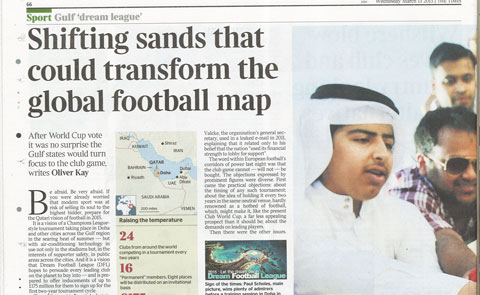
Last week I commented on what looked like a false news story perpetrated against the Times (London). It turns out that is exactly what it was, and the Times has offered an apology to readers:
There are times when all you can do is admit you were wrong. Last week, Times football ran a story that we thought was a blockbuster. The state of Qatar was proposing a new summer tournament that would offer stunning financial rewards to the teams who participated.

It was a horrible prospect that threatened to transform the sport but appeared to be a brilliant story. The Dream Football League (DFL) would turn into a journalistic nightmare.
Richard Whittall, a blogger at Counter Attack, has tracked this story closely and his post mortem is worth a read (as is his disturbing follow up on the source of the false story that duped the Times).

Where does this leave sports journalism? Still at that crossroads I'm afraid.

Saturday, March 16, 2013

For FIFA "Independence" Means Staying Silent

In an interview with Osasu Obayiuwana at Inside World Football, FIFA president Sepp Blatter explains that he has secured a promise from Mark Pieth to remain silent on FIFA's reform process unless given permission to speak from Blatter himself:
Blatter told InsideWorldFootball, in an exclusive interview, in Marrakech, Morocco, that he had recently spoken with Pieth and asked that he make no further public comments on the process.

"Yes I am surprised with his (Pieth's) reaction. I spoke with him [on Friday]."

"He was asked to make proposals. He was designated by me, and confirmed by the [FIFA] executive committee, to be the chair of what we described, at the time, as the committee for solutions.

"He is to propose solutions. But he thought, or the people around him thought, that all of the solutions that they propose have to be implemented. This is not possible.

"We have to look at them, we have to discuss them and then we will see what will be accepted, or not, by the congress.

"If he is to make criticisms, I have told him that he should not go public, because he is a part of the reform process.

"If everybody in the reform process goes public and says that they are not happy with this and that, there will be a lot of confusion. We have to avoid that.

"He has now accepted that he would not go public [with his complaints], unless I tell him that he can go public," Blatter told this reporter.
Blatter's comments reveal, once again, that FIFA does not really understand the concept of "independence" or the difference between advice and decision making. FIFA's reputation would enhanced by open debate and discussion, even public disagreement. Enforced silence doesn't really build confidence, risks Pieth seeing his legacy as reform committee chair being reduced to FIFA lap dog.

It doesn't have to be this way. Pieth's criticism of FIFA's commitment to reform has been growing increasingly strong. I wrote last month that Pieth's apparent distancing himself from the FIFA reform effort was sure to come under increasing pressure and deserved broad support:
If Pieth does indeed split from FIFA it could be huge, as he knows a lot and carries much credibility -- credibility that he has placed at serious risk by taking on the FIFA role. With the FIFA reform process all but over, Pieth is no doubt looking to how his efforts will be received by the broader community, which is yet to be determined. Pieth's assertion of independence deserves support as it cannot be easy.
Sepp Blatter should encourage his "independent" reform committee to speak out, to voice their opinions. An enforced silence serves no one -- not FIFA, an certainly not Mark Pieth.

Thursday, March 14, 2013

Sports Journalism at a Crossroads?

The ongoing flap about the Times (London) exclusive story about the supposed Qatar super football league provides an object lesson in the challenges in making sense of evidence in any high stakes setting, and offers up a fork in the road for the sports journalism community. Let me explain.

During the night of March 11 a French football magazine -- le Cahiers du Football -- published a spoof story about how the Qataris we going to start a new football competition - the Dream Football League. The story was "completely made up."

Less than 24 hours later this happened:
The Times publishes exclusive information weirdly similar. Name of the project, date of launching, number of clubs participating (even on invitation), spending limits, and the same picture. An almost perfect match. Except that everyone in England is yet to realize that.
Shortly after the publication of the article, other British papers run the story. Opinion pieces on the topic appear and English-speaking journalists talk with each other on Twitter, saddened by the possibility of such a project. They are quickly warned by the usual Cahiers readers, especially by us, Christophe and Raphaël, who write on les Dé-Managers, a blog associated with Les Cahiers. We tell them that their exclusive is actually based on an entirely fictional article. At that moment, few of them take us seriously.
To make matters even more interesting the journalist who broke the story in the Times -- the widely respected Oliver Kay --  not only stood by his reporting but fired back strongly at le Cahiers du Football and others who pointed out that key details in his story appeared a day earlier in the spoof, such as in the Twitter exchange below.
It is unclear exactly what happened here. Some facts are clear -- The Qataris have denied the story. It is fairly obvious even with my rusty French that the story appeared first on le Cahiers du Football. The story is a spoof. Oliver Kay denies that and has even followed up his original report with a new story focused on Manchester United's opposition to the imaginary new league. Did a widely respected journalist get taken in by a dodgy source? Something else? Can't say right now. But of course, getting to the bottom of things is an important reason why we have journalists, right?

Maybe not. Consider ESPN which unwisely says that le Cahiers du Foot is wrong and runs with the story:
Kay is the antithesis of that unfair caricature of a headline-hungry, fact-resistant English newspaper journalist. He's intelligent, diligent, cautious and rarely given to hyperbole. Doubting him would be unwise.
One of the things that I try to teach my students is that accepting arguments from authority at face value is not good for them or the authorities. There is nothing wrong with exploring and verifying claims. Writing at Counter Attack Richard Whittall explains well that it actually matters what has gone on here:
Whatever the outcome, this story should not be buried. None of the major papers seem to be including some recent details. Fair enough; they’re all pretty inconclusive on their own right. But it does involve the credibility of a major UK newspaper, the reputation of an established journalist, and the viability of unnamed sources. This doesn’t have to be some sort of journalistic “lesson,” but maybe a warning for those getting information that sometimes seems to good to be true.
At Play the Game earlier this week, ironically enough, David Rowe asked "What is sports journalism for?" and offers up a hard-hitting critque of the profession:
[T]he section of the media dedicated to informing us about it – sports journalists – are looking more than a little dishevelled. The ABC’s Clarke and Dawe lampooned the discipline last week, with Clarke’s “expert sports journalist”, responding to a “release form” question about silence or incompetence, with the answer: “I just get stuff off the internet and stick it in the paper”.

This comic turn raised an important question – what is sports journalism for? Is it reasonable to describe the sports desk as “the toy department of the news media”? Are its journalists part of the fourth estate or simply a fan club?

Sports journalists, it’s fair to say, do not have elevated reputations among (also much-disparaged) fellow reporters on other rounds. That attitude might stem from professional jealousy of the “nice work if you can get it” kind, and also because sport tends to be patronised as “just” popular culture. Nonetheless, sports journalists have found it hard to shake their unfavourable image as middle-aged men billowing smoke and swilling beer, as star-struck sport wannabes playing at being serious scribes.

This cruel stereotype ought to be outmoded as the demographics of sports journalism change, and better educated younger people move into the game, including more women breaking into the locker room. A university education should raise the bar, replacing tunnel vision and back-slapping with critical and investigative sports journalism.
How Oliver Kay, The Times and the broader sports media that has been taken in by a story that is not quite right follow up on the Dream Football League "exclusive" will tell us a lot about the state of the profession. After all, if journalists can't be trusted to take care of their own profession, how can they be trusted to look into match fixing, doping and broad failures of governance in sport?

Monday, March 11, 2013

Football Diplomacy from The Lowy Institute


The Lowy Institute, in Sydney, has released a report -- Football Diplomacy Redux -- on how Australia might use the Asian Cup 2015 as a means to strengthen Australia's ties with Asia. See the new report here. The author, Lowy's Mark Bubalo, discusses the new report in the short video above.

The recent report follows a 2005 report from the Lowy Institute on Football Diplomacy (here in PDF). The 2005 paper presented the opportunity as follows:
While Australian governments have successfully built pragmatic ties with Asian leaders, a popular dimension to our engagement with Asia has in many respects been missing. This didn’t matter greatly in the past, but today public opinion is increasingly a factor in foreign policy. Governments must influence individuals as well as elites to address global problems such as terrorism and disease and ‘branding’ has become critical to a state’s ability to attract trade, investment and international political support. But a new opportunity to deepen people-to-people links with Asia has arrived in the form of Australia’s recent admission into the Asian Football Confederation. For the first time, Australia will have a significant sporting relationship with Asia. The question is, how can Australia best use this opportunity to enhance its regional image and engagement?

Another FIFA Ex Comm Member Suspended

At the request of Michael J. Garcia (chairman of the investigatory chamber of the Ethics Committee), Hans-Joachim Eckert (chairman of the adjudicatory chamber of the Ethics Committee) today provisionally banned FIFA Executive Committee member Vernon Manilal Fernando from taking part in any kind of football-related activity at national and international level for a period of a maximum of 90 days.

The decision was taken based on art. 83 par. 1 in fine of the FIFA Code of Ethics, in order to prevent interference with the establishment of the truth with respect to proceedings now in the adjudicatory chamber.

The proceedings relate to formal ethics charges brought in a final report filed by the chairman of the investigatory chamber with the chairman of the adjudicatory chamber. This report is the result of investigatory proceedings opened in October 2012.

The case is now with the jurisdiction of the adjudicatory chamber for any further procedural steps that chamber deems appropriate.
The report referenced is not, to my knowledge, publicly available. I have emailed the FIFA media office and requested a copy.

The AP reports:
The suspension relates to the investigation by FIFA prosecutor Michael J. Garcia into the alleged misuse of Asian Football Confederation accounts. Fernando's case has been sent to the adjudicatory chamber of FIFA's ethics committee for a decision.

FIFA hasn't indicated any specific allegations against Fernando - a member of FIFA's ruling executive since January 2011 - who was a close ally of bin Hammam, the former AFC head and disgraced FIFA presidential candidate.
Speculation is that the suspension has to do with the infamous money-in-paper-bags that Bin Hammam got into trouble for:
Bin Hammam won a Court of Arbitration for Sport ruling last year to overturn the first ban. The court said FIFA hadn’t proven bin Hammam paid $40,000 bribes in cash to Caribbean officials despite presenting whistleblower evidence.

Fernando, who is a lawyer, was among a group of senior soccer officials who accompanied bin Hammam on that May 2011 trip to Trinidad to woo voters three weeks ahead of the FIFA election. Bin Hammam, who claims Blatter helped orchestrate the scandal, withdrew his candidacy as FIFA prepared to suspend him days before polling.
Of course, Bin Hammam prevailed at the CAS over FIFA's ability to make a convincing case and to follow principles of due process. With the work of the FIFA Ethics Committee still taking place out of sight, it is not clear that FIFA has gotten the message on due process.

Thursday, March 7, 2013

Sunil Gulati Makes a Run for FIFA's Executive Committee

Reuters reports that Sunil Gulati, the head of the US Soccer Federation, and arguably the most powerful person in US soccer, is making a run to join FIFA's Executive Committee:
CONCACAF, the confederation for North and Central America and the Caribbean, said U.S. Soccer Federation president Sunil Gulati and Mexican Football Federation president Justino Compean will face off in an election on April 19 in Panama City.

The pair are standing for the position of North American representative to FIFA's executive but a vote will be taken of all CONCACAF's member associations at the April congress.

The position was held for 16 years by American Chuck Blazer, who has not put himself forward for a fifth term.

The vote will provide a barometer of the balance of power within CONCACAF after the scandal involving former president Jack Warner, who resigned after allegations of 'cash for votes' in the FIFA presidential election.

Trinidadian Warner dominated CONCACAF from the late 1980's and his departure in June 2011 has led to major changes in the body.

Gulati also faces a challenger for a place on CONCACAF's own executive -- Canadian Victor Montagliani is standing against the American.
Chuck Blazer left the position under a dark cloud. I have no doubts that Gulati would be a huge improvement. He was kind enough to read an early draft of my FIFA governance paper and offer comments and suggestions. Gulati, who also serves as an senior lecturer in the Department of Economics at Columbia University, is very smart and thoughtful.

However, Gulati also keeps a low profile and is extremely measured in his public comments. He served on the FIFA Independent Governance Committee (and in the process, illustrating the misnomer "independent"), but has never (to my knowledge) spoken publicly about FIFA reform or the committee's work. He turned down a request to be interviewed for this blog about the FIFA reform process, after seeing my questions.

If he is elected to the FIFA Executive Committee he should expect to face far more questions (and demands for answers) about the US role in FIFA governance. I'd speculate that this might work against his being elected.

He was asked by reporters last month about the 2022 World Cup decision process, and he replied:
I read the same stuff you guys read about investigations. It doesn’t make any sense to comment on that.
Come on. I'd hope that reporters press much harder in the future, and Gulati recognizes that he has an obligation to shed some sunlight on FIFA's governance.

Gulati did open up a bit about how the US looks at the hosting decision process:
Would we [the US] bid in the future? Sure. When in the future, I don’t know. And under what rules, I don’t know. The rules are going to have to be different. The rules need to be much stronger, much stricter about what it is okay and what is not okay [in lobbying efforts]. It’s clear — and this is a tough one for the U.S. and we’ve discussed this at length with the U.S. Olympic Committee  – the role of nation states has become even more critical, that it’s not about a bid committee only. That’s always been true up to a point with governement guarantees. But we are never going to have a situation where the U.S. is going to be able to try to influence a World Cup or Olympic bidding decision that are a matter of our foreign policy or geopolitics. It’s just not that critical to the U.S. Hosting the World Cup or Olympics doesn’t change the face of the U.S. economy. … Can you imagine an American president ever saying, ‘Okay, we will sign a new treaty with a country because they have a voter for something.’ It’s just not the way it works. So that is all going to have to shake out. We have a lot of advantages. We have a country that doesn’t have to virtually build any facility for a World Cup, plus we have a country that could sell 40 to 50 percent more tickets than anyone else could, given the size of our NFL stadiums. We have a country that could host a World Cup several months from now if we needed to do. … In a day where world growth rates are down and economic issues are important, FIFA and the IOC need to understand asking people to spend billions of dollars on infrastructure, unless it has long-term use, is a pretty big ask.
The implication implicit in Gulati's comments -- about what is done in the voting process by others, but not by the US -- deserves much more open discussion.

The election takes place in little over a month.

Wednesday, March 6, 2013

Fool Me Once

Last week I commented on the possibility of a loophole in NCAA rules, which would allow college athletes to get paid via uncontested lawsuits brought over intellectual property violations. Apparently, Johnny Manziel, 2012 Heisman Trophy winner, has sued a T-shirt maker for infringing upon his trademark. Details here.

Well, today news reports say that Johnny Manziel may be involved in a second conflict, this time having to do with autographed player cards.

Hmmmm .... fool me once, shame on me ....

What Social Media May Say

If you are following the Champion's League this season, then the Tweet above needs no explanation. Interesting, no?

Tuesday, March 5, 2013

Look: The Qatar 2022 Debate

[V]ital health and practicality issues relating to the 2022 summer event in Qatar will not go away.

Last weekend, Michel Platini, who played in major soccer tournaments and now organizes them, stirred the pot. “I am in favor of Qatar under two conditions,” he said. “Because of the heat, the World Cup will need to be held in the winter. With over 40 degrees, playing football is impossible, and for the fans it would be unbearable,” he said, referring to temperatures that reach upward of 104 Fahrenheit. Platini also said: “The neighboring countries must be included so that the World Cup is staged throughout the entire region.”

Breathtaking. One of the finest players of his time, now Europe’s leading soccer administrator and a vice president of FIFA, Platini gave his vote to Qatar when the bidding was concluded in December 2010.

Yet today, he has doubts and conditions.
From FIFA's perspective, perhaps the debate over scheduling will distract from other issues, like the internal politics of football governance.

In other news, the CAS has upheld a rules change in the African football confederation that prevented a challenge to the leadership of long-time incumbent Issa Hayatou:
FIFA executive committee member Jacques Anouma was barred from being a candidate to lead African football on Tuesday, losing his legal challenge to stand for election against longtime incumbent Issa Hayatou.

The Court of Arbitration for Sport dismissed Anouma's appeal against the Confederation of African Football, which refused to accept his election bid after he was made ineligible by rules changes engineered by Hayatou.

Hayatou, a FIFA vice-president from Cameroon, will be the only candidate to extend his 26-year CAF reign at its congress this weekend in Marrakech, Morocco.

A new vision in African football is now needed "more than ever," Anouma said in statement published on his personal website.

"Despite our immense disappointment, our determination to bring about real change in the management of African football remains intact," the Ivory Coast official said.

The Cairo-based confederation published a CAS statement announcing the verdict on its website without further comment.

Hayatou steered through new election rules last September which allowed only "current or former members" of the CAF executive committee to challenge him.

Anouma was barred because his FIFA position gives him only non-voting board membership.

"The CAS has confirmed that the CAF executive committee had jurisdiction to refuse the candidature of Jacques Anouma," the court said in a statement.
Never mind that, did you hear about the Qatar 2022 schedule debate?

Saturday, March 2, 2013

MIT Sloan Sports Analytics Conference

The MIT Sloan Sports Analytics Conference is going on this weekend. It looks fascination, wish I was there. They have a great website and are livestreaming panels. Here is a round-up of Day 1.

They have a research paper competition with finalists posted online. My favorite has to do with (what else) decision making, and specifically the choices made by NBA teams in trading off 2-point and three-point shots as a function of context - whether in a winning or losing position. That paper can be found here (in PDF) and the other finalists are here.

You can follow the conference on Twitter at #SSAC13.

Enjoy!