Monday, May 14, 2018

Wisdom on College Hoops from Carlon Brown

This series of comments below from Carlon Brown ((@carlonautentico) on Twitter offers a fantastic perspective on what college basketball prepares an athlete for and what it does not. Brown played at the University of Colorado and professionally in the US and overseas.

It'd be great to get him to my class next year. The perspective below is smart, have a read.


Saturday, May 12, 2018

Reverse Engineering Bermon & Garnier (2017)

Last week, Ross Ticker, Erik Boye and I wrote a letter to the British Journal for Sports Medicine calling for the authors of Bermon and Garnier (2017, BG17) and their sponsor IAAF to release the performance data used in their study. You can read our letter here.

Professor Joe Guinness, a statistician and visiting assistant professor at Cornell (@joeguinness) has attempted to reproduce the reported performance results in BG17 for the women's 800m, which we discuss in our letter.
BG17 report an average time of 121.80 seconds with a standard deviation of 5.42 seconds, for 64 times included in the analysis. Prof. Guinness sought to reporduce these numbers by brute force (his code is linked in the Tweet above).

He has found that he can only come close to reproducing the times by removing Caster Semenya's 2011 time plus that of one other athlete. See his results above. He notes in a Tweet: "There are some caveats here, especially how rounding is dealt with, so this shouldn’t be taken as definitive."

If these numbers are correct then it would mean that Caster Semenya's time was removed while 2 times from Mariya Savinova in 2011 and 2013 would remain. Savinova's times have officially been removed from the IAAF database after she was suspended for doping at both the 2011 and 2013 World Championships.

The inclusion of Savinova alone would call into question the meaningfulness of BG17, and the deletion of Semenya's time would be curious. Of course, we cannot be sure about any of this until IAAF and BG17 release their data.

The longer the stonewall the more questions will be raised as to why the just don't release the data. Are there some things in their work that they are afraid to show?

Wednesday, April 25, 2018

Some Resources on Testosterone Regulation in Elite Athletics

It appears that the IAAF is on the verge of announcing another set of regulations governing allowable natural testosterone levels in women athletes. This is a bad idea. In anticipation of the new regulations I thought I'd post up some resources for those who are interested in the issue.

The regulation of testosterone only the latest effort by sports administrators to police how women should look. There are countless biological characteristics of humans that in some way contribute to elite athletics performance -- testosterone in women (but not in men) is the only naturally occurring biological characteristic that is regulated.

I take on this issue in some depth in this paper
Pielke Jr, R. (2017). Sugar, spice and everything nice: how to end ‘sex testing’in international athletics. International Journal of Sport Policy and Politics, 9:649-665. (PDF, free to read)
Remarkably, in 2011 the IAAF listed a set of criteria for how women should appear, lest they be reported to officials for investigation of their testosterone level. These criteria are listed in the slide below (from a talk I give on this subject). Two of the nine criteria have to do with breats size and shape.
More generally, let's say that you accept the argument that testosterone should be regulated. I don't, but let's play along. Even here, the science relied on by the IAAF does not support the case that they are making.

The IAAF bases its case on this paper:
Bermon, S., & Garnier, P. Y. (2017). Serum androgen levels and their relation to performance in track and field: mass spectrometry results from 2127 observations in male and female elite athletes. British Journal of Sports Medicine. 
That paper purports to show that women in certain events gain a benefit from testosterone levels in the higher end of the range found in female athletes. 

That paper has received a range of criticism as being flawed. Notably:
Franklin S, Ospina Betancurt J, Camporesi S What statistical data of observational performance can tell us and what they cannot: the case of Dutee Chand v. AFI & IAAF Br J Sports Med Published Online First: 23 February 2018. doi: 10.1136/bjsports-2017-098513
That paper concludes:
we believe that it is scientifically incorrect to draw the conclusions in the Bermon and Garnier paper from the statistical results presented. Their paper claims that certain athletes have an advantage in precisely the five events where a significant effect was found: we calculate that a high share of those five significant effects are likely to be false positives.
the statistical analysis data processing in this paper is such a mess that I can’t really figure out what data they are working with, what exactly they are doing, or the connection between some of their analyses and their scientific goals. 
Gelman was motivated by Simon Franklin, a post-doc at LSE, who emailed him that:
There are more than a few problems with the paper, not least the fact that it makes causal claims from correlations in a highly selective sample, and the bizarre choice of comparing averages within the highest and lowest tertiles of fT levels using a student t-test (without any other statistical tests presented).

But most problematic is the multiple hypothesis testing. The authors test for a correlation between T-levels and performance across a total of over 40 events (men and women) and find a significant correlation in 5 events, at the 5% level. They then conclude:
These are 5 events for which they found significant correlations! And we are lead to believe that there is no such advantage for any of the other events.
Female athletes with high fT levels have a significant competitive advantage over those with low fT in 400 m, 400 m hurdles, 800 m, hammer throw, and pole vault.
I also have written two critiques. First, a post-publication peer review:
My bottom line: The paper has some significant methodological issues, most notably the inclusion of female athletes who doped with those with naturally high levels of T. There is some double counting of athletes in 2011 and 2013. There is also speculation that the male findings are contaminated by doping. Methodological issues notwithstanding, the paper nonetheless strongly reinforces the 2015 CAS Chand decision. 

The IAAF data of Bermon and Garnier (2017) don't support the proposed regulations of testosterone in women at distances of 400m to one mile. Consider the figure below:
Let's accept the analysis as valid (maybe not, but let's play along). These IAAF data (pink bar) indicate that over distances of 400m, 800m and 1500m high testosterone women are on average 1.1% faster than their low testosterone counterparts. Unfair, IAAF might scream.

But look at the data that IAAF collected for men at 400m and 1500m (blue bar). These data indicate that high testosterone men are on average 1.1% faster than their low testosterone counterparts. Surely if high T in women in selected events where performance differs is to be regulated, then high T in men in selected events where performance differs is also to be regulated?

If IAAF responds that the T standard applies only to women but not men based on performance data, then this is the very hallmark of sex discrimination. This only scratches the surfaced of flawed T regulation.

We shall see what IAAF actually presents tomorrow. However, based on the evidence and arguments that IAAF have presented thus far, its T regulations are focused on one athlete (initials CS), discriminatory, sexist and (for those who think analysis of T levels in athlete performance is relevant) resting on a flawed evidence base.

There can be little doubt that this new policy will be challenged at CAS.

Monday, April 23, 2018

A Talk on College Sports: How University Faculty Can Help Fix College Athletics

Over the weekend I gave a talk to the Coalition on Intercollegiate Athletics (COIA). Here it is:
Comments welcomed!

Monday, April 16, 2018

Six-Figure Salaries in the US NGBs Reported in 2016 IRS 990s

The figure above was motivated by a column by Sally Jenkins in the Washington Post a few weeks ago in which she reported that the USOC pays 129 staff members more than $100k per year. I was curious how that statistic looks for the 47 Olympic National Governing Bodies.

One way to take a look at that question is to dive into the 20016 (most recently reported) IRS 990 forms required for non-profits and sum up all the highly-paid employees reported on those forms. We identified 184 individuals on the 990s with compensation levels above $100,000. This number is surely an underestimate as not all such salaries are reported on the 990s. In addition, there are many subcontracts and transfers reported on the 990s to other non-profits or businesses for which it is impossible to identify salaries. US Soccer for instance, transferred some $60+ million and awarded USSF employees unspecified bonuses. Even so, the reported numbers tell us something.

Summary stats:

  • Number of salaries between $100k and $150k = 56
  • $150k - $200k = 46
  • $200k - $250k = 33
  • $250k- $500k = 39
  • >$500k = 10
  • >$1M = 3
All told, these salaries for the 184 employees total $44.7 million and represent just about 4% of the total NGB budgets.

Please send along comments, corrections and data requests via Twitter @rogerpielkejr.

Monday, April 9, 2018

US Olympic NGB Revenues in 2016

UPDATE: An eagle-eyed reader caught a mistake in USA Archery and USA Bowling. Now fixed. Thanks for the close reading.

The image and data above shows US Olympic National Governing bodies ranked by 2016 revenue as reported to the IRS on Form 990, line 12. Some details:
  • Blue is a Winter Sport, Green is Summer;
  • We were unable to locate the IRS 990 for USA Canoe/Kayak;
  • US Soccer owns a subsidiary non-profit that reported more than $192 million in revenue, of which USSF says $50M was transferred to USSF. So the US Soccer total includes a net ~$142 million in addition to income reported by USSF. It's all a bit murky. 
Some top level figures:
  • The 47 NGBs collectively had more than $1.2 billion in revenues
  • 3 had revenues over $200m, Soccer, Tennis and Golf
  • 18 had revenues between $10m and $50m
  • 21 had revenues between $1m and $10m
  • 4 had revenues of less than $1m
Golf, Tennis and Soccer are clearly in a financial class by themselves.

In the works: How many employees of the NGBs make salaries of $100k+?

Data:
U.S. Soccer $266,366,465
U.S. Tennis Association $259,711,661
USA Golf $206,656,399
USA Hockey $44,446,718
USA Swimming $39,620,614
USA Track & Field $35,008,413
USA Gymnastics $34,477,340
USA Bowling $33,895,340
U.S. Equestrian Federation $30,658,967
USA Volleyball $28,806,924
U.S. Ski and Snowboard Association $26,924,000
USA Basketball $22,674,932
U.S. Figure Skating $20,481,288
USA Wrestling $18,236,578
USA Triathlon $15,984,236
USA Cycling $14,573,722
U.S. Sailing $11,646,019
USA Rugby $11,188,896
USA Water Polo $10,991,345
USA Softball $10,519,107
US Rowing $10,393,694
USA Baseball $9,268,586
USA Fencing $9,159,034
USA Field Hockey $8,931,960
USA Squash $5,487,560
USA Shooting $5,386,549
USA Weightlifting $5,147,637
USA Boxing $4,558,366
USA Archery $3,816,680
U.S. Speedskating $3,783,442
USA Bobsled & Skeleton $3,696,117
USA Taekwondo $3,451,975
USA Diving $3,257,831
U.S. Biathlon Association $2,696,248
USA Curling $2,340,751
USA Luge $2,330,785
USA Table Tennis $2,168,190
USA Water Ski $1,885,931
USA Judo $1,872,010
USA Synchronized Swimming $1,754,142
USA Roller Sports $1,644,637
USA Racquetball $1,471,286
USA Karate $1,265,814
USA Pentathlon $946,349
USA Badminton $743,341
USA Team Handball $347,825
USA Canoe/Kayak unavailable

Wednesday, April 4, 2018

Has US Soccer Failed to Comply with State of New York Non-Profit Reporting Requirements?

Has the US Soccer Federation failed to comply with relevant laws required to maintain its non-profit status? This post takes a look at this question and concludes, it looks like it. At a minimum there are yet another set of important questions that a US non-profit sports organization should answer.

The US Soccer Federation is a non-profit organization which serves as the Congressionally-legitimated national governing body (NGB) overseeing the amateur sport of soccer, along with46 other NGBs that comprise the Olympic sports in the United States. The USSF derives its authority from the Amateur Sports Act of 1978 (The Ted Stevens Olympic Act, here in PDF).

USSF is technically a non-profit charitable organization incorporated under New York law. New York law requires that certain financial reports be filed by registered charities (see Section 172-B for details). Let's dig into some details.

The state of New York has a really outstanding website that allows for the public inspection of the financial reports filed by registered charities -- CharitiesNYS.com. For instance, we can look at the US Soccer Foundation (and not to be confused with the US Soccer Federation), an organization founded as part of the legacy of the 1994 US World Cup to "help children embrace an active and healthy lifestyle while nurturing their personal growth beyond sports."

On the NYS Charities page here is what a search results for the US Soccer Foundation:
You can see that the organization was registered in 1997 and has filed required financial reports since 1996, with those filed since 2006 available online.

There was a flurry of filings on February 1, 2018, just a few months ago, and only four years of financial data, despite the fact that the USSF has been a registered NY charity for many decades. There is no evidence of any filings before February 1, 2018.

There are a few curiosities to note and a few questions to raise.
  • The USSF filed a registration statement for charitable organizations 1 February 2018 using a form explicitly marked for use by "first time registrants." I have noted this with the red circle in the image below below. Does this imply that the USSF was not properly registered as a NY state charity until February of 2018? What are the implications for its retrospective non-profit status, income earned, taxes?
 
  • No financial information is available on the NY Charities website for dates prior to 2013 or after 2015. Is this limited information in compliance with NY law? Relevant NY statutes explain that a charity's "registration to be cancelled for failure to file." What is the NY attorney general's view on the compliance status of USSF? Sure the February 1, 2018 filing flurry was motivated by something, perhaps a notification of being out of compliance. Regardless, it would be important to publicly disclose this information.
  • As has been noted elsewhere, the USSF has not filed its 2016 financial information, and notes in a handwritten scribble that it has an IRS extension.
The US Soccer Federation financial page has since posted a FY2017 IRS 990 but not an audited financial statement. The USSF is thus out of compliance with the requirements of NY law. Have they been granted an extension by the NY attorney general?
The last question I have is: where is the soccer-savvy media on all this? The CA2016 IRS 990 I reported on yesterday sits in plain view, as do the (non)filings of the USSF in the NY Charities database. Who is going to emerge as the American Andrew Jennings? 

I welcome answers to the various questions posed above. I will update if and when more information comes in.

Tuesday, April 3, 2018

Seven Questions for US Soccer on the CA2016 IRS 990

In 2014 the US Soccer Federation, a non-profit charity registered in New York, created a subsidiary non-profit related to the hosting of the Copa America Centenario soccer tournament. Specifically, on 29 October 2014 the USSF set up a single-member LLC, called The CA2016 Local Organizing Committee LLC.

I've reviewed the 2016 IRS 990 form from the CA2016, and this post raises some questions about the numbers reported in that form.

The FY 2015 audited USSF financial statements (PDF) explain:
The CA2016 Local Organizing Committee LLC, a single-member LLC owned by the Federation and formed on October 29, 2014, was established in conjunction with the Federation’s agreement with The Confederation of North, Central America and Caribbean Association Football (“CONCACAF”), for the purpose of organizing and promoting the Copa America Centenario 2016 tournament to be held in the United States in June 2016. Under the agreement, the Federation was established as the official and exclusive local organizing committee to host and stage the tournament. In consideration for the services provided by the Federation under the agreement, the Federation is entitled to receive a share of the ticketing and stadium revenues generated by the tournament games. On March 13, 2015, the Federation loaned $500,000 to COPA 2016, LLC as a startup loan, which will be reimbursed by COPA 2016, LLC.
Via Guidestar, I have taken a close look at the CA2016 IRS 990 form (here in PDF) and I have a few questions that are unanswered by the information reported, but which seems entirely appropriate information for a non-profit organization to provide to the public.

The CA2016 reported $190 million in revenue in 2016 (specifically $189,681,375). CA2016 reported providing a grant of $64,941,805 to the USSF (Schedule I, Part ID, d). USSF 2017 IRS 990 (PDF) reported receiving $50,000,000 from CA2016 (p. 68, Part V (1)).
  • Question #1: Why is there a $14,941,805 discrepancy between the two numbers?
CA2016 employed 24 people in 2016 and reported $5,144,749 in compensation, salaries and wages (IRS 990, Part IX, lines 5 and 7) plus $548,815 in other employee benefits (IRS 990, Part IX, line 9). This results in an average pay of $237,232 per employee.
  • Question #2: What were each of the 24 employees actually paid?
CA2016 reported “fees for services” paid to non-employees of $15,403,641 (IRS 990, Part IX, line 11a, “Management”) and $46,858,610 (IRS 990, Part IX, line 11g, “Other”). Of this latter amount Schedule O explains that $31,192,095 was for “service agreement total fees” and $15,506,572 was for “hosting agreement total fees.”
  • Question #3: To whom (organizations and individuals) were the $15.4m in management fees paid?
  • Question #4: To whom (organizations and individuals) were the $31.2m in service agreement fees paid?
  • Question #5: To whom (organizations and individuals) were the $15.5 million in hosting agreement fees paid?
Schedule O explains that the CA2016 CEO received a bonus after the tournament, as did all USSF employees.
  • Question #6: To whom were these bonuses paid and how much were they?
CA2016 lists $16,328,276 for travel (IRS 990, Part IX, line 17). Under Schedule J, Part 1 “Questions Regarding Compensation,” unanswered was the question (1a, and the two follow up questions, 1b and 2) asking whether travel involved:
  • first class or charter travel
  • travel for companions
  • tax indemnification and gross-up payments
  • discretionary spending account
  • housing allowance or residence for personal use
  • payments for business use of personal residence
  • health or social club dues or initiation fees
  • personal services (e.g., maid, chauffeur, chef)
  • Question #7: Did travel expenses include any of these categories?
I will be happy to publish any answers that come in.

Monday, April 2, 2018

A Panel at CU Boulder: Are Big-Time College Athletics Compatible with Academics?

On Thursday this week, April 5th at 7pm the CU Athletics Sports Governance Center will be hosting a panel discussion on the subject: Are Big-Time College Athletics Compatible with Academics?

Location: Champions Center, 3rd floor Petry Auditorium
Time: 7-9pm
Free and open to the public

We are thrilled that the event is headlined by the 2018 SGC Distinguished Lecturers, Jay Smith from the University of North Carolina and Victoria Jackson of Arizona State University.

Smith is a professor at UNC where he was involved with the faculty response to the so-called "paper class" scandal. He is the co-author (with Mary Willingham) of Cheated: The UNC Scandal, the Education of Athletes, and the Future of Big-Time College Sports which my students are reading this week in class.

Jackson teaches at ASU where she is completing a book on "Justice and Injustice in American Intercollegiate Athletics" She won a NCAA championship in the 10k at ASU, and prior to that was a varsity athlete at UN in cross county and track.

Joining Smith and Jackson on the panel are:
  • Kris Livingston, associate athletic director for student services CU. Kris is in charge of the group that supports the academics of varsity CU athletes;
  • Joe Jupille, professor of political science and CU Faculty Athletic Representative. As FAR, Joe is responsible for "oversight of the academic integrity of the athletic program and serving as an advocate for student-athlete well-being" (see this PDF for more).
  • Tad Boyle, head men's basketball coach at CU Boulder. In addition to sending a few players to the NBA, his bio notes that "he has graduated every CU senior student-athlete on his roster (25)."
Here is what I shared with the panelists on the goal for the evening:
The goal for the evening is educational, with a wide ranging and open discussion of these challenging and important issues. You should feel free to address the question posed as the title of the panel discussion in whatever way makes the most sense to you. It is intentionally provocative and ideally we will have some debate as well as conversation. In the unlikely event that we do not solve all the problems of college athletics, I'd like the audience to go away with a deeper and perhaps more sophisticated understanding of the challenges, issues, opportunities.
If you are in Boulder on Thursday, please come and participate in this discussion of important issues in college athletics!

Monday, March 26, 2018

US Soccer Federation CEO Salary Data in the Context of US Non-Profits


Update: In today's (27 Mar) Washington Post Sally Jenkins has a hard-hitting piece on executive pay in the U.S. Olympic organizations.

The graph above shows the total compensation of the CEO of the US Soccer Federation. The USSF is a non-profit registered as a charity in the state of New York. Here are the numbers and sources:
  • 2014 $654,907 (IRS 990 2014, pdf)
  • 2015 $694,745 (IRS 990 2015, pdf)
  • 2016 $809,640 (IRS 990 2016, pdf)
How does the USSF CEO salary compare to other non-profits based on the size of the organization? 

In 2016 Charity Navigator looked at 2015 data on the salaries of CEOs at 4,587 charities from the IRS 990 submissions (report here in PDF). From this report graph of salary versus organizational expenses can be seen below. From the 2015 USSF IRS 990 we see that expenses were just over $110 million. Based on this data I have annotated the graph with a red star to indicate the data point that occurs at USSF expenses and CEO salary.
The USSF CEO is one of the highest paid chief executives of any non-profit in the United States. The Charity Navigator report notes: "66 charities paid their CEOs between $500,000 and $1 million" (and 10 paid more than $1 million). This would place the USSF CEO close to the 99th percentile of non-profit executive salaries.

In New York specifically, Steven Hall & Partners looked at all non-profit CEO salaries (in 2014, report here in PDF) for charities registered in New York, finding: "Among organizations with revenues greater than $40 million, median total compensation for the top executive was $458,140." The USSF CEO is again well above the median based on this survey.

Charity Navigator found that from 2008-2014 non-profit CEO compensation increased by less than 3% per year. The USSF CEO saw a raise of 4.9% from 2014 to 2015 and 17.3% from 2015 to 2016.

Bottom line: The US Soccer Federation CEO is among the highest paid chief executives of any charitable, non-profit organizations in the United States.

Other sports NGBs:
  • US Tennis Association 2016 (IRS 990 pdf)
    • $253.9 million in expenses
    • $1.39 million, executive director 
  • USA Track and Field 2016 (IRS 990 pdf)
    • $36.2 million in expenses
    • $1.60 million, CEO
  • USA Swimming 2016 (IRS 990 pdf)
    • $40.5 million in expenses
    • $1.33 million, president and CEO
  • USA Gymnastics 2016 (IRS 990 pdf)
    • $32.4 million in expenses
    • $671,000, CEO
  • US Olympic Committee 2016 (IRS 990 pdf)
    • $257.5 million in expenses
    • $1.08 million, CEO

Thursday, March 22, 2018

Updated NGB Scorecard Values for US Ski and Snowboard, Moves to the Top of the Rankings

Note: I am posting this update here as we work through some technical issues with our NGB project site at the Sports Governance Center at CU Athletics. We will update that site with the new scores ASAP, thanks for your patience.

Last year, we released the first set of scores for the governance of US Olympic national governing bodies (NGBs) based on evaluation metrics developed by the 2015 Sports Governance Observer of Play the Game. We applied these metric to 22 US Olympic Sport Federations. We will be releasing the scores for the remaining NGBs later this spring.

Since releasing the initial set of scores, we have received feedback from the U.S. Olympic Committee and more than a dozen NGBs. One of the organizations that we heard from was US Ski & Snowboard which provided us with an update on their governance practices, the information that they make available on their website and several challenges to our rankings. You can see their response here in PDF.

Our team used the Ski and Snowboard response as the basis for an updated scoring of Ski & Snowboard with respect to the 36 SGO indicators. Our methodology was the same as first applied: A team of three researchers independently evaluated and scored each of the 36 SGO indicators. Then, for the few indicators for which there was a significant difference in scores among the team, the team met to reach a consensus score.

The full set of rankings can be seen on our homepage and the Ski and Snowboard update is summarized in the table below.

The original aggregate score for Ski and Snowboard was a 66.1, for which we gave a D. The updated score is 80.1, earning Ski and Snowboard a B-. Perhaps more importantly, the updated score vaults Ski and Snowboard to the top of our initial rankings.

Here is how Ski and Snowboard ranks in each of the four categories:
  • Transparency = 92%, A-
  • Democratic Processes = 79%, C+
  • Check and Balances = 86%, B
  • Solidarity = 64%, D
We have learned from the USOC that many of the SGO indicators overlap in important respects with the USOC internal compliance standards checklist for the NGBs, but there are also SGO indicators which are of less relevance to USOC and the NGGs. Further, the SGO indicators were originally designed for evaluating international federations and are being applied to US Olympic NGBs. Even with these limitations, the SGO evaluation framework provides a useful, high level tool for evaluating governance from an independent perspective, based solely in publicly available information.

We are in contact with other NGBs and look forward to future updates for other US Olympic organizations.

UPDATED SCORES


US Ski and Snowboard 22-Mar-18
Old Scores New scores
Transparency
1.01 4 5
1.02 5 5
1.03 5 5
1.04 1 3
1.05 4 5
1.06 3 5
1.07 2 4
1.08 5 5
1.09 5 5
1.1 5 5
1.11 5 5
1.12 3 3
Average: 3.92 4.58
Sum: 47 55
Democratic Process
2.01 5 5
2.02 5 5
2.03 3 3.5
2.04 1 2
2.05 3 4
2.06 4 3
2.07 5 5
2.08 2 5
2.09 1 2
2.1 4 5
Average: 3.3 3.95
Sum: 33 39.5
Checks and Balances
3.01 4 4.5
3.02 4 5
3.03 4 4.5
3.04 4 4
3.05 2 4
3.06 3 3
3.07 5 5
Average: 3.71 4.29
Sum: 26 30
Solidarity
4.01 3 3
4.02 1 5
4.03 1 1.5
4.04 1 2
4.05 4 5
4.06 1 1
4.07 5 5
Average: 2.29 3.21
Sum: 16 22.5

Wednesday, March 21, 2018

The Revenue Red Herring in the US Soccer Equal Pay Dispute

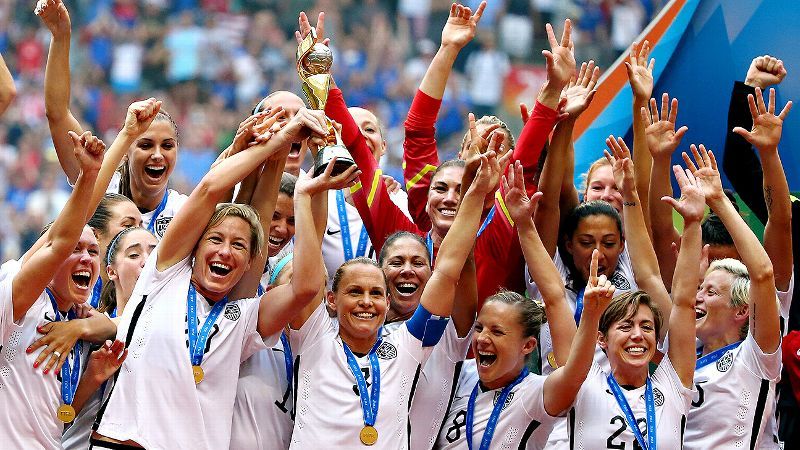
Yesterday, Hope Solo visited my big class at the University of Colorado, Introduction to Sports Governance, and discussed the equal pay issue that is currently the subject of an Equal Employment Opportunity Commission dispute between  a group of US women soccer players and the US Soccer Federation.

In this post I'll discuss what I believe to be the central red herring at the center of this dispute: the idea that differential revenues attributed to men's and women's teams should be used as a basis for the differential compensation of individual athletes under US Olympic sport national governing bodies. Before I proceed, let me emphasize that this post reflects a policy analysis, and not a legal analysis. I'm a policy professor, not a lawyer.

The issues are complex, but let's start with the relevant organizations. The US Soccer Federation is one of 47 organizations in the United States that serve as a "national governing body" for an Olympic sport. USSF exists under US law, the so-called Ted Stevens Olympic Act (or Amateur Sports Act of 1978).  The Stevens Act (here in PDF) created an organizational framework for Olympic sports, centered on the US Olympic Committee and the establishment of national governing bodies for individual sports.

Among the goals of the Stevens Act are:
to obtain for the United States, directly or by delegation to the appropriate national governing body, the most competent amateur representation possible in each event of the Olympic Games, the Paralympic Games, and Pan-American Games.
It would seem fairly obvious that by "most competent representation possible" the law is referring to sporting competence as exhibited in international competitions. We want athletes who are the world's best, who can win tournaments and medals. That is what the Olympics are about and medal counts are, for better or worse, an important criterion in how national governing bodies are judged.

In their pursuit of sporting success, the Stevens Act imposes certain legal requirements on the USOC and national governing bodies, among them:
For the sport that it governs, a national governing body shall provide equitable support and encouragement for participation by women where separate programs for male and female athletes are conducted on a national basis.
This requirement is unambiguous, though lawyers surely will no doubt parse the precise meaning of "equitable support and encouragement." For purposes of this discussion, let's define "equitable support" in financial terms as "roughly equal" with "equal" defined as a mathematical term that can be measured in dollars and cents.

The EEOC complaint filed in 2016 (here in PDF) by several US women soccer players alleges that the compensation for women US national team players "pales in comparison" to that of US men's national team players. The complaint lists a long set of issue for which men and women are compensated differently (at the time of the filing), ranging from the World Cup competitions to daily per diem rates (e.g., men get $75 per day internationally, women get $60).

In a response to the EEOC filing, lawyers for the USSF focused on the relative revenues generated by each team of players as a primary basis for their argument against the complaint. The USSF acknowledges that there may be disparities in pay, but argues that these differences are justified based on differential "production."
. . . to the extent that there are differences in compensation paid to WNT and MNT players, those differences do not establish a violation of Title VII or the Equal Pay Act. Under both statutory schemes, where a payment that differs by gender is being made “pursuant to … (iii) a system which measures earnings by quantity or quality of production[] or (iv) a differential based on any other factor other than sex,” there is, by definition, no violation.
This is important.

The USSF is defining "production" in terms of dollars generated by each team, and not by sporting success. The primary justification offered by USSF for any differences in compensation is: "the greater amount of revenue produced by the MNT."

Further, the players, both men and women, seem to have accepted through their players associations that negotiate collective bargaining agreements governing compensation that revenue should be used as a metric of compensation. The USSF response to the EEOC complaint explains:
With respect to the MNT and WNT, the compensation paid each team is based, in part, on predictions regarding the revenue that each team will generate over the course of the collective bargaining agreement.
The USSF invokes an analogy to make its point:
[A]ssume that Player A and Player B are wide receivers of different races playing for the same professional football team. Suppose further that Player A had consistently produced more yards and touchdowns than Player B, and received a more lucrative contract as a result. The fact that Player B came to outperform the Player A over the term of the contract would not remotely suggest in hindsight that the original contracts were the product of a racially discriminatory motive.
From its response, it seems pretty obvious that the USSF is overseeing the US men's and women's national teams as if they were independent professional franchises. (There are important legal points about employees of the same organization doing the same work, that I won't get into here.)

The professional sports analogy used by USSF is simply misplaced. The USSF is a non-profit which operates under the Ted Stevens Act. While it needs revenues to do its work, such revenues are always to be a means, not an end. Under the Stevens Act (here in PDF) the USOC can provide "financial assistance to any organization or association, except a corporation organized for profit" and "may not engage in business for profit." From a legislative perspective, profits are not the point of Olympic sport.

To the extent that USSF views US national soccer teams as businesses generating profits, and uses those profits as the basis for compensation, it may be in violation of the legislative intent of the Stevens Act governing Olympic sports. Recall that among the legislated goals of a US Olympic sport national governing body are to provide "competent representation" (which means success in the World Cup, the Olympic games and other competitions under the Olympic Movement) and "equitable support and encouragement."

With apologies to Gene Hackman in Unforgiven, revenue's got nothing to do with it.

The relative revenues generated by men's and women's national team should have no bearing on their relative compensation. USSF is not a for-profit business. Soccer players who compete in international competitions produce primarily sporting successes (and losses). The revenues that they generate contribute to support the work of the non-profit, but the revenues should always be viewed as a means to achieving "competent representation." It is worth noting that US Soccer has as much as $140 million sitting in reserve, which dwarfs the size of both the EEOC claim and providing the futureequal compensation.

And crucially, under the law, men's and women's national soccer teams are legally required to be treated equitably from a sporting perspective, with no footnote or clause that says equity can be ignored due to revenues or anything else.

So the bottom line here is that the women soccer players' EEOC complaint is in fact flawed. It is flawed not because they are wrong about equal compensation -- they got that right. The complaint is wrong because it has not gone far enough.

Consider overall investment in men's and women's national teams: The data below come from 2013 and  2014, but they are illustrative.

Whatever the relative profits of the US MNT and WNT, data consistently show that the USSF invests less in the WNT versus the MNT. This disparity would seem to be fundamentally at odds with the legislated objectives of the Ted Stevens Act which governs USSF.

To sum up, issues of equal pay in US Soccer are currently playing out in the legal system. However, with Congress now paying greater attention to USOC and its associated national governing bodies, a more appropriate venue for resolving this issue may be through the legislative process. 

US Soccer is treating the US men's and women's national teams as cost centers that generate profits to justify differential treatment. Not only is this possibly illegal (we shall see in due course), it is all but certainly in violation of the intent of the Ted Stevens Act. 

If athletes also treat the USSF as a professional sport organization, they cede important ground. Consider for instance a court decision in response to a call for dismissal of the EEOC complaint only references the Ted Stevens Act in passing, here in PDF, and proceeds to characterize the USSF as if it were a professional franchise owner.. 

National soccer teams are not professional franchises. Their relative revenues and profits are a red herring. Athletes and their representatives would be on firmer ground if they rejected relative revenues as a legitimate basis for securing athlete payment. USSF is a non-profit under the Stevens Act and is bound to treat men and women equitably. That is the legislated intent of the US Congress and it is time for USSF to be held to that standard.