Wednesday, July 30, 2014

Sports Writing Update

Most of my sports-related writing these days is taking place over at Sporting Intelligence. I just had a piece up on FIFA and the Russian sanctions.
Over the weekend, British deputy prime minister Nick Clegg told the Sunday Times that Russia should be stripped of the 2018 World Cup. Clegg joins several senior German politicians in calling for the next World Cup to be moved as a sanction against Russia for its role in the continuing conflict in the Ukraine. The renewed calls for sanctions have been prompted by the shooting down of Malaysian Airlines 17 over eastern Ukraine, allegedly by Russian-supported Ukrainian separatists.

Does FIFA have a responsibility to engage in global geopolitics? Its history and actions say yes.
I also recently had a piece in the FT on FIFA governance after the World Cup (also here in PDF):
With the final whistle of Sunday’s match between Germany and Argentina, the world’s attention will move away from football for another four years. With it will go the bright spotlight on Fifa, the global body that oversees world football including the World Cup.

Fifa has long been plagued by scandal. In the coming days, it is expected to announce the results of an investigation into bribery allegations surrounding its decision to hold the tournament in Qatar in 2022. History would tell us not to expect much. 
I do expect to be posting more regularly here at The Least Thing when fall starts, as well as continuing regular commentary and analysis at Sporting Intelligence.

Happy Summer!

Wednesday, June 11, 2014

World Cup Prediction Evaluation Competition

16 June UPDATE: This prediction evaluation exercise is now being updated at Sportingintelligence. See it there!

15 June UPDATED: I have updated the Infostrada predictions with a more recent version, thanks to Simon Gleave (@SimonGleave).

The World Cup starts tomorrow. Prognosticators have been hard at work generating their predictions of who will advance and who will win. But which prediction is the best? Is it the one who picks the winner? Or is it the one which best anticipates the knock-out round seedings? How can we tell?

In an ongoing exercise here at The Least Thing I am going to evaluate 10 different World Cup predictions. To do this I am going to quantify the "skill" of each forecast. It is important to understand that forecast evaluation can be done, literally, in an infinite number of ways. Methodological choices must be made and different approaches may lead to different results. Below I'll spell out the choices that I've made and provide links to all the data.

A first thing to understand is that skill is a technical term which refers to how much a forecast improves upon what is called a "naive baseline," another technical term. (I went into more detail on this at FiveThirtyEight earlier this spring.)  A naive baseline is essentially a simple prediction. For example, in forecast evaluation meteorologists use climatology as a naive baseline and mutual fund managers use the S&P 500 Index. The choice of which naive baseline to use can be the subject of debate, not least because it can set a low or a high bar for showing skill.

The naive baseline I have chosen to use in this excercise is the transfer market value of the 23-man World Cup teams from Transfermarkt.com.  In an ideal world I would use the current club team salaries of each player in the tournament, but these just aren't publicly available. So I'm using the next best thing.

So for example, Lionel Messi, who plays his club team soccer at Barcelona and his national soccer for Argentina, is the world’s most valuable player. His rights have never been sold, as he has been with Barcelona since he was a child, yet he’s estimated to have a transfer market value of more than $200 million. By contrast all 23 men on the USA World Cup squad have a combined estimated value of $100 million. (I have all these data by player and team if you have any questions about them -- they are pretty interesting on their own.)

Here then are the estimated transfer values of each World Cup team:

Team Transfer value
1 Spain  $      1,044,960,000
2 Germany  $         944,160,000
3 Brazil  $         803,040,000
4 France  $         691,740,000
5 Argentina  $         657,720,000
6 Belgium  $         584,640,000
7 England  $         561,120,000
8 Italy  $         542,640,000
9 Portugal  $         517,860,000
10 Uruguay  $         364,476,000
11 Netherlands  $         348,600,000
12 Croatia  $         324,660,000
13 Colombia  $         318,931,200
14 Russia  $         308,784,000
15 Switzerland  $         299,040,000
16 Chile  $         234,864,000
17 Cote D'Ivoire  $         202,389,600
18 Cameroon  $         198,072,000
19 Bosnia and Herzegovina  $         192,780,000
20 Ghana  $         183,708,000
21 Japan  $         164,640,000
22 Mexico  $         152,964,000
23 Nigeria  $         145,908,000
24 Greece  $         134,232,000
25 Ecuador  $         105,588,000
26 United States of America  $           97,104,000
27 Algeria  $           96,096,000
28 Korea Republic  $           88,074,000
29 Costa Rica  $           49,980,000
30 Iran  $           41,076,000
31 Australia  $           36,204,000
32 Honduras  $           35,952,000

In using these numbers, my naive assumption is that the higher valued team will beat a lower valued team. As a method of forecasting that leaves a lot to be desired, obviously, as fans of Moneyball will no doubt understand. There is some evidence to suggest that across sports leagues, soccer has the greatest chance for an underdog to win a match. So in principle, a forecaster using more sophisticated method should be able to beat this naive baseline.

Here is what the naive baseline (based on rosters as of June 5) predicts for the Group Stages of the tournament: The final 4 will see Brazil vs. Germany and Spain vs. Argentina. Spain wins the tournament, beating most everyone’s favorite Brazil. The USA does not get out of the group stage, but England does. All 8 of the top valued teams make it into the final 8.

While this naive baseline is just logic and assumptions, work done by “Soccernomics” authors Stefan Szymanski and Simon Kuper indicates that a football team’s payroll tends to predict where it winds up every year in the league table. Payrolls aren't the same thing as transfer fees, of course, but they are related. Unfortunately, as mentioned above individual player salaries are not available for most soccer leagues around the world (MLS is a notable exception).

I will be evaluating 10 predictions over the course of the World Cup. There are (with links to the data sources that I have used, as of 10 June unless noted otherwise):
The predictions are not all expressed apples to apples. So to place them on a comparable basis I have made the following choices:
  • A team with a higher probability of advancing from the group is assumed to beat a team with lower probability.
  • If no group stage advancement probability is given I use the probability of winning the overall tournament in the same manner.
  • This means that I have converted probabilities into deterministic forecasts. (There are of course far more sophisticated approaches to probabilistic forecast evaluation.) 
  • No draws are predicted, as no teams in the group stages have identical probabilities.
  • The units here, in the group stage at least, will simply be games predicted correctly. No weightings. 
Other choices could of course be made. These are designed to balance simplicity and transparency with a level playing field for the evaluation. Just as is the case with respect to the value of having a diversity of predictions, having a diversity of approaches to forecast evaluation would be instructive. No claim is made here that this is the only or best approach (laying the groundwork here for identifying eventual winners and losers).

With all that as background, below then are the predictions in one table (click on it for a bigger view). The yellow cells indicate the teams that the naive baseline sees advancing to the knockout stages, and the green shows the same for each of the 10 predictions. The numbers show the team rankings according to each prediction.
I will be tracking the performance of the 10 predictions against the naive baseline as the tournament unfolds, scoring them in a league table. I'll also discuss the methods and results as well as the sensitivity of the latter to the former. When the Group Stages wind up I'll reset for a second part of the prediction evaluation.

Finally, for now, I welcome any comments on this exercise. If there are other predictions that you'd like to track in the same manner alongside these, please enter them in the comments.

Let the game within the games begin! 

Sunday, June 1, 2014

FIFA has Bigger Problems than Corruption Alone

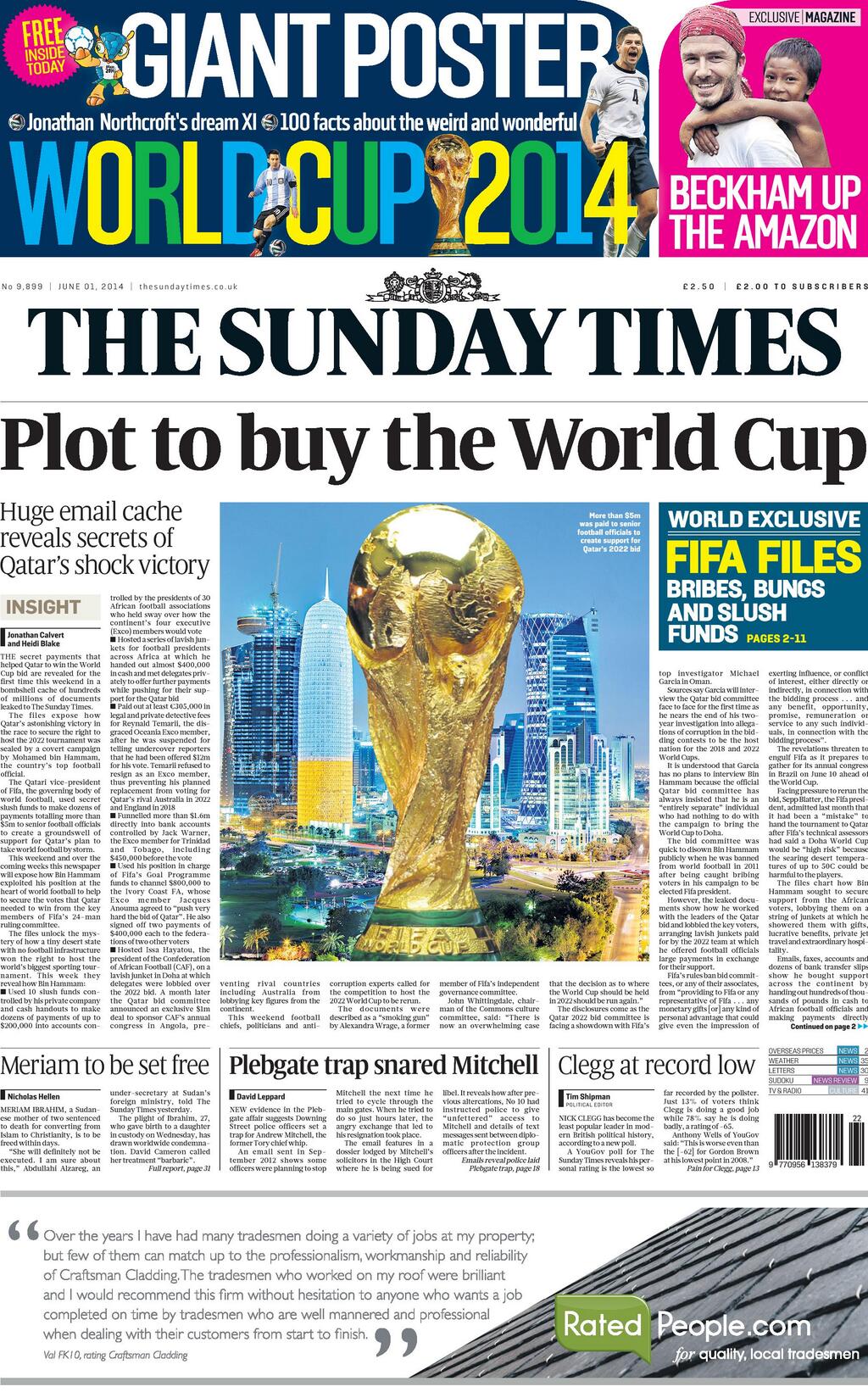
With a big investigation on FIFA being reported by The Sunday Times today (£) I thought I'd repost the commentary below, which appeared earlier this month as a guest post at Soccernomics (Thanks Simon Kuper).

FIFA has Bigger Problems than Corruption Alone

For much of the past four years FIFA, the organization which oversees global football and the World Cup, has been dogged by allegations of corruption and poor management.  In 2011, after two members of the FIFA Executive Committee had tried to sell their votes for future World Cup location to undercover reporters[R1], FIFA felt compelled to respond by setting up an internal reform committee to recommend steps to improve the organization’s governance.

That committee, chaired by Professor Mark Pieth of the Basel Institute of Governance, ended its work last year, and issued a hard-hitting, final report last month.

Like many other international sports governance bodies, the Fédération Internationale de Football Association or International Federation of Association Football, is headquartered in Switzerland. Many international organizations have long found the nation to be a favorable location due to its political neutrality, generous tax treatment and hands-off approach to oversight.

For FIFA, the hands-off oversight has arguably allowed mischief to take root. Among the many scandals that have plagued FIFA, the one getting the most attention today is alleged vote-buying and collusion associated with the awarding of the 2018 World Cup to Russia and 2022 World Cup to Qatar. The decision on who gets to host the World Cup is a consequential one. For instance, Qatar has announced $200 billion in new infrastructure projects [R2] associated with the 2022 World Cup, including 8 new stadiums.

The decision as to which country gets to host the World Cup is made by FIFA’s inner circle, its 25-member Executive Committee. In 2010 FIFA held votes on the awarding of the 2018 and 2022 World Cups at the same meeting. Later, Sepp Blatter, FIFA’s long-time president, admitted[R3]  that there was vote trading across the two votes, and that it was a mistake to have made both decisions at the same time.

But vote trading was the least of FIFA’s troubles associated with the World Cup votes. In February it was revealed that the family[R4]  of a member of FIFA’s Executive Committee in 2010 received $2 million from a Qatari company controlled by a former football official in the months following the vote. On the heels of that revelation we learned that the 10-year old daughter of another member of the FIFA Executive Committee[R5]  has $3 million deposited into a bank account in her name. The funds allegedly came from the (at the time) president of FC Barcelona (home to Lionel Messi), which is sponsored by Qatari Airlines and the Qatar Foundation.

These allegations are cited in Pieth’s final report, which says that the future integrity of the organization depends a great deal on how it responds[R6] : “If FIFA is to emerge from the scandals of recent years it must now produce a convincing and transparent answer to any issues relating to hosting decisions… if allegations are confirmed FIFA must ensure that the consequences are meaningful.“

However, FIFA’s ability to address the World Cup vote scandal may be limited by the fact that most of the recommendations of Pieth’s committee have not been implemented. Further, Pieth observes in his report that “some Members of the Executive Committee have not been sufficiently committed to change.”

In a forthcoming paper I compared the actions taken by FIFA to three reports which made recommendations for steps FIFA should take to improve its governance, as well as to a “good governance” scorecard[R7]  developed by several academics in Switzerland for evaluating international sports organizations.

What I found is in agreement with Pieth’s conclusion that “reform is not yet finished.” In fact, it has a very long way to go. Of the 59 total recommendations in the three reports FIFA is judged to have implemented 7, partially implemented 10 and failed to implement 42. With respect to the “good governance” scorecard, FIFA’s reform effort lifted their score from 55.2% of total possible points to 56.3%. Under each of these metrics, FIFA did not implement the vast majority of recommendations offered by experts in good governance.

For its part, FIFA has hired an investigator, Michael Garcia, a former US federal prosecutor, to investigate. In his report, Pieth says that this process needs to go forward, regardless where it leads: “FIFA and all involved individuals must therefore fully and unconditionally cooperate with Mr. Garcia’s investigation.” However, Pieth also refers to recent media reports of a “plot” among some on FIFA’s Executive Committee[R8]  to remove Garcia as an investigator.

For FIFA, its main problem may not lie in the specific details of the 2010 vote, or even its other scandals, but rather in that it has not yet adopted a strong program of governance reform, in the words of Pieth, in order “to truly reach the standards accepted in the corporate world.”

The stakes involved go far beyond corrupt officials who may be trading votes for money and other favors. For example, Qatar’s 2022 World Cup has faced challenges[R9]  with respect to the timing of the event, which is scheduled to take place during the hottest part of the summer. More significantly, Qatar has faced claims that workers[R10]  who are building the infrastructure for the World Cup, are dying by the hundreds, due to unsafe conditions. Similarly, Russia’s incursion into Crimea has led to international sanctions. Two US Senators are among the voices calling for FIFA [R11] to revisit its 2018 hosting decision.

Whatever actions FIFA may or may not choose to take with respect to Qatar and Russia, one thing seems clear: FIFA’s incomplete reform effort stands in the way of a stronger organization, better able to handle challenges and controversies. FIFA’s ability to effectively govern itself goes well beyond issues of corruption.

* Roger Pielke, Jr. is a professor in the environmental studies program at the University of Colorado. He has been researching sports governance since 2011.
————————————————-
[R1] http://www.baselgovernance.org/fileadmin/FIFA/Final_Report_by_IGC_to_FIFA_ExCo_EN.pdf
[R2] http://gulfnews.com/sport/football/qatar-cuts-2022-world-cup-stadia-from-12-to-eight-1.1322179
[R3] http://news.bbc.co.uk/sport2/hi/football/9387891.stm
[R4] http://www.telegraph.co.uk/sport/football/world-cup/10704290/Qatar-World-Cup-2022-investigation-former-Fifa-vice-president-Jack-Warner-and-family-paid-millions.html
[R5] http://www.telegraph.co.uk/sport/football/world-cup/10775490/Daughter-of-World-Cup-official-had-2m-put-into-account.html
[R6] http://www.baselgovernance.org/fileadmin/FIFA/Final_Report_by_IGC_to_FIFA_ExCo_EN.pdf
[R7] http://www.idheap.ch/idheap.nsf/view/D6156F1EF87ACB07C1257B3900538D87/$File/IDHEAP%20Working%20Paper%201-2013.pdf
[R8] http://www.theguardian.com/football/2014/mar/25/fifa-ethics-investigator-michael-garcia-survives-plot-overthrow-him
[R9] http://www.bbc.com/sport/0/football/25653594
[R10] http://www.theguardian.com/world/2014/feb/18/qatar-world-cup-india-migrant-worker-deaths
[R11]http://www.kirk.senate.gov/?p=press_release&id=1018

Sunday, March 23, 2014

Some News

I'm thrilled to be joining Nate and the excellent team @FiveThirtyEight!

Friday, March 7, 2014

Two US Senators Write to FIFA, Ask for Russia to be Suspended

Two US Senators, Mark Kirk (R-IL) and Dan Coats (R-IN) have written to Sepp Blatter, FIFA president, asking for FIFA to suspend Russia . Here is the letter in full:
March 6, 2014

Joseph S. Blatter
President, Fédération Internationale de Football Association (FIFA)
FIFA-Strasse 20
P.O. Box
CH-8044 Zurich
Switzerland

Dear Mr. Blatter:

In light of Russia’s military occupation of a sovereign Ukraine, we respectfully ask that you urgently convene an emergency session of FIFA to consider suspending Russia’s membership in FIFA, stripping Russia of the right to host the 2018 World Cup, and denying the Russian National Team the right to participate in the upcoming 2014 World Cup in Brazil.

According to Article 3 of the FIFA Statutes: “[d]iscrimination of any kind against a country, private person or group of people on account of ethnic origin, gender, language, religion, politics or any other reason is strictly prohibited and punishable by suspension or expulsion.”

As you know, there is ample precedent for suspending or expelling a FIFA member, such as when FIFA denied the then-Yugoslavia the right to participate in both the 1992 European Championship and the 1994 World Cup.

Since Russia has similarly displayed a brazen disrespect for fundamental principles of FIFA and international law, I hope you will agree that it does not deserve the honor of either hosting the World Cup or participating in one. We ask that a more deserving World Cup 2018 bid should be re-considered instead.

We look forward to your timely action on this matter.

Sincerely,

Senator Mark Kirk

Senator Dan Coats
The action by FIFA in the early 1990s against Yugoslavia only took place after the UN Security Council had voted to place sanctions on the nation.

Tuesday, March 4, 2014

Doping in Sport from PTG 2013


Today in ETHN 3104 we'll be watching selected presentations from PTG 2013, including Pound, Bock, Perikles and Palmer, to conclude our unit on doping in sport.

You can find those presentations in the video above at about

Pound = 1:34
Bock = 1:54
Perikles = 2:43
Palmer = 3:02

Enjoy!

Saturday, February 22, 2014

Some Things I did not Blog on This Week

Here are a few items that caught my eye this week:
Enjoy!

Wednesday, February 19, 2014

Money Predicts in Olympic Hockey

Once again, NHL salaries have proved to offer a tough naive prediction-to-beat for Olympic hockey. The final four are Canada, US, Sweden and Finland. Russia is actually fourth in the NHL money table shown above as compiled by the NHL, but essentially in a tie with Finland.

In Vancouver in 2010 the teams with the higher NHL salaries went 26-4. So far in Sochi, the teams with the higher NHL salaries are 22-4.

Wanna show skill in prediction? Good luck.

Thursday, February 13, 2014

It's a Drag: Those USA Skating Suits

The Wall Street Journal reported earlier today that the disappointing results of the US speed skaters in the Sochi Olympics may originate in the hi-tech suits that the athletes are wearing. This post takes a look at some data to see what it might tell us about the effects of the suits.

The suits are being worn for the first time in Sochi, but that is not the only variable we have to think about. Speed skating takes place at different tracks in different places (and elevations). Athletes have better and worse days and aim to peak at important events (like the Olympics) and so on. So disentangling the effects of the new suits in performance data is not an exact science. But the data can tell us something.

As a starting point, the graph above shows the difference in times for the top 3 finishers in the 500M and 1000M Sochi Olympics long track skating events for both men and women, for the USA and Netherlands. (Note that the 500M times are actually the sum of two 500M races.) The data comes from the excellent speedskatingresults.com and Sochi 2014.

The graph shows that for all 12 USA finishers their times were substantially above their Olympic qualifying times. Netherlands had 5 above their qualifying times and 7 below.

Looking at the graph above you might think that there is good evidence that the suits have slowed down the USA skaters. But it is not so simple. The USA qualifications took place in Salt lake City which is at altitude, and has a notoriously fast track which means faster times.

The graph below shows the same analysis, but compares the difference between times at Sochi and a December, 2013 event in Berlin, the Essent ISU World Cup. Berlin and Sochi have comparable altitudes so that can be factored out. Note that 3 athletes who represented the USA in Sochi did not have relevant times in Berlin, so there are only 9 values shown here for the USA.
Here the data appears a bit more equivocal. However, the USA times in Sochi are on average 0.21 seconds slower than their comparable times in Berlin with only 2 of 9 skaters improving their Berlin times in Sochi, whereas the comparable 9 Dutch times are on average 0.21 seconds faster than their qualifying times (for the median it is +0.15 USA, -0.12 NED).

In a sport where hundredths of a second can mean the difference between winning and losing, clearly something is going on with Team USA. The suits in question have never before been worn in competition and were tested in a wind tunnel on mannequins, not actual people. Rolling out a fancy new innovation for the first time in competition is a big mistake, as was the testing in conditions that were not actually those identical to how the suit would be used. Regardless of the final judgments on the suits, that should be one big lesson from the skaters in Sochi.

What is clear from the data is that Team USA has -- in the 500M and 1000M so far -- under-performed itself. That is, given its past performance it has systematically done worse with respect to time, generally but not universally. Are the suits part of the problem? Is it the meals at the team dinners? Something else?

Perhaps more data from more events will paint a clearer picture, but the evidence collected here leads me to believe that the suits are a leading candidate for the under-performance. No doubt Team USA will get to the bottom of it.

FIFA Scraps ExCo Bonuses

Bloomberg reported last week that FIFA has decided to terminate bonuses for its Executive Committee members:
Domenico Scala, appointed head of a new audit and compliance body in 2012, said executives agreed to scrap the bonuses after he argued that they created a risk of unethical behavior. FIFA, a not-for-profit organization, doesn’t publish compensation details. In its 2012 financial report FIFA said it paid $33.5 million to “key management personnel,” who included the executive board and finance committee.

“FIFA’s executive committee is an oversight and decision-making body, they are not responsible for sales,” Scala said in a telephone interview. “From a governance perspective we don’t want to provide a bonus to people overseeing the operations.”
How much were the bonuses? A 2011 report in Sports Illustrated said that in 2010, a World Cup year, they were 200,000 Euros ($281,000).

I used this info last summer as part of a guesstimate at Sepp Blatter's FIFA salary:
In 2010, if 24 Executive Committee member, minus Sepp Blatter, each made $281,720 then that totals $6,479,560, leaving about $28 million to be allocated among 10 management officials. The average is $2.8 million. If we assume that Sepp Blatter makes twice the average then that would place his salary at ~$6 million per year (or at least, in 2010).

To one significant digit, I'll offer that as a first best guess at Sepp Blatter's salary. Any takers on the over/under?
Now that FIFA is not paying bonuses to its ExCo it looks like it will have about $6.5 million extra dollars. I wonder if that means Blatter will get a raise. We won't know because FIFA does not release its salary information.

Class Assignment - Group Project

Students in ETHN 3104 -- The Governance of Sport -- were given their first big project today. The assignment, due in two weeks, is to come up with a policy recommendation in two different contexts.

The first topic has to do with what I am calling "technological augmentation" in sport and draws upon the case of Oscar Pistorius running in the 2012 Olympics. The two groups with this topic are asked to develop a policy to govern technological augmentation under the Olympic movement.

The second topic focuses on the case of Caster Semenya, the South African sprinter, who was the subject of a gender controversy following the 2009 IAAF championships. The two groups with this topic are asked to develop a policy to govern participation in women's events under the Olympic movement.

Here is what the students are asked to deliver:

A. A <10-paper report on their policy.
B. An executive summary
C. A PowerPoint presentation
D. A 6-7 minute (no more, no less) presentation to the class

There are 2 groups under each topic and I explained to the class that we will collectively evaluate which group comes up with the better policy (and also, what it even means to say that one policy is "better" than another).

The initial readings for these projects are here and I told the students that they will want to go further in their own research. They are a smart and engaged bunch, and I am looking forward to what they come up with!

Tuesday, February 4, 2014

David Epstein on Olbermann


I'm showing the short interview above in class today -- the topic for this week is The Sports Gene by David Epstein.

Monday, February 3, 2014

An Evaluation of the FIFA Reform Process of 2011-2013

My paper on the FIFA reform process has now been submitted -- it is to appear as part of a collection due out this summer before the World Cup.  Here is the abstract:
An Evaluation of the FIFA Reform Process of 2011-2013

Abstract

Following years of allegations of corruption and cronyism, in 2011 FIFA, the Fédération Internationale de Football Association which oversees global football (soccer), embarked upon an ambitious program of governance reform. The process was championed by the organization’s President, Sepp Blatter, and centered on the creation of a new body, the FIFA Independent Governance Committee. This paper evaluates the FIFA reform effort, which came to an end in 2013, drawing upon the well-developed academic literature on policy evaluation and which has been extensively applied to the appraisal of organizations in the public, private and non-profit sectors. A formal evaluation includes three distinct parts: goals to be achieved, metrics of attainment with respect to goals and data with respect to the metrics. A first evaluative perspective on goals and metrics considers the overall reform effort according to criteria drawn from (a) recommendations for reform commissioned by FIFA by an outside governance expert, (b) recommendations for FIFA governance reform put forward by Transparency International, an external governance watchdog, and (c) recommendations put forward by the FIFA IGC. A second evaluative perspective focuses on the performance of the FIFA IGC as an advisory body, applying more general criteria distilled from appraisals of advisory bodies across sports governance settings. The evaluation concludes that FIFA has taken some small steps towards improved governance, but that much work remains. The paper concludes by presenting broader recommendations for governance reform efforts within FIFA.
If you have followed this blog, my commentaries at PTG or my presentation there, then there won't be much new here, but it does pull all that together in a single paper.

Anyone wishing a copy of the paper can email me: rpielkejr at gmail.

Wednesday, January 29, 2014

Northwestern Athletes Petition to Unionize

Yesterday in my course, The Governance of Sport, the topic was concussions in the NFL. A lot of the discussion migrated to the implications of concussion risks for college and high school athletes. As soon as class was over I saw the ESPN Outside the Lines report that Northwestern athletes had petitioned to unionize. Not only is this perfectly timed for my class (Thanks Wildcats!) but a huge deal for the NCAA and college athletics.

ESPN reports:
For the first time in the history of college sports, athletes are asking to be represented by a labor union, taking formal steps on Tuesday to begin the process of being recognized as employees.

Ramogi Huma, president of the National College Players Association, filed a petition in Chicago on behalf of football players at Northwestern University, submitting the form at the regional office of the National Labor Relations Board.

Backed by the United Steelworkers union, Huma also filed union cards signed by an undisclosed number of Northwestern players with the NLRB -- the federal statutory body that recognizes groups that seek collective bargaining rights.

"This is about finally giving college athletes a seat at the table," said Huma, a former UCLA linebacker who created the NCPA as an advocacy group in 2001. "Athletes deserve an equal voice when it comes to their physical, academic and financial protections."

Huma told "Outside The Lines" that the move to unionize players at Northwestern started with quarterback Kain Colter, who reached out to him last spring and asked for help in giving athletes representation in their effort to improve the conditions under which they play NCAA sports. Colter became a leading voice in regular NCPA-organized conference calls among players from around the country.

"The action we're taking isn't because of any mistreatment by Northwestern," Colter said. "We love Northwestern. The school is just playing by the rules of their governing body, the NCAA. We're interested in trying to help all players -- at USC, Stanford, Oklahoma State, everywhere. It's about protecting them and future generations to come.

"Right now the NCAA is like a dictatorship. No one represents us in negotiations. The only way things are going to change is if players have a union."
Reactions have been quick.  The NCAA issued a terse press release:
This union-backed attempt to turn student-athletes into employees undermines the purpose of college: an education. Student-athletes are not employees, and their participation in college sports is voluntary.
Northwestern University took a similar line but acknowledged the legitimacy of the athletes' concerns:
We love and are proud of our students. Northwestern teaches them to be leaders and independent thinkers who will make a positive impact on their communities, the nation and the world. Today's action demonstrates that they are doing so. . . Northwestern believes that our student-athletes are not employees and collective bargaining is therefore not the appropriate method to address these concerns. However, we agree that the health and academic issues being raised by our student-athletes and others are important ones that deserve further consideration."
The Northwestern football coach, Pat Fitzgerald, offered support for his players via Twitter:
So what happens next? Legal expert Michael McCann tells SI.com:
The next step is the NLRB will require that at least 26 of the 85 scholarship players on the Northwestern football team have joined this petition. In order to unionize, there must be at least 30 percent of the group that’s trying to unionize. It sounds like that’s not going to be an issue.

The harder step after that is for the NLRB to assess whether or not student-athletes are, in fact, eligible to unionize. That’s a complicated issue. It doesn’t have an easy answer. The reality is the NLRB will look at what’s called the National Labor Relations Act. It’s a federal law that basically determines whether a group can unionize.

There will be legal challenges, as well, and it’s worth emphasizing that this is not an overnight process. It could take months if not years to play out. But the key issues will be whether or not a student-athlete, especially a football player at a Division I school, is more like an employee than a student.
McCormick and McCormick (2005, PDF) provide an excellent overview of the athlete-as-employee issue, and decidedly come down on the side of athletes as university employees. They conclude:
To call NCAA Division I athletes in revenue-generating sports amateurs is farcical. The NCAA’s droning insistence on labeling them "student-athletes” is done simply to shore up the fiction that they are something other than employees. NCAA rules, promulgated by the university-employers themselves, bar these athletes from earning compensation representing their true worth. Unaware of their market value, constrained by NCAA strictures, and raised in the myth of the student-athlete, they enter into servitude by the thousands every year. Thus, this fiction has worked to convince even the players themselves to bask in the bright, but brief, glow of their status as campus heroes, and has nurtured their unrealistic dreams of glory, obscuring the reality of their exploitation.

The power of myth is undeniable. It has served the economic interests of the NCAA and many other participants in major college sports richly. But the power of the law is also great, and a society that respects the law looks through the myth and the propaganda to facts. The rule of law eschews a “tyranny of labels” and seeks truth. And the truth is that these athletes are employees under the law.
McCann explains to SI.com that a quirk of labor laws in the US means that unionization means different things at public versus private universities:
The National Labor Relations Act, which the Northwestern players are using, does not govern employees at public universities. Student-athletes at public universities who want to join Northwestern in the union effort would have to instead use state labor laws to unionize. This will be a problem for some. States’ laws vary considerably on whether, and how easily, public employees can unionize. Twenty-four of the 50 states are considered “right-to-work” states in that their laws limit opportunities for employees of public institutions, including those employed by state universities, to unionize. Right-to-work states are typically in the south and include Alabama, Arkansas, Georgia, Mississippi, Tennessee, Texas and Virginia. Nebraska, Utah and Iowa are also right-to-work states.

This legal twist means that if college athletes want to be in a union, they need to attend schools where unions not only exist but are possible under the law. In theory, this dynamic could disadvantage public universities in right-to-work states while recruiting high school athletes: If those athletes want to be in a college sports union, they may not be able to do so at public universities in right-to-work states.
What if unionization (and pay/benefits) becomes viewed as a perk by athletes in the recruiting process? Hello Northwestern and Stanford, goodbye Aubrun and Alabama?

McCann sees a snowball effect possible:
I think we’ll see other schools do this. They’re smart, the folks that are doing this. I’m speculating, but I think there will be a trickle effect. I suspect every couple of weeks, we’ll see a new school join. That’ll revisit this topic over and over again, and it’ll give the impression that there is growing support for it.
Stay tuned, lots to come.

Monday, January 27, 2014

An Independence Scorecard for the NFL Head, Neck and Spine Committee

This week my course on "The Governance of Sport" is discussing League of Denial by Mark Fainaru-Wada and Steve Fainaru. The Fainaru brothers document a systematic effort by the NFL to co-opt experts who downplayed the risks of concussions to football players.

They explain that in 1994 the NFL set up an expert advisory committee, the Mild Traumatic Brain Committee, which was compromised from the start:
[NFL Commissioner Paul} Tagliabue's concussion committee was made up entirely of NFL insiders. Nearly half the members were team doctos, the same men who had been sending players back on the field for years. .  . Before the MTBI committee had puiblished a word of scientific research, it had staked out a position as a defender of the NFL.
With the NFL presently being sued over its role in downplaying the risks of concussions, you'd think that it would have cleaned up its advisory process to meet higher standards of expert advice. Indeed, the NFL revamped its committee in 2010, installing new co-chairs and renaming it the Head, Neck, and Spine Committee.

The NFL explains:
As part of its ongoing efforts to protect and support the health and safety of its players, the NFL has established several health committees to advise Commissioner Goodell, the NFL and the 32 teams of the NFL on health-related issues, policies, research and programs. These committees are comprised of independent experts from relevant scientific and medical fields who serve as volunteers.
One of the co-chairs, Dr. Richard Ellenbogen of the University of Washington, also touts the committees lack of conflict of interest:
I should note, neither Hunt Batjer or I [committee co-chairs], and no member of our committee, is paid. We have no conflict of interest, we declare this at the National Institutes of Health every time we apply for a grant. Since we get no money for doing this, we’re in the most enviable position of all, which is we can tell the NFL and the commissioner the truth, all the time, every day.
What is a "conflict of interest," anyway? A committee that I participated on several years ago used the definition accepted by the National Academy of Sciences in the context of expert advisory committees (here in PDF):
The US National Academy of Science uses this definition: “The term ‘conflict of interest’ means any financial or other interest which conflicts with the service of the individual because it (1) could significantly impair the individual’s objectivity or (2) could create an unfair competitive advantage for any person or organization….[Conflict] means something more than individual bias. There must be an interest, ordinarily financial, that could be directly affected by the work of the committee. Conflict of interest requirements are objective and prophylactic. They are not an assessment of one’s actual behavior or character…."
What role should individuals with a conflict of interest have on an expert advisory committee? We explain:
The desired norm . . . should be to appoint advisory committees whose members are free of conflicts of interest. (Relevant experts who have conflicts could still make presentations to a panel.)
Even FIFA recognizes what it means to have "independent" advisors:
 [An advisor]  shall not be considered independent if, at any time during the four years preceding his term, he or any family member (spouse, children, stepchildren, parents, siblings, domestic partner, parents of spouse/domestic partner and siblings and children of domestic partner):
  • held any paid position or material contract (directly or indirectly) with FIFA and/or any Member, Confederation, League or Club (including any of their affiliated companies/organisations);
  • was employed by FIFA’s outside legal counsel or by FIFA’s auditor (and was engaged in auditing FIFA);
  • held any paid or voluntary position with a non-profit organisation to which FIFA and/or any Member, Confederation, League or Club makes annual payments in excess of USD 100,000.
Let's apply the criteria of "independence" recommended by FIFA and the US National Academy of Sciences to the NFL's current membership of its Head, Neck, and Spine Committee.

With just a cursory examination it is easy to see that there are at least 8 (of 34 members) who are not independent and would be judged to have a conflict of interest, as defined by the NAS. They are:
* Ronald Barnes, Senior Vice President of Medical Services, Head Athletic Trainer, New York Giants
* T. Pepper Burruss, Head Athletic Trainer, Green Bay Packers
* Henry Feuer, M.D., FACS, Associate Professor of Neurosurgery, Indiana University School of Medicine; Member, Indiana Spinal Cord and Brain Injury Research Fund Board; Team Neurosurgeon, Indianapolis Colts; Co-Medical Director, Indiana Sports Concussion Network
* Richard Gliklich, M.D., President, Quintiles Outcome, Inc.
* Merril Hoge, Former Player; ESPN Analyst
* Thom Mayer, M.D., Medical Director, Studer Group; Medical Director, NFL Players Association; Founder and CEO, BestPractices, Inc.
* Joseph Skiba, Equipment Director, New York Giants; Member, NFL Injury and Safety Panel, Foot and Ankle Subcommittee
* Anthony Yates, M.D., FACP, Clinical Assistant Professor of Medicine, University of Pittsburgh School of Medicine; Co-Director, Corporate Health Program, University of Pittsburgh Medical Center; President, NFL Physician Society; Team Physician, Pittsburgh Steelers
A more comprehensive evaluation may identify others.

Long story short: The NFL's Head, Neck, and Spine Committee does not come as advertised, nor does it meet basic standards of independence and standard guidelines for managing conflicts of interest.

Friday, January 24, 2014

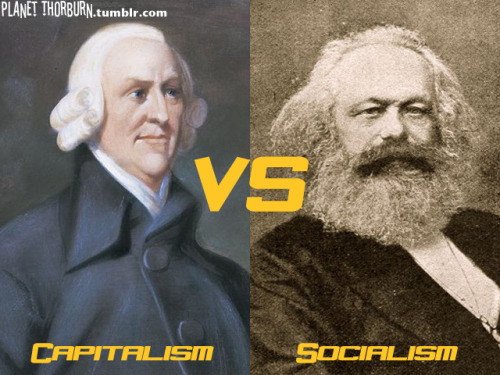
Capitalist Europeans vs. Socialist Americans

Conventional wisdom of course is that Europe is populated by redistributing socialists and America by greedy capitalists. In sport, such stereotypes don't hold so well, as Stefan Szymanski relates in a great essay at CNN.

American sport:
The American model works like this. A collection of businessmen agree to found a league, each operating a franchise which is responsible for managing a team, securing a stadium and selling tickets.

The league, meaning owners operating as a committee, manage several important issues centrally. Typically, the broadcast rights are sold collectively, and often the merchandising rights too, with the money to be equally shared between the teams.

Visiting teams may be given a share of the gate. The league negotiates centrally with a players' union, fixing both minimum and maximum salaries.

No club is allowed to spend too much more than anyone else, and the weakest teams are typically rewarded with the first choice of new players entering the league (the draft).

In essence, the league is run as a kind of socialist collective by the franchise owners. And this model has been colossally successful in generating profits over the last 50 years.

In 2012 a study by WR Hambrecht estimated the market value of the four major leagues (NFL, MLB, NBA, NHL) at $67 billion. Collectivism seems to work.
European sport:
Sports in Europe is dominated by soccer, which operates under a completely different business model.

From an economic perspective there is free entry, in the sense that anyone can start a team and enter at the lowest league level, and then work their way to the top purely on sporting merit.

This is because each league in a given country is connected to every other league through the promotion and relegation system. This specifies that at the end of the season the worst performing teams (in sporting teams) and sent down to play in the next league down (relegation), whose best teams replace them (promotion).

This fluidity promotes a kind of cutthroat competition, where collective agreements are very limited. The threat of relegation means that the strong are not willing to share with the weak.

Perhaps surprisingly, the European model is one of pure capitalist competition, red in tooth and claw. Profitability is very low.

According to a study published by UEFA, the European governing body of soccer, in 2012, out of 700 clubs operating in the top divisions in European countries, 63% reported an operating loss, 55% reported a net loss, 38% reported negative net equity and auditors raised "going concern" doubts in 16% of cases.

European leagues are also highly unequal in sporting terms, with a handful of clubs dominating competition at both national and European level.
The different models also say something about income inequality more generally. Read the whole essay here.

Wednesday, January 22, 2014

An Athlete's Perspective on the Ineffectiveness of Drug Testing


I met Walter Palmer (@PalmerUNIsport) at Play the Game 2013 in Aarhus. Walter is a former NBA basketball player and currently with UNI Global Union, a Switzerland-based association of trade unions which represents skilled workers.

Walter has some very thoughtful views on the impacts of doping regulations on the rights of athletes. He outlined some of these views in a recent Twitter exchange. At the top of this post you can see Walter speaking at Play the Game 2013 (his talk starts at 3:02:20 in the video above).


Tuesday, January 21, 2014

Literacy and Academic Freedom at UNC

It is hard to know what to make of the ongoing scandal that has enveloped the University of North Carolina. The university has already made a name for itself by hosting "phantom courses" for athletes. Now research conducted by a member of the academic support staff for athletics is the subject of controversy. It sure does appear that UNC has made some major errors on this issue.

The latest problems for UNC started with a CNN interview of Mary Willingham, a "learning specialist" who works at UNC with the academic support group which works with athlete. Willingham released some information in that interview:
As a graduate student at UNC-Greensboro, Willingham researched the reading levels of 183 UNC-Chapel Hill athletes who played football or basketball from 2004 to 2012. She found that 60% read between fourth- and eighth-grade levels. Between 8% and 10% read below a third-grade level.

"So what are the classes they are going to take to get a degree here? You cannot come here with a third-, fourth- or fifth-grade education and get a degree here," she told CNN.
A bit more detail can be found in Willingham's declaration provided against the NCAA in the ongoing O'Bannon case (here in PDF):
I have also reviewed data that is consistent with my experience. During the last  decade at UNC, where I have obtained permission from the institutional review board to collect  data for research purposes, the majority of our football and basketball players have entered the institution woefully underprepared for the classroom. At UNC, we routinely tested for learning disabilities any athlete who attended a 2nd summer school session before the first year. Of the 182 athletes screened between 2005 and 2012, a great majority (85%) come from the profit sports, although several teams are represented in the group. About 60% (110) of these athletes had reading scores below the 50% range—constituting 4th-8th grade reading levels. More than a dozen, 8-10%, were functionally illiterate, and 39% were found to be learning disabled and/or have attention deficit hyperactivity disorder.
Willingham says more generally:
The college football and basketball players that I worked with sometimes earned a degree, but they did not get an education. They simply did not have equal access to a real education because the academic experience for athletes is separate and unequal.
The response of the university to the CNN report -- which apparently is not the first time that officials learned of her research -- is remarkable. The University's IRB rescinded approval for her work. The UNC Provost said, "Using this dataset to say our students can’t read is a travesty." The response has been to attack Willingham.  Frank Baumgartner, a political scientist said of the university's reaction, "“What I see unfortunately so far is a strategy of denial.”

The News & Observer, a local paper, struck exactly the right tone in an editorial:
At a time that demands that forthright leadership get to the bottom of the scandal involving athletes and no-show classes, UNC’s leadership is getting it all wrong. Instead of listening to whistle-blower Mary Willingham, the university has tried to discredit her, challenging the accuracy of her research into some athletes’ low literacy levels and suspending her research as a possible threat to student privacy.

Provost Jim Dean said Willingham did not have permission from the UNC research review board to use data that might identify students. He said Willingham’s research was flawed and her conclusions “virtually meaningless.” Chancellor Carol Folt broke her silence on the scandal by saying the data compiled by Willingham did not match what university officials see in athletes’ records.

Men’s basketball coach Roy Williams challenged Willingham’s claim that one of his previous players was illiterate. “I don’t think it’s true, and I’m really, really bothered by the whole thing,” he said.

Willingham, a learning specialist in the UNC athlete tutoring program from 2003 to 2010, offered to show the coach proof of her claim, but Williams said speaking with her wasn’t his role.

Willingham, who now works at the UNC Center for Student Success and Academic Counseling, first disclosed her concerns about academically struggling athletes and bogus classes to The News & Observer in August of 2011 and went public in a Nov. 17, 2012 N&O story. She further stirred the scandal when she discussed athletes poor reading skills in a recent CNN report. Her claims are hardly new, so why is UNC-CH’s leadership responding with shock, denial and disbelief?
This issue still has lots of room to run, but it does seem clear that UNC has made some major missteps.

Sunday, January 19, 2014

FIFA Presidency 2015: The Campaign Begins


The campaign for the presidency of FIFA is off to an early start, with the election not until 2015. James Montague reports for the New York Times:
Jérôme Champagne has spent most of his career in soccer behind the scenes, quietly operating in the shadows with little fanfare or credit. But on Monday, Champagne, a Frenchman who once served as FIFA’s deputy general secretary, is set to become front-page news in Switzerland and beyond.

At a news conference in London, Champagne plans to announce his candidacy for the presidency of FIFA, soccer’s global governing body. That would be the first open challenge to FIFA’s longtime president, Sepp Blatter. Champagne also will unveil several initiatives that he contends would boldly reshape and democratize soccer’s governing body.

“I won’t say that if I am elected, I would not face any hurdles; I would face a lot of hurdles,” Champagne said of the intense spotlight that comes with the job, and sometimes merely the pursuit of it.

“But it is a privilege to run for president,” he added. “It is not a job. It is a mission.”
You can see Champagne speaking on the future of FIFA in the video above (from the 2013 EASM conference in Aalborg, he is the first speaker after the introductions).

Late in 2011 Champagne released a manifesto for FIFA reform which foreshadowed his announcement. The 25-page document can be found at Play the Game, here in PDF.
Interestingly, in 2013 FIFA modified its statutes to make it extremely difficult for candidates to run for president. The image above shows the changes that were made (source: here in PDF). Five member associations (of 209) are required to offer support of the candidate, with a requirement to do so in writing. This means that any organization must "out" itself as potentially not being in support of the incumbent, and with FIFA's hostory of patronage, this exposes the members to possible retribution.

As there is no apparent limit on how many candidates a member association can support, it would be a wise move for any member association to express written support for the incumbent to appear on the ballot in addition to any other alternative candidate.

A second requirement is that the candidate come from within the ranks of FIFA (or have been a player). While there is considerable ambiguity as to what it means to have been a "Player," the requirement that the candidate come from within FIFA is essentially a guarantee that the organization will be protected from outside thinking and agents of change.

As FIFA is a big business with deep governance troubles one might think that FIFA would welcome outside experts looking to aid the organization into the future. Not so. If the 2015 election comes down to a contest between Blatter, Platini and Champagne, then FIFA's comical inbreeding will be set to continue.