Wednesday, June 12, 2013

The BCCI's "Operation Clean Up": Governance not Cheerleaders

The Board of Control for Cricket in India (BCCI) has announced a 12-point plan to address the fixing scandal that threatens the Indian Premier League. First, some background courtesy of the WSJ:
Shoving a towel into their waistbands, fiddling with a necklace, untucking their shirts; these are signals that investigators allege three Indian cricketers used to communicate with bookmakers across India in an attempt to fix parts of matches for illicit financial gain.

Delhi Police said Thursday they had arrested three players from the Rajasthan Royals cricket franchise for allegedly spot-fixing—trying to arrange a predetermined outcome in certain key moments—in the Indian Premier League. The league is a hugely popular annual tournament involving many of the best cricketers from

Spot fixing in cricket occurs when a player deliberately rigs part of the game, for example by bowling a poor delivery from which a batsman can easily score runs. Several high-profile international convictions have tarnished the sport in recent years, which resulted in fines, player bans and even jail time.
The scandal has already led the head of the BCCI, which oversees cricket in India, to step aside. The BCCI 12-point plan is a further response to the scandal.

The 12-point plan is as follows:
1. Removal of sleaze; no cheerleaders, no after-match parties for players and support staff.
2. Strict code of conduct to be followed by players, support staff and franchise owners.
3. Restriction of movement in players’ dug-out and dressing room. The owners from now on will be restricted from entering the dug-out and dressing room during matches.
4. All players and support staff of franchises need to furnish their telephone numbers with the BCCI before the start of the tournament.
5. Adequate number of ACSU officials in the team hotel as well as the ground to supervise the proceedings.
6. Jamming of cell phone towers at the ground during matches.
7. Captains’ meeting to be held in order to get more suggestions and prepare elaborate blueprint.
8. No national selector will be allowed to get associated with any franchise in any capacity.
9. All the players need to disclose every financial transaction they are carrying out with any particular organisation or person.
10. Franchises need to furnish all details of the remunerations and contractual obligations of players and support staff.
11. Players from now on will be prohibited from using ear plugs and microphones.
12. Security control policy will be formulated soon.
These proposals range from the farcical (no cheerleaders as a way of addressing fixing?!) and the just plain dumb ((jamming of cell phone towers?) to the profoundly innovative (player disclosure of financial transactions). Journalists, professors (me included) and politicians routinely have to disclose remuneration which falls outside of their professional contracts. Why not athletes?  In the US the NFL has already adopted a similar set of policies.

Reform is likely going to have to go deeper. In a 2011 submission to an inquiry on governance of the International Cricket Council, Transparency International made recommendations for the harmonization of governance standards across ICC member federations. These were as follows:
30. The ICC should require, as a condition of membership, that domestic boards have in place codes of conduct and procedures that reflect the global best practice that TI recommends ICC itself puts into place.

This would include:

• Tone from the top and ethical leadership
• Code of ethical conduct covering all relevant areas including conflicts of interest
• Risk assessment
• Best-practice policies and procedures and their independent monitoring and review
• Creation of an Anti-corruption Tribunal at domestic level to hold individuals and organisations to account, if existing anti-corruption mechanisms are inadequate.

31. All of the above would need to be underpinned by greater transparency and independence, with the ICC having oversight of each domestic board’s adherence to these requirements. The ICC should be able to review whether domestic boards are adhering to these codes of conduct and procedures, and should have strong sanctions, including financial sanctions, available to it if member countries’ boards or federations are judged to have infringed the rules. For example, ICC should be empowered to exclude a member nation from competing in international matches if fails to adopt and enforce an approved Anti-Corruption Code in its own jurisdiction.

32. This will undoubtedly represent a significant change in the governance of world cricket, and inertia or vested interests may cause there to be opposition. However, TI considers it vital that if a message of zero tolerance for corruption is going to be taken seriously, the managers, administrators and leaders of the game operate to the highest standards of ethics and integrity.
As with FIFA and its various scandals, effective reform will necessarily result from the adoption of standards of good governance and best practices which have been developed in contexts outside of sport. So far, FIFA has been resistant. Perhaps the BCCI and ICC can do better. To do so, however, it is probably best to focus on the governance, not the cheerleaders. 

Financial Fair Play, the English Language and Legal Standing

At Capital.de Stefan Szymanski has a delightful essay on the offense to the English language that is UEFA's Financial Fair Play. Stefan has kindly posted up the original English version at Soccernomics. Here is an excerpt:
Whenever Financial Fair Play is mentioned the names of Roman Abramovitch and Sheikh Mansour are quoted- what they are doing to football, it is alleged, is unfair. Yet in reality they are convenient scapegoats for a political deal that UEFA has stitched up between football’s rich and poor.

The economic reality is that most clubs do not have a sugar daddy and a very large fraction are insolvent. According to UEFA 55% of clubs in Europe’s top divisions reported a net loss in 2011, 38% of clubs reported negative net equity, and 16% of club accounts reviewed contained a qualification expressed by the auditors as to financial viability of the company. This does not make UEFA look like a good housekeeper, so they want to impose tighter regulations. However, since almost all of the insolvent clubs are minnows, it might look as if they were doing the bidding of the big clubs. UEFA would not dare to restrict the freedoms of the established powers and by focusing on sugar daddies they are actually helping them by ensuring that no currently small club will ever pose a serious challenge. Voila, call it Financial Fair Play, and who could disagree?

This was Orwell’s point. The decline of English, he thought, was a political phenomenon. “Political language has to consist largely of euphemism, question-begging and sheer cloudy vagueness”, and if we allow this to go unchallenged we will indeed fall into slovenly thought. UEFA, with the support of many politicians, want us to use warm phrases emptied of their original meaning as camouflage for the pursuit of an agenda which has little to do with fair play and much to do with the exercise of power. But if we listen to Orwell, we need not be fooled. All we have to do is to ask what the words really mean.
It is safe to conclude that Szymanski is not a fan of FFP. Here is the conclusion of a recent academic that Sztmanski collaborated on with Thomas Peeters, which explored the effects of FFP on the EPL via an economic model (Vertical Restraints in Soccer: Financial Fair Play and the English Premier League, here in PDF):
[W]e find that had the Financial Fair Play regulations applied fully in the English Premier League in the 2009/10 season, wage to turnover ratioswould have fallen by as much as 15%, which is in line with the theoretical predictions of Dietl et al (2009). As such, the FFP break-even rule will in many ways resemble a North American salary cap, although the latter applies the same spending cap to all teams. In other words, our paper shows that in this context a vertical restraint may restrict competition in exactly the same way as a horizontal agreement between competing firms. Salary caps have been justified in US courts under the theory that they promote competitive balance among the teams. On top of this, they are agreed upon in a system of collective bargaining with unions representing the players, and such agreements are exempt from antitrust. The break-even rule under FFP has not been negotiated as part of a collective bargaining agreement with unions, and furthermore such agreements are not exempt from competition law in the EU. Therefore, analyzing the impact of FFP on competition in national leagues is important to assess whether it complies with EU competition law.

The rationale advanced by UEFA for its regulation is not the promotion of competitive balance, but “discipline and rationality” in club finances. Considered as a vertical restraint, this might be deemed to have pro-competitive properties if the rules help to preserve the integrity of the competition and the financial stability of the clubs. On the other hand, our results demonstrate that the break-even rule could be construed as a means to raising profitability and therefore an anti-competitive vertical restraint under EU competition law.
The Swiss Ramble recently offered a deep dive into the economics of FFP, and like Szymanski, offers a fairly negative evaluation:
While the majority of clubs are in favour of FFP’s attempts to tackle football’s economic woes, there is a concern that far from making football fairer, all this initiative will achieve is to make permanent the domination of the existing big clubs: survival of the fattest, if you will. The argument goes that those clubs that already enjoy large revenue (like Real Madrid, Barcelona, Manchester United and Bayern Munich) will continue to flourish, while any challengers will no longer be able to spend big in a bid to catch up.
However, more fundamental than the policy effectiveness of FFP is likely to be its legality under European law. The regime has already been challenged, here is The Guardian reporting:
UEFA's financial fair play regulations face a legal challenge in the European courts after a players' agent argued the rules will unfairly restrict the amount of money he can earn. Daniel Striani, an agent registered in Belgium, has lodged a formal complaint with the European commission against the rules, which require clubs in European competitions from 2011 to move towards breaking even financially.

Striani is represented by Jean Louis-Dupont, a lawyer who in 1995 successfully challenged football's contract rules on behalf of a Belgian player, Jean-Marc Bosman, a legal victory which allowed players to move for free at the end of their contracts. Dupont argues that, as in the Bosman case, he will defeat Uefa's FFP rules even though they are supported by the European Commission.

He argues that Uefa's regulations, which prevent clubs making heavy financial losses whether backed by an owner or not, will have five separate consequences he claims are anti-competitive. The first is that they will restrict investment in a club by no longer allowing them to run at a loss.

The second is the key concern being voiced particularly in England, that it will lock in the power of the already rich clubs, whose dominance will no longer be able to be broken by the odd club like Manchester City or Chelsea which has losses supported by a mega-rich owner.

He then argues that the aim of FFP to dampen down players' wage and transfer fee inflation is "anti-competitive", a breach ofEU law. This is because FFP will lead to a "reduction of the number of transfers, of the transfer amounts and of the number of players under contracts per club", and will have a "deflationary effect on the level of players' salaries".

In conclusion, Striani argues that FFP will be "anti-competitive" because it will affect his own ability to earn agents' fees from players' wages and transfer fees.
Stay tuned, more action to come at the lex sportiva frontier!

Sunday, June 9, 2013

The Iran Job


I saw The Iran Job on my flight back from London last week. It is a really neat documentary about US basketball player Kevin Sheppard's journey to Iran to play basketball (Sheppard also has the distinction as being capped for the US Virgin Islands football squad).

Here is an excerpt from a Washington Post article on the film:
Iranian teams offer lavish salaries to foreigners willing to play there, and every year a handful of Americans are scattered through the country’s basketball league. The idea for the film was to find an American “who would go into Iran with a lot of the same perceptions and misperceptions as a lot of us,” said Till Schauder, who wrote, produced, directed and shot it.

Sheppard, born in the U.S. Virgin Islands in 1979 — the year that Iranians staged a revolution and occupied the U.S. Embassy in Tehran — fit the bill. He said he knew little about Iran before going there.

In the film, Sheppard teaches the Iranians how to raise the level of their play and pump themselves up, and the Iranians teach him about Persian politeness and subtle ways of circumventing government oppression.

Along the way, Sheppard’s views on Iran evolve. “I had all the preconceptions that people were on camels, that they were terrorists, that they were probably making bombs,” he said in a telephone interview from the Virgin Islands, where he runs a basketball camp for disadvantaged youths.

Instead, he finds teammates who confide in him about girl troubles and refuse to let him pay for dinner. He meets women who express their frustration with state-imposed restrictions and young fans who shyly ask for his do-rag as a memento.

Sheppard said he hopes the film, expected to be released next year, will alter U.S. perceptions of Iran at a time when diplomacy is at a low. “I think that once you get an opportunity to see it, you must have a change of heart about the Iranians because you’re going to see real live people, with real lives and real struggles,” he said.

The film is full of funny moments, such as when Sheppard enlists his baffled building manager to help him find a Christmas tree, or when an elderly man selling antiques eagerly tells Sheppard that he smoked marijuana in the United States.

Schauder and his wife and co-producer, Sara Nodjoumi, who is of Iranian descent, said an Iranian government official was initially supportive but then abruptly changed his mind and told them the project was “garbage.” They were denied journalist visas, so Schauder, a German citizen, went on a tourist visa and shot with a small hand-held camera. Eventually authorities caught on, and he was barred from entering Iran. By then, he had shot most of the film.

Despite rising tensions between the United States and Iran, Sheppard said he never had a problem on either end during the two additional seasons he went on to play there. Entering Iran, “I would say, ‘Bazi [play] basketball!’ and they say, ‘Great!’ and let you go. It’s like athletes transcend political pressures. We’re entertainers; we kind of take them away from the problems.”
It is due to be out in the US soon. Check it out, highly recommended.

Thursday, June 6, 2013

Technology Aids in Referee Decision Making

Over at the Guardian's Political Science blog I have a commentary up extolling the use of technological aids in referee decision making. I open the piece as follows:
Writing in Nature last week, Nic Fleming argues that "the introduction of goal-line technology to football is likely to perpetrate a mass deception on television viewers." He further worries that, "It will miss a huge opportunity to educate people about the role of uncertainty in science. And it will exacerbate the approaching danger of fake computer-generated video footage."

Here I take the other side. People, especially the sports-viewing public, understand uncertainties just fine. Contrary to Fleming's concern, the opportunities that may actually be missed here include the chance to educate scientists that the public are far more sophisticated than experts generally believe, and the fact that the introduction of technological aids may actually make sports better.
Have a look at both Fleming's Nature piece and my reaction. Is there a dangerhere related to public understanding of uncertainties? I don't think so, but I welcome hearing other views.

Several people have mentioned the Collins/Evans papers on the use of the Hawkeye system in tennis and cricket. I included a link to them (thanks to a suggestion by @AliceBell), though I only agree with parts of their argument.

The parts that I agree with have to do with the central-ness of of legitimacy derived through an alignment of outcome as judged by the officials and as judged by the spectators (this is my jargon, Collins and Evans have their own). I also agree with their conclusion that such technological aids offer much in the way of positive benefits to decision making in sport.

The parts that I disagree with focus on the supposed new-ness of technologies in sport and a corresponding risk to public understanding of uncertainties. My view is much more aligned with Allenby and Sarewitz in that refereeing systems are what they call techno-human systems. The technologies of refereeing sporting events have been evolving for a long time. I would argue that the addition of the Hawkeye system -- or for that matter more, or less officials, instantaneous communication among officials, video replays, heat sensors, doping tests, timing devices, photo finish cameras, changes to the guidelines for adjudicating contingencies and so on -- represents the evolution of a techno-human system that has been under constant evolution, not something so fundamentally new.

Collins and Evans (and Fleming in Nature) worry that the results from Hawkeye (and the like) are presented to viewers without accompanying statistics on uncertainty. However, this is no different than the fact that lines calls have always been presented to viewers without accompanying statistics on uncertainty (such as the number of chair overrules in tennis or missed given goals).

The presentation of such apparently deterministic information has not prevented the public from concluding that uncertainty nonetheless remains -- at least in the context of weather forecasts where there has been a great deal of investigation of public understanding of uncertainties (e.g., here in PDF). Based on that large literature I'd think it likely that people are pretty sophisticated when it comes to sport as well, as it shares many of the same characteristics as weather forecasts (i.e., especially the fact that there are many chances to observe expert judgment and real-world outcomes).

At a minimum, those expressing concern about a danger to the public from increasingly sophisticated techniques of arbitrating sporting events should provide some empirical evidence in support of that danger. As I see it, such sophistication in adjudication simply parallels increasing sophistication in our ability to view the games. Our techno-human systems are evolving. And that is a good thing.

Monday, June 3, 2013

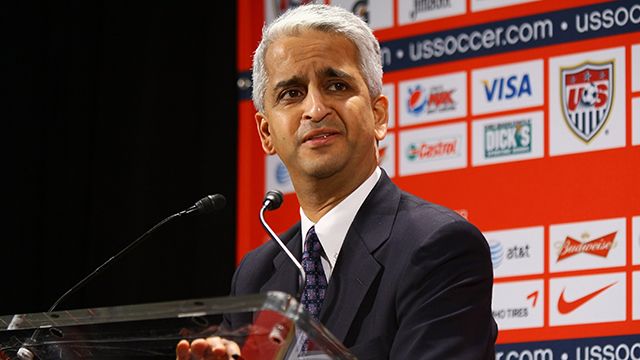
Which Way for Sunil Gulati?

I have a commentary up at Play the Game on Sunil Gulati, head of US Soccer, and his new role on the FIFA Executive Committee. Here is an excerpt to whet your interest:
Gulati, who has not commented on the alleged corruption at CONCACAF which took place while he helped govern the organization, served on the FIFA governance reform committee until his recent election to the FIFA Executive Committee. Thus he helped to develop its recommendations aimed at improving the governance of the organization. Now as a member of the FIFA Executive Committee, Gulati found himself last week in the odd position of receiving advice that he has helped to prepare.

Gulati and colleagues identified as “indispensable” several of the recommendations that the reform committee has proposed to FIFA, but which have not yet been adopted. These include a call for independent integrity checks, term limits in office and full disclosure of compensation.

Surely, as one who helped develop the “indispensable” advice, Gulati might have been expected to be a vocal champion for implementation of the proposals at last week’s FIFA Congress, right? Think again. Since joining the FIFA Executive Committee, Gulati has been almost entirely invisible on issues related to FIFA reform, and based on his actions last week, perhaps even an obstacle.
Go here to read the whole thing, and feel free to come back and comment.

Sunday, June 2, 2013

Wise Words from @ChangeFIFA

Thursday, May 30, 2013

Sunil Gulati Rejects His Own "Indispensable" Advice on FIFA Reform

Andrew Warshaw writes at InsideWorldFootBall (emphasis added):
High-ranking sources have told Insideworldfootball that a ballot was taken at Tuesday's executive committee meeting and that the result was 16-8 in favour of putting off a decision both on an upper age limit for executive committee members and/or the number of permitted terms of office.

Although there were valid and differing opinions within the executive committee over the correct way forward, all eight votes in favour of dealing straight away with the concept of statute-changing age and term restrictions are understood to have come from FIFA's European members who were said to be frustrated that no-one else supported them.
What this means, if accurate, is that Sunil Gulati, recently elected to the FIFA ExCo from CONCACAF, voted against the age limit and terms of office proposal. This is significant because up until being elected to the FIFA ExCo, Gulati was a member of the FIFA Independent Governance Committee which proposed the age and term limits.

Gulati thus rejected advice that he had proposed as "indispensable" as a member of the FIFA IGC (here in PDF).

Warshaw quotes one non-European member of the ExCo as saying the following:
 "It was the right decision," one non-European executive committee member told Insideworldfootball. "It would never have got the three-quarters majority needed and may never have therefore seen the light of day at all. At least this way we have another year to all agree on something concrete."
Given the American colloquialism, I'd wager that there is a good chance that this quote comes from Gulati. If so, then he is arguing that reform proposals should not be brought to the FIFA Congress for the simple reason that they may not succeed. This is a dubious line of argument. The Executive Committee could reintroduce such a measure next year regardless of what happens this year. Instead, Gulati is helping to torpedo reform from within. If the statement does not come from Gulati, then he still should answer why he voted against a reform that he earlier signed on to as "indispensable."

Either way, Gulati's behavior is a huge disappointment. The ExCo vote on the age and term limit reforms, and Sunil Gulati's behind-the-scenes actions at odds with his public recommendations does not suggest that he will be an active champion of reform from within. As president of US Soccer, Gulati operates without term limits. He has not yet said whether he believes they should be instituted.

FIFA Grades Itself on Reform

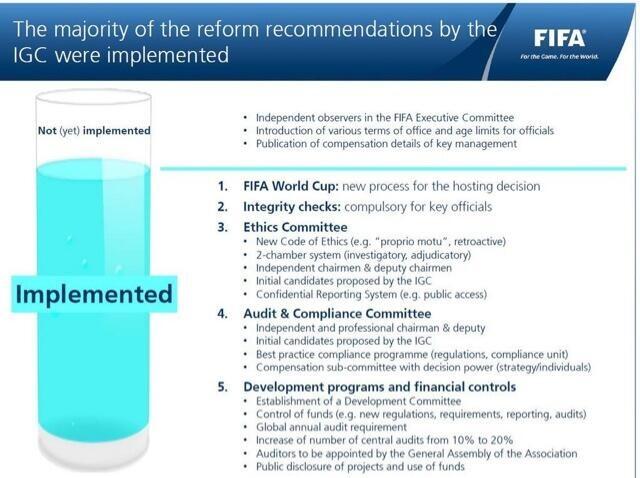
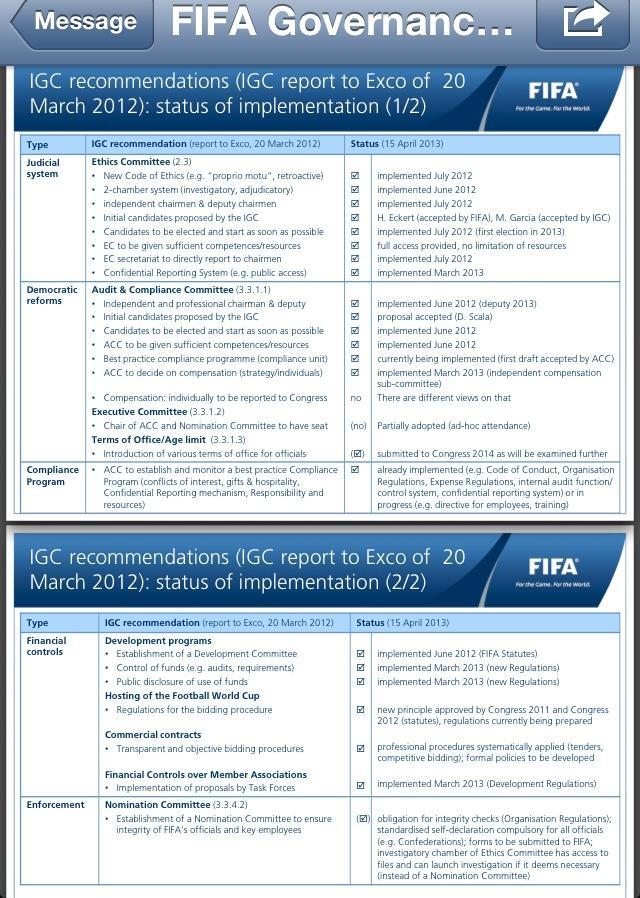
Earlier today in Mauritius, FIFA President Sepp Blatter presented the following tables to illustrate how FIFA sees the completion of its reform process. Courtesy @danroan and @RobHarris.


Wednesday, May 29, 2013

Dominico Scala on FIFA Reform and Corruption

Dominico Scala, the Chairman of FIFA's Audit and Compliance Committee, met with the media earlier today. He offered these comments on the CONCACAF Integrity Report, as reported by the New York Times:
Former FIFA vice-president Warner from Trinidad & Tobago, who was the president of CONCACAF for 21 years, and Blazer of the United States, his general secretary for most of that time, were both members of FIFA's executive committee.

Warner turned his back on football after being implicated in a bribery scandal in 2011, while Blazer has also left the game although, on a technicality, he is suspended from FIFA's executive committee until Friday.

The two men were vilified in a report commissioned by CONCACAF, the confederation responsible for soccer in North and Central America and the Caribbean, and published at their Congress in Panama in April after the examination of 5,000 documents and the testimony of 38 individuals.

"If you read the CONCACAF integrity report it does not say anything positive or polite (about them)," said Scala, a 48-year-old Swiss industrialist who is charged with enforcing new financial controls at FIFA as well as guiding the body's reform process on to the statute books.

"It's a horrible document so therefore whatever they are saying today is frankly useless and worthless because, over an extended period of time, they abused the system.

"I cannot judge on the other cases (of FIFA corruption) as I have no insights but I think it is a stretch to say now that what happened in CONCACAF happened in all the confederations.

"But here we have two individuals who behaved the way they did. Do we have other cases like this at FIFA? Maybe, I don't know, but we have to face facts; we have to be very careful of accusing everybody because we have had 10 years of accusations and allegations and suspicions."
Scala's comments raise some interesting questions, most prominently, why did it take so long for the abuse of the FIFA system to become formally recognized by FIFA? Why didn't FIFA uncover these fact previously, especially as many of the allegations were substantiated for FIFA by investigative journalists?

Also of note is Scala's apparent dismissal of the Warner/Blazer issues as not longer within the purview of FIFA:
"In the case of Jack Warner and Chuck Blazer this has far bigger implications than just (FIFA's) Ethics Committee, or the rules of the game," Scala said at a rare media briefing the day before FIFA's annual congress starts.

"There is sufficient suspicion that they have gone against the law and this will become an issue for the FBI and the IRS (Internal Revenue Service) in the case of taxation.

"So here the Ethics Committee and the world of FIFA stops - and people who have gone against the law will have to deal with the law."
FIFA's rush to move from largely ignoring the corruption within its Executive Committee to declaring the issues now to fall outside of its purview, and into the hands of US law enforcement, simply adds to the perception that FIFA is not yet fully serious about its reform agenda.

Perhaps tellingly, FIFA's official press release on Scala's press interview failed to report his remarks on Warner and Blazer. Instead FIFA emphasized Scala's defense of the now completed FIFA reform process:
“A two-year process to overhaul a global organisation like FIFA is quite ambitious, and normally corporate organisations – and I have worked for a few which are similarly complex – do not achieve this in such a limited timetable” continued Scala. “More than twenty of the recommendations for reform proposed by the IGC have been approved, but till now, this hasn’t been fully recognised or appreciated” he added.
In the interview, Scala also demonstrated another example of FIFA run-around, when asked about Sepp Blatter's salary:
[Scala] knows Blatter's salary. However, he says it's ''not my role to disclose.''

Blatter has reportedly referred questions over his earnings and bonuses to Scala.
He also hinted at problems in the allocation of FIFA development monies, but did not provide details:
Scala revealed to reporters that FIFA's finance committee had blocked projects in seven countries because of accounting concerns - though he would not identify them.
Scala's interview is welcome (and "rare" according to Andrew Warshaw) but it mainly serves to further illustrate how far FIFA has yet to go to achieve even basic standards of due diligence an transparency.

Tuesday, May 28, 2013

FIFA ExCo Tables Age and Term Limits

In an official interview, FIFA President Sepp Blatter yesterday said this of the two top-line agenda items for reform -- an age limit and term limits for FIFA leadership -- being considered at the FIFA Congress this week:
I’ve already said I was against the age limit as I believe it is not a relevant criteria, not everyone is the same at 60, 70, 80, etc. It could even be seen as discriminatory. Passion makes the difference. However I am not against a limitation of a number of mandates, this rule applies in many democracies in fact. But then it should apply to everybody.
Today, FIFA's Executive Committee tabled both proposed reforms until at least next year, according to Kier Radnedge:
A decision on the contentious issues of age and term limits for members of the FIFA executive has been put back at least a year – by the executive itself.

The reform issues both featured on the agenda for the world football federation’s congress here on the Indian Ocean island in Mauritius later this week.

However the inability of senior figures – including president Sepp Blatter – to reach agreement on either issue prompted the exco to push the issue back until next year’s congress in Sao Paulo.

Blatter himself, maybe with an eye on his own possible pursuit of re-election in 2015 when he would be 80 – had already expressed a personal opposition to age limits.

Several of the six regional confederations disagreed on term limits. Several were also concerned by Blatter’s caution that he would expect age and term limits to be mimicked down through the confederations and national associations.
The official interview appears to have served a purpose beyond simply sharing information, but also sending a message. That message was apparently heard loud and clear.

The age and term limits were already leftovers from a watered-down reform agenda. Some interesting questions result -- What will the FIFA IGC do next? How did Sunil Gulati vote on the tabling motion? Where is Mark Pieth?

Monday, May 27, 2013

Blatter Declares Victory, End of FIFA Reform Process

FIFA.com: President, just before the FIFA Congress 2013, do you consider the reform process is now over?
In fact, we are exactly following the road map which was established at the FIFA Congress 2011. Since then, we have been transparent on what was done and we have followed the majority of the recommendations made by the Independent Governance Committee in this two-year process. So I’m extremely proud to say this process will conclude at the 2013 FIFA Congress. However, this does not mean that FIFA will stop adapting and taking measures with regards to governance, and in regards sport politics.

What about the measures which are still under review?
Ten reform areas identified by the Task Force Revision of the Statutes are on the agenda of this year’s Congress. There has been an extensive consultation process observed in order to receive input from the member associations, who ultimately are the ones voting. We have a democratic process in place, we follow it. Between 2011 and 2013, I made a lot of effort to take this reform process as far as I could, but it is now up to the FIFA Congress to decide on these measures.
Mark Pieth, chair of the FIFA IGC, has in the past expressed an intention for the reform work of the IGC to continue. It won't according to Blatter. How that resolves itself bears watching.

Also, Blatter's claim that FIFA has followed the majority of IGC recommendations is something that can be verified empirically.  This analysis will be included in my paper prepared for the upcoming 2013 Play the Game conference in Aarhus. Stay tuned.

Sunil Gulati Should Prepare for More Scrutiny

At Grantland, Noah Davis (@Noah Davis) asks, Can Sunil Gulati Reform FIFA? Davis writes rather gently:
The ExCo is a group massively in need of cleaning up. Since October 2010, more than 10 of its members have been accused of some type of corruption. Gulati is saying all the right things, including expressing his desire for FIFA to disclose the notoriously secret compensation of its directors. But the question is how much impact the American can have. I asked Grant Wahl, Sports Illustrated’s soccer writer who drew attention to corruption within FIFA with his 2011 presidential campaign, for his thoughts.

"Sunil clearly chose to work within the system. That's why he's on the reform committee. He's chosen that instead of publicly shaming FIFA for a lot of the corruption that has happened over the years and has taken down so many of the members of the Executive Committee," he said. "Sunil could have abstained from voting for Sepp Blatter in 2011 just as England did, but he chose not to. He chose to vote with Blatter, and I think Blatter repaid that by putting Sunil in a very good position."

While Gulati's desire to reform FIFA appears genuine, it's simply not possible to fix all that ails the organization while Blatter, the man who has been in charge since 1998, remains on top.
 In contrast, Davis quotes Andrew Jennings being not so gentle:
Andrew Jennings, a Scottish investigative reporter and one of the leading figures in tracking FIFA corruption, has further concerns about the USSF president. In a long post, he outlines how Blazer and former CONCACAF president Jack Warner defrauded Australia and other nations, and argues that Gulati, the Columbia economist, should have been able to see evidence of the fraud while looking at the confederation’s balance sheets. Jennings, who has an air of conspiracy theorist about him but boasts an impressive background in investigating FIFA, has a point.

He also raises another good question about Gulati's statement that he would reveal compensation only if allowed to do so by FIFA's laws: "[Why can't] Little Sunil say to FIFA, 'Listen you jerks, I've been elected from my continental region and I'm going to tell them how much I'm making'?" (Later in our conversation, the outspoken and outraged Jennings added, "Who the fuck are these toe rags in Switzerland to tell a proud American what information he can give to the American people?")
Gulati should be prepared for much more scrutiny that he has received in the past - of both the gentle and not-so-gentle varieties.

Wednesday, May 22, 2013

Wrap Up: Season Long EPL Prediction Contest Results

As an exercise in humility and illustration of the concept of skill in forecasting I have run a few small prediction contests here over the past few years.

Here are the final standings of the 10 participants for 2012-2013:
Elijah 17.4
Megan 17.5
SKILL 17.8
Calvin 19.0
itzik 19.0
n-g 19.3
dave tombs 19.5
keeperusa 23.1
Arthur 23.2
Max 23.9
Pielke 24.0
Congrats to Elijah and Megan, the only two participants whose picks improved upon a naive baseline.  

The numbers above represent the square root of the sums of the mean-squared errors in the predicted standings. The biggest collective errors: West Brom (picked too low) and Newcastle (picked too high). Smallest errors: Man City, Arsenal and Reading.

What does this exercise tell us? The most important lesson, one that is learned in many walks of life, is that a naive prediction methodology can be very hard to beat. Only two entries outperformed an entry based on last year's final table.

The far more difficult question to answer, and one with an answer that has a lot of significance to decision making in areas far more important than sports prognostication -- are those 2 skillful entries showing skill because the forecasts had skill, or just luck?

For a discussion, see this post on hot hands and guaranteed winners.

Thanks all and congrats to the winners!

Monday, May 20, 2013

Goldblatt on the FIFA World Cup in Global History and Culture

David Goldblatt, the author of The Ball is Round: A Global History of Soccer, recently gave a keynote address at the FIFA World Cup Conference in Zurich. He talk was titled, "The FIFA World Cup and its Impact on Global History and Culture” (here in PDF, courtesy Peter Alegi's course, History of Soccer).

Here is how Goldblatt describes his focus:
Such is the global reach and cultural significance of football that the history of the World Cup provides an increasingly powerful lens for examining the course of globalization and global history over the last one hundred and twenty years. At the same time the history of the tournament allows us to see the dynamic of politics in individual nations and the construction of their national identities – all have been encoded in the ways in which the tournament has been staged, played, reported, celebrated and cursed.

To see the relationship between the World Cup and globalization more clearly, we need to divide our narrative into four eras: first, the prehistory of the tournament particularly football’s relationship with the Olympic movement and the Olympic games; second, the short inter war era of the World Cup between 1930 and 1938 played alongside a fragmenting global order; third, the World Cups of the long post war boom and the slow regulated globalisation that accompanied the Cold War; and finally, since 1982, the World Cups of the most recent era of globalization characterised by new geographies of global power and the unprecedented scale, size and significance of global financial and media networks.
Read the full lecture here in PDF.

Ronaldinho: Clever or Uncool?


Some fodder for debates about norms of the game.

H/T Ricardo.

Wednesday, May 15, 2013

Book Review: A Man in a Hurry

Before there was the English Premier League, before the NFL, there was the brief moment in the spotlight for pedestrianism, an early form of competitive walking that became very popular in the 1860s and 1870s in both the United States and the United Kingdom. Pedestrianism first started out as a trial of distance – sometimes vast -- against the clock and then evolved naturally into a race between men. The pedestrian movement saw a great rise and then all but disappeared, supplanted by contemporary competitions such as the marathon and the modern Olympics.

Fortunately, Nick Harris, Helen Harris and Paul Marshall have collaborated to stitch together what is a relatively thin historical record to provide a highly readable account of the life of Edward Payson Weston, the original and most famous pedestrian. Weston’s 90 years spanned 1839 to 1929, a time of enormous change, in the world and in sport and is chronicled in A Man in a Hurry: The Extraordinary Life and Times of the Edward Payson Weston, The World’s Greatest Walker.
Weston’s competitive career was largely of his own creation; it began as a bet and turned into a business opportunity that he would exploit repeatedly such that it became a career and a calling. At the peak of his popularity more than 20,000 people turned out in London in 1876 to watch him walk around a track in a 6-day race in which he took on all comers. It may sound a bit odd to hear of 20,000 people turning out to watch men walk around a short oval track, yet today not far away from the location of Agricultural Hall in Islington 60,000 people turn out regularly to Emirates Stadium to watch 22 men kick around a ball on a rectangular pitch. Many years later, when Weston had become famous mostly just for being famous, he drew a reported half-million people to the streets of New York to watch him conclude a cross-country walk which had started in California.

The thinness of the historical record makes it difficult to get a good reading on who Weston actually was. Much more is known about the competitions that he participated in and walks that he took on, and so the book emphasizes these events in its recounting of Weston’s life. There are hints of snake oil salesman in Weston’s character, with tantalizing but ultimately unverified associations with illegal gambling and political corruption in the form of what today would be called match fixing. Weston preferred to walk in finely tailored and distinctive clothing, adding to the spectacle of the event. He made and lost several fortunes across his long life and throughout there were hints of a playboy lifestyle. In most respects none of this would be surprising to observers of star athletes today.

At his peak form Weston was known for his stamina and remarkable powers of recovery with little or no sleep. During Weston’s first visit to the UK, the British Medical Journal reported that he had been chewing coca leaf, from which cocaine is distilled, while he walked. The negative reaction and quick denials by Weston of more general usage illustrates that even at this time the notion of doping – a word that had yet to be invested – was a concern in sport. Weston’s use of the drug led to a spat among experts on the pages of the BMJ (another dynamic familiar to modern observers of sport) leading the journal to opine quite presciently:
“Pushed to excess, coca is said to become a narcotic; and we shall, no doubt, hear a great deal about its use and abuse. Possibly we may be indebted to Mr. Weston for the introduction of a new stimulant and a new narcotic: two forms of novelty in excitement which our modern civilization is likely to highly esteem.” 
Weston was no fool and quickly embraced science as a route to legitimacy, first presenting himself as a subject for scientific research and later extolling the virtues of walking for health and serving as one of the first anti-smoking advocates.

Pedestrianism’s moment in the spotlight did not last long. The automobile, organized sport and age saw Weston fade from public view. When he died senile and poor few turned out for his funeral. But over his 90 years he never stopped walking. Thanks to A Man in Hurry, this delightful part of sport history has been brought back into view.

Saturday, May 11, 2013

The FA Cup and US Hurricane Damage

In a 2009 paper on the ability (actually, lack thereof) to predict US hurricane landfalls or damage on time scales of 5 years or less, I illustrated the perils of correlation shopping with the data shown in the graph above (paper here in PDF).

Over the period 1950 to 2007, in years which the score of the FA Cup final totaled 3 goals or greater, US hurricane damage in the subsequent season (June through December of the same year) was 31% greater than average. In years which saw 2 goals or less scored in the final, hurricane damage was 33% less than average. The relationship is remarkable. Chance you say? I once thought so too.

Little did I know that I had stumbled on to a  major scientific breakthrough. Since 2007, the FA Cup hurricane damage predictor (FACHDP for short) has correctly predicted 3 of the 5 seasons damage correctly. By contrast, sophisticated catastrophe models used in the financial world to assess risk correctly anticipated only 2 of those 5 years. Obviously, they have not yet caught up with the implications of this remarkable new discovery.

The mechanisms underlying the surprising predictive ability of the FA Cup are still being explored, but they are no doubt reflective of what some have called "a new normal" in hurricane behavior.

US coastal residents, Bermuda reinsurers and City financiers await today's match with great anticipation.

Wednesday, May 8, 2013

Jens Sejer Andersen: FIFA’s New Ethics Committee Fails First Test

Over at Play the Game, Jens Sejer Andersen takes a clear-eyed look at the recent report of the FIFA Ethics Committee on the so-called ISL case and finds it to be a failure.  Andersen summarizes (but do read the post in full):
In its totality the report of judge Eckert is a disappointing piece of work, and as long as the public is prevented from studying the investigations of Michael J. Garcia, Eckert has to carry the full responsibility for the flaws that can be summarized as follows:
  1. Out of the 142 million CHF handed out as bribes by ISL, more than 100 million are still unaccounted for. Eckert does not mention this fact at all. Did FIFA’s Ethics Committee forget to ask those people in FIFA and around FIFA who are likely to know more about this huge sum of unidentified bribes. If the committee did ask, but without success, shouldn’t the public know about this culture of denial?
  2. As earlier stated, Blatter and other FIFA officials are cleared of several charges only on the ground that FIFA regulations were unsatisfying or non-existent at the time of events. Thereby the new, independent Ethics Committee fails to meet the expectations that the outside world has rightly had of decisions based on independent consideration of ethical questions and not only on well-known legal formalities.
  3. The Ethics Committee has an unclear stand on the key question if it was ethically ok for Sepp Blatter as FIFA Secretary General to watch passively in the 1990ies while the biggest corruption scandal in sport unfolded among his closest allies.
  4. Eckert does not lay out the premises behind his few assessments of ethical character – for instance the description of Blatter as “clumsy”.
  5. The Ethics Committee declares this case for closed without dealing an inch with the fact that Sepp Blatter over ten years, from 2001 to 2011, used all his powers to keep the ISL-affair secret with lies, threats and manipulation. This happened also after the introduction of an Ethics Code in 2004. Why has the Ethics Committee not pronounced itself on this behavior?
  6. Especially big sums of FIFA money were used by Blatter on lawyers’ fees to make the courts ensure that nothing came out about the persons involved in the post-bankruptcy negotiations or about the settlement that ended the ISL case in the Swiss legal system. Was this an ethical use of FIFA’s resources, or an unethical attempt to cover it all up?
  7. Sepp Blatter avoided over two years, from 2010 to 2012 – to publish the ISL settlement, although he was free to do so and although he said from October 2011 that he would like to. He claimed in contrast to the truth that the other parties in the case prevented him from doing so. Proper ethics, Mr. Eckert?
  8. Although judge Eckert recognizes that key persons in FIFA have rejected to cooperate in the investigations, that FIFA investigators do not dispose of the same powerful tools as the real police and that various important case facts remain in the dark, he chooses on this fragile foundation to wipe all doubts aside, declare case closed and exonerate all FIFA officials in the future. Effective, perhaps. But ethically sustainable?
So much for the failed responsibilities of the Ethics Committee. The real responsibility rests of course with the political level of FIFA, with Blatter, with the ExCo and with the general assembly. If FIFA leadership believes that the Ethics Committee has done an excellent job, why not support this evaluation by publishing all papers produced by investigator Garcia?
 Andersen points to the IOC and US authorities as possible venues for further investigations of FIFA. For its part, FIFA clearly hopes that the sham report will serve to sweep the ISL case under the rug. Perhaps so, but I am skeptical.

The work of FIFA reform has a long way to go.

Tuesday, May 7, 2013

Slightly Higher Salaries, More Equity in the MLS

Last May I showed that the income distribution in Major League Soccer was akin to that which might be found in Haiti -- that is to say, lots and lots of people at the low end of the income scale and a few at the top. The league has just released its 2013 salary information (H/T @FutbalIntellect).

I can report that the MLS Gini Index (a conventional measure of income inequality) has decreased (become more equal) from about 57 to 53 -- so rather than Haiti as an analogue, think Panama. The graph at the top of this post comes from this nifty online calculator.

Some other facts:
Obviously, the MLS has a long way to go to be able to afford top talent from top to bottom.

Tuesday, April 30, 2013

FIFA Closes the Books on the ISL Case

Today FIFA released a short 8-page report on the so-called ISL case (here in PDF). The report, which describes a series of bribes or kickbacks received by FIFA officials from the now-defunct marketing company. The report concludes:
  1. The ISL case is concluded for the Ethics Committee.
  2. I note that Mr. Havelange resigned from his position as Honorary President effective from 18.04.2013 and that Dr. Nicolás Leoz resigned from his positions as a FIFA Executive Committee member, as a FIFA standing committee member and as CONMEBOL President effective from 24.04.2013. Hence, any further steps or suggestions are superfluous.
  3. No further proceedings related to the ISL matter are warranted against any other football official.
The substance of the report -- what little there is -- has been commented on elsewhere, see Kier Radnedge, Sepp Blatter, Richard Conway, and Play the Game.

For his part, Sepp Blatter says that no one has tried to bribe him since 1986. Given the staggering scale of corruption involving many (if not most) of Blatter's colleagues now exposed, it is a remarkable statement, but I digress.

The release of the judgment reinforces FIFA's well-earned reputation for a lack of transparency.  The 8 page judgment notes:
The Report of Examination spans approximately 30 pages, and the documents obtained during the course of the examination, including the transcripts of testimonies, comprise approximately 4,200 pages.
Neither the 30 pages examination report nor the documents obtained during the investigation have been made available. Contrast this with the massive dump of information by USADA as part of its "reasoned decision" on doping in cycling.

FIFA finds itself asking people to "trust us" -- hardly a viable position for the organization. FIFA should make available its 30 paper investigation report and 4,200 pages of investigatory materials and allow its stakeholders to see for themselves.

Monday, April 29, 2013

The End of the NCAA?

Under the strict rules of the NCAA, student athletes are not paid for the value they create. Many do get a free education, as well as room and board, a package that can be worth more than $50,000 a year. Defenders of the system say that is plenty.

Yet critics say a scholarship is hardly commensurate with the value of some student athletes. Take Johnny Manziel, the star quarterback at Texas A&M University. According to a study by Joyce Julius & Associates, a research firm, Mr Manziel generated $37m-worth of media exposure for his school last year. Under the rules, he is not allowed to profit from his performance. But critics allege that the NCAA and its members are doing just that. A replica of his number “2” jersey can be bought for around $60 in the university’s online store, and his avatar will appear in an officially licensed videogame.
Similar complaints can be found in an antitrust lawsuit that poses a threat to the current system. The initial challenge was brought in 2009 by Ed O’Bannon, a former basketball player for the University of California, Los Angeles, who tired of seeing his image used in ways that profited only the NCAA and its licensees. He has since been joined by other former college stars. In June a judge will decide whether to certify the lawsuit as a class action involving all current and former student athletes.

If that happens, the NCAA will face astronomical claims. Mr O’Bannon and company want a share of everything from TV contracts to trading-card deals. A settlement upending the system would be the most likely result. Such a deal might set aside a portion of the revenue generated by elite college sports to pay ex-players and create a trust to compensate current student athletes when they graduate. But it would also raise thorny questions, not least over how the money is divided.
Sports Illustrated recently put together a short primer on O'Bannon vs. NCAA. CBS Sports discussed newly released emails from NCAA officials that show deep concern over the implications of the lawsuit:
[N]ew emails made public Friday and published in part at al.com strongly suggest that the NCAA was aware that EA was using real athletes in their games but did nothing to stop them.

"The jersey number along with the position and vital statistics is clearly an attempt to have the public make the association with the current student-athlete," NCAA membership services official Steve Mallonee wrote in a 2005 email to NCAA colleagues. "And it appears to be working ... The biggest concern I have is that such a position really does allow for the maximum commercial exploitation of the (student-athlete), and if that occurs, will it be long before we can defend not giving them a piece of the profits?"

Former NCAA official Bo Kerrin wrote that he considered the threat of revenue sharing with athletes over the games a "real concern," and NCAA Vice President David Berst participated in another 2005 email exchange with an Ivy League compliance coordinator who raised the same issues.

"This seems to go beyond the plausible deniability inherent in selling a jersey with a uniform number but no name on the back," the coordinator, Brian Barrio, wrote. "Is anyone at the NCAA tracking on this issue?"
For a range of informed views on what the lawsuit might mean, see this nice overview by Inside Higher Ed of a panel discussion at the University of North Carolina.

Next stop is a June 20th certification hearing to determine if the suit will be allowed to proceed. Stay tuned.

Friday, April 26, 2013

Famous Predictions in Sport - Doping in Baseball

On performance enhancing drugs in Major League Baseball:
"Nothing has ever come to my attention that would require a special ruling. It never has come up, and I don't think it ever will."

Warren Giles, President, National League
1969 in Sports Illustrated

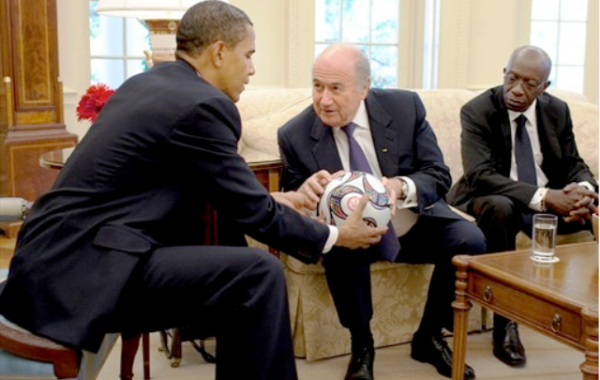
Note to US Media: Curious How this Came to Be?

Jack Warner stands accused of fraud and is allegedly being investigated by the FBI.

So how did he get a personal meeting with President Obama?
The meeting was a part of the US effort to win the World Cup, and presumably was brokered by US Soccer and its political allies. Ultimately, the question that will need to be asked (or at least, should be asked), is what did Sunil Gulati know about CONCACAF corruption, and when did he know it?

Jack Warner Responds, Digs Deeper Hole

Last night in a speech to his (former) constituents in Trinidad and Tobago. embattled politicians and former FIFA Executive Committee member Jack Warner offered a response to the recent CONCACAF Integrity Report, which accused him of fraud and other transgressions (the original document prepared by Warner, with exhibits, is here in PDF).

It is not clear that Warner has helped his cause. He explains how a $6 million loan from FIFA to help build the now infamous "Centre of Excellence" (described in detail in the CONCACAF Integrity Report), was converted into a "grant" by then-FIFA President Joao Havelange in exchange for Warner delivering the support of CONCACAF and its 30 votes in the FIFA Congress to Sepp Blatter, Havelange's choice of successor at the helm of FIFA:
Blatter was Havelange’s candidate to succeed him for the FIFA Presidency. Blatter had been at this time the most hated FIFA official. by both the European and African Confederations and without my CONCACAF support at the FIFA elections, Blatter would never have seen the light of day as President of FIFA.

I told Havelange that, through him, Blatter will get CONCACAF’s total support and Bin Hammam also said the same day thing though at the time he did not have Asia’s 100% support as I had with the CONCACAF.

“Votamos como un bloque”, I told my Central American colleagues. In 1997, Havelange came to Antigua for the Shell Umbro Cup and in an invitation meeting at St. James Club, Antigua, again reiterated his request to me. Again I promised him CONCACAF’s total support. Then and there he began to count Blatter’s votes and said that if CONCACAF supported Blatter he will win by thirty votes.

CONCACAF at the time had 30 voting members.

The FIFA Presidential elections were held in Paris on June 8, 1998. I will now ask that the results of that election be read.. . 
The Congress elects Joseph S. Blatter as his successor. Rival Lennart Johansson withdraws after Blatter has gained 111 votes to Johansson’s 80 after the first ballot.. .

Havlange was off by one!!! Blatter had defeated Johanssen by 31 votes.
Warner explains how swinging the election to Blatter made him extremely powerful in FIFA with commensurate rewards:
In 1998 therefore, I had delivered and since then I emerged the second highest sporting personality in the FIFA.

1. I was placed on 6 out of 11 committees,

2. I was the Chairman of 2 and the Deputy Chairman of 2, one being the prestigious Finance Committee of the FIFA,

3. Trinidad and Tobago was given the seat to host the Under 17 2001 World Cup, and

4. Additional financial assistance was given for the further construction of the Center of Excellence.

I was Blatter’s idol then and he was mine.
Warner explains that anything he may be guilty of was because of FIFA's complicity:
It is still a mystery to me to fathom how a little country boy from Todd’s Road, Longdenville and Chaguanas could deceive for so long the mighty FIFA with more than 200 lawyers and an annual budget of US$2 billion for so long.

One must ask the question how did little Jack Warner manage to stay in his corner under the radar and enjoyed so much success for so long? Or is it just that what we are seeing today is the vindictiveness of an oligarchy against one who attempted to challenge the power of a Eurocentric and White regime and thus balance the playing field so that leaders of every colour, race and ethnicity could have a fair chance to become a President of FIFA?
Warner singles out journalists Andrew Jennings, Jens Weinreich and Lasana Liburd as his enemies for their efforts to expose corruption in football.

Warner ended the speech by announcing his intent to compete in the by-election for the parliamentary seat which he just resigned from. Jack Warner is not done yet.

Thursday, April 25, 2013

My Abstract for PTG 2013

I just submitted a paper proposal for Play the Game 2013, to be held later this year in Aarhus, Denmark. Here is the call for papers.

Here is my abstract:
An Evaluation of the FIFA Reform Process
Roger Pielke, Jr.
University of Colorado

Following years of allegations of corruption and cronyism, in 2011 FIFA embarked upon an ambitious program of governance reform. The process was championed by the organization’s President, Sepp Blatter, and centered on the creation of a new body, the FIFA Independent Governance Committee. This paper evaluates the FIFA reform effort rigorously, drawing upon the well-developed academic literature on policy evaluation, which has been extensively applied to the appraisal of organizations in the public, private and non-profit sectors. A formal evaluation consists logically of four distinct parts: goals to be achieved, metrics of attainment with respect to goals, data with respect to the metrics and finally, judgments of responsibility for successes and shortfalls with respect to goal attainment. This paper conducts a two-part evaluation of the FIFA reform process as implemented from 2011-2013. A first evaluative perspective considers the overall reform effort according to three different sets of objective criteria. These criteria are drawn from internal recommendations produced by FIFA and its IGC, with a third set of criteria distilled from recommendations for FIFA governance reform put forward by Transparency International, an external governance watchdog. A second evaluative perspective focuses on the performance of the FIFA IGC as an advisory body, applying more general criteria distilled from appraisals of advisory bodies across policy settings. The paper concludes with a comprehensive summary “report card” on the FIFA reform effort and its IGC, and presents broader recommendations for governance reform efforts in sports organizations drawn from the FIFA reform experience.
Comments welcomed!

Wednesday, April 24, 2013

Lance Armstrong and the Prisoner's Dilemma

Bill Brock, the general counsel for the US Anti-Doping Agency or USADA, explained earlier this week at a panel discussion at the University of Texas that Lance Armstrong would have retained five of his Tour de France titles had he agreed to cooperate with USADA.
Bill Bock, USADA general counsel, at a University of Texas discussion Monday night, entitled “The Real Price of Winning at All Costs: A Discussion about Elite Cycling” ... said that of the Americans the anti-doping body approached as part of its investigation, Armstrong was the only one to refuse to work with his agency. The key question USADA asked, Bock said, was if athletes were willing to be truthful to help the sport.

“Lance is the only American rider that refused that request … had he done that? The reason we could go back and seek disqualification of results from 1998 was because of the subversion of the legal system,” said Bock. “If he had been open and honest with us … we wouldn’t have been able to do that.”

Somewhat shockingly, Bock said that if Armstrong had contributed to the USADA investigation, he would have kept five of his seven yellow jerseys. “Yeah, he would have kept five of them,” Bock said. “And most likely would not have been banned for life.”
Sounds like Lance Armstrong needed to brush up on his game theory.

Rough Rider Trailer


Rough Rider Promo from Wildfire Films on Vimeo.

Tuesday, April 23, 2013

Alexandra Wrage Explains Resignation from FIFA IGC

If you are interested in FIFA governance and (non)reform, then you should listen to the outstanding interview with Alexandra Wrage conducted by Richard McGovern (@RichardMcGovern) available here (from 52:44-1:11:41).

Wrage also has written a hard-hitting blog post at Forbes, which starts like this:
When FIFA’s leaders could no longer ignore the spate of scandals ranging from World Cup hosting decisions to irregularities in its internal elections, they announced a new “reform initiative”.   The initiative was declared an effort to restore public confidence in the organization, but has done little more than polish the veneer on an outdated men’s club.   The inaptly named Independent Governance Committee was originally comprised of a cross-section of stakeholders, including two people who have since been elevated to FIFA’s Executive Committee, as well as governance professionals.  The process has been expensive and time-consuming, but little has really changed back at FIFA’s headquarters in Zurich.
Read the rest here.

Monday, April 22, 2013

My Questions for Sunil Gulati

Here are the immediate questions that I would like to ask Sunil Gulati upon his election to the FIFA Executive Committee:

You are assuming a role as a member of FIFA's Executive Committee, and are presently a member of the FIFA IGC.

a. Will you be resigning from the IGC? Why or why not?
b. As one who has signed on to the recommendations of the IGC for FIFA officials, will you voluntarily adhere to those recommendations even if they are not adopted as formal policies by FIFA?

Specifically, I am referring to the following provisions recommended by the IGC as "indispensable":
  • That the President and all Members of the ExCo as well as the standing Committees of FIFA undergo an integrity check performed by an independent body within FIFA centrally prior to their (re-) election.
  • Both, the President and the Members of ExCo should be subjected to limited terms of office.
  • The IGC would like to stress the importance of transparency in the area of compensation and benefits. [NOTE: In this case as related to all compensation with respect your roles with CONCACAF and FIFA]
Of course, with respect to each I would like to know why or why not.

FIFA IGC Bits and Pieces

An interesting day:
Did I miss anything?

Stonewalled by Sunil Gulati

Sunil Gulati (pictured above with Sepp Blatter) is the president of US Soccer. He also just won an extremely narrow victory to represent CONCACAF on the much criticized FIFA Executive Committee. On Friday, CONCACAF released a report documenting how its leadership -- including the man Gulati is replacing on FIFA's ExCo -- took the organization for an estimated $88 million. Gulati also serves on the so-called Independent Governance Committee of FIFA which today saw a member resign in protest (Alexandra Wrage, more on that later).

I emailed Gulati requesting an interview as part of my ongoing research into the governance of football. Not long ago Gulati has declined to be interviewed when I contacted him about the IGC, however, in 2011 he did kindly offer some comments on an early version of my recent paper on FIFA accountability.

Today, through a spokesman who just emailed back, Gulati refused again to be interviewed as follows:
Roger,

Thanks for reaching out. I handle most of the interview requests for Sunil.

We just did a call with national media that should be helpful in providing you with some information. I will send along the audio and transcription when it is completed later today.

Also, there will be another time down the road where we will be making Sunil available for questions. We can make sure you are included in that opportunity.

Take care. 
Neil Buethe
Senior Manager of Communications
US Soccer
Gulati is busy no doubt. However, I am a professor doing research (busy also) and can wait for my questions related to governance to be answered on his schedule. The refusal to be interviewed at all speaks for itself in a way I guess. And not in a good way.  Gulati should expect much more attention in his new role. Continued stonewalling of legitimate questions probably can't sustain.

I'll post the transcript of the pooled media interview when I get it (here it is). 

Sunday, April 21, 2013

The CONCACAF Integrity Report

On Friday, CONCACAF (the Confederation of North, Central American and Caribbean Association Football) released the report of its "Integrity Committee" which it describes as follows:
The Integrity Committee was established by the Executive Committee of CONCACAF by resolution dated June 26, 2012, and was charged with conducting an investigation of certain matters related to the conduct of the former management of CONCACAF.
Before I get to the top line conclusions of the report let me first note the following recommendation of the FIFA Independent Governance Committee which has not been accepted by FIFA (PDF):
The IGC would like to stress the importance of transparency in the area of compensation and  benefits. The establishment of an expert subcommittee to the Audit and Compliance Committee is an important step. However, the decisions of the sub-committee need to be made public, to the same degree as in not-for-profit organizations and other international organizations.
As you will see, this is not a matter such as making Sepp Blatter's compensation public, but rather, a matter of preventing the wholesale looting of football associations for personal gain.  Onto the report.
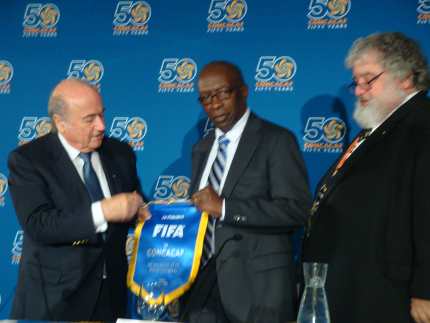
The report focuses on the activities of Jack Warner and Chuck Blazer (pictured above), both of whom have been discussed on multiple occasions on this blog. Here is the remarkable list of top line conclusions of the report:
• Warner Committed Fraud Against CONCACAF and FIFA
• Warner Committed Fraud and Misappropriated Funds from FFA
• Warner and Blazer Breached Their Fiduciary Duties to CONCACAF
• Warner and Blazer Violated the CONCACAF Statutes
• Warner Violated the FIFA Ethics Code
• Blazer Misappropriated CONCACAF Funds
• Warner and Blazer Breached Their Fiduciary Duties to CONCACAF
• Blazer Violated the CONCACAF Statutes
• Blazer Violated the FIFA Ethics Code
• Blazer Violated U.S. Federal Tax Laws
• Blazer Breached His Fiduciary Duties to CONCACAF and CMTV
• Blazer Violated the CONCACAF Statutes
• Warner and Blazer Committed Fraud Against CONCACAF
• Warner and Blazer Breached Their Fiduciary Duties to CONCACAF
• Warner and Blazer Violated the CONCACAF Statutes
Not surprisingly, neither Warner nor Blazer cooperated with the investigation meaning the the investigators relied a great deal upon investigative reporting from the media to assemble the report. This means that much of the information in the report has been publicly available for some time, and should serve as (another) vindication of the excellent reporting that has been done by reporters, and largely ignored by FIFA (or worse, treated hostile fashion).

The scope of the alleged fraud is remarkable, totaling to the tens of millions of dollars. It is also comedic in its apparent brazenness. One of the holding companies that Jack Warner incorporated to take ownership of a FIFA-sponsored football training center -- called a Centre of Excellence -- the report alleges, was named Renraw Investments Limited. Yes, that is "Renraw" as in Warner spelled backwards.

FIFA was contacted by the CONCACAF Integrity Committee on this issue. Here is how the report characterizes the response:
As FIFA informed CONCACAF in 2012, based on its review of records, it “was never aware that the Centre of Excellence would not be owned by CONCACAF."
Because FIFA has also rejected the following recommendation of the IGC, FIFA is in effect saying that it does not want to have the capability to identify such fraudulant activities -- even when it comes to the misappropriation of FIFA funds.
That the President and all Members of the ExCo as well as the standing Committees of FIFA  undergo an integrity check performed by an independent body within FIFA centrally prior to their (re-)election.
The scale of the alleged corruption is staggering. The report quotes Chuck Blazer as saying:
“[T]here are so many things that we could have done with the 10s of millions of dollars wasted there.”
Here is tabulation of the looting of CONCACAF according to my reading of the report:
  • $16 million (misappropriated Centre of Excellence, from FIFA, T&T)
  • $10 million (more COE, from FIFA FAP funds, other?)
  • $462,000 (COE, from Football Federation Australia)
  • $11 million (CONCACAF expenses paid to Warner)
  • $20 million (CONCACAF compensation to Warner)
  • $20.6 million (CONCACAF compensation to Blazer)
  • ~$10 million? (CONCACAF for Trump tower apartment, Miami South Beach apartments, Bahamas apartment, a Hummer, American Express account, insurance)
This totals to a staggering $88 million!

The Integrity report concludes:
The record leaves no doubt that Jack Warner and Chuck Blazer did much to promote and develop the sport of football both in the CONCACAF region and globally over a period of more than two decades. Each man deserves considerable credit for his contributions to the advancement of football. Nevertheless, it is equally apparent that Warner and Blazer, together and individually, used their official positions to promote their own self-interests, and frequently acted with disregard for the interests of the CONCACAF member associations and with disdain for the rules that governed their conduct. Furthermore, it is apparent that Warner and Blazer each was aware of the risk of potential misconduct posed by the other and was most capable of holding the other accountable; but neither did so, at least in part, to preserve the unfettered freedom to act in his own self-interest. This mutual lack of accountability enabled Warner and Blazer to coexist in unity for many years until May 2011, when Blazer disrupted the balance by reporting Warner to FIFA for ethics violations related to Mohamed bin Hammam’s campaign for President of FIFA.
The Integrity Report leads to questions:
  • What will FIFA do in response?
  • What will CONCACAF do in response?
  • What will Sunil Gulati, newly elected CONCACAF representative (US) and FIFA IGC member, do in response?
  • What will US authorities do in response?
Football governance has reached another important fork in the road.