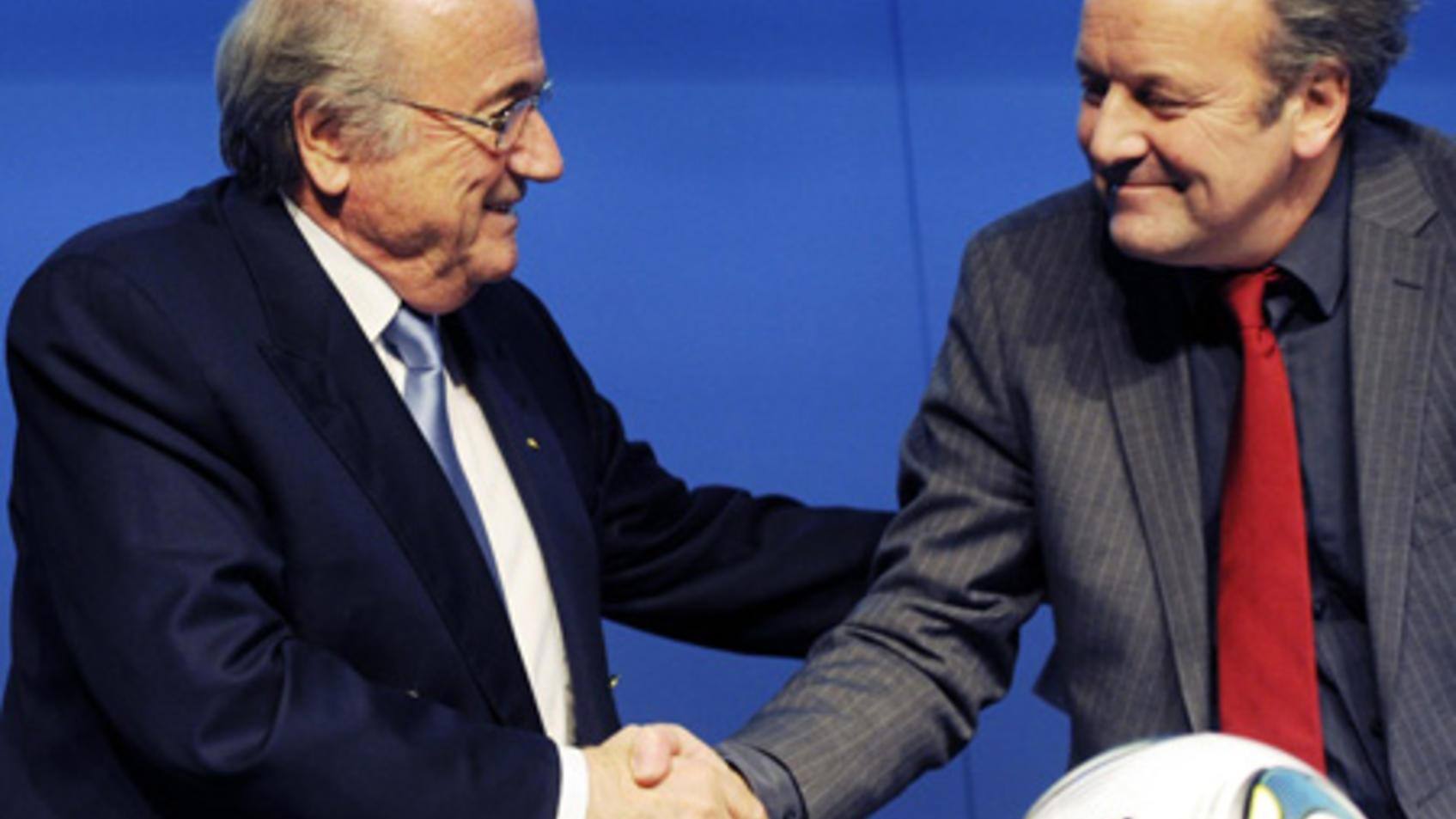
When Blatter learned that OlĂ©'s book of cartoons was imminent he responded with typical FIFA transparency. He sent his lawyers to a Zurich court in late 2013 claiming that their client “has a good reputation and if the cartoons were published he would never be able to repair the damage.”Like most efforts to squelch speech, this one failed too. You can find an English version of the cartoon book here at Amazon.
Stop laughing.
Sunday, March 29, 2015
Blatter vs. The Cartoonist
It is difficult to be surprised by anything that FIFA does. Via investigative journalist Andrew Jennings comes details of a legal campaign by FIFA to prevent the publication of a book of cartoons about Sepp Blatter and FIFA. An excerpt:
Tuesday, March 24, 2015
Congrats to Nick Harris at Sporting Intelligence
Congrats!
Last night Nick Harris, proprietor of Sporting Intelligence, took home the award for top specialist sports website at the annual British Sports Journalists Awards.
Congratulations to Nick and to the contributors to Sporting Intelligence, as well as to all the other award winners.
You can follow Nick on Twitter @sportingintel and regular contributors: @teddycutler @ianherbs
Last night Nick Harris, proprietor of Sporting Intelligence, took home the award for top specialist sports website at the annual British Sports Journalists Awards.
Congratulations to Nick and to the contributors to Sporting Intelligence, as well as to all the other award winners.
You can follow Nick on Twitter @sportingintel and regular contributors: @teddycutler @ianherbs
Monday, March 23, 2015
Data Point of the Day: Madness in March
Percentage of NCAA men's basketball players who think that they are somewhat likely to go pro?
76%
Percentage of NCAA men's basketball players who actually make it to the NBA?
1.2%
Percentage of NCAA men's basketball players who play professionally at any level (e.g., Europe, NBA D League, etc.)?
11.6%
76%
Percentage of NCAA men's basketball players who actually make it to the NBA?
1.2%
Percentage of NCAA men's basketball players who play professionally at any level (e.g., Europe, NBA D League, etc.)?
11.6%
A Forensic Estimate of Sepp Blatter's Salary
Over at Sporting Intelligence I parse the latest FIFA financials to uncover a few more clues about Sepp Blatter's salary.
Read it here and feel free to come back with any comments.
Wednesday, March 18, 2015
Research Question: Media Attention to Sports?
I have stumped some of my colleagues who study the media, so I am enlisted the help of the crowd. For my new book, I'd like to report on how much attention (in absolute or relative measures) that the media place on sports.
By "the media" I am referring to online, print, TV, etc. I welcome US-focused data or international. I have come across a 2001 paper from Northwestern University looking at print newspapers. But that was before the big changes in the journalism landscape occurred.
Any pointers or suggestions most welcomed! (email rpielkejr at gmail or comments below).
Thanks.
By "the media" I am referring to online, print, TV, etc. I welcome US-focused data or international. I have come across a 2001 paper from Northwestern University looking at print newspapers. But that was before the big changes in the journalism landscape occurred.
Any pointers or suggestions most welcomed! (email rpielkejr at gmail or comments below).
Thanks.
Monday, March 16, 2015
Thursday, March 12, 2015
ASU's Curtain of Distraction - Second Bite of the Apple
At The New York Times, Justin Wolfers is back with another look at ASU's "curtain of distraction" -- a fun little stage that students use to try to distract opponents when shooting free throws. In my earlier critique I was pretty generous to Justin. This post is less generous. Fool me once ...
In January, I showed that Wolfers' first analysis was spurious and was a good example of torquing data to fit a narrative. Then I wrote:
But then Wolfers says this:
It is not even worth looking at this analysis unless it compares apples to apples. Either compare all teams over the past 2 years, or all teams over the past 5 years. It is fairly obvious to any quant that a short-term dataset of this type will have much higher variability than a longer-term dataset. Wolfers does present the data for ASU over 5 years, no such relationship exists. He doesn't present the data for all teams for 2 years. I can guess what it might show.
Given than the ASU numbers already been shown to be spurious, mixing them in improperly with another dataset does not alter this fact. Stuff like this gives data journalism a bad name.
In January, I showed that Wolfers' first analysis was spurious and was a good example of torquing data to fit a narrative. Then I wrote:
Sure one can spin a compelling narrative and find some numbers that seem to support that narrative. As the saying goes, numbers which are sufficiently tortured using statistical methods will ultimately confess. As a corollary I might add that pretty much any narrative one cares to spin can be supported by some plausible or plausible-sounding data. But I'm also pretty sure that is not how "data journalism" is supposed to work.
As far as narratives go, the ASU Curtain of Distraction is a great one. Too bad the numbers don't follow along.
I asked Wolfers several times via email and Twitter for his data, and he ignored me. This is pretty common in academia I am afraid, but journals have cracked down in peer reviewed settings. Academics aspiring to be data journalists should continue to meet professional standards, even when publishing in the New York Times, but I digress.
Wolfers is back with a second effort to fit the data to the narrative. In the NYT today he writes of a look across college basketball:
We found that distraction works. On average, college basketball players are about one percentage point less likely to make a free throw when in front of a hostile crowd than when at home. They are not less accurate in neutral arenas, which suggests that what matters is not whether a player is in a familiar arena, or whether they have had to travel, but whether they are trying to shoot in front of an organized student section hellbent on distracting them.The home court advantage in basketball is very well known, so the overall conclusions of a small home court advantage in free throw percentages confirms that which we already know.
But then Wolfers says this:
Our analysis reveals that there appear to be some fan sections that are particularly effective. The best remain the Arizona State fans, at least since their introduction of the Curtain of Distraction. Teams playing in front of the curtain shoot about nine percentage points worse than they do at home. A handful of other teams, including Northwestern, Baylor, Utah, Nebraska and U.C.L.A., are also blessed with effective fans, costing visitors about one point per game on average.You may not have noticed what Wolfers has done with some statistical sleight of hand, so let me explain. He looks at data for all teams over 5 years, but ASU over just 2 years. You have to follow a few asterixes to the fine print to discover this - he writes at the bottom: "That said, this [ASU] data sample is significantly smaller than those of other colleges, which grouped five seasons into a single rating." What!?
It is not even worth looking at this analysis unless it compares apples to apples. Either compare all teams over the past 2 years, or all teams over the past 5 years. It is fairly obvious to any quant that a short-term dataset of this type will have much higher variability than a longer-term dataset. Wolfers does present the data for ASU over 5 years, no such relationship exists. He doesn't present the data for all teams for 2 years. I can guess what it might show.
Given than the ASU numbers already been shown to be spurious, mixing them in improperly with another dataset does not alter this fact. Stuff like this gives data journalism a bad name.
Are We All Complicit in Doping Scandals?
The basic story of doping in sport goes something like this. A superstar athlete is caught doping. There is great outrage expressed among athletes, fans, and the media. The athlete is punished, shamed and sometimes ostracized. Everyone laments doping and lays blame on the bad apple. Then we set things up for the pattern to repeat. And it does.
It doesn't have to be this way of course.
In my latest piece at Sporting Intelligence I discuss some "uncomfortable truths" laid bare by the UCI CIRC report issued earlier this week. Here is how my essay begins:
It doesn't have to be this way of course.
In my latest piece at Sporting Intelligence I discuss some "uncomfortable truths" laid bare by the UCI CIRC report issued earlier this week. Here is how my essay begins:
Sport, it is often said, is a mirror to society. That is no more true than in the revelations found in the report of the Cycling Independent Reform Commission (downloadable as a PDF on this website), which earlier this week released its report on doping in professional cycling. We may not like what we see when we look into that mirror. Here are three uncomfortable truths that The CIRC forces us to confront.Please head here to read the whole thing. You are welcome to come back and comment if you'd like.
Tuesday, March 10, 2015
Monday, March 9, 2015
Inside the CIRC Report: Part I, Doping Knowledge
This is the first of what will be a series of posts on the Cycling Independent Reform Commission Report (available here). The report is substantive and covers a range of different issues. These posts are as essentially notes for me to help organize my thoughts, and if readers also find them of some use, so much the better. Comments are of course welcomed.
This first post asks, what did UCI know about systematic doping in cycling?
Prior to the release of the CIRC report, there were competing narratives on what UCI knew and when it knew what.
On the one hand, in 2012 the Daily Mail reported that that, "[Hein Verbruggen] the former head of world cycling knew about [Armstrong's] drug abuse and encouraged him to cover up his doping."
On the other hand, in response the Telegraph reported of Hein Verbruggen, "The man accused of covering up Lance Armstrong’s drug-taking has hit back at the American’s claims, branding them “b---s---”.
So which is it?
There is a bit of confusion here, which can be traced back to the USADA "Reasoned Decision" for entering headline-type allegations into the public discussion which, after investigation, do not appear to hold up. Even so, in the end, the CIRC concludes that UCI was not only deeply aware of doping in cycling, but helped to cover it up.
First the bits that need some clarification.
- There has been rampant speculation that donations Armstrong made to UCI were in effect "bribes." The CIRC report finds "no evidence" to support a linkage between the donations and favorable treatment of Armstrong. However, "CIRC considers that UCI did not act prudently in accepting a donation from an athlete, all the more so given the rumours about him doping."
- CIRC finds no evidence to support that UCI covered up a positive test of Armstrong at the 2001 Tour de Suisse. In fact, Armstrong's test was merely "suspicious" but not positive. CIRC notes that this is contrary to affidavits by Tyler Hamilton and Floyd Landis as part of the USADA "Reasoned Decision." CIRC raps USADA for allowing such allegation into the public discussion without proper investigation.
- CIRC finds that UCI was complicit in facilitation Armstrong's backdating of a prescription: "it should have been obvious to UCI that the medical certificate provided by his doctor was backdated and solely provided to justify a posteriori the traces of triamcinolone found in the rider's urine." CIRC says that the UCI should have reported Armstrong and his doctor to "the criminal authorities and the relevant medical boards." In this instance, CIRC does not name names, but Verbruggen was the head of UCI when it facilitated Armstrong's evasion of consequences for the positive doping test.
I have studied the CIRC report and I am satisfied that it confirms what I have always said: that there have never been any cover-ups, complicity or corruption in the Lance Armstrong case (or, indeed, in any other doping cases) . . .In stark contrast, Brian Cookson, the current head of UCI called on Verbruggen to resign his position as "honorary president" of the UCI:
I am very concerned by what I read in the report about [Verbruggen]’s actions and I will write to him asking him to consider his position as honorary president.The CIRC report goes into considerably more detail about Verbruggen's and Pat McQuaid's leadership of the UCI. These details offer ample support for Cookson's call for Verbruggen's resignation and makes Verbruggen's claim to exoneration look pretty silly.
Based on a review of various episodes 1992 to 2006, here is CIRC's very hard-hitting bottom line:
The doping problem was well known to the UCI leadership and it was clear to everyone that doping was endemic in cycling. Hein Verbruggen had acknowledged this, in principle in his campaign manifesto when running for president of UCI in 1991. After his election, UCI employed a strategy of diverting public opinion from the fact that UCI was responsible for the doping issue in cycling. Doping was portrayed by UCl leadership as the faulty (and surprising) behaviour of a few individuals, but not as endemic group behaviour or as a structural problem within its sport.Doping among professional cyclists was known to UCI, which sought to manage it as an unspoken norm of the sport. UCI went so far as to facilitate doping, intentionally and also as a consequence of health measures, and to protect athletes from scrutiny. The CIRC report offers a pretty depressing tale of corruption, abuse of power and disdain for rules.
Not only did UCI leadership publicly disregard the magnitude of the problem, but the policies put in place to combat doping were inadequate. Credit should be given to the UCI insofar as it was at the forefront of anti-doping in introducing new testing techniques. However, the science is only one part of anti-doping strategy. To have an effective antidoping strategy, it is essential to get the right sample from the right rider at the right time and to the right laboratory. In the CIRC's view, there was not enough willingness to put such a system in place. The approach to doping was one of containment, with a focus on protecting health. Looking at the tools available to UCI to combat doping, there was no satisfactory commitment to push the fight against doping beyond the limits of health protection. Anti-doping policy was for the most part based on a predictable and quantitative approach. Going after the cheaters was perceived as a witch-hunt that would be detrimental to the image of cycling.
Since UCI's anti-doping strategy was directed against the abuse of doping substances rather than the use of them, only the visible tip of the iceberg was tackled. Deterrence was not an integral part of the strategy. Instead, the CIRC considers that the policies of announcing sample collections, notifying riders and leaving them unattended, gave riders the opportunity to adapt and to evade testing positive through medical supervision, whilst at the same time giving the impression to the public that cycling was trying to address the doping problem.
The emphasis of UCI's anti-doping policy was, therefore, to give the impression that UCI was tough on doping rather than actually being good at anti-doping.
People ask who won the Tour de France during this era. The CIRC report makes this question a bit more complex, and it is something I'll return to in the near future.
Sunday, March 8, 2015
Top Line Conclusions of the CIRC Report: Corruption, Flawed Governance Endemic at UCI
Late today the Cycling Independent Reform Commission released its independent report to the president of the Union Cyclist Internationale (available here). The 228 report is hard-hitting and provides considerable evidence of corruption at the highest levels of the UCI.
Just briefly, here are some top line conclusions for the period up to 2006:
- There is little evidence to support allegations that Lance Armstrong bribed the UCI with several cash donations that he made to the organization.
- There is strong circumstantial evidence that Armstrong did in effect bribe (a "temporal link" in CIRC's words) UCI president Pat McQuaid by agreeing to participate in the Tour of Ireland, directed by McQuaid's brother, in exchange for favorable treatment.
- The UCI conspired with Armstrong to undercut a report into his alleged doping led by Emile Vrijman.
- UCI was "run in an autocratic manner without appropriate checks and balances."
- UCI lacks transparency in financial matters. (Some parts of the report are redacted.)
- UCI turned a blind eye to doping, and sought to manage "the abuse of doping substances, rather than the use of them."
- There are considerably more ugly details in the lengthy report.
The CIRC report finds evidence of some improvements in governance and outcomes since 2006, but "a culture of doping in cycling continues to exist."
The report is hard hitting and substantive. In the coming days I'll have further posts taking a closer look at different parts of the report. There is a lot in there -- like footnote 296 which alleges that at the 2010 World Cup, 11 soccer players for one particular team tested positive for a banned substance, which was judged to be the result of contamination, and not publicized.
More soon!
Thursday, March 5, 2015
Can Drug Testing be Used to Detect Doping?
Nature has a correspondence in this week's issue on my recent piece on the poor state of data on doping. Simon Evans of Uppsala University argues that drug testing, as currently employed by anti-doping agencies, cannot be used to evaluate the prevalence of doping. He writes:
Roger Pielke Jr suggests that doping prevalence can be estimated by drug testing of athletes (Nature 517, 529; 2015). I contend that this method is flawed: as the autobiographies of some athletes attest, regular dopers have a track record of avoiding testing positive.These procedures are (a) statistical and (b) based on surveys of elite athletes. He cites the results on Hon et al. (recently discussed here), which indicate that 14% to 39% of elite athletes dope.
To estimate doping's true prevalence, two procedures that circumvent inherent weaknesses in simple counts of positive test results are useful.
I don't disagree with anything Evans writes, and find his argument reasonable. However, if it really is the case that drug testing cannot be used to detect doping then it is also the case that the results of drug testing cannot be used to evaluate the effectiveness (or not) of anti-doping regulations and agencies.
Taken to the limit, this would mean that anti-doping regulations are a fig leaf, to be polite, with little purpose beyond the symbolic. Even more reason to shine a bright light on the prevalence of doping and the policies in place to regulate it.
Monday, March 2, 2015
The Home Stretch
I am off completing a book. The title ... The Least Thing. It is about sports in society. More details soon, now back to work!
Wednesday, February 18, 2015
How Many Elite Athletes Dope? A Lot Says a New Study
A new study has just been published by the journal Sports Medicine which argues that, currently, between 14-39% of elite athletes are doping - that is, taking prohibited performance enhancing drugs. The Dutch authors, led by Oliver de Hon, the manager for scientific affairs for the national anti-doping organization of the Netherlands, conclude:
All doping-related discussions and decisions would be strengthened if this vital piece of information, i.e. scientifically reliable information on the prevalence of doping, becomes more readily available.Their conclusions are very much the same as the ones that I argued in my recent piece in Nature. The research by de Hon et al. adds some considerable empirical heft to calls for better data and methods in quantifying the prevalence of doping. Also, as officials involved in sports governance their calls for better evaluation of anti-doping policies should carry some gravitas.
Current data suggest that 14–39 % of elite athletes are doping, but this figure needs further confirmation in different groups of athletes with varying levels and backgrounds. Doping prevalence can be expected to fluctuate substantially between different groups. However, the prevalence figure can be expected to be far higher than the average of 1–2 % of athletes who are caught with doping substances, or their metabolites, in their system. There are many efforts underway to close this gap, but this process is by no means complete.
Evaluations of the prevalence of doping use are not only interesting for sports fans and journalists. They are necessary for anti-doping professionals to enable true evaluation of the effectiveness of their policies. If the non-dopers are cheated by the dopers too often, and when doping tests are insufficient to control doping use in a meaningful manner, anti-doping efforts are doomed to fail. This is not a problem for the anti-doping professionals, but first and foremost for the athletes they have vowed to protect. Tools to evaluate the prevalence of doping use in sports are readily available; they only need to be used more often.
Of note, the authors find that between 19 and 56% of athletes admit to using a permitted performance enhancing drug (nicotine) and conclude:
If the entire doping test system is indeed unable to keep the use of prohibited substances at a lower level than a permitted substance, it adds to the idea that current anti-doping testing is far from effective in curbing doping. It is also disconcerting that calls for more clarity in this area that were made more than 25 years ago have not yet yielded much progress.The paper is perhaps the most significant one yet published on the prevalence of doping and can be found at:
de Hon, O., Kuipers, H., & van Bottenburg, M. (2015). Prevalence of doping use in elite sports: a review of numbers and methods. Sports Medicine, 45(1), 57-69.Evidence suggests that lots of elite athletes dope, anti-doping policies aren't working, and anti-doping agencies aren't doing much about it.
Saturday, February 14, 2015
On Narrative, Data and the ASU Curtain of Distraction
In today's New York Times, economist Justin Wolfers has a front page article on ASU's "Curtain of Distraction.," a feature of its raucous student section at home basketball games. Before diving into this post, let me say up front that I'm a fan of Wolfers research and follow him on Twitter, where he has a great presence. He has a lot of smart things to say on a lot of important subjects, including sports, where he has done some significant work. In this post I'm going to critique his NYT article, which is just not up to Wolfers' usual standards. It also offers a cautionary tale for would-be "data journalists."
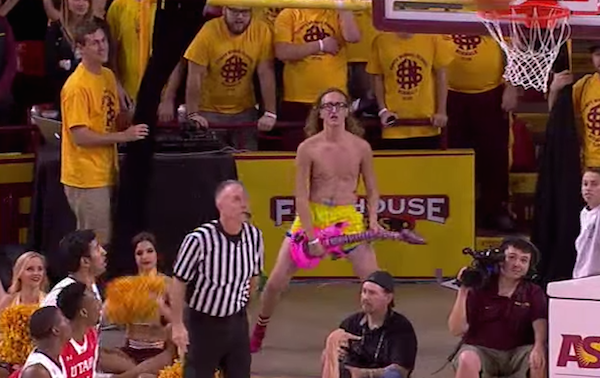
The ASU Curtain of Distraction a make-shift stage that the student section uses to try to distract opposing the opposing team when it is attempting free throws. As the opposing player stands on the free throw line the curtain opens to reveal all sorts of eye-catching displays, from a guy in a Speedo to kissing unicorns (see above for an example). Wolfers argues that the Curtain of Distraction provides ASU with a quantifiable benefit because it leads the team's opponents to miss free throws.
It's a fun news story that combines what is best about college kids supporting their home team and the ideal of data journalism to provide insights behind the story. It's likely that combination of narrative and numbers that landed this article on page one of the NY Times. Unfortunately, like a lot of what passes for "data journalism," when you take a closer look, the story and the numbers don't actually fit together. There is a deeper lesson here about the power of narrative over the substance of data. Let me explain.
Wolfer's article is about causality, and specifically it's about detecting the impact of the Curtain of Distraction in a time series of data on free throws in games that ASU has played at home in Tempe, AZ. There are of course many ways to look for signals in data using statistical methods. As far as methodologically challenging signal detection, this one is not too complicated, because the data is good and the phenomena to be explained are very well observed. Even so, the data do not lend themselves to unique or conclusive claims of causality.
But Wolfers thinks that they do. He explains what he did:
A statistical analysis by The Upshot — with an assist from Nick Wan, who runs the True Brain blog, and from Jan Zilinsky — suggests that the Curtain really works.
It appears to give Arizona State an additional one to two point advantage per home game, beyond the normal home court advantage. The Curtain may even have played the pivotal role in the Sun Devils’ recent upset of their state rivals, the Arizona Wildcats.
The easiest way to see the effect is to compare visitors’ free throw shooting percentage before and after the Curtain’s 2013 introduction. In each of the three seasons from 2010-11 to 2012-13, visitors missed 28 to 32 percent of their free throws. Last season, the Curtain’s first, the rate at which visitors missed free throws rose sharply, to 40 percent.
In the first 14 home games of this season — when the Curtain and its surprises have continued to appear — visitors have missed 36 percent of all free throws. If you didn’t know better, you might suspect that the size of the hoop had gotten smaller.
Given the timing, and the fact that players are powerless to defend a free throw, it seems reasonable to attribute this sharp change to the student high jinks, rather than any change of players or strategy. In fact, the statistics largely rule out competing explanations.
As I'll show, the last sentence is completely wrong, and the conclusion of detection a strong signal from the Curtain of Distraction - an effect of 1 or 2 points a game - is just not supported by the data, despite the appeal of the narrative.
One mistake that Wolfers makes is to look at all free throws. The Curtain of Distraction (CoD) appears only on one side of the court, the student section, which ASU opponents face only in the second half of each game. So to look for a signal of the CoD we should look for its effects in second half free throws.
What do we see when we break down ASU opponents' free throws by half?
In the first half opponents shoot 66.7% when not facing the CoD. In the second half that drops to 61.1%.
Aha!! ... we might say, the effect is 5.6%. But as any student of causality knows, detecting a difference is not the same as accounting for that difference. So let's take a look at individual games to see if we might account for that difference.
It turns out that 8 of the 14 ASU opponents (including 7 of its last 9) actually improved their free throw percentages in the second half. Thus, there is very little basis in these 8 games to suggest that the CoD caused worse free throws. In fact, one could make a stronger case that the CoD improved second-half free throw shooting in the majority of ASU games. Of course, given any data, lots of plausible theories could be proposed.
Looking game-by-game we can quickly see that through ASU's 14 home games this season so far, the reason that opponents shoot a lower free throw percentage in the second half can be entirely attributed to ASU's first two games of the season, Chicago St. and Bethune-Cookman. Chicago St. is ranked 333 of the 351 teams tracked by ESPN, and Bethune-Cookman is ranked 344. These are two of the worst teams in the country. One could plausibly come up with a large number of possible explanations for their poor free throw shooting in the second half - including the CoD - but also more prosaic reasons such as fatigue, or early-season road jitters, or the pressure of facing a much better team, or just chance, or something else.
Since those two games, in the subsequent 12 home games opposing teams at ASU have made 62.3% of their free throws in the first half and 65.0% in the second half. When facing the CoD teams have on average improved their free throw shooting! So even if we were to postulate a CoD effect in those first two games, it clearly wore off pretty quickly (and maybe even reversed;-).
Wolfers takes the causality argument even further when he writes that the CoD "may even have played the pivotal role in the Sun Devils’ recent upset of their state rivals, the Arizona Wildcats." Again, a wonderful story, even movie-script stuff, but the data just does not cooperate. Arizona was 0-2 from the line in the first half and 8 for 12 in the second half (66%). Arizona's season-long free-throw percentage is 69.2%.
The bottom line here is that the evidence does not support, much at all and far from strongly or uniquely, a claim that the ASU Curtain of Distraction impacts opponents free throws in any quantifiable way. (For other analyses see the Harvard Sports Collective and True Brain).
Sure one can spin a compelling narrative and find some numbers that seem to support that narrative. As the saying goes, numbers which are sufficiently tortured using statistical methods will ultimately confess. As a corollary I might add that pretty much any narrative one cares to spin can be supported by some plausible or plausible-sounding data. But I'm also pretty sure that is not how "data journalism" is supposed to work.
Wednesday, February 11, 2015
The (Mostly) Non-News of FIFA's Watered Down Governance Report
Earlier this week Der Spiegel reported that FIFA's "independent" reform committee had submitted a draft of its final report to FIFA, and made subsequent changes at FIFA's request. Someone apparently leaked internal FIFA emails.
As readers of this blog will appreciate, the news is really not news.
We have known for a while that the FIFA IGC (reform committee) was not independent and that its report was watered down (see this summary and full analysis in PDF). We also know that the FIFA IGC chair, Professor Mark Pieth, has faced a wide range of challenges dealing with FIFA, and has not always come away from the experience in the best light (just search this blog for "Pieth").
If there is little new here, the fact that this information has been leaked is itself interesting. Either the internal emails were leaked by Pieth or someone within inside FIFA's "football family." If the former then Pieth once again comes away the worse off, as FIFA's effusive defense of him (via this press release) simply provides more evidence of how conflicted his role of IGC chair actually was -- FIFA actually wrote: " People should stop questioning the independence of such a credible character." Ouch!
If the leaker is another FIFA insider, then it would speak to an internal split over the organization's leadership. However, were I to guess, I'd say that the leak most probably comes from Pieth. Any insider wanting to embarrass Sepp Blatter and also with access to confidential FIFA emails surely has to have better material than this weak tea.
Either way, the leak tells us nothing that we didn't already know: Sepp Blatter is well on his way to captaining FIFA to another term.
As readers of this blog will appreciate, the news is really not news.
We have known for a while that the FIFA IGC (reform committee) was not independent and that its report was watered down (see this summary and full analysis in PDF). We also know that the FIFA IGC chair, Professor Mark Pieth, has faced a wide range of challenges dealing with FIFA, and has not always come away from the experience in the best light (just search this blog for "Pieth").
If there is little new here, the fact that this information has been leaked is itself interesting. Either the internal emails were leaked by Pieth or someone within inside FIFA's "football family." If the former then Pieth once again comes away the worse off, as FIFA's effusive defense of him (via this press release) simply provides more evidence of how conflicted his role of IGC chair actually was -- FIFA actually wrote: " People should stop questioning the independence of such a credible character." Ouch!
If the leaker is another FIFA insider, then it would speak to an internal split over the organization's leadership. However, were I to guess, I'd say that the leak most probably comes from Pieth. Any insider wanting to embarrass Sepp Blatter and also with access to confidential FIFA emails surely has to have better material than this weak tea.
Either way, the leak tells us nothing that we didn't already know: Sepp Blatter is well on his way to captaining FIFA to another term.
Monday, February 2, 2015
My Talk on "Sex Testing" Now Available
You can see my recent talk on "sex testing" in sport here. (Opens an AdobeConnect window)
If you'd like just the slides, they are here in PDF.
And if you'd like a draft for comment version of the full paper, just drop me an email (rpielkejr at gmail). I am happy to receive comments and appreciative of those who have already sent some.
Here is the abstract:
If you'd like just the slides, they are here in PDF.
And if you'd like a draft for comment version of the full paper, just drop me an email (rpielkejr at gmail). I am happy to receive comments and appreciative of those who have already sent some.
Here is the abstract:
Sugar, Spice and Everything Nice:“Sex Testing” in International Athletics
Roger Pielke, Jr.
University of Colorado
Center for Science and Technology Policy Research
Abstract
In many settings, decision makers look to science as the basis for making decisions that are made difficult by their social or political context. Sport is no different. For more than a half century sports officials have looked to science to provide a clear distinction between men and women for purposes of determining who is eligible to participate in women’s athletic competitions. However, the science of sex provides overwhelming evidence that there is no such clear biological demarcation that differentiates men and women. Despite this evidence, the International Olympic Committee and the International Association of Athletics Federations in 2011 implemented a form of “sex testing” based on androgens, and specifically, testosterone levels in females. This paper evaluates this policy, finding it contradictory to scientific understandings of sex and counter to widely-held social norms about gender. The paper recommends an alternative approach to determining eligibility for participation in women’s sports events, one more consistent with the stated values of sports organizations, and more generally, with principles of human dignity.
New Resource: Human Diversity in Sport
Human Diversity in Sport is a new resource focused on increasing awareness of "human physiological diversity" in sport, with a focus on issues related to sex and gender. The resource has been created by Kristen Worley and Mianne Bagger.
The resource will be of particular interest to academics and others due to its searchable database of materials, including academic research, related to human diversity in sport.
They are also on Twitter at @HDiSport.
The resource will be of particular interest to academics and others due to its searchable database of materials, including academic research, related to human diversity in sport.
They are also on Twitter at @HDiSport.
Wednesday, January 28, 2015
How Useful is Anti-Doping Testing Data?
I have a piece out in Nature today (free!) on the utility of anti-doping testing data. It turns out, you can't really use the available data to answer the most basic questions -- such as, how many athletes dope? or Are anti-doping programs effective?
That piece can be seen here.
Over at SportingIntelligence I have a companion piece with more background and data. I show some USADA testing data (above) and conclude:
The data show that the number of athletes sanctioned from 2001 to 2013 almost doubled, and from 2007 to 2013 just about tripled.Have a look at both pieces. I welcomed comments and critique.
Does this mean that doping incidence has doubled or tripled? That USADA’s testing program is twice or three times more effective? Unfortunately, we just can’t answer these questions.
The good news here is that just about everyone – athletes, anti-doping agencies, independent scholars – appears to have shared goals. Moving forward I am hopeful that the anti-doping agencies will help to better support researchers wanting to quantify the prevalence of doping and the effectiveness of anti-doping programs — no matter how uncomfortable the answers might be.
Tuesday, January 27, 2015
Question for FIFA: How many Watches Were Returned?
Last September, FIFA investigated a gift of expensive watches giving to its top officials. Here is what it found:
[The Confederação Brasileira de Futebol] distributed 65 gift bags, each containing a Parmigiani watch, to a group comprising the 28 officials on the FIFA Executive Committee, a representative from each of the 32 Member Associations competing in the 2014 FIFA World Cup Brazil, and a representative from each of the 10 Member Associations in Conmebol. CBF produced records indicating that it obtained the watches from Parmigiani, a CBF sponsor, at a price of USD 8,750 each. The Investigatory Chamber commissioned an independent appraisal of one of the watches CBF distributed. That appraisal determined that the watch had a market value of CHF 25,000. That value was confirmed by a later appraisal done in Zurich.So FIFA asked for the 65 watches back, and stated that it would donate them to a charity organizations.
The FCE [FIFA Code of Ethics] plainly prohibits such gifts.
However, FIFA has never followed up, to my knowledge, to account for compliance to its request for the watches to be returned or to identify the charity to which the watches were donated. I have asked FIFA for this compliance information, and have yet to hear back.
Subscribe to:
Posts (Atom)