Thursday, December 18, 2014

FIFA 2010 ExCo Scorecard (Updated)

UPDATED 28 Dec 2014

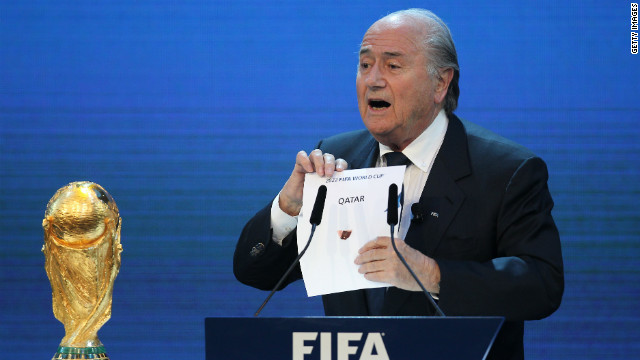
Above is a scorecard I just made up showing the status of the 2010 FIFA Executive Committee. These are the individuals who selected Russia for the 2018 World Cup and Qatar for 2022.

Some summary stats:
  • Of the 24 members 5 have been suspended or banned by FIFA (in red);
  • 13 others have been accused of corruption of one sort or another (in yellow);
  • 9 of those 13 are current members of the FIFA ExCo;
  • Only 6 of the original 24 (in white) do not face allegations (though some might disagree);
  • Only 3 of these 6 are still on the ExCo, including FIFA President Sepp Blatter.
This is a work in progress, so comments welcomed.

The Difficult Economics of Professional Tennis Players

Yesterday, the New York Times reported on a new analysis by the International Tennis Federation:
The I.T.F. surveyed more than 7,000 players and other stakeholders in the sport and analyzed data from the past 14 years, which revealed differences in expenses incurred by players based on ranking, geography and gender, as well as a falling success rate for players transitioning from the junior level to the professional ranks. According to the federation’s study, the number of ranked players competing in junior tennis has increased, while the percentage of those who achieve a professional ranking has decreased significantly.

The I.T.F. found that the top 1 percent of male players (the top 50) earned 60 percent of all prize money, while the top 1 percent of female players (only the top 26 because of the smaller total number) earned 51 percent.
These numbers are similar to those I discussed at FiveThirtyEight earlier this year in a piece I did on income inequality in professional sports, with a focus on golf. In that piece I noted that three men's tennis players, Roger Federer, Rafael Nadal and Novak Djokovic, accounted for 20-26% of total winnings on the ATP Tour from 2007-2011.  

The ITF analysis came up with this incredible statistic:
In an I.T.F. calculation that accounted for only minimal expenses, the ranking point at which players could expect to stop losing money on their careers was No. 336 for men and No. 253 for women. Aside from prize-money discrepancies at many levels of the game, female players have fewer tournaments to choose from and therefore travel more, resulting in higher expenses.
Sponsorships are not included, but these numbers suggests that the professional tennis economies can  only sustain a few hundred players on the men's and women's tour. This cannot be a recipe for developing talent or even sustaining the sport.

Both the ITF and the ATP are implementing proposals to increase prize money and balance out its distribution. Yet, there is a continuing debate over how much income inequality is appropriate in tennis. As Eric Butorac, president of the ATP Player Council, noted: "I think it is so important that we continue to build the base of tennis. However, if fans are not paying to watch these levels of tennis, then where does the money come from?"

Wednesday, December 17, 2014

Concussion Risks: Adults vs. Minors

Here are some very interesting statements from NFL players about the risks of long-term health issues associated with playing the sport.

First Chicago Bears safety Chris Conte:
“I’d rather have the experience of playing in the NFL and die 10 to 15 years earlier than not play in the NFL and have a long life. I don’t really look toward my life after football. I’ll figure things out when I get there. As long as I outlive my parents…. I’m not saying I’m going to go die when I’m 45, 50. I’m fortunate to go out and play football.”
 And also the Seattle Seahawks Richard Sherman:
“Do I think about the consequences 30 years down the line? No more than I think about the food I’m enjoying today, which could be revealed in 30 years to cause cancer or a heart murmur or something else unpredictable. Those are the things you can’t plan for.”
For gridiron football, the existential issues associated with concussions are not primarily with these guys - they are very intelligent adults, well compensated for their work.

The bigger issue is with minors who play the sport - the essential pipeline to the NFL. Can they make similar judgments? Of course not.

Michael Garcia's Resignation Statement

Earlier today Michael Garcia, FIFA's ethics investigator, gave his resignation to FIFA. It was not a surprise. Below is his full statement, which has been reproduced at various media outlets.
"For the first two years after my July 2012 appointment as independent Chairman of the FIFA Ethics Committee’s Investigatory Chamber, I felt that the Ethics Committee was making real progress in advancing ethics enforcement at FIFA. In recent months, that changed.

On September 5, 2014, I and Cornel Borbely, the Deputy Chair of the Investigatory Chamber, sent a “Report on the Inquiry into the 2018/2022 Fifa World Cup Bidding Process” (the “Report”) to the Fifa Ethics Committee’s Adjudicatory Chamber. The Report identified serious and wide-ranging issues with the bidding and selection process. (Mr. Borbely also filed separate reports from his inquiries into the activities of the bid teams from Russia and the United States.)

Soon after, the Chairman of the Adjudicatory Chamber, Hans-Joachim Eckert, indicated publicly that only limited information from the Report would be made public. Concerned that insufficient transparency would not serve Fifa’s interests, I issued a public statement calling on the Fifa Executive Committee to authorize the appropriate publication of the Report. The Executive Committee took no action on this subject during its September 2014 meetings — other than to refer me to the Fifa Disciplinary Committee for allegedly violating the Code of Ethics through my public comments, namely, my public request that the Executive Committee authorize appropriate publication of the Report and the on-the-record statement Mr. Borbely and I released concerning watches given to certain football officials. The Chairman of the Disciplinary Committee, Claudio Sulser, ultimately rejected the Executive Committee’s referral.

On November 13, 2014, Mr. Eckert issued a 42-page “Statement of the Chairman of the Adjudicatory Chamber of the Fifa Ethics Committee on the Report on the Inquiry into the 2018/2022 Fifa World Cup Bidding Process prepared by the Investigatory Chamber of the Fifa Ethics Committee” (the “Eckert Decision”). In a cover letter, Mr. Eckert described the statement as his “findings, including certain descriptions of the contents of the Investigatory Chamber’s report.”

The issues raised by Mr. Eckert’s selection and omission of material from the Report, and his additional comments, went far beyond the initial transparency concerns. As my public statement at the time explained, the Eckert Decision contained “numerous materially incomplete and erroneous representations of facts and conclusions.” Accordingly, I appealed.

A brief I filed with the Fifa Appeal Committee on November 24, 2014, outlined the Eckert Decision’s most serious failings. Among other points, the brief explained why, when viewed in the context of the Report it purported to summarize, no principled approach could justify the Eckert Decision’s edits, omissions, and additions.

Yesterday’s decision by the Appeal Committee declined to address these points. Instead, the Appeal Committee rejected my appeal on procedural grounds, concluding that “it is not necessary for the Fifa Appeals Committee to enter into considerations on the substance of the appeal.” The Appeal Committee found that the Eckert Decision was “merely a personal opinion on the Report” and had “no legally binding effect whatsoever.” It reached this conclusion even though, under Article 36 of the Code of Ethics, only “final decisions” may be made public, as the Eckert Decision, which was published on Fifa’s website, obviously was. The Appeal Committee also overlooked the Eckert Decision’s self-described “findings,” including one stating that “the evaluation of the 2018/2022 Fifa World Cups bidding process is closed for the Fifa Ethics Committee.” Fifa President Blatter recently reaffirmed that “finding” during an interview published by Fifa, stating: “Furthermore, there is no change to Judge Eckert’s statement that the investigation into the bidding process for the 2018 and 2022 Fifa World Cups is concluded.”

I disagree with the Appeal Committee’s decision.

It now appears that, at least for the foreseeable future, the Eckert Decision will stand as the final word on the 2018/2022 Fifa World Cup bidding process. While the Appeal Committee’s decision notes that further appeal may be taken to the Court of Arbitration for Sport, I have concluded that such a course of action would not be practicable in this case. No independent governance committee, investigator, or arbitration panel can change the culture of an organization. And while the November 13, 2014, Eckert Decision made me lose confidence in the independence of the Adjudicatory Chamber, it is the lack of leadership on these issues within Fifa that leads me to conclude that my role in this process is at an end.

Accordingly, effective today, December 17, 2014, I am resigning as independent Chairman of the Investigatory Chamber of the Fifa Ethics Committee."

Tuesday, December 16, 2014

You Don't Like FIFA Jurisprudence? Tough Shit

FIFA is an odd, insular organization. As such, it has developed a form of jurisprudence that to an outsider looks amateur, self-serving and inconsistent. But if you don't like it, too bad. Illustrating this, today FIFA released two decisions related to its ongoing investigation of the 2018 and 2022 World Cup site selections..

One was a decision on an appeal lodged by Michael Garcia, the lead investigator looking into the 2018/2022 decisions. After submitting his 400+ page report to the FIFA Adjudicatory Chamber, its chairman, Hans Joachim Eckert, released a 42 page statement with four findings (here in PDF):
  • The evaluation of the World Cup bidding process is "closed for thr FIFA Ethics Committee;"
  • The investigation was conduction in "full compliance" with FIFA's Code of Ethics;
  • Eckert supports the recommendations in the Garcia report;
  • The Adjudicatory Chamber will consider "specific cases" of ethics violations if Garcia open proceedings against any individuals.
Garcia protested in the media that Eckert's report "numerous materially incomplete and erroneous representations of the facts" and lodged an appeal with FIFA. Today FIFA ruled on that appeal (here in PDF). 

In short, FIFA rejected Garcia's appeal. FIFA explained that:
In its assessment of the matter, the FIFA Appeal Committee pointed out that the chairman of the adjudicatory chamber of the Ethics Committee (and not the adjudicatory chamber as such) had released a statement on the Report prepared by the investigatory chamber. In doing so, the chairman had merely commented on the Report of the investigatory chamber on a voluntary basis. 
In other words, FIFA is saying that it has no basis for adjudicating a dispute over a representation of facts. Further, because no sanctions were recommended by Eckert against anyone, then there is no basis for an appeal, which can apparently be lodged only against a sanction of an individual.

In plain English, under FIFA's bizarre jurisprudence, a whitewash (defined as giving a clean bill of health based on factual errors) is simply not appeal-able. (Whether this is in fact a whitewash or not is irrelevant.)

One possible silver lining is that FIFA may have opened the door for Michael Garcia to prepare his own "voluntary" comment on his report. As FIFA notes of Eckert's summary: "the Report, as transmitted by the chairmen of the investigatory chamber to the chairmen of the adjudicatory chamber, is as such not foreseen under the FIFA Code of Ethics." The same presumably goes for any summary that Garcia chooses to release "voluntarily."

The second decision handed down today involved a complaint lodged by two whistle blowers which FIFA had identified in Eckert's "voluntary" summary of the Garcia report. The whistle blowers had been promised confidentiality by FIFA, a promise which was broken. So Phaedra Almajid and Bonita Mersiades lodged a complaint.

FIFA dismissed the complaint. James Corbett observes that the media release by FIFA says something different than the letter sent to the whistle blowers. In the media, FIFA said that the complaint was dismissed because the whistle blowers had already spoken to the media, a claim that Corbett shows to be untrue. Either way, it makes one wonder why FIFA promised confidentiality in the first place, if it had no intention of respecting that promise. But in a letter to Almajid, FIFA says that her complaint was dismissed because she is not a football official, and thus FIFA has no jurisdiction over her complaint.

In other words, FIFA is saying that it has no accountability to its behaviors with respect to anyone outside FIFA. More to the point, FIFA is saying: "Don't like it? So sue us." The next stop for the whistle blowers would necessarily be the Swiss court system, which seems unlikely due to costs and precedent.

For all the absurdities surrounding FIFA's odd style of jurisprudence, there is little point in complaining. FIFA is a non-profit association located in Switzerland. They are not a public body and have essentially no accountability to anyone outside the association. They have every right to make up rules, change them on a whim and ignore them as is convenient. Don't like it? Tough shit. That is the way it is.

For change to occur in how FIFA does business, FIFA will have to be changed.

Monday, December 15, 2014

German Doping Documentary on Russia


Above is the recent documentary produced by German TV station ARD which contain the explosive allegations of systematic doping among Russian athletes (and others). The documentary is in German, but an English script can be found here in PDF.

ARD put out a press release whichstarts out as follows (the whole thing is here):
With a degree of clarity previously never seen, athletes, coaches and other whistleblowers have undermined the reputation of this year’s Olympic and future football World Cup host Russia – before the camera and with plenty of evidence. In the programme “Top-secret Doping: How Russia makes its Winners” (Wednesday, December 3rd 18.50 – 19.50 hrs., Das Erste – First German TV Channel), several people involved in Russian sport deliver extensive evidence about state-supported doping and massive corruption and coverups. “You cannot achieve the results that you are getting, at least in Russia, without doping. You must dope. That’s how it is done in Russia. The officials and coaches clearly say by using natural ability you can only do so well. To get medals you need help. And the help is doping, prohibited substances”, Vitaliy Stepanov told the ARD. Stepanov was an employee of the Russian Anti-Doping Agency RUSADA for three years and even advised the DirectorGeneral. He reports for the first time and openly before the camera about his experiences.
The program is worth watching (or reading) in full.

Lots of Action: A Sports Governance Run Down

There is an awful lot of stuff going on in the world of sports governance. I'd like to devote a post to each of these, but a listing will have to do for now.
  •  Ary S. Graça, president of the FIVB (International Volleyball Federation) faces accusations by the Brazilian government of financial improprieties while serving as the head of the Brazilian Volleyball Federation (CVB). Meantime the president of Polish Volleyball Federation is accused of accepting bribes.
  • The Swiss government has passed new legislation that defines sports executives (and their staffs and families) as what is called "politically exposed persons." The legislation, part of what's called "Lex FIFA,"creates new authority to look into the financial transactions of these individuals. It represents a significant step by the Swiss government and is reportedly not the last legislative action that will be taken.
  • Some materials from Michael Garcia's investigation of FIFA's World Cup 2018/2022 process have been leaked to Andrew Jennings. James Corbett explains that the materials show FIFA vindictiveness at those who it has judged to violate its culture of omerta. This leak is probably of interest to those paying close attention, and lacks any sort of bombshell revelation.
  • The IAAF (International Association of Athletics Federations) is facing what could be a monumental scandal. A German TV documentary has alleged that the IAAF has participated in covering up institutionalized doping by Russia and the son of the IAAF president sought a bribe from Qatar. The IAAF official in charge of its anti-doping program resigned after being interviewed by its ethics committee. Lots to play out in this story.
  • In Italy, an investigative report by a public prosecutor looking into the affairs of Dr. Michele Ferrari (yes, the same guy who was Lance Armstrong's associate) has been leaked. The report (leak to La Gazetta della Sport) contains the names of 38 cyclists and other athletes who allegedly used banned performance enhancing drugs. At least one of these athletes is British, and Twitter chat I've seen suggests it is a big name. Stay tuned.
Each of these are big, big stories. More to come on each.

Friday, December 5, 2014

Against the Autonomy of Sport

I have a piece in the FT today arguing that conventional wisdom of the "autonomy of sport" has been taken too far. Exactly how governments might play a constructive role in the governance of international sports is a topic for another time. This piece argues that they must.

Comments welcomed.
Sport, it is often said, should be free to govern itself. That is a principle endorsed by no less an institution than the UN, which in October passed a resolution supporting the independence of sport.

Thomas Bach, the former Olympic fencer who now runs the movement’s organising body, goes so far as to call athletic competition “the only area of human existence which has achieved universal law”, arguing that it is incumbent on politicians to respect the autonomy of sport.

Yet for all these lofty words, experience tells us that leaving sport to govern itself is a bad idea.

Politics and sport are inextricably mixed. They always have been. We have learnt over and over that corrupt practices in sport can easily spill over into more combustible areas of international politics and business. It is time for governments to take a much bigger role in governing sport.

Kowtowing to the autonomy of sport means stopping governments from doing their jobs. In 2011 Fifa, the organisation that oversees world football, suspended the Football Federation of Belize, citing “severe government interference” in the national football body. Yet it was surely the prerogative of the courts, rather than Fifa, to decide whether the government had overstepped its bounds.

It is both sensible and practical for governments to stay out of disputes involving what happens on the pitch or in the arena. That is what happened during the World Cup in Brazil this year, when Luis Suárez took a bite out of the shoulder of Italy’s Giorgio Chiellini. The Argentine football star’s ensuing suspension was delivered by the sporting bodies, which also handled the appeal and enforced the ban. In another setting, the assault would probably have been a matter for the police. The autonomy of sport is best thought of in terms of what happens in competition.

The deeply unsatisfying process employed by Fifa to select World Cup venues for 2018 and 2022 illustrates what can happen when sports and politics mix at the highest levels, especially when accountability is lax. The alleged misdeeds go far beyond a few shady individuals taking bribes for votes, and in some instances may involve state-sponsored corruption. Allegations of impropriety surround the bids submitted by Russia, Qatar and the UK, among others.

If governments do not step in to help govern sport we may well find that global sporting events continue to gravitate to poorly governed places where corruption can flourish autonomously. Norway recently dropped out of the running to host the 2022 Winter Olympics, citing unreasonable costs. That leaves only Kazakhstan and China in the running. On the Transparency International Corruption Perceptions Index, Norway ranks fifth. China ranks 100th, and Kazakhstan 126th.

Mr Bach is right to say that sport has developed one of the best examples of universal law. That can be found in the institutions which oversee doping, the use of prohibited performance-enhancing substances in international competitions.

In a conspicuous exception to the notion of the autonomy of sport, the relevant agency operates under the provisions of a UN treaty ratified by more than 170 governments. It is overseen by representatives drawn, in equal number, from the Olympic movement and public authorities.

Observers of Fifa are right to complain about its failure to meet basic standards of governance and its ossified, insular leadership. However, little will change until we bring the games we love inside the ambit of the governance mechanisms we use in just about every other area of modern society.

That will not make problems in sport go away. But it will give us a better way to deal with them.

Tuesday, December 2, 2014

College Football is Uneconomic

The University of Alabama-Birmingham is reportedly to shut down its college football program. This is big news, because college football programs are rarely terminated. Since 1920 only 9 other universities (in the highest division) have dropped their football programs(Clotfelter 2011, p. 50).

One of the reasons that UAB has given for ending football is the dismal finances of the program. According to USA Today, in 2013 the school's athletics program required a subsidy of more than $18 million representing about 64% of its total budget (with "subsidy" defined as "students fees, direct and indirect institutional support and state money").

Interestingly, of the top 230 schools 33 schools required a greater subsidy than UAB in absolute dollars and 124 in terms of percentage. So from a comparative perspective, UAB's finances do not appear particularly unusual in the context of college sports.

More generally, of those 230 schools, their athletic programs received revenues of more than $8.1 billion, mostly from football and basketball. Of this total, more than $2.4 billion, about 30%, was subsidized. College sports, overall, are simply uneconomic. They require socialized support to sustain. Historically, securing such support has not been difficult, as big-time athletics is valued on college campuses and communities.

In 2013, only 7 schools (of the 230 in the USA Today survey) received no subsidy for their programs. Given this state of affairs, losing money is probably not going to fly as a good reason for terminating the UAB program. I'd expect a vigorous debate to ensue on the UAB campus and in the Birmingham community.

Monday, December 1, 2014

State-Sponsored Corruption of the World Cup Bidding Process

Last week, The Sunday Times continued its heroic work investigating FIFA by submitting a brief to the UK Parliament on its ongoing analysis of the so-called FIFA Files which a whistle blower shared with the paper.

The most important new revelations in the submission, published here, are that the allegations of corruption involving FIFA and the awarding of the 2018 and 2022 World Cups involve much more than just individuals selling votes. As one source told the Sunday Times:
“We did have intelligence that states paid bribes to Fifa members"
State-sponsored corruption of FIFA, which is probably an surprise to no one, makes the issue even more difficult. The new revelations originate in an intelligence-gathering effort by the England 2018 campaign which apparently spied on its competitors and assembled a yet-to-be-released dossier on what it found. It is alleged that the British government aided in the spying campaign.

The Sunday Times explains of the Russian bid:
Sources said Putin was understood to have summoned a select group of oligarchs and tasked them with doing whatever was necessary to ensure the victory of the Russia 2018 bid, including striking personal deals with voters. The ex-MI6 source said: “What you need to remember about this is the way this was done in Russia is that nothing was written down. Don’t expect me or anyone else to produce a document with Putin’s signature saying please X bribe Y with this amount in this way. He’s not going to do that.” He explained: “Putin is an ex intelligence officer. Everything he does has to be deniable.” He said that the deals with voters “would have been strategic level but not state to state because of the need for deniability. That’s why the oligarchs were brought in”.  He added: “Sochi was a complete pigs’ trough in terms of corruption and the World Cup is five times as big.”
The currency of corruption was allegedly gas deals brokered by energy rich Russia and Qatar. The Sunday Times provides what appears to be a smoking gun linking a gas deal between Qatar and Thailand to the World Cup (reported here last June and then denied here immediately thereafter).

One remarkable allegation involves Michele Platini, head of UEFA, and widely expected to run for the FIFA presidency when Sepp Blatter finally step down in 2068. The Sunday Times reports that Platini was given a Picasso painting by the Russian government, even Putin himself (Platini denies this and has threatened a libel suit). Other FIFA officials are also accused of accepting gifts of art from Russian vaults, with Michel D'Hoogh of Belgium, confirming that he was indeed given a painting. Platini was also alleged to have been pressured to vote for the Qatar bid by Nicolas Sarkozy, the French president at the time, to facilitate political relations between France and Qatar.

The individuals named in the Sunday Times briefing to the UK parliament include Vladimir Putin, Nicolas Sarkozy, David Cameron and refers to government officials of other countries as well. If you want to understand why it is that FIFA cannot handle this issue on its own, you need look no farther than this.

To reform FIFA will require the involvement of governments, and at the highest levels. With David Cameron and Nicolas Sarkozy looking at upcoming elections, it would be hard to imagine either taking an interest in FIFA reform. Perhaps current French President Hollande might see an advantage in raising the issue, but I doubt it. It is hard to imagine other footballing nations or those involved in the 2018/2022 bidding process taking an interest either (probably ruling out Germany and Holland).

So that most likely leaves the US and its FBI, which is apparently looking into FIFA for yet-to-be-released reasons. The incoming Republican Congress might appreciate a chance to focus attention on foreign governments involved in corrupt practices. While possible, both seem like long shots, especially the interest of the US Congress. The more likely outcome is lots of outrage and indignation followed by World Cups in Russia and Qatar in 2018 and 2022. But I'd like to be proven wrong.

Thursday, November 13, 2014

FIFA Qatar Report

Earlier today, the FIFA report on Qatar -- more accurately, a summary of the FIFA report on Qatar -- was released. The bottom line was a complete vindication of the integrity of the FIFA World Cup bidding processes for 2022. FIFA is congratulating itself, many others are calling it a whitewash.

The Guardian has a good summary of various reactions.

While the verdict was not a surprise, lead investigator Michael Garcia's reaction was unexpected. He has claimed that the summary report: “contains numerous materially incomplete and erroneous representations of the facts. I intend to appeal this decision to the FIFA Appeal Committee.”

However, some knowledgeable folks on Twitter have noted some cautions in the likelihood of success of any such appeal:
So this episode still has a way to run.

However, as I've often observed, don't count on FIFA changing its ways anytime soon, or anyone making them change. One remaining wild card in the ongoing FBI investigation, about which we know little. So stay tuned.

Monday, November 10, 2014

FIVB Sanctions Iran Over its Ban on Female Spectators

The International Volleyball Federation has sanctioned Iran for jailing a woman who attended a recent FIVB World League volleyball match. Women are banned from attending matches in Iran. FIVB says that Iran must lift the ban. Human Rights Watch has details here.

It is unclear how severe the sanction actually is, as several planned FIVB events in iran are unaffected by the ban. Insidethegames.biz reports:
There will be no events awarded to Iran by the International Volleyball Federation (FIVB) until Ghoncheh Ghavami is released from prison and a ban on women attending matches is lifted, it has been revealed.

The pledge was made by the FIVB during a meeting with Non-Governmental Organisation Human Rights Watch after they called upon them to "step up its action" to support the Iranian-British woman sentenced to a year in jail in Iran for attending a match.

The new ban does not include next year's FIVB World League, whose fixtures had already been scheduled.

It also does not include the 2015 Asian Volleyball Championships, awarded to Tehran even though there is international condemnation of the arrest of Ghavami.
However, according to the FIVB, the under-19 World Championships have in fact been stripped from Iran and awarded to Argentina. Iran's volleyball federation says it is unaware of the actions.

The FIVB action is significant, and stands in stark contrast to how FIFA has handled issues of alleged human rights abuses in Qatar and Russian's incursion into Ukraine. FIVB has been put under considerable pressure by human rights organization, and its pledge to sanction Iran was announced by Human Rights Watch, an NGO.

The FIVB itself has very recently been the focus of its own governance issues, as chronicled by Play the Game. Its president has been accused of violating its statutes in order to extend his term.

Where sport meets society, messiness inevitably results. The FIVB sanctioning of Iran represents an important case of a sports organization paying attention to what is going on in the outside world, and taking action.

Thirteen US Senators Weight In on Turf

Last week 13 US Senators - 12 Democrats, 1 Republican - wrote to Sunil Gulati and Sepp Blatter in support of the women soccer players who have appealed to Canada and FIFA to play the 2015 Women's World Cup on grass rather than turf.

The letter is significant for have being written, but also because it has 13 signatories (out of 100 US Senators). The letter is exhortation, as US Senators have no formal oversight of FIFA or the 2015 WWC. But significant still. Soccer is on the radar.

You can see the letters here.

Tuesday, November 4, 2014

So is this Cheating?


Hockey goalie faces 2 on zero break. Intentionally displaces goal from mooring, stopping play. Penalty shot is awarded for delay of game. Goalie faces 1 on zero break. Stops shot.

Brilliant? Cheating?

Discuss.

Monday, November 3, 2014

Cut FIFA a Break?

FIFA officials often claim that they get an undeserved bad rap from outside observers. Without a doubt, I've personally met some fine people who work at FIFA, However, the organization's public behavior does not led itself to very charitable interpretations of its actions.

Here is a case in point.

Last week FIFA, in the midst over debate over the artificial turf fields planned for the 2015 Women's World Cup, posted a discussion with a so-called "independent" turf expert:
After the FIFA Executive Committee ratified the decision to use football turf pitches at Canada 2015, independent consultant Professor Eric Harrison travelled to Canada from 29 September to 8 October to assess all of the stadium and training pitches ahead of the event.
The independent expert was effusive in his support of artificial turf, as one might expect to find at FIFA.com, because FIFA wants the tournament played on that surface.

I study experts in decision making, and it would be hardly interesting or newsworthy had FIFA cherry picked an independent expert to profile who just so happened to share their views on turf. Such "expert shopping" happens all the time, and is to be expected.

However, what FIFA has done instead is to characterize an expert as independent who just so happens to be on the FIFA payroll. That is a big no-no in any setting. FIFA explained that its turf expert is a paid FIFA consultant in an interview with @figurethingsout (emphasis added):
FigureThingsOut – There has also been concern regarding FIFA’s latest review of the Turf in Canada. FIFA used Professor Harrison in the study and people are questioning how, as FIFA put it, “independent” Professor Harrison is when he’s worked with FIFA since 2000. Can you address their concern?

FIFA Spokesperson Professor Eric Harrison is not a FIFA employee and as such is considered as “independent”.

FigureThingsOut – Does FIFA pay Professor Harrison for all his studies dating back to 2000.

FIFA SpokespersonDr. Harrison is paid a consultancy fee for his technical advice. The research itself is carried out by universities or testing institutes.
Maybe FIFA just doesn't understand what "independent" actually means. The organization is often said to have "cultural" issues, and maybe it just doesn't understand. Perhaps we should cut the organization some slack as it gets up to speed on matters of late-20th century corporate governance standards?

Well, no. In the FIFA Statutes (here in PDF) we can find its definition of "independent," in the context of its Ethics appointments, which in part reads:
. . . shall not be considered independent if, at any time during the four years preceding his term, he or any family member (spouse, children, stepchildren, parents, siblings, domestic partner, parents of spouse/domestic partner and siblings and children of domestic partner):

• held any paid position or material contract (directly or indirectly) with FIFA and/or any Member, Confederation, League or Club (including any of their affiliated companies/organisations);
So under FIFA's own definition, its turf expert is clearly not "independent." And FIFA knows this, despite representing him otherwise.

So for the good folks in FIFA wishing that external critics will cut you some slack, this little example is a recipe for how not to build trust or goodwill among your outside observers. We do pay attention.

Chuck Blazer and the FBI

By now, if you follow FIFA and sports governance you know all about the NY Daily News revelations about the FBI turning Chuck Blazer. The Daily News reports:
a wide-ranging Daily News investigation revealed the feds flipped the 450-pound Blazer, who at the behest of the FBI and IRS discreetly placed his keychain — a tiny microphone embedded in its specially altered fob — on a nearby table as a parade of international figures visited Blazer at various venues, including the London Olympics.
The story is colorful and titillating, but what does the story actually tell us?

We've known for a while, thanks to reporting by Andrew Jennings and others, that the FBI and IRS were hot after Blazer. I discussed these investigations back in 2013 on this blog.  At the time it was unclear how far the investigations were going, or which target(s) was/were the focus of the investigations.

The interest in Blazer is obvious -- he avoided a boatload of taxes and may have engaged in various other crimes. Many details were provided in the 2013 CONCACAF Integrity Report. The NY Daily News tells us that the FBI is looking for bigger fish to fry.

Presumably -- and this is me speculating -- the FBI is looking at crimes committed under the US Foreign Corrupt Practices Act, which is a 1977 law focused on corrupt business practices. But FIFA is headquartered in Switzerland and CONCACAF in the Bahamas, and both are registered as NGOs. So would the FCPA actually apply?

A brief legal note (here in PDF) from Murphy & Gonigle on the FCPA and FIFA suggests maybe not. However, football federations in various countries almost certainly would fall under the provisions of the FCPA, as they are formal instruments of government, if not actual government entities.

If the FCPA is deemed to have jurisdiction over aspects of the Blazer investigation, then the FBI is just one short step away from looking at the role of corporate sponsors in partnering with organizations that are in violation of US law. If so, that could bring enormous pressure upon FIFA.

I discussed this possibility in my 2011 paper on holding FIFA accountable (here in PDF):
The invocation of US anti-corruption legislation was arguably a central factor that motivated reform of the IOC. There is no formal obstacle to a similar strategy being employed in the case of international football. However, it might be difficult to imagine a US member of Congress getting too excited about corruption in FIFA or even CONCACAF, given the relatively low stature of soccer in the United States. Yet, at the same time, the issue of corruption in FIFA and its relation to corporate sponsors who do business in the US has all of the same elements of compelling political theater that were present in the case of the IOC. It is not inconceivable that at some point in the future a member of the US Congress might see some political advantage in taking on FIFA, as a low-risk, high-visibility issue.

In the UK, by contrast, there is no lack of attention or visibility to football. The UK media and politicians have been the most outspoken voices calling for reform of FIFA Damian Collins, UK MP, is perhaps the most prominent (see, e.g., Collins, 2011). But the UK has historically lacked legislation comparable to the US anti-corruption laws, making it extremely difficult to invoke domestic laws as a basis for holding FIFA indirectly accountable. However, this has changed with the implementation of the UK Bribery Act of 2010 in July 2011 (Summers, 2011). The Act is not retrospective, so the act is irrelevant to all of the allegations levied at FIFA prior to its implementation. Future FIFA actions may however fall under the provisions of the Act. Given the attention paid to FIFA by the English Football Association, the UK parliament and prime minister, it is possible that in the future, the Bribery Act may be considered a mechanism for holding FIFA accountable.
Not surprisingly, Damian Collins is in the news today invoking the UK 2010 Bribery Act in response to the Daily News story. Could the new revelations be another domino to fall in a long series?

On the other hand, the FBI and DOJ famously dropped, without explanation, a criminal investigation into Lance Armstrong and the US Postal cycling team. Perhaps the NY Daily News story is the result of internal debate over whether to carry the investigation forward.

What we do know is that we don't know much more than we did before. The FBI is hot on the trail of some football officials. Who exactly is at focus of the investigation, we don't know. Where it leads, we don't know. Whether it continues, we don't know.

Stay tuned.

Wednesday, October 29, 2014

FIFA Allegedly Threatens Retaliation Against Players

In the latest installment of "I Can't Believe What FIFA Has Just Done" several players participating in a Canadian lawsuit to play the 2015 Women's World Cup on grass, not artificial turf, have alleged reprisals against them for their role in the legal action.

The reprisals were noted on Inside World Football based on information provided by The Sport Spectacle blog.  The latter provides a direct link (here in PDF) to the explosive allegations, made in a legal filing.

Among the claims:
  • Teresa Noyola ... was slated to play in World Cup qualifying matches in October of 2014. Soon before the matches began Mexican Federation officials communicated to Ms. Noyola that FIFA was preparing to suspend or unaffiliate her because of her participation in this action
  • Camille Abily and Élise Bussaglia, both of France ... were led to believe that their continued participation in this action would lead to retaliation by FIFA in the awarding of the 2019 women’s World Cup. 
  • Sunil Gulati, President of the United States Soccer Federation, indicated that he believed players risked suspension by FIFA – carried out by national federations -- as a result of their application.
As a result of these threats, the three players have withdrawn from the turf lawsuit.

This is a story deserving broader media coverage. Whatever you might think about the merits of artificial turf, there should be no question that such reprisals and intimidation - if accurate - have no place in sports governance disputes.

Monday, October 27, 2014

A Ridiculous Turf War

FIFA is being sued by some top women soccer players because it has planned the 2015 Women's World Cup to be played on 6 artificial turf fields across Canada.  The NY Times reports:
According to the players’ filing with the Human Rights Tribunal of Ontario in Toronto, World Cup organizers are violating Section 1 of Canada’s human rights code, which states that “every person has a right to equal treatment with respect to services, goods and facilities, without discrimination.”

The filing seeks an order requiring that the tournament, scheduled to begin June 6, be played on natural grass fields. It also proposes possible resolutions that include installing grass fields on top of artificial ones and even relocating games to stadiums with grass surfaces.
I tweeted the local experts here at CU a question about costs of replacing turf with grass. Here is how they responded:
FIFA has $1,432 million dollars in reserve.  Even at the upper end of costs, say $1 million per field to replace or build temporary grass field, the cost is but a rounding error in FIFA's full coffers.

As far as whether temporary grass is better than turf, I'll defer to Clint Dempsey, speaking ahead of a 2013 hexagonal match with Panama (emphasis added):
I'd rather play on real grass over turf than to play on turf. The ball rolls good. We felt fine yesterday playing on it; we'll get another chance to play on it today. They'll water the field and the ball will be moving quickly – which is important – and rolling true. The only thing you might notice is that when it bounces it doesn't bounce as much on this surface. But both teams will be able to play good soccer.” 
For its part FIFA says:
 “We play on artificial turf, and there’s no Plan B,”
FIFA is known for taking indefensible positions. Add this to the list.

Tuesday, September 30, 2014

Evidence Based Policy Needed for Evaluation of Anti-Doping Effectiveness

I've a new piece up at SportingIntelligence. Here is how it begins:
Sport is in the news for a lot of the wrong reasons, from the scandal over the NFL’s response to cases of alleged domestic abuse to FIFA’s latest farce – the global football body ordering executives to return $27,000 watches given as gifts during this year’s World Cup by a grateful Brazilian FA in the same week FIFA sponsored a meeting on ethics.

One area where sport would seem to have its act together is in the area of anti-doping, or in clamping down on the use of prohibited performance-enhancing drugs. The biggest ‘catch’ in recent times could hardly have been more exemplary, in the shape of Lance Armstrong, who finally admitted to years of doping and was stripped of his seven Tour de France titles.

But all is not well with anti-doping efforts. Current policies are unaccountable, threaten athletes’ rights and risk the integrity of very sports that they are supposed to protect.
Read the full piece here.

Sunday, August 24, 2014

Conflicts of Interest at the USTA

The NY Times has an eye-opening investigation into financial conflicts of interest among the board of the US Tennis Association:
Experts on nonprofit groups said that the cozy connections at the U.S.T.A. raised concerns about conflicts of interest on the board, particularly because the organization had not clearly publicly disclosed any of the relationships.

“You begin to ask questions,” said Frances Hill, a professor at the University of Miami School of Law who has studied tax-exempt organizations. “Aren’t there any people out there who understand tennis who don’t need to have a deal and can just serve on this board and maybe get some tickets?”

The U.S.T.A. spends roughly $200 million a year on salaries, grants to tennis organizations, operating costs and outside contracts. But The Times was able to determine that at least $3.1 million of that annually goes to organizations with ties to board members.
The article also has a nice graphic showing the tangled web of relationships.

It is almost like the USTA has emerged from a time machine and is unaware of decades of corporate governance reform that has identified financial conflicts of interest as problematic.