Tuesday, February 19, 2013

Does Uncertainty of Outcome Define Sport?

A common argument against match fixing, doping and other corrupting influences in sport is that such activities detract from uncertainty in outcomes, which is taken to be a defining feature of sporting contests. Here I argue that the notion of "uncertainty of outcome" as a criterion to be used in identifying corruption is highly problematic both empirically and theoretically.

McClaren (2008, here in PDF) offers a standard view of the role of uncertainty in sport and its relationship to corruption:
Corruption attempts to alter this equation and make sport more of an entertainment event with a greater certainty of outcome. This equation is altered when corruption is centered on match fixing or gambling; biased refereeing; and, to a similar but different degree, when sporting results are affected by the use of performance enhancing drugs. Corruption, in any of the foregoing forms, robs sport of its essential feature of uncertainty of the outcome and accelerates its spin into the forum of entertainment, and thus it no longer is sport. Corruption gnaws away at the fundamental foundations of sport and therefore of sporting integrity. It becomes essential to protect that integrity to ensure that sport is free from any corrupt influence that might cast doubt over the authenticity and unpredictability of the sporting result.
Let's take a step back and ask, what is uncertainty anyway?

In The Honest Broker I define uncertainty as follows:
Uncertainty means that in a particular situation more than one outcome is consistent with our expectations. An “outcome” simply refers to an actual situation (i.e., some realized or true condition) in the past, present, or future, such as the number of whales in the ocean, the current temperature you feel on your skin as you read this sentence, or the roll of a die.
In sport, an “outcome” might refer to any number of things. It could be victory in a contest, the result of individual events within a contest (a serve, a pitch to a batter, a corner kick, a field goal attempt, etc.), the result of a series of contests (a league winner or tournament champion) or something else. From this perspective, sport is indeed a competition over uncertainty in an effort to reduce the possible scope of outcomes in a particular direction. A pitcher wants to make an out certain, a batter wants to make getting on base certain.

From this perspective on uncertainty, can we use the notion of "uncertainty of outcome" as the basis for identifying corrupting influences in sport?

Let's first ask an empirical question. Do spectators of sports value uncertainty as the defining characteristic of sport? If this value is strong, one could make a utilitarian argument against efforts to reduce uncertainty, based on the subjective perceptions of stakeholders in sporting events.

On the face of it one might expect the evidence to be mixed. After all, audiences routinely turn out to see performances such as Romeo and Juliet and Zero Dark Thirty, despite knowing that there is no uncertainty in the outcome or the events within the story. Perhaps, however, sports are different?

In a 2003 review Stefan Szymanski found the evidence was indeed mixed (here in PDF): 
Overall, of the 22 cases cited here, ten offer clear support for the uncertainty of outcome hypothesis, seven offer weak support, and five contradict it. Given that even supportive studies on the issue of match uncertainty seem to imply that attendance is maximized when the home team is about twice as likely to win as the visiting team, the empirical evidence in this area seems far from unambiguous. This is remarkable given the weight that is placed on this argument in policy making and in antitrust cases. Given that even quite unbalanced matches, championships, and leagues can be attractive to consumers, a more nuanced approach is called for.
In addition to the lack of strong evidence in support of the "uncertainty of outcome" hypothesis, there are also fundamental theoretical problems with the uncertainty of outcome hypothesis.

At the start of a fair match, opposing sides wish to reduce uncertainty of outcome such that certain outcomes are ruled out (e..g, their opponent proving victorious) and others are inevitable (e.g., a victory for themselves). Right away this shows that a definition of corruption as an effort to rob sport of uncertainty has the unhelpful effect of defining the actions of would-be corruptors in the exact same manner that we define the actions of fair competitors:  

Both would-be corruptors of and fair-minded participants in sport seek to reduce uncertainty of outcome. Consequently, it is not the effort to reduce uncertainty or its consequential reduction that is problematic, it is the means employed.

Ryan Rodenberg, a smart professor of sports law at Florida State University finds it problematic that existing laws (in the United States) cover only gambling-related efforts to influence uncertainty of outcome. Last week he wrote over at The Atlantic:
Uncertainty of outcome is also the reason American sports fans should take a moment to pause when commercialized sports are juxtaposed with the Quiz Show Scandal from more than 50 years ago. The web of laws applicable to sports, such as the Sports Bribery Act of 1964, only prohibits gambling-related corruption. There is no federal law explicitly preventing the clandestine manipulation of sporting events to enhance suspense. This gap is problematic. As with certain televised quiz shows decades ago, the in-game action of sporting events can be contrived in profit-maximizing ways. The federal law passed in the wake of the Quiz Show Scandal does not explicitly include televised sports; it only forbids deception of the public in connection with contests of an "intellectual" nature. Wheel of Fortune, Jeopardy!, and Who Wants to Be A Millionaire are covered by the law. Football, basketball, and baseball are not.
I'm not so sure. I get what he is arguing, however, I would argue that the existence of manipulation is not necessarily problematic, much less an indication of a corruptive influence. Sport after all are nothing if not a contrived activity.

The only reason that match-fixing and doping are prohibited -- sometimes by the constitutive rules of sporting contests and sometimes by domestic or international law -- is because people have decided to put rules in place proscribing certain actions. Corruption in sport is whatever is decided to be corruption in the constitutive rules of the contest.

Unfortunately, efforts to reduce uncertainty in sporting outcomes do not provide a clear basis for identifying corruption. Ultimately it is the means employed to reduce uncertainty that matter, and will vary from sport to sport, jurisdiction by jurisdiction. This of course is one important reason why rooting out corruption in sport proves so difficult. I will follow up with discussion of specific cases in future posts.

Wednesday, February 13, 2013

USADA's Conflict of Interest Problem

When it was revealed that Lance Armstrong donated money to the International Cycling Union and allegedly offered a donation to the US Anti-Doping Agency, Travis Tygart (USADA's CEO pictured above), had this to say:
Disgraced cyclist Lance Armstrong attempted to donate around $250,000 to the US Anti-Doping Agency (USADA), the head of the agency says in a 60 Minutes episode that will air January 9. The television program distributed Tygart's comments in a news release on Tuesday ahead of Wednesday night's airing of the interview.

USADA chief executive Travis Tygart said he was bowled over by the "totally inappropriate" offer from one of Armstrong's representatives in 2004, which he immediately turned down.

"I was stunned," Tygart said in the interview. "It was a clear conflict of interest for USADA. We had no hesitation in rejecting that offer." Asked if the offer was in the range of $250,000, Tygart told the interviewer, "It was in that ballpark."

Tygart, who described Armstrong's heavy-handed tactics as being similar to the "Mafia," denounced a $100,000 donation Armstrong made previously to the International Cycling Union (UCI).
Tygart is of course correct. There is a clear conflict of interest in having an athlete pay an organization that is expected to oversee that athlete's conformance with the organization's rules. We learned about the perverse incentives created by such relationships in the recent financial crisis with cozy relationships of ratings agencies and banks.

So it was with some surprise that I have learned that USADA has engaged in the same sort of practices. Here are the details.

The sport of boxing is governed by multiple organizations. Among them are the International Boxing Association (AIBA) which oversees amateur boxing of the sort that occurs in the Olympics. There is also the World Boxing Council (WBC) which is one of a panoply of organizations that oversee the professional version of the sport.
The AIBA, as an Olympic sport, falls under the provisions of the WADA (World Anti-Doping Agency) Code (details here in PDF) which details the rules and sanctions associated with taking prhibeted performance enhancing substances. US boxers who expect to participate in the Olympics, or competitions held under the Olympic movement more generally, are thus subject to the rules and regulations of USADA as provided by the US Congress. In contrast, US boxers who fight under the provisions of the WBC may have absolutely nothing to do with the Olympic movement and thus fall completely outside the framework of WADA and USADA (details here in PDF).

So it was with some surprise to learn recently that a boxer who participated in a WBC sanctioned fight in new York last October, Erik Morales faces sanctions by the USADA for failing a drug test (for clenbuterol). Despite the failed test, the fight went on, Morales lost and subsequently retired. (Lots of details here.)

USADA's odd role was highlighted in the headline of an article published yesterday: "Morales Faces USADA Ban, But From What?" The article explains:
At this point, many in the boxing industry don't consider USADA's ruling to carry much impact, if any at all.

"Morales announced his retirement after the fight in New York and said that he was only going to be fighting in Mexico, so they can probably sanction him all day long and it won't mean anything," said one promoter who operates regularly in Mexico.

"I can tell you this much: I've yet to see a suspension in the United States that they really recognize that much, if at all, down in Mexico. Have you ever seen a suspension in the U.S. be recognized in Mexico? You can draw your own conclusions."

What about in the United States?

"Any suspension would have to come from an athletic commission with jurisdiction," said English. "The regulation of boxing and professional boxing, by law, is charged to the athletic commission in the United States, and not to USADA."

Top Rank CEO Bob Arum was even more emphatic.

"It means nothing in Mexico or the United States either," said Arum. "These people have no authority, so it doesn't mean a thing."
An obvious question is why USADA was involved with the WBC in the first place?

USADA has no jurisdiction over the WBC, either under WBC rules or more broadly under any federal provisions or the New York State Athletic Commission (polices here). The NY Commission provides for blood tests independently of USADA. In this circumstance, the USADA drug test of Morales apparently has no meaning and USADA no standing.  As ESPN.com expressed at the time:
So what was the point of it all? Why have a drug-testing program if testing positive means nothing? If commissions are going to stand on the sideline, will failing a drug test become like missing weight: an inconvenience that can be smoothed over with some extra money changing hands?
Apparently Morales is not alone -- a number of professional boxers have contracted via their promoters directly with USADA to conduct "Olympic style" drug testing. USADA proudly announced the first of such relationships with this press release (in PDF). From the boxers perspective I guess the point is to show that the boxers are clean (whoops).

USADA contracts directly with the fight promoters -- that is those people who are arranging the fight, representing the boxers and who stand to make a lot of money. In the case of boxer Floyd Mayweather, USADA was paid by his promoter a reported $100,000 per fight. Can there be any surprise that a positive drug test in the Morales case did not lead to a cancellation of the fight?

Of note here is that clenbuterol is a prohibited substance which may lead to sanctions according to the NY State Athletic Commission (see here in PDF). Further, the Association of Boxing Commissions decided last year to follow the WADA Code. However, USADA was contracted to work with the fight promoter, and not the NY State Athletic Commission.

Maxboxing.com has a look at the contractbetween USADA and the promoter as well as other exchanges and reports the following:
[I]n no clause, rule or any other place found in several Master Agreement contracts obtained by Maxboxing.com, between Golden Boy Promotions and the United States Anti-Doping Agency regarding anti-doping testing for their fighters are the words “State Athletic Commission” used. No variation of those words is used. It would appear, after careful perusal of these varied versions of the same Master Agreement, that this alliance between Golden Boy and USADA potentially takes the commission completely out of the loop.
A sharply worded letter from the promoter of the Morales fight to Travis Tygart accuses the organization of hypocrisy, overstepping its authority and a failure to disclose the test results to the governmental body which actually has such authority (the NY Commission) with jurisdiction over the fight (here in PDF). Of course, if USADA had no relationship with the NY Commission then it would not have any reason to share the test results. So USADA is way out on a limb operating far outside its Congressional mandate, apparently making up rules as it goes along and inviting the perception (at least) of a compromising conflict of interest.

What a mess.

So USADA finds itself in a situation where it is being paid directly by a fight promoter to test an athlete who does not fall under USADA's jurisdiction. Nonetheless, USADA announces sanctions and finds itself embroiled in a messy public spat. However this situation works itself out in the boxing world, the fallout for USADA could be much broader, now that it is much more in the public eye.

For USADA the lessons are clear. First, practice what you preach. Second, do not engage in a contractual relationship with individual athletes. Third, stick to your formal obligations under the mandate provided by the US Congress within the Olympic movement. If that mandate is to be expanded, request that such changes be formally adopted in the USADA governing charter.

USADA scored a big victory with its Reasoned Decision against Lance Armstrong. However, that does not mean that USADA is free from following rules or good practices. The mess that USADA finds itself in related to boxing suggests that the organization has some work to do to shore up its practices.

Salary of Travis Tygart, USADA

In doing some research I came across the 2010 IRS 990 Form for US Anti-Doping Agency. In it I was surprised to learn that its head, Travis Tygart received $335,000 in salary and benefits in 2010 (p. 36, here in PDF).

Tygart's salary is of note because USADA is a quasi-public non-governmental body which is almost entirely funded by the US taxpayer. For comparison, the Secretary of Defense (along with other members of the cabinet) is payed $199,700 per year. The state of New York has recently proposed capping the annual salary of non-profit CEOs that rely primarily on public funds at $199,000.

Is Tygart's salary too high? Too low? I'm not sure, but given USADA's reliance on public funds, it does invite scrutiny. More on that coming soon.

Tuesday, February 12, 2013

Souring Relations between FIFA and its IGC

Writing at Forbes, Alexandra Wrage, a member of FIFA's Independent Governance Committee, has a hard-hitting piece on the dismal state of affairs at FIFA. She writes:
The recommendations [of the second IGC report] include three points that illustrate the distance between FIFA’s current position on governance and widely established “best practices”.  To be clear, FIFA has not rejected these provisions, they’ve simply failed to implement them to date.   The IGC has no means by which to compel change, yet FIFA describes itself as being bullied by the advisory committee.  Predictably, the discussion has shifted – on both sides – to the public forum.    The IGC must consider how much it can accomplish; FIFA must decide how much it values good governance, the reform process and public opinion.
She concludes:
FIFA is producing governance case study material that will be discussed for years.  The IGC recommendations make simple, clear sense.   Unfortunately, the background noise about match-fixing, sexism and succession intrigue have overshadowed the very simple, ordinary measures the IGC has recommended.   These recommendations are now at risk of becoming casualties of the political process when their merits are obvious.
The second report of the IGC that she refers to can be found here in PDF. The sorry state of affairs between the IGC and FIFA can be discerned from this rather amazing disclaimer included at the end of the report.
The purpose of this Report is to provide the Executive Committee of FIFA with an independent assessment of FIFA’s governance reform project including specific recommendations regarding the improvement of FIFA’s governance. The information forming the basis for recommendations contained in this Report has been obtained in good faith from FIFA representatives and from interviews with its officials and employees. The information in this Report is, in the IGC’s professional judgment, an accurate presentation and analysis of the information provided to us. However, the authors accept no responsibility for any information that has been withheld, knowingly or otherwise.
The IGC also felts compelled to offer to help:
The IGC offers its active participation in the consultation process up to the Congress in May 2013 . . .
With Sepp Blatter declaring the reform process to be almost completed, it seems unlikely that FIFA will take up the IGC's offer of assistance.  However, I don't think that we have heard the last from the committee or its members.

Sunday, February 10, 2013

Fixing Match Fixing Won't be Easy

By now you've no doubt heard of the big Interpol announcement of a major investigation into match fixing in European football. The New York Times reports:
[A] European police intelligence agency said Monday that its 19-month investigation, code-named Operation Veto, revealed widespread occurrences of match-fixing in recent years, with 680 games globally deemed suspicious. The extent was staggering: some 150 international matches, mostly in Africa, Asia and Latin America; roughly 380 games in Europe, covering World Cup and European championship qualifiers as well as two Champions League games; and games that run the gamut from lower-division semiprofessional matches to contests in top domestic leagues.
Writing at his blog, Declan Hill, author of The Fix (which I enjoyed a great deal), writes:
 Anyone who tells you that match-fixing is complicated to solve is either ignorant or lying.
I'm not sure what category Declan will put me in, but you can put me in the camp who says that match fixing presents a problem that is incredibly complicated to solve. In fact "solving" match fixing may be the wrong way to think about it -- in all likelihood it can only be contained.

Hill lays out his argument for the simplicity of dealing with match fixing as follows:
It is very, very simple.
Let us take out ‘football’ for the moment and imagine that we are speaking about bank robberies.

There is a gang that is going around the world and robbing banks.  They have stolen money from at least 680 banks in over-20 different countries.

We know the name of the alleged leader of the gang.

We know the address of the alleged leader of the gang.

We know his birth date and his phone number.

Police forces in some of those countries have collected hundreds of pages of evidence against him.

The police forces have gone to the country where he lives with an international arrest warrant and asked the government of that country to arrest him.

His national government has refused to arrest him.

They have come up with a variety of responses, ‘not enough evidence’, ‘warrant not valid’, ‘we are helping [but not enough to make any arrests]’, etc…  But basically, they are refusing to act.

It is that simple.
What Hill has overlooked is international law. Match fixing is handled very differently in countries around the world -- in some countries it is not recognized as a crime (e.g., Japan and through at least last fall in Russia). In most countries it is a crime only insofar as it is related to illegal gambling or fraud.

Even in Europe, a detailed review of the laws in place across the continent prepared for the European Commission found that international conventions at the global or European level do not provide a legal framework for the criminalization of match fixing. The report states (here in PDF):
As far as the international and European framework is concerned, international conventions on corruption do not impose the criminalisation of acts related to the manipulation of sport results. The most relevant provisions in the United Nations and Council of Europe conventions – those on private corruption - are not mandatory, thus they do not create a direct obligation for signatory parties. In the EU, the manipulation of sports results, in principle falls under the scope of the Framework Decision on Private Corruption. However, the extent to which this applies to all kinds of betting motivated cases, in particular as far as non professional sports are concerned is not clear.
Within Europe the review found a "lack of a coherent and comparable legal basis between Member States" which creates obstacles to enforcement, cooperation and sanctions. Further, match fixing is in an embryonic legal state:
Examples of criminal jurisprudence in relation to the manipulation of sport results are rare. We identified relevant decisions in only nine countries: the Czech Republic, France, Finland, Germany, Italy, Poland, Portugal, Malta and the UK. Nevertheless, there are ongoing investigations in Austria, Belgium, the Czech Republic, Germany, Greece, Hungary, Italy, Malta, Poland, Portugal, Romania, Slovenia and the UK.
Consider one complicated aspect of dealing with match fixing, which would even apply to Hill's bank robber -- extradition. In the case of a match fixer ensconced in, say, Singapore who has fixed matches in several countries in Europe. Calling him to account through existing legal frameworks is difficult to say the least.
Consider that the fixer may not have violated any domestic laws. Think Roman Polanski. Further, the domestic government may or may not have established an extradition treaty with the countries where he may have violated their laws. When nations invoke extradition it brings it the possibility of big-time international politics. Even more -- there are lots of procedural questions, like, which country gets him, anyway? Such questions go on and on.

A 2003 law review by Christopher Joyner looked at challenges extradition in the context of post 9/11 terrorism. You can be sure that if extradition is complex and difficult in the case of international terrorism, then it will also be in international sports offenses. Joyner explains (here in PDF):
Under contemporary international law, no universal rule obligates governments to extradite, or even prosecute, alleged offenders who hide in their territory. Indeed, the international extradition process today operates almost entirely through bilateral treaties, and certain conditions such as the nationality of the offender, concern over the fairness of a foreign trial, or the supposed political nature of the offense can obstruct the extradition process. Moreover, the international extradition system is neither comprehensive nor complete. No state has extradition treaties with every other state...  The United States, for example, has extradition treaties with approximately 100 states, although today there are at least a total of 193 states in the international community. 
As an example, the image below shows the countries with with the UK has extradition treaties. You'll note the large swaths of grey representing countries with which the UK has no extradition treaty. There are plenty of places around the world for a would-be English football fixer to set up shop without much worry about being extradited to the UK.

To contain match fixing requires breaking new ground in both sports governance and international law.

Simple? Hardly.

To its credit, FIFA appears to fully understand these complexities. Sepp Blatter and FIFA’s Director of Security Ralf Mutschke explained:
"In football, a national association can sanction a member of the football family if they are found guilty of contravening the legal, football framework,” [Mutschke] continued. “FIFA’s Disciplinary Code provides the opportunity to extend those sanctions, and impose a life ban.

“But for people outside of football, currently the custodial sentences imposed are too weak, and offer little to deter someone from getting involved in match-fixing.

"FIFA requests that law enforcement bodies continue their engagement, and continue to assist FIFA in the global fight against match-manipulation and organised criminals, even if the investigations are considered complex."

In recent interviews, FIFA President Joseph S. Blatter echoed Mutschke’s sentiments, saying: “We are working here together with the political authorities and also with INTERPOL. What is necessary is solidarity within the football community. Then, when players, coaches and referees are touched by these people they should immediately disclose it, acting as whistle-blowers. Only then can we intervene effectively.

“Outside the football family, it is also time for governments to take the threat of match-fixing seriously and introduce appropriate sanctions as a deterrent, for while a player may be prepared to rish a ban for throwing a match, he will most likely not wish to risk a prison sentence.

“We must lobby governments to introduce legislation of this kind, both nationally and across borders where possible, through countries reaching a common position on this problem.”
What then can be done? The good news is that there are some steps that can be taken to make progress on containing match fixing. This is a subject I'll return to in coming discussions.

Wednesday, February 6, 2013

Mark Pieth Lets Loose

Last April I commented that the odds of a split between Mark Pieth, chairman of FIFA's Independent Good Governance Committee, and FIFA appeared to be increasing. With Pieth's most recent public criticisms of FIFA that split now seems a done deal.

In the SueddeutscheZeitung Pieth lets loose on FIFA and the reform process in a manner reveals deep frustrations with the process. Kier Radnedge reports:
FIFA reformer Mark Pieth is on a collision course with Sepp Blatter, the president who hired him in summer 2011, after an explosive outburst at the obstructions laid in his path.

The Basel governance professor, in today’s edition of the SueddeutscheZeitung, pulled no punches in defiance of a warning from Blatter that reform commission members should not go public with any criticisms which might undermine the credibility of the process.

Pieth, interviewed by Claudio Catuogno, Thomas Kistner and Klaus Ott, attacked – among others:

— European federation UEFA for blocking key reform proposals;

— the manner of the ethics committee’s final despatch of Mohamed Bin Hammam; and

— confusion over the handling of the ISL scandal.

Pieth also railed at the way his four nominations for the role of ethics prosecutor had been blocked, one by one.
If Pieth does indeed split from FIFA it could be huge, as he knows a lot and carries much credibility -- credibility that he has placed at serious risk by taking on the FIFA role. With the FIFA reform process all but over, Pieth is no doubt looking to how his efforts will be received by the broader community, which is yet to be determined. Pieth's assertion of independence deserves support as it cannot be easy. Stay tuned.

Thursday, January 31, 2013

Institutions Matter

Issues of sports governance are often overshadowed by personalities and drama - Lance, Oprah, Deer Antler Spray, Oh My! Yet the ability of sports to work as sport depends upon something far more mundane  - healthy institutions with the ability to enforce rules. Mundane, yet vital: Consider your favorite sport played without referees.

Over at The Breakthrough Institute I have an essay on Lance Armstrong and the importance of strong institutions. Yet, such institutions sit in a complex world where civil society overlaps with government, a tapestry made far more complex in an international setting.

Here is an excerpt:
The bodies that failed spectacularly in the case of cycling include the International Cycling Union (UCI), the World Anti-Doping Agency (WADA) and the various national cycling organizations responsible for hosting races and overseeing their athletes. None of these organizations was able to identify the systemic rule-breaking, much less bring the offenders to account. Armstrong explained to Oprah that he never worried about being caught.

The rot within cycling did not go unnoticed — cyclists Greg LeMond and Christophe Bassons, close observers Betsy Andreau and Emma Reilly, and journalists David Walsh and Paul Kimmage among others brought forth evidence of systematic rules violations. These individuals have now been vindicated, in some cases after much professional and personal suffering.

Why was the sports community unable to identify and correct the systematic violations within cycling? This is a question that will require honest and independent investigations. The answers will be uncomfortable and likely suggest the need for significant changes in how international sports are governed. We can start to answer this question by understanding how it was that Lance Armstrong was finally caught.
Read the whole thing here.

Tuesday, January 29, 2013

Qatargate: A Roundup and Commentary

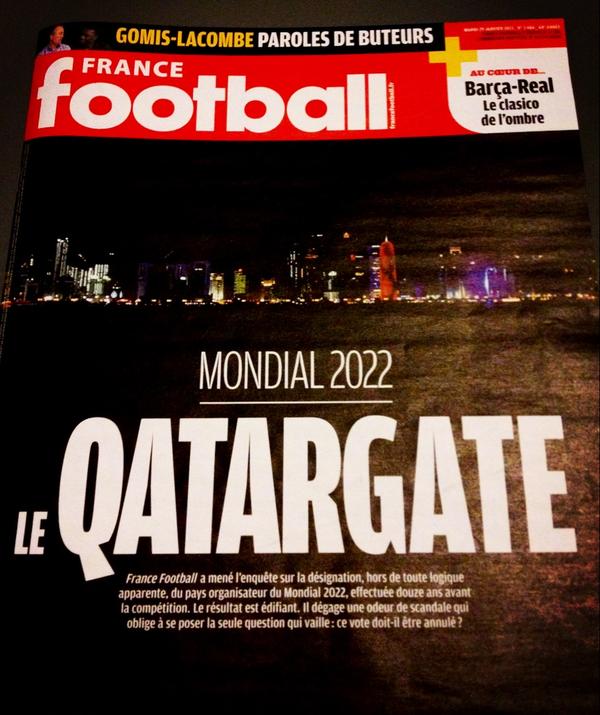
France Football has a 16 page expose on the FIFA decision to award the 2022 World Cup to Qatar. Paul Kennedy provides a useful summary of the key allegations:
-- The votes of African confederation president Issa Hayatou (Cameroon) and Jacques Anouma (Ivory Coast) were bought for $1.5 million apiece, then the whistle-blower, former Qatari bid employee Phaedra Al Majid, mysteriously retracted, saying she made everything up.

-- Qatar "sponsored" the 2010 African confederation congress to the tune of $1.25 million to gain exclusive access to the four Africans on the FIFA executive committee.

-- One of the four, Nigerian Amos Adamu, was suspended from the executive committee before the vote following revelations in a Sunday Times sting investigations. The Qataris have subsequently been accused of seeking to "sponsor" a pre-World Cup 2010 banquet to the tune of $1 million. Its organizer: Adamu's son.

-- Then-French President Nicolas Sarkozy asked UEFA President Michel Platini, who was expected to support the USA, to vote for Qatar for geopolitical reasons. Sarkozy and Platini met with the Qatari crown prince Sheikh Tamim bin Hamad bin Khalifa Al-Thani in 2010 to discuss Qatari investment in French soccer. (It has since bought Paris St. Germain and launched beIN Sport in France.)

-- A Qatari representative offered to spend millions on pumping up ailing Argentine soccer to gain the vote of Argentine Julio Grondona.

-- Middle Eastern holding companies bankrolled deals struck by since-disgraced Brazilian soccer boss Ricardo Teixeira.

-- A sweetheart deal was struck with the Spanish federation to organize a friendly game in Qatar and "silence" Angel Maria Villar, who supposedly had a vote-swapping  pact with Qatar to back Spain's 2018 World Cup bid with Portugal and was furious that in fact Russia won the 2018 contest easily.

-- The Qatari sports agency Aspire spent millions on promoting youth sports in countries with members on FIFA's executive committee.
For his part Michel Platini rejects the allegations and says that he voted his conscience:
Platini, for all the good work he has done at the helm of European football, has come in for criticism over his decision to cast his vote towards the tiny Gulf state amid persistent reports he had been influenced by Sarkozy because of potential commercial spin-offs.

"I voted for a region that never received the World Cup, that was my philosophy, not because Sarkozy had lunch with me," Platini insisted.

"I have enough personality to decide what is good for football, not for the President of France or the Prime Minister of Great Britain, who also wanted my vote."
At his blog, James Corbett offers some valuable perspective:
It’s a well articulated piece and important that all these aspects are put into a single narrative, but there’s no real smoking gun. I think the journalist James M. Dorsey is most on the money when he is quoted: ‘The Qataris were very malignant and explored all the shadows and were near to the edge of the cliff, but, in my opinion, didn’t cross the yellow line.’

For me the only new revelation was that a couple of Swiss law firms are looking at the legalities of a winter switch, and that Karl Heinz Rummenigge, president of the European Clubs Association, says on the record for the first time that he is not averse to making European club football a summer game. While the Qatar Supreme Committee get a right of reply, it wasn’t clear from my reading whether the reporter had actually visited Qatar.

There is also a lack of context regarding the bid race itself. The rules of engagement – such as they were – set out by FIFA were there to be exploited. They were wholly inadequate and this was compounded by the ludicrous decision to simultaneously run the 2018 and 2022 races. This led to all sorts of vote trading, secret (and illegal) pacts and other horseplay.

The lack of context is slightly troubling, because it adds to the Qatar-bad, everyone else-virtuous narrative which is overly simplistic. The reality is far more nuanced and complex than those assumptions would suggest. I think it’s fair to say that few people came out of the bid race with much credit and while it may have been more palatable for England, the US or Australia to have won hosting rights, they lost out to healthier resourced opponents who played to the margins better than they did.

Every bid that was in serious contention sought to exploit loopholes in the bid guidelines and played to the line. Yes, Qatar sponsored the CAF Congress, but England 2018 supported the Caribbean Football Union’s annual beanfest. It’s true that Qatar had the influential (and subsequently disgraced) Mohamed Bin Hammam, but the United States had those paradigms of virtue Jack Warner and Chuck Blazer. Qatar spent millions on PR consultants, but other bids spent a lot of money and charmed and bullied and smeared journalists (the vitriolic campaign against Andrew Jennings and his Panorama programme on FIFA was one of the most disgraceful things I’ve witnessed in journalism). And you think that Australia, which pumped millions of its taxpayers money into the pockets of people like Fedor Radmann played a straight bat? And then there’s the 22 men who made the decision, half of whom have had significant questions about there integrity posed since December 2010. I could go on (and on).
What is most troubling at this point is not the allegations, as Corbett notes, Germany 2006 suffered from similar allegations and behaviors. Rather, the most troubling aspect of the situation is that FIFA has shown little interest or ability to clean up its governance.

You may have seen recent news reports indicating that FIFA is now using its new ethics committee to investigate the awarding of the 2022 World Cup. From James Dorsey we learn that is not quite true:
In an email in response to this posting, FIFA drew in an email a distinction between a review of allegations and an investigation. It said the review was intended to determine whether there were grounds for an investigation.
While the meaning of FIFA's fine distinction between a "review" and an "investigation" is a mystery, even a casual observer can find enough in the public record to indicate that a thorough investigation is needed.

Dorsey is spot on when he concludes:
The outcome of the review will be widely seen as a test of FIFA's willingness to thoroughly investigate allegations and truly tackle fundamental governance issues against a widely held perception that the soccer body has yet to demonstrate real sincerity. Few believe that FIFA, which will also look at Russia’s winning of the right to host the 2018 tournament, would want to risk a either country being deprived of the honor.

FIFA's effort would have to further address the worst albeit politically loaded corruption scandal in the history of world soccer in which the bids are inextricably meshed as part of its undertaking to convince its critics.
For more on why it is that FIFA is so hard to hold accountable and reform, you can see my recent paper in Sport Management Review (PDF).

Winning Grim

After reading my post on Victoria Azarenka's clever use of the injury timeout, Rowland Jack writes to point me to a blog post of his on "winning grim." Rowland captures the concept nicely, here is an excerpt from his post:
Winning grim refers to teams and occasionally individual athletes plus their management who take a more holistic view of sport and seek to influence all the factors which can determine the result of a match. The masters of winning grim are often the leading contenders in their sport. Exponents of winning grim will have a strategy for considerations such as these off the field of play:
  • -The structure of competitions (method of qualification, schedules, the way the draw is done etc.)
  • Legal challenges before, during and after competition (on issues such as player eligibility, suspensions etc.)
  • The priorities of broadcasters and sponsors (what final they would ideally like to see, style of commentary, length of agreements etc.)
  • Pre-match PR (putting psychological pressure on opponents, match officials, spreading rumours)
They will also be expert at the use of specific tactics on the field which go a step beyond the requirements of winning ugly:
  • Pressurising match officials for maximum impact
  • Time-wasting when in a potentially winning position or to disrupt the opponent’s momentum
  • Tactical use of injuries (exaggerating injuries to give team-mates a rest or influence the referee)
  • Choosing ultra low-risk tactics when a normal tactic would probably suffice (think of a rugby team repeatedly kicking long when leading or a football team substituting an attacker for a defender when 2-0 up)
  • Selecting players who are consistent but limited in place of others who are more talented but unpredictable
Winning grim is the logical end-point when fans, financial backers and political stakeholders demand results. It is a strategy motivated by fear which is perfectly focused on the bigger prize. For this reason winning grim is better suited to league competition and major tournaments rather than to individual matches.

Winning grim should not be equated with cheating. Winning grim is legal and sometimes necessary, especially after a series of disappointments in big events. Eventually, however, winning grim will leave fans joyless and frustrated, alienating federations and other stakeholders along the way. You can’t afford to win grim all the time.
Nice!

Monday, January 28, 2013

How to Stop Injury Time Gamesmanship in Tennis

Last week I put up a post about the notion of "cheating within the rules" motivated by Victoria Azarenka's, ahem, tactical use of an injury timeout to alleviate a constricting feeling around her neck. I was actually more sympathetic than most, and argued that while she may have violated norms of sportsmanship in now way did she cheat.

I argued that If the tennis community feels strongly enough, then it can engage the constitutive decision process to change the rules to address violations of what are today held as norms. Today The Economist proposed an entirely sensible approach to such a rule:
Perhaps the most effective solution would be a point-docking system. If players forfeited just a single point per timeout, that would probably eliminate the temptation to cheat the system, since in tight matches, each point is immensely valuable. The ability to remain fit throughout a match is as just much a skill as having a good backhand. Playing poorly loses you points—so why shouldn’t, in a modest way, getting injured?
Players could have as much access to trainers as they want during normal breaks in play. Should they need additional treatment, they could be charged 1 point for the first 3 minutes (or whatever deemed appropriate) and then 1 point per minute thereafter. As I read somewhere this week, the marathon doesn't have injury timeouts, and tennis is a marathon. Simple, unambiguous, fair.

Who Will Now Investigate UCI?

The International Cycling Union (UCI) has disbanded its own independent commission set up to investigate any alleged involvement the UCI may have had in the Lance Armstrong doping scandal.

The commission was established to look into allegations made against cycling's world governing body by the United States Anti-Doping Agency's (USADA) investigation into Armstrong, which shone a light on a decade of drug use in the sport.

However, both the World Anti-Doping Agency (WADA) and USADA said they would take no part in the commission inquiry and that turns of events, according to the UCI, would have led to any report being dismissed as "not complete or credible".

UCI president Pat McQuaid said: "We have listened carefully to the views of WADA, USADA and cycling stakeholders and have decided that a truth and reconciliation process is the best way to examine the culture of doping in cycling in the past and to clear the air so that cycling can move forward."

McQuaid continued: "Given this development, the UCI management committee today decided that the federation could no longer fund a procedure whose outcome is likely to be rejected by such an important stakeholder. We have therefore decided to disband the independent commission with immediate effect."
Part of the mandate of the independent UCI commission was to investigate the role of the UCI in the looking past or even contributing to the pervasive doping in cycling. Here are the now-defunct commission's terms of reference:
1. Whether the allegations against the UCI set out in the Reasoned Decision are well founded.

2. Whether, between 1998 and 2012, the UCI realised that Lance Armstrong and the USPS Team were collaborating to avoid detection in the use, possession, administration and trafficking of performance enhancing drugs and methods, and: (i) if the UCI did realise, whether it failed to respond appropriately; and (ii) if the UCI did not realise, whether it ought to have done so, and what steps (if any) it should have taken to inform itself of the actions of Lance Armstrong and the USPS Team in order to act appropriately.

3. Whether, and if so, to what extent the UCI’s anti-doping policies and procedures between (i) 1998 and 2005 and (ii) 2005 and 2012, were inadequate or were not enforced with sufficient rigour; and if so, whether the UCI was at the time aware, or ought to have been aware, of such inadequacy or lack of enforcement.

4. Whether there was, between 1998 and 2012, any reliable evidence or information in the possession of or known to the UCI regarding allegations or suspicions of doping by Lance Armstrong and the USPS Team; and if so, whether there was any failure by the UCI to act appropriately in regard to such information.

5. Whether, when Lance Armstrong returned to racing in 2009, there was a failure by the UCI to detect signs of doping by him, and whether it was appropriate for him to return to and continue racing.

6. Whether payments were made by Lance Armstrong and the USPS Team to the UCI, between 1998 and 2012, and if so whether it was appropriate for the UCI to have accepted such payments, or to have accepted them on the basis (explicit or implicit) upon which they were made.

7. Whether the UCI inappropriately discouraged those persons with knowledge of doping by Lance Armstrong and the USPS Team from coming forward with such knowledge, and whether the UCI should have done more to encourage such persons to come forward sooner.

8. Whether the UCI adequately co-operated with, assisted in and reacted to the USADA USPS Team Investigation.

9. Whether any persons previously convicted of doping, or voluntarily admitting to doping, or supporting riders in doping, should be able to work within the world of cycling in the future; and, if not, how such a prohibition could and should be enforced.

10. Whether the UCI had a conflict of interest between its roles in promoting the sport of cycling and in investigating or making adverse findings against Lance Armstrong and the USPS Team.

11. Whether the current doping controls of the UCI are adequate and compliant with the World Anti-Doping Code of the World Anti-Doping Agency, and whether those controls can be improved.
The focus now appears to have turned to a yet-to-be defined "truth and reconciliation commission" with details to be spelled out later in the year. Let's hope that the focus on the role of the UCI which featured so prominently in the independent commission is part of any TRC.

FIFA Still Falls Short on Transparency

Last week FIFA provided an update on the work of its new investigative and adjudication bodies (chair respectively by Michael J. Garcia and Hans-Joachim Eckert pictured above):
First, proceedings related to the settlement order in the case involving the former FIFA marketing partner ISL are ongoing. When the examination is complete, Chairman Garcia will detail his findings in a final report to FIFA’s Executive Committee, which, as previously reported, referred the matter to the Chairman. It is anticipated that this will occur at the next regularly scheduled meeting of that committee in March 2013.

Second, we are responding to recent referrals related to allegations of match manipulation. The Ethics Committee has an important role to play in ensuring that such allegations are properly addressed in order to protect the integrity of the game. The Investigatory Chamber will be making decisions as to formal proceedings on these referrals.

Third, as has been publicly announced, certain allegations regarding events surrounding the bidding for the World Cup 2018 and 2022 were referred to the Ethics Committee by FIFA following media reports. We intend to conduct a thorough review of those allegations, including the evidentiary basis for and credibility of any allegations of individual misconduct.
If you expect to learn much about what FIFA uncovers, don't hold your breath. FIFA explains:
Confidentiality rules, as well as principles of fairness and due process, preclude us from disclosing information about much of our ongoing casework.
In its investigatory work it is reasonable to expect FIFA to achieve a level of disclosure comparable to that of the Court of Arbitration for Sport. Judged by the first major decision rendered by FIFA's new ethics committee -- on Mohammed bin Hammam -- FIFA intends to say what it decided and nothing else.

A true commitment to "fairness and due process" would suggest that FIFA should adopt a less secretive approach.

Friday, January 25, 2013

Cheating Within the Rules

Earlier this week at the Australian Open Victoria Azarenka caused a stir when, with her game falling apart as she tried to close out the match against Sloan Stephens, she took a 10 minute injury timeout to regain her composure, after which she won the match.

USA Today had these comments from David Nainkin, Stephens coach:
I thought it was very unfair — cheating within the rules. It was unsportsmanlike. I don't think you should be able to leave the court before the opponent serves for 10 minutes for whatever reason. You'd better have something pretty good. I think there's a gray area in the rule book that shouldn't be allowed. End of story.
In this post -- perhaps wonky and boring, you've been warned -- I try to tease apart the notion of "cheating within the rules" and apply some concepts from the academic policy literature to thinking about the governance of sport.

A first distinction to make, found in the policy sciences corpus, is that between constitutive and ordinary decisions. Constitutive decisions refers to the process of establishing a decision process. The rules of tennis -- established by the International Tennis Federation and codified in a 43 page document -- are an outcome of a constitutive decision process.

In principle, the rules that govern play within a sport are design to create a closed system, meaning that every possible contingency is expected to be covered by the rules of the game. In practice, this is not always the case as people are clever. Sometimes we find a "rules hole" that needs fixing. The closed nature of sports systems is one key difference from decision making more generally.

Ordinary decisions are those that result from the application of the rules of the game. Calling a ball in or out, a player offsides, passing or running and so on are examples of such ordinary decisions. When the rules of the game are violated, then there typically is some sanction. If Azarenka hits the ball out, Stephens gets a point. Sanctions can also occur outside the context of the competition, such as fines for flopping in the NBA or vicious hits in the NFL.

Now back to Azarenka. According to the Australian Open tournament directory, "Everything was within the rules of the game." This brings us to another distinction -- between rules and norms. Rules are the formal guidelines for play. Norms are expectations for what constitutes appropriate behavior in play.

When Stephens coach accused Azarenka of "cheating within the rules" he meant that while her behavior was not formally illegal, it violated the generally held expectations of the tennis community for what constituted appropriate behavior.

Here is some of the reaction found on Twitter, courtesy Sports Illustrated:
I understand the reactions. However, care needs to be taken to recognize that norms go only so far in shaping behavior. If the offending behavior is deemed egregious enough, such as a violation of the spirit of the game, then the rules need to be changed.

Was Azarenka guilty of "cheating within the rules"? No. She was within the rules, and that is not cheating.

Was she guilty of poor sportsmanship? There is a strong consensus that the answer is yes.

So I come out a little bit less harsh on Azarenka and a bit more critical of the tennis community for playing under rules that allow (encourage?) behavior contrary to community norms.
If the tennis community feels strongly enough, then it can engage the constitutive decision process to change the rules to address violations of what are today held as norms. Alternatively, they can hope that social pressures associated with violating a community norm are sufficient to compel the desired behavior. Think about flopping in the NBA, where social pressure was deemed insufficient and rules have been changed to try to reduce the incidence of simulation through post-game video review. In conrast, FIFA does not (yet) have such rules. 

Of course, the relationship of rules and norms is highly contextual according to sport, and even then is quite complex. Consider this recent controversy involving Luis Adriano of Shaktar Donesk:

In this instance, no formal rule was broken, but a strongly held norm was violated. Yet, UEFA still sanctioned Adriano, in effect turning the norm into a rule.

In contrast, a similar instance occurred in 2010 during Liverpool-Sunderland, and in that case no rule or norm was deemed to have been broken. (A video of the incident can be seen here, thanks @ismurray!) What is the proper behavior in such a context? Neither the rules nor norms provide a clear picture.

What is far more clear as cheating however are violations of the constitutive decisions of the game. This is the sort of cheating that Lance Armstrong engaged in. A full discussion of which will await a future post.

Monday, January 21, 2013

Integrity Trumps Tragedy: Why USADA Should Seek a Deal With Lance Armstrong

Writing in the weekend FT, Christopher Caldwell had this to say about the Lance Armstrong affair:
[B]efore the cyclist Lance Armstrong admitted in an interview with Oprah Winfrey that he had used performance-enhancing drugs, the wildest rumours and discussions were circulating in US daily newspapers. According to these accounts Mr Armstrong was angling for a lifting of his lifetime ban from competition. In exchange, the 41-year-old would give testimony against teammates, financial backers or figures in the International Cycling Union.

It is too early to estimate the legal fallout of Mr Armstrong’s mea culpa. But this sort of plea bargain makes no sense. Why would any prosecutor, or any custodian of the good name of the sport of cycling, want to get to the people “behind” Mr Armstrong? This is like promising immunity to a wayward chief executive on the condition that he spill the beans about two interns in the mailroom.
I really enjoy Caldwell's columns, but on this one, he has things exactly backwards. I'll explain, but first, I'll offer some background on the broader context of sports governance and its complexities.

Cycling, like all Olympic sports, is governed through nongovernmental organizations. Prohibitions against doping -- the use of performance enhancing drugs -- has come to be widely accepted as part of the rules of the various Olympic games, and institutions have been created to enforce those rules. The sports covered by these rules, called the WADA Code, include those which take place at the Olympics, but not the major US professional sports leagues or the NCAA. Among those agencies are the World Anti-Doping Agency (WADA), a Swiss private law foundation headquartered in Montreal, and the US Anti-Doping Agency (USADA), a non-profit organization incorporated in Colorado, and headquartered in Colorado Springs.

The governance issues are very complex and still evolving. For instance, both WADA and USADA receive significant government support. Half of WADA's $26 million budget comes from governments which participate in the Olympics and the other half comes from the Olympic organizations within those countries, which may also come from government sources (see 2013 budget here in PDF, the US contributes about $2 million annually). USADA gets about $10 million in funding from the US government each year, about 70% of its budget (see this CBO report in PDF), and is recognized in law as the organization responsible for supporting the US Olympic organizations on issues related to doping (law here in PDF)

USADA is also the organization, designated by the US government, responsible for fulfilling the US obligations under the United Nations International Convention Against Doping in Sport, which was ratified by the US Senate in 2005 and stands as one of the most widely-adopted international treaties on any issue. USADA is independent from but works with the US Olympic Committee, which was established as a private federal corporation in 1950 and given further responsibilities under the Amateur Sports Act of 1978. There is a debate among experts as to whether USADA should be considered a "state actor" under the US Constitution, and thus subject to the same rules of government agencies. There is a case for (here) and against (here in PDF). (Side note- This is a fascinating issue of lex sportiva vs. lex imperium that I will be returning to). In practice, USADA is considered a non-state actor, an outcome that has been established via the courts in several cases.

Issues are made even more complex because there is an overlap between the WADA Code and US law on certain prohibitions (like anabolic steroids) but not others (human growth hormone). This distinction allows one to understand why Lance Armstrong was being investigated independently by the US Department of Justice and USADA. The DOJ dropped its investigation one year ago, and as well all know USADA continued its own investigation. USADA has no interest or jurisdiction in determining if an athlete violated US law. USADA's jurisdiction is with respect to the WADA Code, and ultimately an athletes participation in events that take place under that code. Similarly, US government officials have no jurisdiction over who is determined to be eligible for participation in events which are held under the provisions of the WADA Code.

Now with some context, let's get back to Caldwell's column and think about this in the abstract for a moment. Imagine if instead of Lance Armstrong we were discussing a case of an athlete fixing the outcome of a competition to aid gamblers. Set aside any legal considerations implicated by the fix and focus on the integrity of the sport. Imagine further that we learn that the referees and player's financial sponsors were in on the fix. Most everyone would agree that the athlete in this case deserves sanctions from the sporting organizations, and I'd guess that most would also agree that the referee and financial sponsors bear some culpability and deserve sanctions. We might go further and suggest reform to the institutions to make such occurrences less likely in the future. Think about it -- simply sanctioning the player would likely allow the fixing to continue without rooting out the rot in the system.

This is where Caldwell's column helps us to understand that Armstrong may not have been the kingpin. He might merely have been the opportunist exploiting a flawed and perhaps corrupt system. Either way -- flawed or corrupt (or both) -- it is incumbent upon USADA (and WADA, UCI, IOC, etc.) to find out for sure and to reform as necessary. Hence, the ongoing investigations are of critical importance to the future integrity of cycling and other sports.

In the Armstrong affair, it is easy to conflate the Greek drama aspects of the case with the far less dramatic issues of governance. But insofar as integrity of sport is concerned it is these governance issues that matter most for the future of competition. If Armstrong is willing to testify about assistance he received from the International Cycling Union, his financial sponsors, government officials or others, then it is a deal that the USADA should take willingly.

The integrity of sport is far more important than any athlete, not matter how far he has fallen or how egregious his failings.

Wednesday, January 16, 2013

Payroll-Point Efficiency in the Bundesliga

The figure above, courtesy of FOCUS and Sports Business Daily, shows a scatter plot of payroll versus point per million Euros payroll in the Bundesliga, halfway through the 2012-2013 season.

The data illustrate a steady decrease in payroll-point efficiency. The more a club pays its players the less efficient is that spending. The reason for this is that salaries increase non-linearly and points increase linearly.

The graph below shows that, in general, the core Soccernomics conclusion that more payroll means more points can be seen in these data as well. But there is a lot of spread in the data too, suggesting that payroll is not the entire story.
The graph below shows how payroll efficiency compares to points accrued so far this season. There is more than a hint of improved efficiency for better performing teams. There is also a significant spread in the data at all point levels.
These data suggest that while more money means more success, at least in the Bundesliga for the first half of 2012-2013, there is a lot more going than pay checks which determine success in the league.

Tuesday, January 15, 2013

The Art of Football


The Armstrong Confession

I've been meaning to write up some thoughts about the latest in l'affaire Armstrong, but the issue is moving fast, so best to see what plays out over the week. There is a lot to discuss.

Here is the latest from CBS News:
If Armstrong offers to be a witness, then there must be bigger fish to fry. Stay tuned. 

Thursday, January 10, 2013

Economic Valuation of College Football Progams

 
Earlier this week the WSJ provided an update to estimates of the economic valuation of college football teams produced by Ryan Brewer, a finance professor at the Indiana University-Purdue University Columbus. Brewer wrote a dissertation on the subject and the methodology is described in this paper (in PDF). This post provides a few visualizations of the data and a bit of commentary.

Because college football programs are not bought and sold on the open market, estimating an economic valuation requires making assumptions and applying a methodology. Necessarily such an approach will be far less satisfying than observing a price paid by a buyer to a seller. Nonetheless, Brewer's methodology provides a consistent and defensible way to look at valuation.

Under Brewer's method Texas comes out on top at $805 million. To convert that into a university metric, that amount of money could endow about 400 faculty positions ($100k per position, 5% return on endowment per year), or about 20% of the total number of faculty at UT-Austin. The University of Colorado, my employer, sits at #29 at $156 million. For a university with a billion dollar budget, this valuation does not seem particularly high, it is equivalent to the endowment value of about 78 faculty members, or in round numbers about 5% of the campus total.

There are 52 programs with a valuation >$100 million -- what might called big-time football programs. The figure below shows the breakdown by conference, showing that there are 2 big time conferences -- SEC and Big 10, 3 wannabe big time conferences, and 5 minnow conferences.  The huge disparities suggest that the resorting that has gone on in football alignments in recent years might yet have a ways to run.
The figure below breaks out the conferences by team, and shows large disparities within conferences. Consider that in the Big 12 with Texas is lowly Kansas valued at only 5% of the Texas valuation, at $40 million. The valuation estimates reflect a number of factors, including the ability of each program to secure its financial future.

Monday, January 7, 2013

Mid-Season 2012-2013 EPL Prediction Contest Update

As an exercise in humility and illustration of the concept of skill in forecasting I have run a few small prediction contests here over the past few years. We are just past mid-season in the Premier League which provides a good excuse to see how things stand in that contest.

Here are the mid-season standings of the 10 participants:
Elijah 15.4
Megan 15.9
SKILL 16.4
itzik 17.8
n-g 18.0
dave tombs 20.2
Calvin 20.8
Pielke 23.3
keeperusa 23.3
Arthur 24.0
Max 24.7
The numbers above represent the square root of the sums of the mean-squared errors in the predicted standings. The biggest collective errors: West Brom (picked too low) and Newcastle (picked too high). Smallest errors: Man City, Man U and Reading.

What does this exercise tell us? The most important lesson, one that is learned in many walks of life, is that a naive prediction methodology can be very hard to beat. Only two entries are running ahead of an entry based on last year's final table.

The far more difficult question to answer, and one with an answer that has a lot of significance to decision making in areas far more important than sports prognostication -- are those 2 skillful entries showing skill because the forecasts had skill, or just luck?

For a discussion, see this post on hot hands and guaranteed winners.

Friday, January 4, 2013

Interview on Vuvuzela: The World Soccer Show

Above is the recent interview I did with WWDB-AM 860 in Philadelphia over the holidays. One hour is enough time to barely scratch the surface, but thanks to a deeply informed host in Richard McGovern, we got into some interesting issues.

If you'd like to hear more, please have a read of my forthcoming paper on FIFA governance in Sport Management Review.

I appreciate the opportunity to discuss the issue with Vuvuzela: The World Soccer Show.

Thursday, January 3, 2013

A Bad Call in Tuscon

The image above from the just completed CU-UA game provides unambiguous evidence that Colorado was the victim of an outcome changing blown call by the refs tonite in Tuscon. The refs called off this shot, claiming that it did not beat the clock. The clock and the lights (not on) around the backboard, coupled with the ball clearly out of Chen's hands show that the shot should have counted.

Bad calls are part of the game, but with the aid of replay the refs should not have gotten this one wrong.