Wednesday, February 18, 2015

How Many Elite Athletes Dope? A Lot Says a New Study

A new study has just been published by the journal Sports Medicine which argues that, currently, between 14-39% of elite athletes are doping - that is, taking prohibited performance enhancing drugs. The Dutch authors, led by Oliver de Hon, the manager for scientific affairs for the national anti-doping organization of  the Netherlands, conclude:
All doping-related discussions and decisions would be strengthened if this vital piece of information, i.e. scientifically reliable information on the prevalence of doping, becomes more readily available.

Current data suggest that 14–39 % of elite athletes are doping, but this figure needs further confirmation in different groups of athletes with varying levels and backgrounds. Doping prevalence can be expected to fluctuate substantially between different groups. However, the prevalence figure can be expected to be far higher than the average of 1–2 % of athletes who are caught with doping substances, or their metabolites, in their system. There are many efforts underway to close this gap, but this process is by no means complete.

Evaluations of the prevalence of doping use are not only interesting for sports fans and journalists. They are necessary for anti-doping professionals to enable true evaluation of the effectiveness of their policies. If the non-dopers are cheated by the dopers too often, and when doping tests are insufficient to control doping use in a meaningful manner, anti-doping efforts are doomed to fail. This is not a problem for the anti-doping professionals, but first and foremost for the athletes they have vowed to protect. Tools to evaluate the prevalence of doping use in sports are readily available; they only need to be used more often.
Their conclusions are very much the same as the ones that I argued in my recent piece in Nature. The research by de Hon et al. adds some considerable empirical heft to calls for better data and methods in quantifying the prevalence of doping. Also, as officials involved in sports governance their calls for better evaluation of anti-doping policies should carry some gravitas.

Of note, the authors find that between 19 and 56% of athletes admit to using a permitted performance enhancing drug (nicotine) and conclude:
If the entire doping test system is indeed unable to keep the use of prohibited substances at a lower level than a permitted substance, it adds to the idea that current anti-doping testing is far from effective in curbing doping. It is also disconcerting that calls for more clarity in this area that were made more than 25 years ago have not yet yielded much progress.
The paper is perhaps the most significant one yet published on the prevalence of doping and can be found at:
 de Hon, O., Kuipers, H., & van Bottenburg, M. (2015). Prevalence of doping use in elite sports: a review of numbers and methods. Sports Medicine, 45(1), 57-69.
Evidence suggests that lots of elite athletes dope, anti-doping policies aren't working, and anti-doping agencies aren't doing much about it.

Saturday, February 14, 2015

On Narrative, Data and the ASU Curtain of Distraction

In today's New York Times, economist Justin Wolfers has a front page article on ASU's "Curtain of Distraction.," a feature of its raucous student section at home basketball games. Before diving into this post, let me say up front that I'm a fan of Wolfers research and follow him on Twitter, where he has a great presence. He has a lot of smart things to say on a lot of important subjects, including sports, where he has done some significant work. In this post I'm going to critique his NYT article, which is just not up to Wolfers' usual standards. It also offers a cautionary tale for would-be "data journalists."

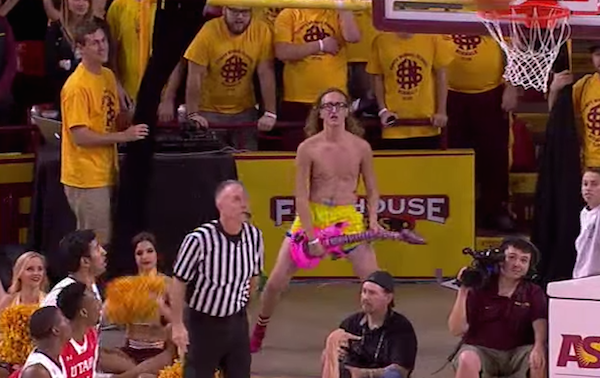
The ASU Curtain of Distraction a make-shift stage that the student section uses to try to distract opposing the opposing team when it is attempting free throws. As the opposing player stands on the free throw line the curtain opens to reveal all sorts of eye-catching displays, from a guy in a Speedo to kissing unicorns (see above for an example). Wolfers argues that the Curtain of Distraction provides ASU with a quantifiable benefit because it leads the team's opponents to miss free throws.

It's a fun news story that combines what is best about college kids supporting their home team and the ideal of data journalism to provide insights behind the story. It's likely that combination of narrative and numbers that landed this article on page one of the NY Times. Unfortunately, like a lot of what passes for "data journalism," when you take a closer look, the story and the numbers don't actually fit together. There is a deeper lesson here about the power of narrative over the substance of data. Let me explain.

Wolfer's article is about causality, and specifically it's about detecting the impact of the Curtain of Distraction in a time series of data on free throws in games that ASU has played at home in Tempe, AZ. There are of course many ways to look for signals in data using statistical methods. As far as methodologically challenging signal detection, this one is not too complicated, because the data is good and the phenomena to be explained are very well observed. Even so, the data do not lend themselves to unique or conclusive claims of causality.

But Wolfers thinks that they do. He explains what he did:
A statistical analysis by The Upshot — with an assist from Nick Wan, who runs the True Brain blog, and from Jan Zilinsky — suggests that the Curtain really works.

It appears to give Arizona State an additional one­ to two­ point advantage per home game, beyond the normal home court advantage. The Curtain may even have played the pivotal role in the Sun Devils’ recent upset of their state rivals, the Arizona Wildcats.

The easiest way to see the effect is to compare visitors’ free­ throw shooting percentage before and after the Curtain’s 2013 introduction. In each of the three seasons from 2010­-11 to 2012­-13, visitors missed 28 to 32 percent of their free throws. Last season, the Curtain’s first, the rate at which visitors missed free throws rose sharply, to 40 percent.

In the first 14 home games of this season — when the Curtain and its surprises have continued to appear — visitors have missed 36 percent of all free throws. If you didn’t know better, you might suspect that the size of the hoop had gotten smaller.

Given the timing, and the fact that players are powerless to defend a free throw, it seems reasonable to attribute this sharp change to the student high jinks, rather than any change of players or strategy. In fact, the statistics largely rule out competing explanations.
As I'll show, the last sentence is completely wrong, and the conclusion of detection a strong signal from the Curtain of Distraction - an effect of 1 or 2 points a game - is just not supported by the data, despite the appeal of the narrative.

One mistake that Wolfers makes is to look at all free throws. The Curtain of Distraction (CoD) appears only on one side of the court, the student section, which ASU opponents face only in the second half of each game. So to look for a signal of the CoD we should look for its effects in second half free throws.

What do we see when we break down ASU opponents' free throws by half?

In the first half opponents shoot 66.7% when not facing the CoD. In the second half that drops to 61.1%.

Aha!! ... we might say, the effect is 5.6%. But as any student of causality knows, detecting a difference is not the same as accounting for that difference. So let's take a look at individual games to see if we might account for that difference.

It turns out that 8 of the 14 ASU opponents (including 7 of its last 9) actually improved their free throw percentages in the second half. Thus, there is very little basis in these 8 games to suggest that the CoD caused worse free throws. In fact, one could make a stronger case that the CoD improved second-half free throw shooting in the majority of ASU games. Of course, given any data, lots of plausible theories could be proposed. 

Looking game-by-game we can quickly see that through ASU's 14 home games this season so far, the reason that opponents shoot a lower free throw percentage in the second half can be entirely attributed to ASU's first two games of the season, Chicago St. and Bethune-Cookman. Chicago St. is ranked 333 of the 351 teams tracked by ESPN, and Bethune-Cookman is ranked 344. These are two of the worst teams in the country. One could plausibly come up with a large number of possible explanations for their poor free throw shooting in the second half - including the CoD - but also more prosaic reasons such as fatigue, or early-season road jitters, or the pressure of facing a much better team, or just chance, or something else.

Since those two games, in the subsequent 12 home games opposing teams at ASU have made 62.3% of their free throws in the first half and 65.0% in the second half. When facing the CoD teams have on average improved their free throw shooting! So even if we were to postulate a CoD effect in those first two games, it clearly wore off pretty quickly (and maybe even reversed;-).

Wolfers takes the causality argument even further when he writes that the CoD "may even have played the pivotal role in the Sun Devils’ recent upset of their state rivals, the Arizona Wildcats." Again, a wonderful story, even movie-script stuff, but the data just does not cooperate. Arizona was 0-2 from the line in the first half and 8 for 12 in the second half (66%). Arizona's season-long free-throw percentage is 69.2%. 

The bottom line here is that the evidence does not support, much at all and far from strongly or uniquely, a claim that the ASU Curtain of Distraction impacts opponents free throws in any quantifiable way. (For other analyses see the Harvard Sports Collective and True Brain). 

Sure one can spin a compelling narrative and find some numbers that seem to support that narrative. As the saying goes, numbers which are sufficiently tortured using statistical methods will ultimately confess. As a corollary I might add that pretty much any narrative one cares to spin can be supported by some plausible or plausible-sounding data. But I'm also pretty sure that is not how "data journalism" is supposed to work. 

As far as narratives go, the ASU Curtain of Distraction is a great one. Too bad the numbers don't follow along.

PS. If you'd like to play with the data from ASU's first 14 home games, here it is.
Wednesday, February 11, 2015

The (Mostly) Non-News of FIFA's Watered Down Governance Report

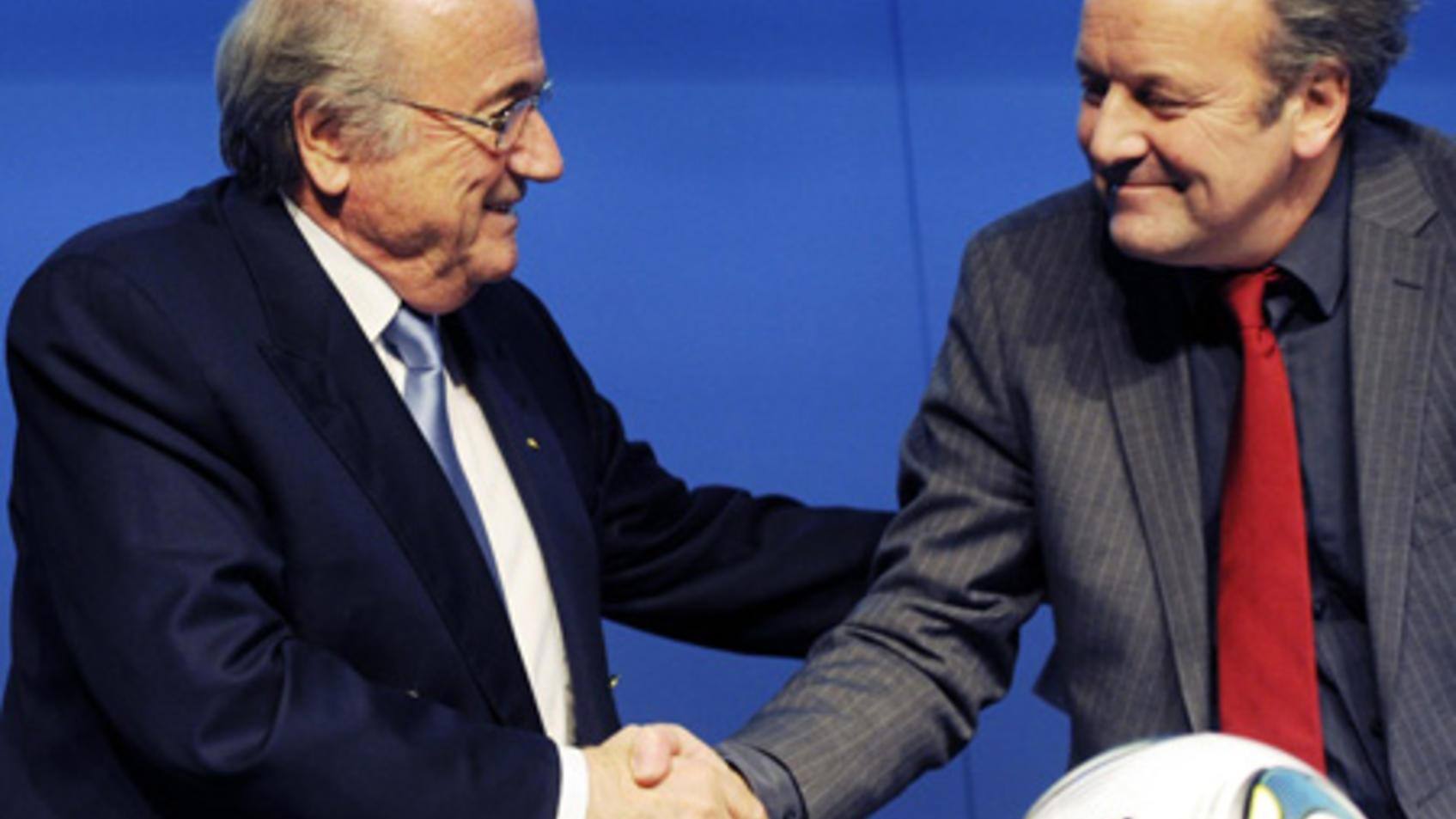
Earlier this week Der Spiegel reported that FIFA's "independent" reform committee had submitted a draft of its final report to FIFA, and made subsequent changes at FIFA's request. Someone apparently leaked internal FIFA emails.

As readers of this blog will appreciate, the news is really not news.

We have known for a while that the FIFA IGC (reform committee) was not independent and that its report was watered down (see this summary and full analysis in PDF). We also know that the FIFA IGC chair, Professor Mark Pieth, has faced a wide range of challenges dealing with FIFA, and has not always come away from the experience in the best light (just search this blog for "Pieth").

If there is little new here, the fact that this information has been leaked is itself interesting. Either the internal emails were leaked by Pieth or someone within inside FIFA's "football family." If the former then Pieth once again comes away the worse off, as FIFA's effusive defense of him (via this press release) simply provides more evidence of how conflicted his role of IGC chair actually was -- FIFA actually wrote: " People should stop questioning the independence of such a credible character." Ouch!

If the leaker is another FIFA insider, then it would speak to an internal split over the organization's leadership. However, were I to guess, I'd say that the leak most probably comes from Pieth. Any insider wanting to embarrass Sepp Blatter and also with access to confidential FIFA emails surely has to have better material than this weak tea.

Either way, the leak tells us nothing that we didn't already know: Sepp Blatter is well on his way to captaining FIFA to another term.

Monday, February 2, 2015

My Talk on "Sex Testing" Now Available

You can see my recent talk on "sex testing" in sport here. (Opens an AdobeConnect window)

If you'd like just the slides, they are here in PDF.

And if you'd like a draft for comment version of the full paper, just drop me an email (rpielkejr at gmail). I am happy to receive comments and appreciative of those who have already sent some.

Here is the abstract:
Sugar, Spice and Everything Nice:“Sex Testing” in International Athletics

Roger Pielke, Jr.
University of Colorado
Center for Science and Technology Policy Research

Abstract

In many settings, decision makers look to science as the basis for making decisions that are made difficult by their social or political context. Sport is no different. For more than a half century sports officials have looked to science to provide a clear distinction between men and women for purposes of determining who is eligible to participate in women’s athletic competitions. However, the science of sex provides overwhelming evidence that there is no such clear biological demarcation that differentiates men and women. Despite this evidence, the International Olympic Committee and the International Association of Athletics Federations in 2011 implemented a form of “sex testing” based on androgens, and specifically, testosterone levels in females. This paper evaluates this policy, finding it contradictory to scientific understandings of sex and counter to widely-held social norms about gender. The paper recommends an alternative approach to determining eligibility for participation in women’s sports events, one more consistent with the stated values of sports organizations, and more generally, with principles of human dignity.

New Resource: Human Diversity in Sport

Human Diversity in Sport is a new resource focused on increasing awareness of "human physiological diversity" in sport, with a focus on issues related to sex and gender. The resource has been created by Kristen Worley and Mianne Bagger.

The resource will be of particular interest to academics and others due to its searchable database of materials, including academic research, related to human diversity in sport.
They are also on Twitter at @HDiSport.

Wednesday, January 28, 2015

How Useful is Anti-Doping Testing Data?

I have a piece out in Nature today (free!) on the utility of anti-doping testing data. It turns out, you can't really use the available data to answer the most basic questions -- such as, how many athletes dope? or Are anti-doping programs effective?

That piece can be seen here.


Over at SportingIntelligence I have a companion piece with more background and data. I show some USADA testing data (above) and conclude:
The data show that the number of athletes sanctioned from 2001 to 2013 almost doubled, and from 2007 to 2013 just about tripled.

Does this mean that doping incidence has doubled or tripled? That USADA’s testing program is twice or three times more effective?  Unfortunately, we just can’t answer these questions.

The good news here is that just about everyone – athletes, anti-doping agencies, independent scholars – appears to have shared goals. Moving forward I am hopeful that the anti-doping agencies will help to better support researchers wanting to quantify the prevalence of doping and the effectiveness of anti-doping programs — no matter how uncomfortable the answers might be.
Have a look at both pieces. I welcomed comments and critique.

Tuesday, January 27, 2015

Question for FIFA: How many Watches Were Returned?

Last September, FIFA investigated a gift of expensive watches giving to its top officials. Here is what it found:
[The Confederação Brasileira de Futebol] distributed 65 gift bags, each containing a Parmigiani watch, to a group comprising the 28 officials on the FIFA Executive Committee, a representative from each of the 32 Member Associations competing in the 2014 FIFA World Cup Brazil, and a representative from each of the 10 Member Associations in Conmebol. CBF produced records indicating that it obtained the watches from Parmigiani, a CBF sponsor, at a price of USD 8,750 each. The Investigatory Chamber commissioned an independent appraisal of one of the watches CBF distributed. That appraisal determined that the watch had a market value of CHF 25,000. That value was confirmed by a later appraisal done in Zurich.

The FCE [FIFA Code of Ethics] plainly prohibits such gifts.
So FIFA asked for the 65 watches back, and stated that it would donate them to a charity organizations.

However, FIFA has never followed up, to my knowledge, to account for compliance to its request for the watches to be returned or to identify the charity to which the watches were donated. I have asked FIFA for this compliance information, and have yet to hear back.

Tuesday, January 20, 2015

Upcoming Talk on "Sex Testing" in International Sport

Next Monday, 26 January at 12:15 (MT) at CSTPR, I'll be giving the first talk of our Center's spring seminar series. Here is the title and abstract:
Sugar, Spice and Everything Nice:“Sex Testing” in International Athletics

Roger Pielke, Jr.
University of Colorado
Center for Science and Technology Policy Research

Abstract

In many settings, decision makers look to science as the basis for making decisions that are made difficult by their social or political context. Sport is no different. For more than a half century sports officials have looked to science to provide a clear distinction between men and women for purposes of determining who is eligible to participate in women’s athletic competitions. However, the science of sex provides overwhelming evidence that there is no such clear biological demarcation that differentiates men and women. Despite this evidence, the International Olympic Committee and the International Association of Athletics Federations in 2011 implemented a form of “sex testing” based on androgens, and specifically, testosterone levels in females. This paper evaluates this policy, finding it contradictory to scientific understandings of sex and counter to widely-held social norms about gender. The paper recommends an alternative approach to determining eligibility for participation in women’s sports events, one more consistent with the stated values of sports organizations, and more generally, with principles of human dignity.
If you are in Boulder and want to attend or are elsewhere wish to watch it online, here are all the details.

The talk is based on a paper of the same title. If you are interested in a draft of that paper for comment -- and I'd sure welcome comments -- please drop me an email at rpielkejr at gmail. Thanks!

Details on the WADA "Independent" Investigation

WADA has released the Terms of Reference (in PDF) for its investigation into allegations of systematic doping by Russian athletes and the participation of the IAAF in a cover-up. Here is the Purpose for what WADA has titled an "Independent Investigation":
The IC has been established to conduct an independent investigation into doping practices; corrupt practices around sample collection and results management; and, other ineffective administration of anti-doping processes that implicate Russia, the International Association of Athletics Federations (IAAF), athletes, coaches, trainers, doctors and other members of athletes’ entourages; as well as, the accredited laboratory based in Moscow and the Russian Anti-Doping Agency (RUSADA). To achieve this task the IC will review evidence gathered by WADA and will request the collection of further evidence as it deems appropriate. In principle, the IC is also able to obtain information on its own initiative, including interviews with persons of interest. This however will be the exception and will be coordinated with WADA to avoid duplication
The committee of three is bound by the WADA confidentiality policy and media policy. It reports to WADA and WADA is coordinating the information gathering. The committee chair is the only member allowed to speak to the media, and the committee is planning to release very little information or documentation. All of this is troubling for an effort focused on trust and credibility.

While the investigation may ultimately be useful and lead to positive change, it is clearly a misnomer to call it "independent" in any manner. It is an internal WADA committee, which is chaired by a former WADA president. Calling a committee independent when it is not is just not good practice. WADA is not alone in facing difficulties understanding what "independent" actually means.

Monday, January 12, 2015

How Big Will College Football Get?


UPDATE: The data are in: 33.4 million viewers. The most-watched cable program of all time.

Tonite marks the culmination of the first top division college football tournament. How big will college football get?

I'd suggest paying attention to the numbers below to get a sense whether its continued financial growth will be really big or really, really big. These are the audience sizes for the top-watched programs ever on US cable networks. Yes, they are all sports events on ESPN.

For comparison, last year's Super Bowl had an audience of 111 million. Last night's NFL playoff games had an estimated audience of 40 million. And last year's NCAA basketball championship had an audience of 21.2 million.

How big will college football be? Tonite TV viewership should help to answer that question.

RankDateProgramNetworkViewers (000s)
1.01/01/2015CFB/Sugar Bowl: Alabama-Ohio St.ESPN28,271
2.01/01/2015CFB/Rose Bowl: Oregon-Florida St.ESPN28,164
3.01/10/2011CFB/BCS Champ: Oregon-AuburnESPN27,316
4.01/07/2013CFB/BCS Champ: Alabama-Notre DameESPN26,380
5.01/06/2014CFB/BCS Champ: Florida St.-AuburnESPN25,572
6.01/09/2012CFB/BCS Champ: Alabama-LSUESPN24,214
7.10/05/2009NFL MNF: Green Bay-MinnesotaESPN21,839
8.01/03/2015NFL Wild Card: Arizona-CarolinaESPN21,678
9.11/30/2009NFL MNF: New England-New OrleansESPN21,402
10.01/01/2011CFB/Rose Bowl: TCU-WisconsinESPN20,558

Wednesday, January 7, 2015

Accountability to Principles of Gender Equity

At Sporting Intelligence my first column of 2015 is up. It was inspired by several things, including Venus Vs., a documentary on prize equity in grand slam tennis which I show in my Sports Governance class. Most recently however I was inspired (well, shocked really) by this blog post by Helen Wyman, a British professional cyclist. 

Here is an excerpt from my piece:
Today, the issue of equal pay for men and women in sport is more about accountability than gender. So long as sports organizations like the IOC and UCI invoke equality as a guiding principle, then they should be held to those principles.

That is not a matter of gender equality, it is simply a matter of good governance. Alternatively, if the leaders of these organizations actually believe that women should receive smaller purses for their competitions, then these leaders should have the courage to change the stated principles of the organisations that they lead to reflect those beliefs. Saying one thing and doing another is not a successful course of action for any institution.
I argue that gender equity in pay is really not much about gender anymore, but rather, about good governance. You can read the whole thing here.

Tuesday, January 6, 2015

Two Investigations to Watch in 2015

Two significant investigations are scheduled to report their findings in 2015.

One is the recently-created three person committee established by the World Anti-Doping Agency hot on the heels of revelations of systematic doping by Russia in the IAAF.  The committee includes Richard Pound and Richard McClaren, both long-time sports insiders. Pound is a member of the IOC and McClaren is a CAS arbitrator. Both are highly respected. However, Pound was the first president of WADA and can hardly be considered independent. Sports governing bodies have yet to fully appreciate the significance of independent advice. The third member of the committee has not been announced. WADA does not say when the committee will report, but it seems unlikely to go on too long without reporting, given the magnitude of the allegations.

The second is the Cycling Independent Reform Commission established one year ago by the UCI to investigate various allegations which resulted from the USADA investigation of Lance Armstrong and his team mates. That commission was to have reported by the end of 2014, so it seems likely that it should be saying something soon (maybe by the end of February). That three-person committee includes:  Dick Marty,Ulrich Haas and Peter Nicholson. A number of cyclists, including Armstrong, have reportedly met with the CIRC. At Sporting Intelligence, Teddy Cutler has an in depth look at the CIRC.

Expectations are very high for the CIRC and the WADA committee has barely gotten started. Both have the potential to profoundly change the landscape of sport. Stay tuned.

Thursday, December 18, 2014

FIFA 2010 ExCo Scorecard (Updated)

UPDATED 28 Dec 2014

Above is a scorecard I just made up showing the status of the 2010 FIFA Executive Committee. These are the individuals who selected Russia for the 2018 World Cup and Qatar for 2022.

Some summary stats:
  • Of the 24 members 5 have been suspended or banned by FIFA (in red);
  • 13 others have been accused of corruption of one sort or another (in yellow);
  • 9 of those 13 are current members of the FIFA ExCo;
  • Only 6 of the original 24 (in white) do not face allegations (though some might disagree);
  • Only 3 of these 6 are still on the ExCo, including FIFA President Sepp Blatter.
This is a work in progress, so comments welcomed.

The Difficult Economics of Professional Tennis Players

Yesterday, the New York Times reported on a new analysis by the International Tennis Federation:
The I.T.F. surveyed more than 7,000 players and other stakeholders in the sport and analyzed data from the past 14 years, which revealed differences in expenses incurred by players based on ranking, geography and gender, as well as a falling success rate for players transitioning from the junior level to the professional ranks. According to the federation’s study, the number of ranked players competing in junior tennis has increased, while the percentage of those who achieve a professional ranking has decreased significantly.

The I.T.F. found that the top 1 percent of male players (the top 50) earned 60 percent of all prize money, while the top 1 percent of female players (only the top 26 because of the smaller total number) earned 51 percent.
These numbers are similar to those I discussed at FiveThirtyEight earlier this year in a piece I did on income inequality in professional sports, with a focus on golf. In that piece I noted that three men's tennis players, Roger Federer, Rafael Nadal and Novak Djokovic, accounted for 20-26% of total winnings on the ATP Tour from 2007-2011.  

The ITF analysis came up with this incredible statistic:
In an I.T.F. calculation that accounted for only minimal expenses, the ranking point at which players could expect to stop losing money on their careers was No. 336 for men and No. 253 for women. Aside from prize-money discrepancies at many levels of the game, female players have fewer tournaments to choose from and therefore travel more, resulting in higher expenses.
Sponsorships are not included, but these numbers suggests that the professional tennis economies can  only sustain a few hundred players on the men's and women's tour. This cannot be a recipe for developing talent or even sustaining the sport.

Both the ITF and the ATP are implementing proposals to increase prize money and balance out its distribution. Yet, there is a continuing debate over how much income inequality is appropriate in tennis. As Eric Butorac, president of the ATP Player Council, noted: "I think it is so important that we continue to build the base of tennis. However, if fans are not paying to watch these levels of tennis, then where does the money come from?"

Wednesday, December 17, 2014

Concussion Risks: Adults vs. Minors

Here are some very interesting statements from NFL players about the risks of long-term health issues associated with playing the sport.

First Chicago Bears safety Chris Conte:
“I’d rather have the experience of playing in the NFL and die 10 to 15 years earlier than not play in the NFL and have a long life. I don’t really look toward my life after football. I’ll figure things out when I get there. As long as I outlive my parents…. I’m not saying I’m going to go die when I’m 45, 50. I’m fortunate to go out and play football.”
 And also the Seattle Seahawks Richard Sherman:
“Do I think about the consequences 30 years down the line? No more than I think about the food I’m enjoying today, which could be revealed in 30 years to cause cancer or a heart murmur or something else unpredictable. Those are the things you can’t plan for.”
For gridiron football, the existential issues associated with concussions are not primarily with these guys - they are very intelligent adults, well compensated for their work.

The bigger issue is with minors who play the sport - the essential pipeline to the NFL. Can they make similar judgments? Of course not.

Michael Garcia's Resignation Statement

Earlier today Michael Garcia, FIFA's ethics investigator, gave his resignation to FIFA. It was not a surprise. Below is his full statement, which has been reproduced at various media outlets.
"For the first two years after my July 2012 appointment as independent Chairman of the FIFA Ethics Committee’s Investigatory Chamber, I felt that the Ethics Committee was making real progress in advancing ethics enforcement at FIFA. In recent months, that changed.

On September 5, 2014, I and Cornel Borbely, the Deputy Chair of the Investigatory Chamber, sent a “Report on the Inquiry into the 2018/2022 Fifa World Cup Bidding Process” (the “Report”) to the Fifa Ethics Committee’s Adjudicatory Chamber. The Report identified serious and wide-ranging issues with the bidding and selection process. (Mr. Borbely also filed separate reports from his inquiries into the activities of the bid teams from Russia and the United States.)

Soon after, the Chairman of the Adjudicatory Chamber, Hans-Joachim Eckert, indicated publicly that only limited information from the Report would be made public. Concerned that insufficient transparency would not serve Fifa’s interests, I issued a public statement calling on the Fifa Executive Committee to authorize the appropriate publication of the Report. The Executive Committee took no action on this subject during its September 2014 meetings — other than to refer me to the Fifa Disciplinary Committee for allegedly violating the Code of Ethics through my public comments, namely, my public request that the Executive Committee authorize appropriate publication of the Report and the on-the-record statement Mr. Borbely and I released concerning watches given to certain football officials. The Chairman of the Disciplinary Committee, Claudio Sulser, ultimately rejected the Executive Committee’s referral.

On November 13, 2014, Mr. Eckert issued a 42-page “Statement of the Chairman of the Adjudicatory Chamber of the Fifa Ethics Committee on the Report on the Inquiry into the 2018/2022 Fifa World Cup Bidding Process prepared by the Investigatory Chamber of the Fifa Ethics Committee” (the “Eckert Decision”). In a cover letter, Mr. Eckert described the statement as his “findings, including certain descriptions of the contents of the Investigatory Chamber’s report.”

The issues raised by Mr. Eckert’s selection and omission of material from the Report, and his additional comments, went far beyond the initial transparency concerns. As my public statement at the time explained, the Eckert Decision contained “numerous materially incomplete and erroneous representations of facts and conclusions.” Accordingly, I appealed.

A brief I filed with the Fifa Appeal Committee on November 24, 2014, outlined the Eckert Decision’s most serious failings. Among other points, the brief explained why, when viewed in the context of the Report it purported to summarize, no principled approach could justify the Eckert Decision’s edits, omissions, and additions.

Yesterday’s decision by the Appeal Committee declined to address these points. Instead, the Appeal Committee rejected my appeal on procedural grounds, concluding that “it is not necessary for the Fifa Appeals Committee to enter into considerations on the substance of the appeal.” The Appeal Committee found that the Eckert Decision was “merely a personal opinion on the Report” and had “no legally binding effect whatsoever.” It reached this conclusion even though, under Article 36 of the Code of Ethics, only “final decisions” may be made public, as the Eckert Decision, which was published on Fifa’s website, obviously was. The Appeal Committee also overlooked the Eckert Decision’s self-described “findings,” including one stating that “the evaluation of the 2018/2022 Fifa World Cups bidding process is closed for the Fifa Ethics Committee.” Fifa President Blatter recently reaffirmed that “finding” during an interview published by Fifa, stating: “Furthermore, there is no change to Judge Eckert’s statement that the investigation into the bidding process for the 2018 and 2022 Fifa World Cups is concluded.”

I disagree with the Appeal Committee’s decision.

It now appears that, at least for the foreseeable future, the Eckert Decision will stand as the final word on the 2018/2022 Fifa World Cup bidding process. While the Appeal Committee’s decision notes that further appeal may be taken to the Court of Arbitration for Sport, I have concluded that such a course of action would not be practicable in this case. No independent governance committee, investigator, or arbitration panel can change the culture of an organization. And while the November 13, 2014, Eckert Decision made me lose confidence in the independence of the Adjudicatory Chamber, it is the lack of leadership on these issues within Fifa that leads me to conclude that my role in this process is at an end.

Accordingly, effective today, December 17, 2014, I am resigning as independent Chairman of the Investigatory Chamber of the Fifa Ethics Committee."

Tuesday, December 16, 2014

You Don't Like FIFA Jurisprudence? Tough Shit

FIFA is an odd, insular organization. As such, it has developed a form of jurisprudence that to an outsider looks amateur, self-serving and inconsistent. But if you don't like it, too bad. Illustrating this, today FIFA released two decisions related to its ongoing investigation of the 2018 and 2022 World Cup site selections..

One was a decision on an appeal lodged by Michael Garcia, the lead investigator looking into the 2018/2022 decisions. After submitting his 400+ page report to the FIFA Adjudicatory Chamber, its chairman, Hans Joachim Eckert, released a 42 page statement with four findings (here in PDF):
  • The evaluation of the World Cup bidding process is "closed for thr FIFA Ethics Committee;"
  • The investigation was conduction in "full compliance" with FIFA's Code of Ethics;
  • Eckert supports the recommendations in the Garcia report;
  • The Adjudicatory Chamber will consider "specific cases" of ethics violations if Garcia open proceedings against any individuals.
Garcia protested in the media that Eckert's report "numerous materially incomplete and erroneous representations of the facts" and lodged an appeal with FIFA. Today FIFA ruled on that appeal (here in PDF). 

In short, FIFA rejected Garcia's appeal. FIFA explained that:
In its assessment of the matter, the FIFA Appeal Committee pointed out that the chairman of the adjudicatory chamber of the Ethics Committee (and not the adjudicatory chamber as such) had released a statement on the Report prepared by the investigatory chamber. In doing so, the chairman had merely commented on the Report of the investigatory chamber on a voluntary basis. 
In other words, FIFA is saying that it has no basis for adjudicating a dispute over a representation of facts. Further, because no sanctions were recommended by Eckert against anyone, then there is no basis for an appeal, which can apparently be lodged only against a sanction of an individual.

In plain English, under FIFA's bizarre jurisprudence, a whitewash (defined as giving a clean bill of health based on factual errors) is simply not appeal-able. (Whether this is in fact a whitewash or not is irrelevant.)

One possible silver lining is that FIFA may have opened the door for Michael Garcia to prepare his own "voluntary" comment on his report. As FIFA notes of Eckert's summary: "the Report, as transmitted by the chairmen of the investigatory chamber to the chairmen of the adjudicatory chamber, is as such not foreseen under the FIFA Code of Ethics." The same presumably goes for any summary that Garcia chooses to release "voluntarily."

The second decision handed down today involved a complaint lodged by two whistle blowers which FIFA had identified in Eckert's "voluntary" summary of the Garcia report. The whistle blowers had been promised confidentiality by FIFA, a promise which was broken. So Phaedra Almajid and Bonita Mersiades lodged a complaint.

FIFA dismissed the complaint. James Corbett observes that the media release by FIFA says something different than the letter sent to the whistle blowers. In the media, FIFA said that the complaint was dismissed because the whistle blowers had already spoken to the media, a claim that Corbett shows to be untrue. Either way, it makes one wonder why FIFA promised confidentiality in the first place, if it had no intention of respecting that promise. But in a letter to Almajid, FIFA says that her complaint was dismissed because she is not a football official, and thus FIFA has no jurisdiction over her complaint.

In other words, FIFA is saying that it has no accountability to its behaviors with respect to anyone outside FIFA. More to the point, FIFA is saying: "Don't like it? So sue us." The next stop for the whistle blowers would necessarily be the Swiss court system, which seems unlikely due to costs and precedent.

For all the absurdities surrounding FIFA's odd style of jurisprudence, there is little point in complaining. FIFA is a non-profit association located in Switzerland. They are not a public body and have essentially no accountability to anyone outside the association. They have every right to make up rules, change them on a whim and ignore them as is convenient. Don't like it? Tough shit. That is the way it is.

For change to occur in how FIFA does business, FIFA will have to be changed.

Monday, December 15, 2014

German Doping Documentary on Russia


Above is the recent documentary produced by German TV station ARD which contain the explosive allegations of systematic doping among Russian athletes (and others). The documentary is in German, but an English script can be found here in PDF.

ARD put out a press release whichstarts out as follows (the whole thing is here):
With a degree of clarity previously never seen, athletes, coaches and other whistleblowers have undermined the reputation of this year’s Olympic and future football World Cup host Russia – before the camera and with plenty of evidence. In the programme “Top-secret Doping: How Russia makes its Winners” (Wednesday, December 3rd 18.50 – 19.50 hrs., Das Erste – First German TV Channel), several people involved in Russian sport deliver extensive evidence about state-supported doping and massive corruption and coverups. “You cannot achieve the results that you are getting, at least in Russia, without doping. You must dope. That’s how it is done in Russia. The officials and coaches clearly say by using natural ability you can only do so well. To get medals you need help. And the help is doping, prohibited substances”, Vitaliy Stepanov told the ARD. Stepanov was an employee of the Russian Anti-Doping Agency RUSADA for three years and even advised the DirectorGeneral. He reports for the first time and openly before the camera about his experiences.
The program is worth watching (or reading) in full.

Lots of Action: A Sports Governance Run Down

There is an awful lot of stuff going on in the world of sports governance. I'd like to devote a post to each of these, but a listing will have to do for now.
  •  Ary S. GraƧa, president of the FIVB (International Volleyball Federation) faces accusations by the Brazilian government of financial improprieties while serving as the head of the Brazilian Volleyball Federation (CVB). Meantime the president of Polish Volleyball Federation is accused of accepting bribes.
  • The Swiss government has passed new legislation that defines sports executives (and their staffs and families) as what is called "politically exposed persons." The legislation, part of what's called "Lex FIFA,"creates new authority to look into the financial transactions of these individuals. It represents a significant step by the Swiss government and is reportedly not the last legislative action that will be taken.
  • Some materials from Michael Garcia's investigation of FIFA's World Cup 2018/2022 process have been leaked to Andrew Jennings. James Corbett explains that the materials show FIFA vindictiveness at those who it has judged to violate its culture of omerta. This leak is probably of interest to those paying close attention, and lacks any sort of bombshell revelation.
  • The IAAF (International Association of Athletics Federations) is facing what could be a monumental scandal. A German TV documentary has alleged that the IAAF has participated in covering up institutionalized doping by Russia and the son of the IAAF president sought a bribe from Qatar. The IAAF official in charge of its anti-doping program resigned after being interviewed by its ethics committee. Lots to play out in this story.
  • In Italy, an investigative report by a public prosecutor looking into the affairs of Dr. Michele Ferrari (yes, the same guy who was Lance Armstrong's associate) has been leaked. The report (leak to La Gazetta della Sport) contains the names of 38 cyclists and other athletes who allegedly used banned performance enhancing drugs. At least one of these athletes is British, and Twitter chat I've seen suggests it is a big name. Stay tuned.
Each of these are big, big stories. More to come on each.