Friday, September 28, 2012

Legitimately Avoiding the Rules

The Canadian Centre for Ethics in Sport highlights this interesting situation related to the consequences of sanctions that the US Anti-Doping Agency have levied against Lance Armstrong, which include a lifetime ban from participating in any event that falls under the jurisdiction of the World Anti-Doping Code:
[W]hen Mr. Armstrong sought to participate in the Chicago Marathon. The Chicago Marathon is a sporting event certified by USA Track & Field [A body under WADA Code]. Hence, the organizing committee for the Chicago Marathon were obliged, under the terms of his lifetime sanction, to deny Mr. Armstrong entry as a participant.

Mr. Armstrong has now sought to enter the Half Full Triathlon of Maryland on October 7, 2012. The Half Full Triathlon of Maryland is an event certified by USA Triathlon – whose events are subject to the World Anti-Doping Code. Therefore, as with the Chicago Marathon, the Half Full Triathlon should deny Mr. Armstrong entry into their event. If they choose to allow Mr. Armstrong to compete in their certified event, they may be subject to discipline imposed by USA Triathlon.

The Half Full Triathlon of Maryland has chosen to become a non-certified event to allow Mr. Armstrong to compete. The loss of the certification by USA Triathlon appears to be of little consequence to the Half Full Triathlon, while the added revenue generated by having Mr. Armstrong compete is of great value to the event. The mission of the Half Full Marathon is to raise money for cancer. Mr. Armstrong’s Livestrong Foundation has raised millions of dollars for cancer research and Mr. Armstrong himself is a cancer survivor.

No one is against raising money to fight cancer. But, by finding a way to skirt the doping sanction that Mr. Armstrong is under, is the Half Full Triathlon potentially doing more harm than good?
The Canadian Centre is focused on ethics, and raises a question that they answer in the affirmative. Ethics aside, as sporting events are organized and run by associations which generally self-govern, it is up to the Half Full Triathlon whether or not they'd like to be run under the WADA Code. Should its organizers choose it to be a fundraising event primarily and a sporting event second, rather than the other way round would seem to be their business.

Tuesday, September 25, 2012

Ambiguity and the Remarkable Ending to Seattle-Green Bay


UPDATE: The NFL has issued a lengthy statement on this situation that muddies rather than clarifies the issues. The NFL says that the joint possession situation should not have mattered because the officials missed an earlier infraction. Even so, the NFL says: "The NFL Officiating Department reviewed the video today and supports the decision not to overturn the on-field ruling following the instant replay review." The NFL's judgement wouldn't be clouded by the ongoing referee dispute, would it?

This evidence seems pretty compelling to me:
Original post . . .

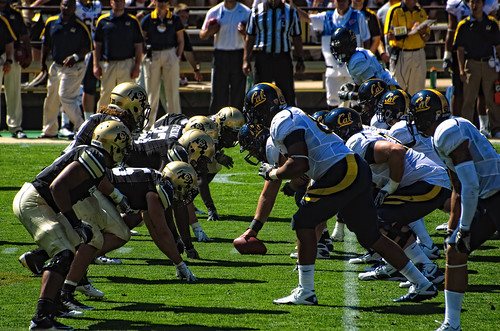
The remarkable ending of the NFL game last night between Seattle and Green Bay (shown above) is sure to prompt much discussion today. Note how one referee called the play an interception and the other a touchdown.

While I am not an NFL referee (though I may be qualified to be a replacement;-), I can not see any reason why that play was not called an interception. I don't see much ambiguity here based on my 40 years of watching NFL games. The Seattle player was clearly still establishing possession after the Green Bay player would have been judged down and the play over.

Mike Tirico, the ESPN announcer, says on the telecast that joint possession is not reviewable. If that is the case then this might qualify for one a rare "rules hole" occasionally found in sports competitions. I'd expect joint possession to be reviewable soon. [UPDATE: Joint possession is apparently not reviewable on the field of play but it is in the end zone. Details.]

All the excitement on the field aside, it is situations like this that help to explain the incentives for match fixing. USA Today reports:
The disputed call on the final pass into the end zone not only allowed Seattle to win the game but blew the Packers cover of the game. Green Bay came into the game as a 3-point favorite.

According to wagerminds.com, more than 70% of the wagers in Las Vegas last night were on Green Bay to cover. The website estimates that if the final call had been ruled an interception that the sportsbooks would have paide out $7.6 million to Packer backers and collected $3.6 million on those who bet Seattle.

Instead, the books only had to pay $3.2 million and kept the $8.4 million wagered on the Packers. So instead of absorbing a $4 million loss the Vegas books took in $5.1 million.
Too much ambiguity is no friend to professional sports.

Thursday, September 20, 2012

Mark Pieth at EASM and What is Next for FIFA Reform

Speaking today at the 20th conference of the European Association for Sport Management, Mark Pieth, chair of FIFA's Independent Governance Committee, gave a feisty but ultimately resigned perspective on the organization's prospects for reform.

Pieth asserted that no one in positions of influence cares much about FIFA reform, and he specifically cited governments, including those of the OECD and the Swiss government (where FIFA is incorporated), and the businesses that sponsor FIFA. The implication, he explained, is that the only option is self-reform. Pieth is clearly committed to reform within the current system and with the current leadership, and has concluded as a consequence that reform potential is limited. This contrasts with Lord Triesman, former English FA chairman, who yesterday at EASM 2012 told participants that "FIFA as it stands is incapable of cultural change, its current leadership will have to go."

Theo Zwanziger, a current FIFA Executive Committee member who spoke before Pieth in the same session, was clear in his defense of FIFA's current leadership (a group of which he is a part). Zwanzinger said (through a translator) that there was no point in calling for a change in FIFA leadership, as new leaders would come to occupy the same institutional structures which are what needs reform. Pieth said nothing about the need for leadership change, and explicitly highlighted the importance of Sepp Blatter in the reform effort due to the power of his position. Far from an independent overseer calling for change, Pieth appeared much more as a defender of incrementalism in reform, based on what is deemed acceptable by the current leadership.

Pieth repeatedly defended his role on the IGC, explaining that if you know anything about the challenges of politics, things are "five times worse" inside FIFA, with many interests and coalitions working to block reforms. He said that his experience in pressing for reforms has been that, "at some point there is a wall, and they tell me to go away." It was not long ago that Pieth was drawing a bright line on what would be acceptable and what would happen if it wasn't:
If we are unsuccessful, we would have to walk away. ‘We’ve had it, goodbye.’
Now it seems that whatever FIFA decides to do will be acceptable to Pieth.

Oddly, Pieth repeatedly called on the audience (and he cited specifically civil society, fans, academics, journalists) to put pressure on FIFA for reform. While there is nothing wrong with outside pressure (and there has been no shortage of such pressure), I say this is odd because over the past year there has been no one in a more powerful position to influence change than Pieth himself. He clearly has far more assets at his disposal than he has deployed.

For instance, do you remember early this year when Pieth said this?
"We must see to it that the gangsters do not escape in the wake of reform detractors. Many of those who now sit on the Executive Committee will not be there much longer. They will resign because of scandals."
Such tough talk appears to be in the past. For Pieth to assert now that the power to affect change lies in some general conception of outside pressure is to minimize the potential that the IGC has had as an agent of change. Perhaps it also reflects Pieth's acceptance of the limited influence of the IGC going forward.

Pieth explained that his mandate to work with FIFA carries through only to May, 2013 and then he is moving on. It is not clear what FIFA will do with its IGC at that point. What does seem clear is that the current IGC is well into its lame duck phase and we should expect little from FIFA in adopting anything further related to its proposed reforms.

Wednesday, September 19, 2012

EASM 2012: Second Day

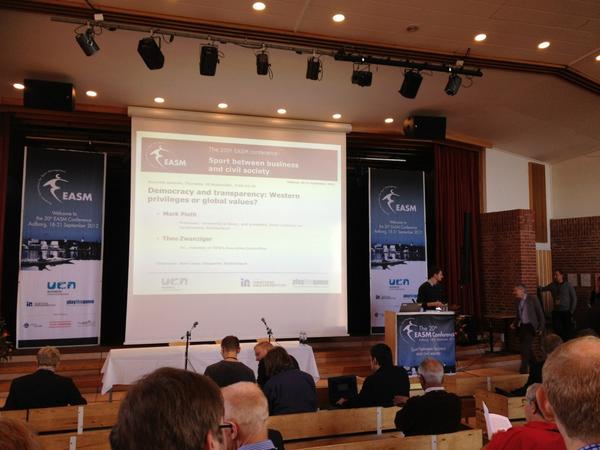
Up today is a plenary session featuring Mark Pieth, chair of the FIFA IGC, and Theo Zwanziger, a member of FIFA's Executive Committee.

Pieth has frequently been the subject of posts on this blog, such as here and here and here.

As yesterday I'll be live-tweeting the plenary, and will update this post as occasion warrants.

Playthegame.org has a report on yesterday's morning plenary here.

Looks to be a good day!
UPDATE 9:18, opening plenary photo courtesy @jason_doyle1
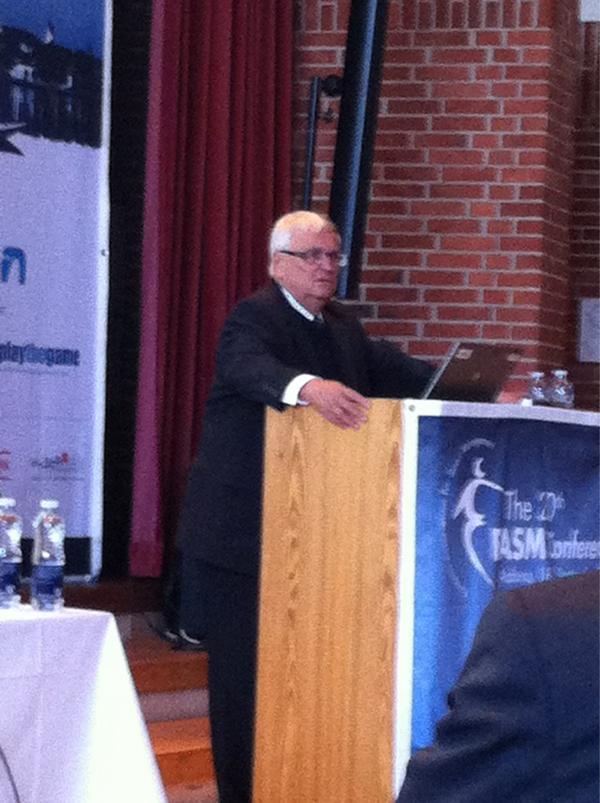
Theo Zwanziger speaking, courtesy @playthegame_org

UPDATE 20:08, PTG has posted up the text of Jens Sejer Andersen's keynote talk from yesterday, which challenges academics to work on 7 sports governance-related themes.

EASM 2012: First Day

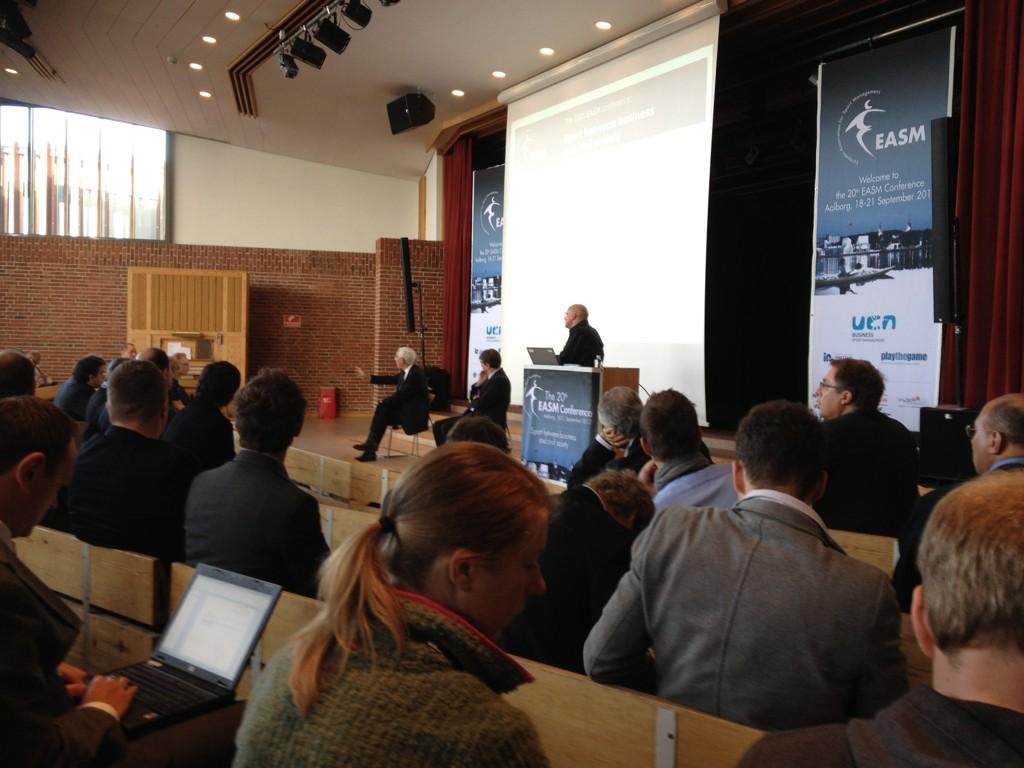
You can follow my commentary on EASM 2012 via my twitter feed - @RogerPielkeJr - and #easm2012. Picture of the plenary above courtesy @Jason_Doyle1

Quote of the day so far from Lord Triesman (pictured above):
"FIFA as it stands is incapable of cultural change, its current leadership will have to go .. a harsh prescription"
I'll update this post as needed during the day.

UPDATE 13:35

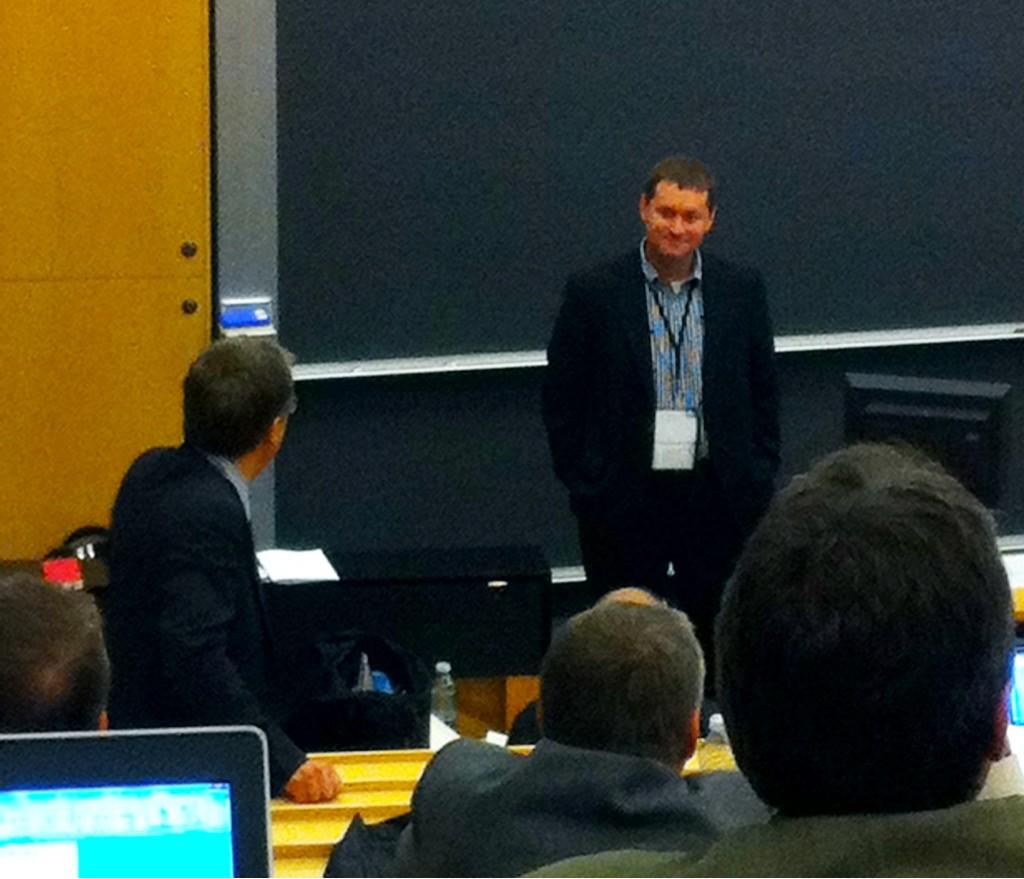
Here is me receiving a gracious introduction by Jens Sejer Andersen before my talk, photo courtesy @playthegame:
UPDATE 16:35

Here is the Real Madrid logo with (left) and without (right) the cross, as mentioned by James Dorsey in his plenary talk. Can you see it?


Sunday, September 16, 2012

EASM 2012

Just a quick heads up that I'll be blogging here and tweeting (@RogerPielkeJr) from the European Association for Sport Management 2012 Conference in Aalborg, Denmark.

You can see the program and abstract book here. I am participating in a session on Wednesday, organized by Play the Game (details here in PDF) titled, "Corruption and match-fixing: Can reforms work?"  I will present some lessons from broader experience in and research on policy implementation and evaluation, and how that might shine some light on implementation/evaluation challenges in sport governance. Right now my talk includes discussion of goal-line technology, doping, match fixing and good governance standards in sport organizations.

My talk will be among the least interesting events of the week, I am sure. More importantly, I am looking forward to learning a lot at EASM 2012. I'll do my best to report from the conference what I find most interesting and enlightening. 

Wednesday, September 12, 2012

The Long Arm of the Law

I've been busy on travel this week, lecturing on the Green Revolution, tornadoes and disasters. So I missed this important story:
Singapore-based World Sports Group (WSG) has started legal proceedings against veteran journalist and soccer scholar James M. Dorsey in a bid to silence sources and squash reporting about its relationship with the Asian Football Confederation (AFC) and disgraced FIFA vice president and AFC president Mohammed Bin Hammam, who is at the center of the worst corruption scandal in soccer history.

WSG has asked the Singapore High Court to instruct Mr. Dorsey to reveal how he may have come into possession of internal AFC documents, including an audit that puts on record unexplained payments of $14 million to Mr. Bin Hammam by one of the company’s shareholders in the walk-up to the signing of its controversial $1 billion marketing rights contract with the AFC. The report by PriceWaterhouseCoopers (PwC) also raises questions about how WSG was chosen, the terms of the contract and how it was negotiated.

A syndicated columnist, blogger and senior fellow at Singapore’s S. Rajaratnam School of International Studies, Mr. Dorsey reported extensively on the PwC report as well as the web of scandals that have wracked world soccer body FIFA and the AFC at which Mr. Bin Hammam, a Qatari national, is at the core. His reports have been posted on social media including Twitter, which has been cited in WSG’s petition to the court.
This story was written by ... James Dorsey. There is a complex connection made in the story between those exposed by Dorsey and those taking legal action against him under Singaporean law. The initial court date was to have been today ... news reports are silent on what transpired.

As far as I am aware the PwC report is not publicly available. However, for those who may be interested in leaking documents in the future, I'd suggest that US-based bloggers offer a safer/lesss risky alternative than others.

That said, Dorsey deserves broad support for simply reporting. He has mine. This story is worth following for anyone concerned about the media, transparency and freedom of speech.

Friday, September 7, 2012

Central Bankers Visit the Sports Laboratory

In a paper presented last week at the Jackson Hole gathering of central bankers, economists and other global power brokers Andrew Haldane and Vasileios Madouros of the Bank of England presented a paper titled "The Dog and the Frisbee" (here in PDF). In the paper they make a case for the use of simple, transparent heuristics as the basis for financial regulation, rather than complex and impenetrable regulatory regimes.

In making their argument, they draw upon the literature on sport, and specifically several studies on the use of heuristics to predict outcomes of Wimbledon.  They write:
Too great a focus on information gathered from the past may retard effective decision-making about the future. Knowing too much can clog up the cognitive inbox, overload the neurological hard disk. One of the main purposes of sleep – doing less – is to unclog the cognitive inbox (Wang et al (2011)). That is why, when making a big decision, we often “sleep on it”.
“Sleeping on it” has a direct parallel in statistical theory. In econometrics, a model seeking to infer behaviour from the past, based on too short a sample, may lead to “over-fitting”. Noise is then mistaken as signal, blips parameterised as trends. A model which is “over-fitted” sways with the smallest statistical breeze. For that reason, it may yield rather fragile predictions about the future.

Experimental evidence bears this out. Take sports prediction. In principle, this should draw on a complex array of historical data, optimally weighted. That is why complex, data-hungry algorithms are used to generate rankings for sports events, such as the FIFA world rankings for football teams or the ATP world rankings for tennis players. These complex algorithms are designed to fit performance data from the past.

Yet, when it comes to out-of-sample prediction, these complex rules perform miserably. In fact, they are often inferior to simple alternatives. One such alternative would be the “recognition heuristic” – picking a winning team or player purely on the basis of name-recognition. This simple rule out-performs the ATP or FIFA rankings (Serwe and Frings (2006), Scheibehenne and Broder (2007)). One good reason beats many.
While the overall point being made is a sound one, the two papers that they cite are not the best examples from the literature on prediction, and actually do not even support the claims being made. Let me explain.

Both papers cited by Haldane and Madouros used name recognition as the basis for creating predictions of the Wimbledon tennis tournament. Both papers looked at recognition among amateur tennis players as well as laypeople. Scheibehenne and Broder (2007, here in PDF) came up with the following results  (and Serwe and Frings 2006 had very similar results):
Predictions based on recognition rankings aggregated over all participants correctly predicted 70% of all matches. These recognition predictions were equal to or better than predictions based on official ATP rankings and the seedings of Wimbledon experts, while online betting odds led to more accurate forecasts. When applicable, individual amateurs and laypeople made accurate predictions by relying on individual name recognition. However, for cases in which individuals did not recognize either of the two players, their average prediction accuracy across all matches was low. The study shows that simple heuristics that rely on a few valid cues can lead to highly accurate forecasts.
The authors explain:
The systematic relationship between recognition and player success is presumably mediated by mass media coverage. Thus, by relying on their partial ignorance, non-experts are able to make accurate predictions by exploiting an environmental structure that contains relevant information and that is available at almost no cost.
So, "name recognition" is in effect simply a proxy for the ATP ranking which is reflected in Wimbledon seedings. There should thus be no surprise that the results of the analysis find the name recognition heuristic. The results showed that for amateur tennis players the recognition heuristic performed identically to the rankings and seedings, and for laypeople the recognition heuristic underperformed the rankings and seedings.

What this shows -- to use language frequently mentioned on this blog -- is that neither group showed skill in prediction, where skill is a demonstrable improvement over a naive baseline, and the laypeople actually showed negative skill. (For a discussion of skill in Olympic medals predictions, see this recent post.) This makes sense logically as amateur tennis players are far more likely to recognize the names of professionals than the average layperson. Hence, the recognition heuristic is more likely to accurately reflect the ATP rankings and seedings for those paying attention than for those who do not.

Thus, when Haldane and Madouros claim that -- "One such alternative would be the “recognition heuristic” – picking a winning team or player purely on the basis of name-recognition. This simple rule out-performs the ATP or FIFA rankings" -- They are incorrect insofar as the literature that they are citing, as the two papers on Wimbledon that they cite don't actually support the claim they are making and they don't cite any studies of FIFA rankings. The ATP rankings and  Wimbledon seedings are naive baseline predictions as they are readily available and suggest a first order expectation of tournament outcomes. To explain that a recognition heuristic performs as well as the naive baselines is to say that the recognition heuristic does not add any value. However, it may show that the media coverage accurately conveys the rankings.

Haldane and Madouros are however on the right track. The definitive paper on prediction lessons from sport research has yet to be written, but given its apparent importance to the work of central bankers managing the global economy, it should be soon.

Wednesday, September 5, 2012

University Oversight of Athletics: Who is in Charge?

The Chronicle of Higher Education has conducted an eye-opening analysis of the contracts of the presidents of the 25 biggest athletics departments in state universities.  Here is what they found:
Of the presidents or chancellors who oversee the 25 biggest athletic departments, not a single one has contract language related to oversight of athletics. That includes Rodney A. Erickson, who was named president of Penn State following a breakdown in university leadership during the Jerry Sandusky sex-abuse scandal. Employment agreements for top officials at Ohio State University and the University of North Carolina at Chapel Hill, which have both faced major NCAA sanctions in the past year, do not spell out any specific powers.

More common in presidential contracts, The Chronicle found, were specific goals for fund raising and financial management. If athletics was mentioned at all, it was to spell out perks the presidents would receive, such as free lifetime tickets to games.

Campus chiefs are held accountable for sports in various ways, including through individual performance reviews or their institutions' accreditation processes. But contract provisions are one of the measures governing boards use to assess presidential performance.

Governance experts say boards should do a better job of spelling out their leaders' athletics responsibilities to protect institutions from conflicts with boosters and outside parties, and to guard against potential fallout from scandal.
The University of Colorado, where I am a faculty member, is not among the 25 largest athletic departments so it wasn't included in the study. I had a look at the "Laws of the regents" which is the top-level governance document for the university, to see where athletics sits.

First, the University of Colorado mission statement:
The University of Colorado is a public research university with multiple campuses serving Colorado, the nation, and the world through leadership in high-quality education and professional training, public service, advancing research and knowledge, and state-of-the-art health care.
There is no mention of athletics in the mission, which is consistent with the findings reported by Charles Clofelter in his excellent book, Big-Time Sports in American Universities. Clofelter finds that despite the prominence of sports in major US universities, their presence is neglected when it comes to formal statements of mission and objectives. That fidning is similar to what the Chrinicle found of presidential contracts.

That said, the University of Colorado does have an Intercollegiate Athletics Policy, which specifies who is in charge (emphasis added):
Intercollegiate athletic competition at the University of Colorado commenced in 1890. Since that time, athletics have continued to be an integral part of the university's educational offerings and student activities. At the present time, teams in a wide variety of sports compete at local, regional, and national levels.

Each campus may support intercollegiate athletic teams at appropriate levels of competition and as approved by the Board of Regents. Intercollegiate athletics provide opportunities for student development as well as a forum and opportunity to promote the individual campuses and the University of Colorado. The campus chancellors are responsible for the oversight and management of their respective athletic programs and related representational events. The chancellors will provide opportunities for the president and Board of Regents to attend and participate in athletic and related representational events that can enhance the image and outreach of the university.
The Regent policy also appears to contain a provision that suggests free tickets for the Regents, but I digress. The University of Colorado is a "system" of campuses, and CU-Boulder is the only campus with a big-time athletic program. Our Chancellor is given explicit responsibility for CU-Boulder athletics oversight.

The University of Colorado also has a policy on the Interrelationship of Athletics and Educational Programs: 
Health Education, Physical Education, Recreation, and Intercollegiate Athletics are related areas which share common objectives and similar physical facilities. These disciplines and activities are financed through a combination of academic budgets, student fees, gate receipts, and from individual donations.

Due to their related goals, they are important parts of one very significant University responsibility. The University recognizes the instructional value of all four of these areas of activity. They each interrelate for instruction not only at the undergraduate and graduate level but also provide a learning experience for life after leaving the University.

In particular, intercollegiate athletics are drama--tragedy and comedy. They are discipline and dedication. They are victory and defeat--elation and dejection. They are respect and discourtesy--sportsmanship and gamesmanship. They are constructive outlets for the adventurous spirit. They are a positive way of life that teaches our young to control their minds, bodies, and emotions through exciting competitions governed by the rules of the game. The Regents of the University recognize the interrelationship of these four areas as an integral portion of the University’s instructional program.
Constructive outlets for the adventurous spirit -- a nice phrase, but I am not buying the notion that athletics are part of the instructional program. Universities have some work to do to shore up the governance of athletics.

Monday, September 3, 2012

Your Legs are Too Long


UPDATE: The Science of Sport blog has a nice discussion of this issue here.

In the 2012 Paralympic Games in London Brazilian sprinter Alan Oliveira upset South Africa's Oscar Pistorius in the 200 meter race, marking Pistorius' first defeat at that distance (watch the race above). Immediately after the race Pistorius lodged a complaint in a media interview:
"Not taking away from Alan's performance - he's a great athlete - but these guys are a lot taller and you can't compete (with the) stride length," Pistorius said in a broadcast interview. "You saw how far he came back. We aren't racing a fair race. I gave it my best. The IPC (International Paralympic Committee) have their regulations. The regulations (allow) that athletes can make themselves unbelievably high.

"We've tried to address the issue with them in the weeks up to this and it's just been falling on deaf ears."

For Pistorius, it is "ridiculous" that Oliveira could win after being eight meters adrift at the 100-meter mark.

"He's never run a 21-second race and I don't think he's a 21-second athlete," Pistorius said. "I've never lost a 200-meter race in my career."
Later Pistorius apologized for the timing of his complaint but did not back dwon from the substance of his criticism:
The South African claimed gold medallist Alan Oliveira's artificial legs were too long and criticised the International Paralympic Committee.

In a statement, he said: "That was Alan's moment and I would like to put on record the respect I have for him.

"I want to apologise for the timing of my comments but I do believe there is an issue here."
The length of prostheses is specified by the International Paralympic Committee in a process called "classification" which it describes as follows:
To ensure competition is fair and equal, all Paralympic sports have a system in place which ensures that winning is determined by skill, fitness, power, endurance, tactical ability and mental focus, the same factors that account for success in sport for able bodied athletes.

This process is called classification and its purpose is to minimise the impact of impairments on the activity (sport discipline). Having the impairment thus is not sufficient. The impact on the sport must be proved, and in each Paralympic sport, the criteria of grouping athletes by the degree of activity limitation resulting from the impairment are named ‘Sport Classes’. Through classification, it is determined which athletes are eligible to compete in a sport and how athletes are grouped together for competition. This, to a certain extent, is similar to grouping athletes by age, gender or weight.
There are exacting guidelines for the allowed length of leg prostheses, specified on pp. 45-47 in the IPC Athletics Classification Rules and Regulations – version 9/2011 (here in PDF).

Pistorius' complaint appears to be not that Oliveira broke the rules but that the rules themselves are flawed. For its part the IPC said,
"All [competitors] were within the regulations outlined in the IPC Athletics Classification Handbook." 
Pistorius, whose impressive record as a sportsman and an athlete will surely survive this particular controversy, is playing a losing hand here. Not only is he an interested party in the design of the rules, but he has been competing for years under those very same rules, representing a form of acceptance of those rules as legitimate. (Indeed, in the recent Sparks ruling on the Lance Armstrong case, the judge argued that Armstrong's decision to compete under WADA rules represented  an acceptance of them as legitimate and binding.)

That said, Pistorius is correct about the more fundamental issues as debate and discussion over prosthetic technology is sure to continue.

Postscript: In my fall graduate seminar, half of the students in the class are hard at work developing a proposed policy for participation of runners with prostheses in the Olympics. When they report to the class I'll share their results.

Thursday, August 30, 2012

Next up for FIFA Reform: The 20 Point List

In an interview with Mark Bisson, the Head of FIFA's Independent Governance Committee Mark Pieth says that he and his committee are now embarking on the more substantive reforms of FIFA's governance:
The head of FIFA's Independent Governance Committee tells World Football INSIDER that his committee will soon embark on "the bigger haul" of the process to improve the way world football's governing body is run.

Mark Pieth said putting in place a better governance structure would help to root out unethical behaviour and make FIFA more accountable.

A 20-point list will form part of discussions at the IGC's meeting at the end of September.

He said phase two of FIFA's reforms process was aimed at "organising in a pro-active way the institution to transparency and compliance on anti-corruption rules", noting that World Cup host country selection was among procedural issues "that have caused so much trouble in the past".
The biggest risk areas in FIFA's financial controls, Pieth has said, are its development programs, decisions relating to the selection of World Cup hosts as well as marketing and TV rights deals.

Recommendations will be put forward for discussion at December's meeting of the FIFA Executive Committee.
I do not know if the 20-point list is public (I have emailed Prof. Pieth to inquire), however, a few months ago I distilled 13 recommendations made by Pieth in his original scoping paper prepared for FIFA one year ago.

Here are those 13 recommendations are along with the grade that I assigned to the reform effort back in May:
The call-out boxes have the text of Pieth's recommendations, which is then followed by my assignment of a grade and explanation.
1. Recommendations in Analogy to the Corporate World

1.1 FIFA could further upgrade its existing financial governance, in particular by: a) developing a catalogue of potentially critical payments, and by deciding whether direct controls are warranted or whether indirect controls could be sufficient; b) intensifying its specific anti-corruption controls within existing COSO.
GRADE: Incomplete -- FIFA has apparently taken none of these steps.
1.2. FIFA should upgrade its compliance system to meet the requirements of a state of the art corporate anti-corruption compliance programme (including a review of the Code of Ethics, the risk analysis, the detailed rules on contributions etc. and the hiring of third parties, education and training as well as notification channels). Particular emphasis needs to be placed on the credible implementation of the programme. Member Associations and Confederations should be encouraged to adopt comparable standards.
GRADE: F --  FIFA is far from a "state of the art corporate anti-corruption compliance programme."  This is an F not an Incomplete because FIFA has recognized the need for such steps. The revelations this past week from CONCACAF underscore this need.
1.3. On an organisational level, a) FIFA should consider electing independent members into the ExCo.
GRADE: F -- this recommendation is posed as "should consider" which is rather weak. Nontheless, there is little evidence for such consideration.
b) The competences of the Financial Committee and the Audit Committee should be clearly distinguished. The Audit Committee, in order to act as a genuine internal control body, needs to be sufficiently independent from the administration (the agenda should be set by the Chair, the Committee should have access to external resources under its own authority, if need be).
GRADE: F -- There is no evidence that the FIFA Audit Committee has the capability to act as a "genuine internal control committee" and there is not independence.
c) Likewise, the Ethics Committee and the Disciplinary Committee should obtain clearly distinct tasks. This will require a reform of the underlying Codes (Ethics Code and Disciplinary Code). The Ethics Committee needs to be transformed into an independent body with a mix of external and internal members and the power to initiate investigations based on its own assessment.
GRADE: D -- This is the recommendation that FIFA has focused on throughout.  I suppose this is the cherry that Blatter picked. The functions have been split, however the degree of independence is minimal, which severely undercuts the proposed reform.
d) A Compensation and Benefits Committee should decide over benefits of officials of FIFA bodies and senior staff.
GRADE: F-- This also appears to have been rejected outright by FIFA.
2. Recommendations Derived from FIFA’s Public Role 2.1. Elections into FIFA’s Bodies a) Presidential Election< Candidates should announce their wish to stand sufficiently ahead of the election.
GRADE: Incomplete -- It is not clear if FIFA has considered this recommendation.
FIFA should examine a system of campaign financing which provides officially announced candidates with sufficient backing (a certain number of Member Associations) with FIFA funding, ruling out further private campaign contributions.
GRADE: Incomplete -- it is not clear if FIFA has considered this recommendation.
b) Term of Office FIFA should consider limiting terms of office of its officials.
GRADE: F -- It appears that FIFA has considered and rejected this recommendation.
c) Due Diligence on Members of FIFA Bodies< FIFA should consider introducing regular due diligence checks by the Ethics Committee on elected Members of its bodies. A regulation should specify cases of incompatibility with the FIFA function. The regulation should also define the procedure, and clarify under which circumstances an official would be temporarily suspended from his function.
GRADE: Incomplete -- this does not appear to have been considered by FIFA, and seems implausible that it would be implemented in any manner under current circumstances.
2.2. Decisions Decisions on hosting and on commercialising would greatly benefit, beyond a review of the actual procedures, of an overall abstract strategy, defined by relevant Committees and ratified by Congress.
GRADE: Incomplete -- This too does not appear to have been considered by FIFA.
3. Recommendations Reflecting FIFA’s Relations to its Members 3.1. Conflict of Interest Regulation An institution of the size and significance of FIFA needs a state of the art conflict of interest regulation, indicating cases of conflict and specifying the procedures (up to a possible recusal). While a conflict of interest regulation is a general requirement, it will be particularly useful to prevent abuses and adverse publicity in FIFA’s relations to Members.
GRADE: F -- This has been oft-commented upon here (such as) and even the IGC fell well short of the standards set by Pieth.
3.2. Development Funding Additional preventive measures ensuring transparency and accountability in its relations with Members should be taken in the area of financial contributions for the development of football in countries and regions. An overall strategy should be adopted for the multitude of historically grown funds. They should be governed in a comparable manner, and expenditure as well as uses audited on the standard of the Goal Programme and FAP.
GRADE: F -- As learned this past week, FIFA has a long way to go.
It will be interesting to compare the current 20 point list with the recommendations originally put forward.

Sepp Blatter Crticizes Joachim Eckert

Andrew Warshaw reports that FIFA's president, Sepp Blatter, is not happy with comments made by the newly installed co-chair of his Ethics Committee, Joachim Eckert:
Just weeks after announcing a revamped Ethics Committee aimed at combating corruption as part of his road map to reform, FIFA President Sepp Blatter has criticised one of the body's two independent chiefs.

Earlier this week, Joachim Eckert, a German judge, was quoted as telling a news magazine that Blatter needed to play his part in cleaning up the organisation or he would no longer be acceptable as its leader.

But in what can only be construed as another embarrassing episode in his Presidency, Blatter made it clear he was not happy with the comments of a man whose praises he was singing back in July.

"A judge should not say anything," Blatter (pictured below) told Germany's Sport Bild newspaper.

"I have never experienced it that a judge makes a comment about an ongoing case; he only says something when he makes the judgement."
Surely Blatter would not be trying to influence Eckert's actions? That would place him at risk of violating the provisions of independence set forth in new FIFA's Ethics Code (here in PDF):
The members of the Ethics Committee shall manage their investigations and proceedings and render their decisions entirely independently and must avoid any third-party influence.
It is not clear to me that Garcia has actually opened up a formal investigation of Blatter. However, Blatter is learning that actual "independence" means "outside of FIFA's control" and this initial indication is that he does not much like it. That said, Eckert comments are pretty tame compared to the sorts of information and actions that the new FIFA Ethics Committee might be dealing with in the future. With Blatter reacting to Eckert's comments in anger, it will be interesting to see what might lie ahead. FIFA, never dull.

Tuesday, August 28, 2012

Sport as Technological Laboratory

Accord to the FT, there is to be a new international racing series involving electric cars:
Electric cars will compete in a new global formula racing series after a deal between motorsport’s governing body and a group of investors who plan to stage international races around city-centre landmarks.

The Formula E championship will start in 2014 and involve 10 teams and 20 drivers, the aim being to draw competitors from traditional F1 teams, electric car companies and global brands.

Jean Todt, president of the Federation Internationale de l’Automobile, last year pledged to launch an electric car racing series in response to the European Commission’s desire to get the car industry to adopt more sustainable forms of energy.
The structure of the race tells us something about the technological state of electric vehicles:
The Formula E teams will be offered an evolution of a prototype vehicle for teams to compete in the 2014 championship.

The prototype vehicle developed by Formulec, a French maker of electric racing cars, is a two-gear machine that runs off lithium-iron batteries and weighs 780kg.

It has a maximum speed of 220km per hour, and an acceleration of 0 to 100km/h in three seconds. It can run for 25 minutes before needing charging, meaning drivers will have the use of a second car to complete the one-hour race.
25 minutes? Ouch. By way of comparison:
In contrast, an F1 car, fitted with a 2.6-litre V8 engine with 750 horsepower, has a minimum weight of no less than 640kg, including the driver, and can have a maximum of seven gears.

F1 cars are capable of going from 0 to 100km/h in 1.7 seconds, and cars can reach speeds of more than 300km/h.
It looks like electric cars have a long way to go from the simple technological perspective of being able to participate in an F1-style race. For the Formula E circuit to be more than a gimmick it will have to actually matter to racers and fans, and to matter to fans the technology is going to have to advance. Governments who what to see progress on electric vehicles might consider underwriting such competitions.

One area where technological improvements via sports has potential to influence normal folks is the Paralympics, where prosthetics and wheelchairs offer the promise (if not always the reality) of meaningful advances:
Prosthetics in the Paralympics are the product of thousands of dollars of research and designed for a very specific purpose: improving sports performance. Their benefits may trickle down to the general population, but much of what is showcased at the Paralympics is restricted to elite athletes.

Bruce McLelland, an engineer who has an artificial leg, said the prosthetics used at the Paralympics are 'a world away' from what he uses.

McLelland has a normal artificial leg for everyday use and another one for swimming. He said his legs incorporate some of the design of the running blades, including being made of carbon fiber so they are lightweight while also being strong and flexible.

"The blades are great if you're going to go running, but they would not suit everyday life,'' he said.

Pistorius' blades are designed for sprinting at high speed so it's very hard to stay still on them without rocking.

"They also don't really fit well into your normal trouser legs,'' McLelland said.

McLelland said he usually watches the Paralympics to see the newest prosthetic technology, noting different designs in various sports, like the artificial legs used by badminton players, which are thicker than the running blades since they must be strong enough to allow athletes to jump sideways and quickly change direction.

"I think having that kind of flexibility in my prosthetic would be great,'' he said. In wheelchair sports, some countries including Britain and Japan have partnered with car companies to ensure the wheelchairs will one day be available on the mass market. To give athletes an edge in sports like wheelchair rugby and basketball, the chairs are now more agile and lightweight, an advantage ordinary wheelchair users could certainly benefit from.
Electric cars have a long ways to go to catch up with wheelchairs.

Some Questions for Michael Garcia

When Michael Garcia (pictured above), FIFA's new investigator at the head of its ethics committee, announced that he would be looking into several instances of alleged corruption in FIFA, he raised expectations (see Garcia here in German TV). He also opened the door to a number of questions.

First, a review of the proposed investigations:
  • Mohammed bin Hammam, currently re-suspended by FIFA for alleged bribery
  • Awarding of the 2018/2022 World Cups to Russia and Qatar
  • Awarding of the 2006 World Cup to Germany
  • Conduct of Sepp Blatter
  • Fallout from the so-called ISL scandal
These subjects are not all independent of one another, of course. There are other candidates to be included in such a list but not as yet publicly mentioned by Garcia.

The questions that I'd like to ask Garcia following from his comments start with these:
  • What is the product of an investigation? A report? Findings?
  • Do your investigations have a "terms of reference" or a "probable cause" statement that initiates action? If so, will you release them? If not, how do you avoid charges of ad hoc decision making?
  • What is the process that you will use to conduct an investigation? Public evidentiary hearings? On-record interviews? What else?
  • What is the time frame of these investigations? When will you report your findings?
  • What resources do you have at your disposal and how will they be allocated across these topics?
I have the sense that Garcia is making this up as he goes along, which may be a necessary feature of FIFA's reform process. It is entering uncharted waters. However, how Garcia and his committee makes things up matters -- they are redesigning an airplane as it is flying. It is not an easy task.

It is not an overstatement to say that how Garcia handles these investigations will go a long way to sustaining FIFA's tenuous efforts at reform. People who are paying attention and with access can help that process along by asking questions such as these, and expecting answers.

Sunday, August 26, 2012

Michael Garcia's To Do List Swells

[T]he 2018 and 2022 World Cups to Russia and Qatar respectively will come under scrutiny.

Garcia of the USA and Hans-Joachim Eckert of Germany were appointed joint chairmen of the Ethics Committee during FIFA's extraordinary meeting in Zurich in July.

The awarding of the 2006 World Cup to Germany will also come under scrutiny as part of the pairs' inquiries, Garcia told German television in an interview.

The American said one of their many tasks is also to look into the relationship between FIFA and defunct marketing company ISL, who sold FIFA's World Cup TV rights.

Swiss court documents, recently published by FIFA, reveal ISL paid millions of dollars in bribes to former FIFA president Joao Havelange and ex-FIFA executive committee member Ricardo Teixeira.

"If you look at things, it is clear there is something to investigate and that is what we are going to do," the 51-year-old Garcia told ARD.

Garcia also said the conduct of FIFA President Sepp Blatter will also come under scrutiny.
It is unclear what it means to "come under scrutiny" but Garicia ia rapidly raising expectations. I hope FIFA has given him a large budget.

Friday, August 24, 2012

Lance Armstrong and the US Courts

Just a quick comment on Lance Armstrong's decision to -- in effect -- plead nolo contendre to the USADA charges against him.  It seems that this decision not to enter into arbitration almost completely closes the door to future legal challenges in the United States.

From the Sparks ruling in the lawsuit brought by Armstrong against USADA earlier this week:
The Court agrees with the reasoning of Slaney and Harding, that federal courts should not interfere with an amateur sports organization's disciplinary procedures unless the organization shows wanton disregard for its rules, to the immediate and irreparable harm of a plaintiff, where the plaintiff has no other available remedy. To hold otherwise would be to turn federal judges into referees for a game in which they have no place, and about which they know little. . .
Armstrong's challenges to USADA's jurisdiction, and his arguments about which rules govern, can and should be made in arbitration. If the panel's resolution of those issues is manifestly unjust and devoid of any reasonable legal basis, Armstrong may have a judicial remedy; but this Court cannot act on the basis of a hypothetical injury.
In principle, Armstrong could have won in arbitration, and by choosing not to go through that process Armstrong eliminates the possibility of arguing that the arbitration process was "manifestly unjust" in his case. To make such an argument now he'd have to allege that past arbitration decisions lead to such a conclusion -- not at all an easy case to make.

I say above that the door is not completely closed because in the US judicial system lawsuits are frequently brought from a losing position. However, I'd venture that if Armstrong's fight on this issue is to continue, it will be through CAS and via a proxy, such as UCI.

Of course, another alternative is that this really is the end.

Note: For a largely sympathetic analysis of the content of the dispute see here (which is the source of the image above) and for an unsympathetic view see here.

Thursday, August 23, 2012

Doping and the 2012 London Games

Writing at the British Journal of Sports Medicine Blog, Dr Peter Brukner provides a detailed rundown of the 13 athletes who tested positive for doping and assorted controversies in the 2012 London Olympic games. Here is his bottom line:
There were very few actual positive tests from the 2012 Olympics. This relative paucity of positive drug tests could mean one of two things.

That we are winning the war against drugs and the extensive testing and prospect of retrospective disqualification had succeeded in putting athletes off.
Alternatively, as has always been the case, that the athletes, coaches and scientists have perfected the art of avoiding detection using regular low dosages of drugs and hormones that are too small to detect. There are certainly plenty of rumours of endurance athletes using daily low doses of synthetic blood products which maintain high red blood cell count rather than using EPO. Victor Conte of BALCO fame was in London (I thought he was in jail!!) and claimed that 60% of athletics medallists were taking drugs. Probably not the most reliable witness, but he certainly knows the drug scene!
I believe that the use of performance-enhancing drugs is still widespread in certain Olympic sports. History tells us that there have always been athletes and coaches trying to gain an advantage. History also tells us that they are invariably ahead of the drug testers, thus the relatively small number of positive drug tests at Olympics. Out-of-competition testing and the co-operation of customs and law enforcement agencies have helped catch some drug cheats, but I cannot believe there are not lots more out there getting away with it.
What does that mean? Brukner gives an estimate:
It is feared that of the 258,000 tests conducted annually, as few as 2% include the blood tests that can detect the use of Human Growth Hormone. In 2010 there were just 36 positives – a total WADA regarded as “disappointing”. Across sport, there are fears that one in 10 athletes is attempting to cheat but of those only one in five is being caught.
Taking this estimate at face value, it means that 80% (!) of those who engage in doping violations get away with it. Applied to the 2012 Olympic games that would imply 52 violators not caught. A sobering number if true

Tuesday, August 21, 2012

Notes from Sparks Ruling on Armstrong vs. USADA

This week, a US District Court ruled against a lawsuit filed by Lance Armstrong against the US Anti-Doping Agency (ruling here in PDF). Armstrong was seeking to halt an arbitration proceeding against him on procedural grounds. The ruling, explained in 30 pages by Judge Sam Sparks, is an excellent read, especially in the context of my frequent ruminations on lex imperium vs. lex sportiva -- where the law of the land begins and the law of sport ends.

Below are a few excerpts from Sparks colorful ruling, along with my commentary.

Sparks does not shy away from commenting on the motivations that he suspects are behind USADA's pursuit of Armstrong:
The Court begins by recognizing the substantial private interest involved: it is no exaggeration to say the future of Armstrong's career, and maybe also its past, will likely be determined by the result of USADA's arbitration. Balanced against this, of course, is USADA's strong interest in fulfilling its mandate to root out doping in Olympic sports(fn19) -- an interest which is shared by other athletes, and the international sports community as a whole.
 Footnote 19 says:
19 As discussed further below, USADA's conduct raises serious questions about whether its real interest in charging Armstrong is to combat doping, or if it is acting according to less noble motives. Ultimately, however, the subjective motivations of the parties cannot control the Court's due process analysis, or give this Court jurisdiction over claims Congress and Armstrong have decided should be resolved through arbitration.
Sparks also says in footnote 36:
36 Among the Court's concerns is the fact that USADA has targeted Armstrong for prosecution many years after his alleged doping violations occurred, and intends to consolidate his case with those of several other alleged offenders, including--incredibly--several over whom USA Cycling and USOC apparently have no authority whatsoever. Further, if Armstrong's allegations are true, and USADA is promising lesser sanctions against other allegedly offending riders in exchange for their testimony against Armstrong, it is difficult to avoid the conclusion that USADA is motivated more by politics and a desire for media attention than faithful adherence to its obligations to USOC.
Nonetheless, Sparks is quite clear that sporting organizations should be responsible for the adjudication of disputes which properly fall under their governance regimes:
The Court agrees with the reasoning of Slaney and Harding, that federal courts should not interfere with an amateur sports organization's disciplinary procedures unless the organization shows wanton disregard for its rules, to the immediate and irreparable harm of a plaintiff, where the plaintiff has no other available remedy. To hold otherwise would be to turn federal judges into referees for a game in which they have no place, and about which they know little.
The threshold of a "wanton disregard for its rules" shows up again with different language:
Armstrong's challenges to USADA's jurisdiction, and his arguments about which rules govern, can and should be made in arbitration. If the panel's resolution of those issues is manifestly unjust and devoid of any reasonable legal basis, Armstrong may have a judicial remedy; but this Court cannot act on the basis of a hypothetical injury.
The court is carefully explaining to Armstrong that he may yet have a judicial option,. but not yet. Sparks concerns about the special "targeting" of Armstrong may yet be the basis for such a future suit justified by a "wanton disregard for the rules."

Sparks levies some pretty strong charges against the various organizations involved, not quite calling them Keystone Cops, but coming close:
As the Court has indicated, there are troubling aspects of this case, not least of which is USADA' s apparent single-minded determination to force Armstrong to arbitrate the charges against him, in direct conflict with UCI's equally evident desire not to proceed against him. Unfortunately, the appearance of conflict on the part of both organizations creates doubt the charges against Armstrong would receive fair consideration in either forum. The issue is further complicated by USA Cycling's late-breaking show of support for UCI, and apparent opposition to USADA's proceedings--a wrinkle which does not change the Court's legal analysis, but only confirms that these matters should be resolved internally, by the parties most affected, rather than by edict of this Court.38

The events in USADA's charging letter date back fourteen years, span a multitude of international competitions, and involve not only five non-citizens of the United States who were never licensed in this country, but also one of the most well-known figures in the history of cycling. As mystifying as USADA's election to proceed at this date and in this manner may be, it is equally perplexing that these three national and international bodies are apparently unable to work together to accomplish their shared goalthe regulation and promotion of cycling. However, if these bodies wish to damage the image of their sport through bitter infighting, they will have to do so without the involvement of the United States courts.
Footnote 38 from the passage above says:
38 Indeed, it is hard to imagine a situation more illustrative of Judge Posner's famous words, that "there can be few less suitable bodies than the federal courts for determining the eligibility, or the procedures for determining the eligibility, of athletes to participate in the Olympic Games." Michels v. US. Olympic Comm., 741 F.2d 155, 159 (7th Cir. 1984) (Posner, J., concurring). By the same token, this Court simply has no business telling national and international amateur athletic organizations how to regulate their respective sports.
So where does this leave sports jurisprudence and Lance Armstrong?
On the former, the Sparks decision reaffirms a sharp distinction between lex imperium and lex sportiva, while leaving that boundary permeable in certain exceptional circumstances. In other words, Sparks is saying, sporting associations should tend to their own business, unless and until that business violates the laws of the land. As that has not happened in this case, Sparks has tossed the issue back to USADA, as unsavory an outcome as that likely is to Armstrong.

For Armstrong, barring an appeal of the Sparks decision (which he'd likely lose), he now faces a decision to proceed with arbitration with USADA or accept their sanctions. The arbitration proceedings offer the prospects for an unseemly spectacle of various sports organizations (WADA, USADA, UCI, USA Cycling) arrayed on opposing sides of the dispute. Should an arbitration not turn out in Armstrong's favor then possible future stops for the dispute would include the Committee of Arbitration for Sport in Switzerland, and then perhaps Swiss Courts.

However, given the recent decisions of the CAS (e.g., FC Sion, bin Hamman) in support of sporting organizations and their due process standards, and the reluctance of Swiss Courts to revisit CAS decisions, Armstrong's legal teams may decide to seek recourse in the US. However, here as well Armstrong does not appear to have a firm basis for overturning an arbitrated decision against him. Perhaps such a calculus increases the chances of a deal being stuck to avoid arbitration altogether.

On this latter question, we'll know by Thursday. Stay tuned.

Monday, August 20, 2012

Beer, Circuses and the Case of CSU's Proposed Stadium

NOTE: This also appears on my other blog today.

Colorado State University in Fort Collins is proposing to build a new stadium for its football team (visualized above). One of the central arguments for building the stadium is to increase out-of-state applications, the quality of the student body and raise more tuition revenue. A close look shows that the numbers just don't add up.

Frequent readers here will be aware of the dwindling support of university education by the State of Colorado. This leaves a situation where state institutions must figure out a way to fill a gap left by the reduced state support. How this is done is not complicated, as I wrote last year about my institution, the University of Colorado:
In round numbers, the state provides about $3,000 per student.  If the state allows the university to charge about $8,000 per student in tuition, and the cost of running the university requires a break-even tuition of about $14,000, then you can see that the result is a loss of $3,000 per in-state student.  That adds up fast -- it is a  $60 million shortfall.

How does the university make up the difference?  Answer: Out-of-state students!  In 2010 the proportion of out-of-state students at CU was larger than at any time since 1975 (data, it was 34.5% in fall, 2010 and state law allows it to go to as much as 45%).  From 2005 to 2010 the number of CU in-state undergraduates shrunk by 1% while the number from out-of-state increased by 17%.
An interesting twist on this argument comes from Colorado State University, up the road in Fort Collins where my father was on the faculty for about 25 years. At CSU the administration is seeking to dramatically upgrade its athletic program. Writing in The Denver Post, Terry Frei explains:
[CSU President Tony] Frank has overseen a massive overhaul in the Rams' athletic department. He was dissatisfied with the department's direction, and also increasingly determined to use sports to help raise the university's national profile. The move comes at a time when national league realignment has significantly weakened CSU's conference, the Mountain West, making the highest priority — football prominence — even more of a challenge.

In the wake of a Stadium Advisory Committee's report last week that the controversial project is feasible, Frank said he will announce by early October his recommendation to the school's board about whether CSU should move forward with construction of a 42,000-seat, on-campus stadium. The new facility would replace the 32,500-seat, off-campus Hughes Stadium as the Rams' game-day home starting with the 2015 season.

Estimated cost: $246 million for the core project, planned for the south side of the campus. The SAC, headed by athletic director Jack Graham and school vice president Amy Parsons, said it had "roughly estimated" another $51 million in costs if previously cited features were included, including an alumni center, parking facilities and other buildings.
The stadium is only the tip of the iceberg:
Now Graham is hopeful of not only witnessing the Rams' move into a new stadium, but eventually a buildup of the athletic department budget — from the $23.5 million 2011-12 budget he inherited, to a planned $28.45 million in 2012-13, and to around $55 million a year at some point.

"The rest of this campus knows what excellence looks like," Graham said in his office at the Fum McGraw Athletic Center. "You go to our veterinary school, our agriculture school, our college of business. They don't settle for mediocrity. That is not what the culture's been like in our athletic department the last 10 years. ... I did not come here to babysit mediocrity. We're going to drive athletics to a level of excellence that reflects the standards of the rest of the university."
Frank outlines a vision for athletics in a speech here. One notable feature of the justifications being offered for the new stadium is tuition costs and out-of-state students:
Frank can rattle off stunning numbers about the increases in tuition at public universities over the past few decades, a result of both inflation and a precipitous percentage drop in state support, which traditionally subsidized much of the costs for in-state students. "Over that period, we've essentially been privatizing American public higher education," he said.

If the trend continues, Frank said, state support could completely dry up in the next 20 years. He views his mission as positioning CSU — which has an enrollment of about 27,000 — to withstand that. One move, of course, would be to continue with major tuition hikes, but he speculates that it would require a doubling of in-state tuition to make up for the lost state money. He also scoffs at trying to make up the money through volume, such as increasing enrollment to 63,000. "That doesn't work for CSU; that doesn't work for this community," he said.

A more palatable alternative, he said, is to draw more students paying out-of-state tuition. And higher-profile sports teams, he believes, would draw more national attention to CSU, including from potential nonresident students. "Adding 4,000 nonresident students is $80 million," he said.

That's where the on-campus stadium comes into play, with the country seeing — and the fans attending the games getting — a better feel for the campus itself than if games continue to play be played at Hughes Stadium, which opened in 1968 along the foothills to the west of campus. Frank said a realistic goal could be to add 2,000 to 3,000 in-state students, while pursuing even harder additional out-of-state students. "The carrying capacity of this campus is somewhere between 35,000 and 40,000," he said. "You've got plenty of room for nonresident growth that maintains the character of the campus."
While there may be good arguments for the building of a new stadium in Fort Collins, the appeal to the tuition gaps smacks of an argument of convenience. Let's take a look at the numbers.
In his presentation of February 3, 2012, CSU athletic director Jack Graham explained that "increasing the flow of student applications is an objective of construction of an on campus stadium" (here in PDF). The relevant slide from Graham's presentation is shown above.

In that slide you see that Graham cites Pope and Pope (2008) to argue that "applications received will increase 2%-8%." Pope and Pope (2008) can be found here in PDF. Here is what they concluded from their analysis:
For basketball, the results suggest that being one of the 64 teams in the NCAA tournament yields approximately a 1% increase in applications the following year, making it to the “sweet sixteen” yields a 3% increase, the “final four” a 4-5% increase, and winning the tournament a 7-8% increase. The impact of the athletic lags, are as we expected. While there is an effect of winning on the current year’s applications, the largest effect comes in the first lag. By the third lag, the effect has usually diminished substantially. . .

For football, the results suggest that ending the season ranked in the top twenty in football yields approximately a 2.5% increase in applications the following year, ending in the top ten yields a 3% increase, and winning the football championship a 7-8% increase. The largest effect is on the current football sports variable along with a small effect on the first lag.
The numbers above are for all universities, public and private, and the study finds larger effects for private schools. CSU is public, but let's set that distinction aside, and place the numbers reported above into the context of actual admissions numbers for CSU.

In 2011 CSU received about 16,000 applications of which about 7,000 were out of state. A top-20 team would therefore boost out of state applicants by 175, a top-10 team by 210 applications and a National Championship by as much as 560 applicants. This boost would be for only one year, after which the effect would disappear. I think it is safe to say that CSU's football successes simply cannot drive large increases in out-of-state applications, even with a national championship every year.

There may indeed be good reasons to build a new stadium at CSU, but increasing student applications, improving the academic quality of the study body and filling the State budget tuition hole cannot be supported based on the evidence provided by CSU.

Friday, August 17, 2012

There is No Such Thing as a Little Bit of Good Governance

FIFA has established a new set of procedures for investigations of ethical violations in the organization. Such investigations will be headed by the newly appointed Michael Garcia (above, with Hans Joachim Ekert), who recently explained his wide remit:
“There are no limitations at all on what we will be looking at, it will be determined solely by what we perceive as evidence or suggestions or reasons to look further and that will be our guiding principle,” Michael J. Garcia, head investigator for FIFA’s ethics committee, said today at a press conference in Zurich. An investigation can be started into anything or anyone, “whether that is a particular World Cup or a particular person,” he added.

Blatter’s ruling board agreed to create a two-chamber ethics court to prosecute cases more effectively after a panel of anti-corruption experts advising FIFA said previous cases were “insufficiently investigated.”

Former U.S. attorney Garcia was named by FIFA on July 17 as lead investigator of the restructured committee to investigate allegations of corruption in the sport, while German judge Hans- Joachim Eckert was chosen to lead the adjudicatory branch.
It is thus of note that Garcia decided that the first investigation to open would be of Mohammed bin Hammam, who is embroiled in a long-running dispute with FIFA and Sepp Blatter. Recently, FIFA was rebuked in an arbitration proceeding by the Court of Arbitration for Sport in a complaint filed by bin Hammam. 

Garcia's decision to place the investigation of bin Hammam at the front of the queue, raises some eyebrows. Writing at ESPNStar, Jesse Fink opines:
Now you'd be safe in deducing Sepp Blatter and his cronies at FIFA in Zurich have a lot of reasons to be worried about Mohamed Bin Hammam.

Why else immediately re-suspend the stood-aside president of the Asian Football Confederation and re-open an ethics committee investigation, even when the Court of Arbitration of Sport found the initial "eth-co" probe lacked procedural fairness and the sort of standard of evidence required to nail him?

Clearly the man presents a clear and present danger to President Sepp Blatter.

And so long as he stays in power the president's wishes are obvious: do what it takes to get rid of him once and for all and keep me well out of it.

The new, double-barrelled ethics committee might be reloaded, renamed and under new leadership, but to all intents and purposes it's still contains individuals that didn't do their job properly in the first place.

If the eth-co weren't so politically geared, it would be opening an investigation into how Blatter, Bin Hammam's rival in the same 2011 presidential election, allegedly gave away in "gifts" an identical amount of money as the Qatari - $1 million in US currency - during the campaign.
It is perfectly reasonable for people to ask how FIFA's new investigative regime sets its priorities and decides how to open an particular investigation. Other various allegations and apparent irregularities are further down Garcia's queue, including those having to do with the awarding of the 2018 and 2022 World Cups, Sepp Blatter's insinuations about Germany 2006, the revelations from the ISL scandal, the allegations leveled by Fink about Blatter above and so on.

There is so much that Garcia might begin investigating that an ability to clearly explain how he sets priorities is going to be essential to FIFA's ability to demonstrate transparency and progress toward better governance.

Garcia should therefore be questioned about his priorities and decision making processes, with an expectation that he can back them up publicly. FIFA is learning that, as with pregnancy, there is no such thing as a little bit of good governance.