Tuesday, March 13, 2012

Economics and Politics of Public Financing of Professional Sports

At the Freakonomics blog, Dave Berri, a professor of economics at Southern Utah University, has a piece up today on the decision by the city of Sacramento to provide a large amount of public financing for a new NBA arena for the Kings:
The Sacramento Kings will continue to exist. This week, the City Council approved a plan to finance a new home for the Kings in Sacramento. The price tag, though, is pretty steep. The arena will cost $391 million, and $255.5 million will be coming from the city of Sacramento.

Opponents of this plan – and there were just two on the nine-member Council – noted that sports arenas don’t provide much economic benefit. Furthermore, they questioned why public money should be given to a private business.

As Councilwoman Sandy Sheedy – who voted no – observed: “This city is on the verge of insolvency. As far as I know, we still technically qualify for bankruptcy under federal law.”

Proponents of this plan, though, argued that this plan will create jobs and economic benefits. And it was this argument that apparently persuaded the majority.

So we have two perspectives and one question: Do sports generate jobs and economic growth?
The short and simple answer to this question is "no." In a 2011 review of public subsidies for professional sports Baade and Matheson (here in PDF) summarize their findings:
Improving citizens quality of life is clearly an important goal for public policy makers, and there is evidence that sports are a valued amenity for local communities. Evidence of significant direct economic benefits from sporting events, franchises, and stadiums is lacking, however. While public-private partnerships can be justified on quality of life grounds, voters and public officials should not be deluded by over-optimistic predictions of a financial windfall. Sports may make a city happy, but they are unlikely to make a city rich.
There is plenty of evidence that facilities built for mega-events, like the Olympics or cup competitions, turn into "white elephants" and economists are in general agreement that public subsidies of professional sports cannot be justified on economics grounds. Despite this plethora of evidence, politicians continue to justify such subsidies on economic grounds, leading to what economist Stefan Szymanski has called "hypocrisy of the highest order."

Whenever there is an allegation of "hypocrisy of the highest order" that should direct our attention in one direction -- to politics. Public financing of professional sports continues not because it makes sense in economic terms, but because it is politically popular. At Freakonomics, Berri explains in the case of Sacramento:
I think the jobs argument is not the main issue motivating the proponents.

If we look back at this debate we see another motivation for the supporters of this arena.  A year ago, it looked like the Kings were going to depart Sacramento for the city of Anaheim.  In response, Kevin Johnson – the Mayor of Sacramento (and former NBA All-Star) – staged an immense effort to keep the Kings in Sacramento.  That effort culminated in the city of Sacramento giving $255 million to a new arena and it is important to emphasize, that money is not just coming from basketball fans.  These are funds the city could have used for other projects.  Therefore, this money is coming from people who may not even like the product sold by the Kings and the NBA.
Such a story clearly suggests that the Kings used the threat of re-location to elicit a substantial subsidy from the people of Sacramento.  Although the Kings do not have much economic impact on Sacramento, the Kings do make basketball fans happy.  And if they departed, those same people would be very unhappy with Kevin Johnson.  Consequently, the Mayor has an incentive to do what he can to keep the Kings in Sacramento (although it not entirely clear if making the non-basketball fans unhappy is good politics).
What we have here is a classic case of the politicization of expertise, in the sense that arguments grounded in values -- in this case the intangible and non-economic value to a community of a professional sports franchise -- are smuggled into a debate ostensibly about cold, hard dollars and sense. By making the arguments about economics, it is as if we believe that all of those intangibles can be somehow ignored.

Because economics is malleable enough to make pretty much any outcome sound plausible, arguments about the economic benefits of public subsidies for professional sports give an air of credibility to the debates. Ultimately however, it is the experts and democracy that suffer the consequences of such politicized debates. Changing the focus of the debates from economics to all those other things that we value may not change the outcomes of such decisions, but they would make the deliberations more consistent with the effective use of experts and a healthy democratic process of decision making.

Monday, March 12, 2012

NCAA Basketball Expense Bracket

The bracket above (click on it or here for a larger version) for the NCAA basketball tournament comes from Forbes, which has filled it out according to filings over the past three years that each school makes with the Department of Education. Forbes explains:
Including the play-in round, the team with the higher operating expenses won in 70% of the games in last year’s tournament. If you used our system to fill out your bracket, you would have correctly picked 68.3% of the games from the round of 64 up to the Final Four. For comparison’s sake, taking the favored teams in those games would have yielded a 65% rate of correct picks. That’s not a large difference in total correct picks, but operating expenses offer a significant advantage if you want to capture those late-round points: team spending correctly predicted half of the Elite Eight and Final Four, whereas picking by the favorites predicted just three of the final eight teams and none in the Final Four.
Can you out pick the prediction made by cold, hard cash? I doubt it ;-)

Friday, March 9, 2012

Regulating Bribery in Sporting Events in the United States

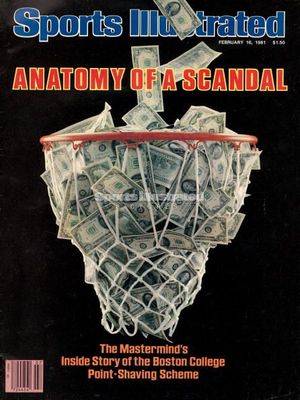
The corruption of sporting events via players or officials who are paid (or otherwise compensated) to influence results is in the news on both sides of the Atlantic. In Europe, much attention is being paid to match-fixing in football and in the US an allegation of point-shaving has surfaced involving the Auburn University basketball team. This post addresses some fundamental issues associated with the regulation of bribery in sporting events.

Is bribery in sporting events illegal?

Remarkably, according to a Council of Europe report released this week, "only ten countries in the world have passed legislation sanctioning sports frauds" (here in PDF).  That means that in the other 200-odd countries which participate and host sporting events, the regulation of bribery in sport is left to the sporting associations and other bodies which oversee the contests. This is another good example of the varied texture around the world of lex sportiva (the governance of sport by sport) and lex imperium (the governance of sport by governments). The United States does have federal legislation governing bribery in sport.

What does the US legal regulatory environment look like?

In the US, the federal government passed a law in 1979 called the "Bribery in Sporting Contests Act" who says the following:
Whoever carries into effect, attempts to carry into effect, or conspires with any other person to carry into effect any scheme in commerce to influence, in any way, by bribery any sporting contest, with knowledge that the purpose of such scheme is to influence by bribery that contest, shall be fined under this title, or imprisoned not more than 5 years, or both.
The Act defines a "sporting contest" as:
[A]ny contest in any sport, between individual contestants or teams of contestants (without regard to the amateur or professional status of the contestants therein), the occurrence of which is publicly announced before its occurrence;
Because bribery in sport is often closely tied to illegal gambling, there is also related legislation in that domain (e.g., see this review in PDF). The relationships between the federal government and sporting associations in the regulation of bribery is -- as far as I can see -- murky, out of the public eye, and rarely discussed in the media and virtually absent in the scholarly literature.

How do sporting associations regulate bribery in the United States?

The US professional sporting leagues only address bribery in cursory fashion.  Here is what the National Football League says that no one associated with a team or the league may (here in PDF at p. 39):
Offer, agree, conspire, or attempt to illegally influence the outcome of the member or fail to suspend immediately any officer or player or other employee of the member who shall be proven guilty of offering, agreeing, conspiring, or attempting to influence the outcome of any game or be interested in any pool or wager of any game in which a member club participates;
Similar language can be found in the Major League Baseball constitution (not available to the public but here in PDF, though the MLB focuses on self-governance and not illegality). The National Basketball Association Constitution and Bylaws are not readily available (itself interesting). It does seem that the major professional sports are perfectly willing to outsource the bribery issue to federal officials.

The NCAA does have a rigorous and public set of policies and sanctions in place for bribery among college athletes (here in PDF):
A student-athlete who engages in activities designed to influence the outcome of an intercollegiate contest or in an effort to affect win-loss margins (i.e., "point shaving") or who solicite or accepts a bet or participates in any gambling activity through a bookmaker, a parlay card or any other method employed by organized gambling that involves wagering on the student-athlete's institution shall permanently lose all remaining regular-season and postseason eligibility in all sports.
Like much that the NCAA does, its attention seems focused on the behavior of the athletes, rather than the coaches or officials.

Sources for further info: here and here

Thursday, March 8, 2012

FIFA's Red Herring on Exchange Rates

In its response to the sport governance report released yesterday by the Council of Europe, FIFA objects that the report overstates the compensation received by its staff due to exchange rate conversions.  Specifically FIFA explains:
Page 17 [101]. Salaries are paid in CHF and have for accounting reasons to be converted to USD. The strengthening of the CHF against the USD in the last years leads to an increase of costs.
Here is the CoE section 101 in full (p. 17 in this PDF):
In 2010, the total wage bill at FIFA was USD 65,280,000, distributed between 387 staff on average over the year, meaning that average pay per staff member was USD 168,682.17. The average monthly income at FIFA in 2010 was thus USD 14,056.85. FIFA's spending on salaries rose by 31.6% between 2009 and 2010 (from a total of USD 49,599,000 in 2009 to USD 65,280,000 in 2010), while the average number of staff members increased by only 7.2% over the same period. The financial report does not explain these increases and gives no information about the salaries of key management personnel.
Let's explore whether FIFA's criticism is warranted. According to the FIFA Finanacial Report 2010 (here in PDF at p. 62), it used an exchange rate of 0.9505 CHF/dollar for 2009 and 0.9079 for 2010, reflecting a strengthening of the franc against the dollar. How would the CoE section 101 read if expressed in 2009 Swiss Franc conversion rates? Here is the answer:
FACTORING OUT EXCHANGE RATE EFFECTS IN THE CoE REPORT SECTION 101: In 2010, the total wage bill at FIFA was USD 62,354,000 distributed between 387 staff on average over the year, meaning that average pay per staff member was USD 161,122.09. The average monthly income at FIFA in 2010 was thus USD 13,426.84. FIFA's spending on salaries rose by 25.7% between 2009 and 2010 (from a total of USD 49,599,000 in 2009 to USD 62,354,000 in 2010), while the average number of staff members increased by only 7.2% over the same period. The financial report does not explain these increases and gives no information about the salaries of key management personnel.
The average salary of FIFA employees changed by about 4% after taking into account exchange rate effects on the accounting, an amount which is insignificant in the context of the CoE's report. My conclusion: FIFA's complaint is a red herring.

Of course, rather than quibble about exchange rate effects in annual financial reports, FIFA could just release the details of its compensation packages. How hard would that be?

Wednesday, March 7, 2012

A Few Reactions to the Council of Europe's Draft Report on Sports Govenance

UPDATE: FIFA is quick out of the blocks with a response to the report here.

Today, the Council of Europe released a draft report titled, Good governance and ethics in sport (PDF, and first discussed on this blog here). The report is a welcome addition to the attention being devoted to good governance in international sport. At the same time the report highlights many issues which are problematic and difficult to resolve. Here are a few reactions.

On so-called financial fair play in European football the report singles out Manchester City FC as an example of how the rules can easily be circumvented:
Care will have to be taken to prevent any circumvention of the financial fair play rules in this way. A case in point is Manchester City, which has entered into a contract estimated at £400 million (over €450 million) with the airline Etihad. Etihad belongs to the Abu Dhabi royal family, and the Abu Dhabi United Group, which is led by Suleiman Al-Fahim, owns Manchester City. In order to avoid improper transactions of this kind, UEFA should prohibit clubs from sponsoring themselves or using associated bodies to do so. There is also a need to monitor the “purchases” of sponsors, who should not overpay for the rights they acquire.
Stefan Szymanski of the University of Michigan has warned that such rules may fail if challenged under European law, as reported by the New York Times last fall:
Any attempt to nullify the sponsorship deal may fail in court, said Stefan Szymanski, a British economist and co-author of the book “Soccernomics.”

“How do you determine what is the fair value of a corporate sponsorship? In essence, it’s arbitrary,” said Szymanski, who teaches at the University of Michigan. “It comes down to what people are willing to pay.”

The financial fair-play rules may also face a legal challenge for arbitrarily restricting what is considered allowable income on team balance sheets, Szymanski said. “If a wealthy owner wants to put his own money into his own business, how is that not money devoted to football?” he said. “When I go to a game, I take my money and buy a ticket and it becomes football income. When it transfers from the bank account of an Arab sheik, why isn’t that the same thing?”
The CoE report suggests that the middle eastern sheik's with deep pockets are not the only route to avoiding the strictures of financial fair play:
This poses the question at which point competition between clubs can significantly be distorted, and some clubs enjoy an undue advantage, as a result of the financing of sports infrastructure, its sale to sports companies or placing on loan to teams, the granting of subsidies, loans, tax breaks or other financial benefits, gifts, the purchase by public authorities of advertising space or, indeed, facilities belonging to clubs, or other measures to support sports companies. For example, in the early 2000s Real Madrid was able to sell its training ground back to the city for more than €400 million.
The CoE report also weighs in on controversies involving FIFA governance, explaining:
The aim is not to condemn. But FIFA's image is deteriorating, and action is urgently needed to prevent further abuses. Furthermore, other sports are experiencing similar problems. So the question is what to do to improve governance and financial transparency in the sport sector in general. . .

If we are turning our attention to FIFA here, this is not because it has the worst governance machinery, but more because it is better-known (and also – praise should go to FIFA where it is due – because the quality of information on its official website is very high) and because that institution is incomparably more important than any other sports federation, with the exception of the IOC.
I guess one should expect that if the best thing that can be said about FIFA is that it has a nice website, then what is to follow will be hard hitting. And it is. The CoE characterizes FIFA as unaccountable, not transparent and awarding high compensation to its employees. It makes the following recommendations:
The Assembly specifically calls on the Fédération Internationale de Football Association (FIFA) to take the necessary steps to cast full light on the facts underlying the various scandals which, in recent years, have tarnished its image and that of international football. The Assembly insists that FIFA, inter alia:

6.1. speed up the process of reform of its internal governance and, in this context, significantly increase the investigative powers of its Ethics Committee;
6.2. publish in full any judicial and other documents relating to the ISL/ISMM case which may be in its possession;
6.3. open an internal investigation in order to determine whether, and to what extent, during the latest campaign for the office of President, the candidates, and particularly the successful candidate, exploited their institutional positions to obtain unfair advantages for themselves or for potential voters.
While the call for FIFA to open an internal investigation is likely to garner the most attention from observers, it is a toothless recommendation, as the CoE has no authority over or control of FIFA. The best result that might occur is that FIFA's "good governance committee" takes on some of the advice of the CoE, none of which however will be new.

The bottom line is that the CoE report helps to elevate issues of sports governance and in doing so helps to focus attention to various important issues within that theme (some of which are covered in the report but not discussed here). Securing effective reform however will be a long and difficult process.

John Calipari on the NCAA

John Calipari, basketball coach at the University of Kentucky, has some string things to say about the NCCA in an interview with The Sporting News:
They’re not going to be around long. The NCAA will not. Before I retire from coaching, they will no longer oversee college athletics. They will, but it won’t be the four power conferences—they’ll be on their own. And the main thing is, do you really care about these kids? They’ll get mad that I say it. The NCAA Tournament, for example. It’s more about the selection committee getting on TV, everybody getting their tickets on the aisle, down low, all the parties they go to, the traveling. But we don’t take the parents of the participants. But they take their kids and their families.

The officials will get better hotels than some of their teams. And I know it for a fact. The decisions they make on the $2,000 (expense allowance for student-athletes)—it should have been $4,000. It’s a stipend. It’s not salary. It’s not “pay-for-play.” It’s a stipend. It’s expenses. And then schools vote against it. All this stuff piles up to where people are going to say, “Enough’s enough.”
His outrage is interesting, let's say, given that he currently has an 8-year salary package worth $36.5 million, with a chance to earn an additional $6.8 million in incentives.

Tuesday, March 6, 2012

NFL Bounties: Much Ado About Very Little

The ongoing controversy centered on the New Orleans Saints about the so-called bounties being offered by NFL players as a sort of performance bonus for hard hits, including those that diminish an opponent's ability to play the game is all a bit rich for me. Let us not forget that football is an intensely physical sport in which the physical domination of the other team in an effort to score points is the main point of the game.

There is a big difference between playing dirty and providing incentives for playing well within the rules. Former New York Jets linebacker Bart Scott told the New York Times:
"Knocking someone out doesn’t mean you’re doing something dirty. It’s no different than when the Detroit Pistons played Michael Jordan and every time he went to the hole, they were physical with him. No one was literally trying to hurt him."
Former Denver Bronco Trevor Pryce said something similar:
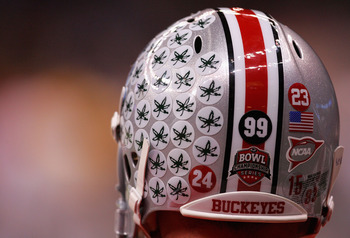
"A big hit is different. Getting rewarded for a big hit, they do that in college. You get a sticker on your helmet.”
We can chalk that up to another instance of college players not getting proper compensation in a pseudo-professional sport, but I digress.

If a team had a bounty system was for touchdowns scored or long punt returns, we wouldn't be having this debate. It is only because the bounty systems involves defensive players doing what defensive players do -- hitting people really hard -- that there is the veneer of faux outrage coming from the commentariat.

In recent years, the NFL has cracked down on certain hard hits, especially those involving the head and which result in concussions. In doing so they are taking some of the raw brutality out of the game, which is a response to both modern sensitivities and the risks of legal liability from players exposed to serious injuries.

But make no mistake -- the game is brutal. Legendary running back Tony Dorsett explains:
"If it was me, and I'm a defensive player, and I'm playing against the Dallas Cowboys, and Tony Dorsett happens to be one of their best players, it would be to our best advantage to get him out of the game. If it's within the rules of tackling and contact, so be it. I don't think it's that big of a deal. … They're not telling a guy to mangle somebody or kill somebody. It's 'Get him out of the game.' "
The WSJ has done a nice job cutting through the rhetoric to explore what it is we are really talking about here by doing an empirical investigation of game films from the New Orleans Saints to catalog their track record of defensive hits that led to a player leave the field injured. What did they find? Well, not very much:
A Wall Street Journal review of every regular- and postseason Saints game since 2009 makes clear what the NFL report didn't: Seldom did a Saints-inflicted injury force an opponent to leave the field.

In 48 regular-season and six postseason games, such incidents occurred only 18 times. The Saints player involved in the largest number of those cases was safety Roman Harper. That number was four.
While it would be useful to compare the Saints with other teams, seeing an injured player leave once every 3 games does not seem unusual for NFL football, where on-field injuries are otherwise known as commercial breaks.  The WSJ continues:
According to the NFL, the Saints rewarded players $1,000 for knocking opponents out of the game and $1,500 if the player had to be taken off in a cart. Exactly who received what on the Saints roster isn't clear, including whether Harper received any money at all. But under that formula, the total payout during those three seasons would have been about $19,000. And of that, based on the review of those seasons, Harper could have pocketed a grand total of about $4,500—peanuts for a player earning more than $7 million a year.
Forgotten it seems is that a defensive player like Harper is paid $7 million per year because he has a rare talent in being able to physically dominate opposing players. That obscene salary is the real bounty. To think that he (or anyone else) is going to risk their base salary via suspension or the on-field wrath of his peers by playing dirty (see the trials and tribulations of Ndamukong Suh) in order to make a few thousand dollars need a primer on basic economics.

The bounty scandal is not a scandal at all. What we have here is a sport that is based on physical contact which is being administered by people who are increasingly sensitive to the images and values that are projected by the sport. Those sensitivities are a good thing and NFL football is not alone -- rugby, ice hockey, boxing (and its variants), various Olympic sports like wrestling and judo and lacrosse all involve some form of physical domination by one person of another.

The NFL would be well served by focusing attention on what really matters here, which is the rules they have in place governing the impressive spectacle that they put out on the field. Focusing attention on "bounties" is a distraction and an insult to fans and players alike.

Read more here: http://www.sacbee.com/2012/03/06/4314274/pro-footballs-bounty-system-doesnt.html#storylink=cpy

Monday, March 5, 2012

Strife Around the World in National Football Leagues

Here is a round-up of various controversies, debate and strife occurring in various football leagues and associations around the world.

Switzerland, from the WSJ Europe:
Switzerland evokes images of stability, tranquillity and, well, boredom. It's rife with banks, watches and chocolates. It's where the von Trapps sought refuge, at least in the musical version, and where supposedly nothing much happens.

Nothing much, that is, unless you're a soccer fan.

As outwardly staid as the Swiss stereotype might be, the Swiss Super League has been a cauldron of controversy, bankruptcy and lawsuits. A season that began with 10 teams may well finish with just eight. Another club, Sion, which would otherwise find itself in third place, is dead last with a slightly surreal total of -1 points after it was slapped with a 36-point penalty.
Australia (oh, where to begin, how about here),
It has been the most tumultuous fortnight in Australian soccer since the game was effectively shut down after the 2004 NSL grand final as the federal government probed its future, finally releasing the Crawford Report that led to the creation of the A-League in 2005-06. Clive Palmer, the forthright billionaire owner of Gold Coast United, has emerged as a figurehead for those opposed to Football Federation Australia, while Frank Lowy and Ben Buckley are defending the FFA's legitimacy as the game's governing body.
Nigeria, Oluwashina Okeleji reports for the BBC:
The Nigeria Football Federation will not comment on remarks made within the Senate which labelled it the country's 'most corrupt government agency'.

On Wednesday, the President of the Senate, David Mark, said the corruption within the NFF was responsible for the Super Eagles' dwindling fortunes.

"The NFF is the centre of corruption in the country - there is no running away from the fact," said Mark.

The NFF told BBC Sport it does not comment on matters debated by Senate.

"We have failed woefully," said Mark, who presides over the Senate, which is the Upper House of the Nigerian Parliament.

"Corruption is not just financial corruption alone - even the way the players were brought in is another form of corruption."

"There is confusion and the government must put its foot down to get it right."

In a statement which may further worry supporters, Mark suggested that there may be a need for the government to pull Nigeria out of international football to allow for reconstruction.
Turkey, seeking to recover from a major match-fixing scandal:
The Turkish Football Federation (TFF) elected Besiktas' Yildirim Demiroren as its new chairman on Monday, setting him the task of quickly resolving a match-fixing crisis which has engulfed Turkey's domestic league this season.
Scotland, where Rangers, one of the two largest clubs faces a slew of controversies over finance, the latest from the Daily Mail:
The Scottish Football Association are set to investigate claims by former director Hugh Adam that secretive payments to Rangers players were excluded from contracts lodged with the governing body.

Sportsmail reported Adam’s claims that directors of the club were aware of the widespread use of the Employee Benefits Trust scheme.

The issue raises awkward and embarrassing questions over the role of respected SFA president Campbell Ogilvie — despite sources close to the former Rangers secretary insisting the EBTs were handled in entirety by the Murray Group at their Edinburgh HQ and that some directors were unaware of the details.
Indonesia, where its football federation is under investigation following the remarkable 10-0 scoreline in a loss to Bahrain in last week's World Cup qualifier:
Indonesian football authorities on Friday denied any foul play in the national team's 10-0 thrashing by Bahrain, after world governing body FIFA announced an inquiry and fans expressed outrage.

The Gulf side needed to win Wednesday's match in Manama by nine goals to have any hope of making the last round of Asian zone qualifiers for the 2014 World Cup, while Indonesia had already been eliminated from the tournament.

Indonesia's football association (PSSI) has long been mired in graft scandals, but the head of its disciplinary committee Bernhard Limbong told AFP there was "no way" corruption was involved in the remarkable scoreline.

"I know because I was involved in organising the match. If anyone did that, they would be a traitor to Indonesia.

"I would like to apologise to the whole nation for the defeat and for making Indonesia look like a total loser."
And what would a  round-up of global football governance be without a stop in Brazil, where Ricardo Teixeira remains as the head of the CBF, despite allegations of corruption. In other news FIFA and Brazil continue their spat over national sovereignty:
The Brazilian government is severing relations with FIFA’s top administrator after he criticized the country’s preparations for the 2014 soccer World Cup.

The organizers of sports most-watched event needed a “kick up the ass,” General Secretary Jerome Valcke said yesterday at a meeting in England. Brazilian Sports Minister Aldo Rebelo today labeled the comments as “unacceptable” and said the government will cease to recognize Valcke.
Never a dull moment in the governance of football around the world!

Thursday, March 1, 2012

My (Unproven) Theory About USA Soccer

Yesterday's 1-0 victory over Italy has USA soccer fans feeling giddy. Sure it was a friendly and against a less-than full strength Italian side, but breaking a 78 year, 10 game losing streak is worth noting. Especially when it is done on Italian soil. On Twitter Alexi Lalas, former goatee and denim wearing US international, asked what, if anything, is different about US soccer that might account for the victory.

Here is my theory: US soccer players are slowly but surely climbing the ranks of the international game, and not just keepers or individual stars, but a generation of players who give Jurgen Klinsmann a very deep bench. The team as a whole has vastly more experience at a higher level than they did just a few years ago. Consider that yesterday's US scorer Clint Dempsey is not even the same player he was last season.

The last time the US played Italy in Italy was almost exactly 10 years ago, when they lost a tight 1-0 match that featured a 19-year old Landon Donovan who clanked a shot off the post. The difference over those 10 years is a squad with vastly more experience perhaps overall quality -- recognizing that the 2002 squad was extremely strong, reaching the quarterfinals of the World Cup a few months after the loss to Italy. Perhaps most surprising about yesterday's victory in Italy is the fact that few would call it the strongest US line-up.

You can certainly point to the large number of players on that excellent 2002 squad who were playing in Europe, but few were regulars and home clubs included NAC Breda and FC Metz. But it is not enough for US players simply to be based in Europe, where the world's best football is played (in professional leagues, mind you). If the US men's national team is to excel it needs players who excel at the game's top level. Period.

So I have compiled a statistic that I think reflects the new stature of the US squad, and that is the number of goals scored in all competitions by players who are based in European clubs. Thanks to the excellent web site Yanks Abroad, for yesterday's match I come up with a total of 43 goals scored in all competitions (in the current season so far) by the US players who participated (10 starters - I'm not counting MLS-based Breck Shea - plus 4 subs). Yes, I am indeed using this crude offensive statistic as a proxy for experience across the entire game, including defense and keeper as well (no one would argue about Tim Howard's quality, and the keeper position has been a US strength for a long time). However, if there is one area of the game where the US has lacked it is in finishing.

I am hypothesizing that yesterday's squad had the most goals scored in all competitions by European based players than any squad that the US has ever put together. I don't actually know if this is the case (I have emailed the excellent guys at Opta to see what they might be able to tell me, but it is an odd request, and perhaps labor intensive) and I am willing to be corrected -- it is a theory after all.  However, if US soccer has snuck up on anyone, after yesterday's result, the days of sneaking up are probably over.

Tuesday, February 28, 2012

Against Platini: Why Goal Line Technology Makes Good Sense

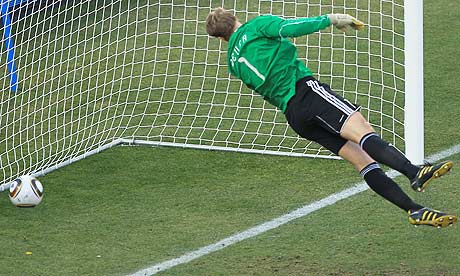
The picture above is of course from last weekend's match between AC Milan and Juventus in which the goal ball pictured above was ruled incorrectly by the linesman to have not crossed the goal line, in the process overruling the referee. Such controversial non-goals have led many to call for the introduction of some form of goal line technology which would assist officials in determining unequivocally whether or not a goal has been scored. Remarkably, some object to the introduction of goal line technology.

The most prominent advocate against such technology is Michel Platini, president of UEFA and heir apparent to FIFA. Last year he explained that such technology was not necessary because missed calls were oh so rare:
"How often do you have an incident where there is a real doubt as to whether the ball crossed the line? Perhaps once every 40 years."
Platini said that once goal line technology had been accepted, then videos could be used to make other difficult decisions.

"I'm afraid that if you start with technology which is used once every 40 years, it could lead to other uses for the technology and I'm afraid that maybe this could lead to video refereeing," he said.

"I don't think this technology is really good for football."
Perhaps he had in mind the 1966 and 2010 World Cups during which England found itself on different sides of goal controversies in matches against Germany, with a questionable goal awarded in 1966 and a clear goal denied in 2010. Although England's two experiences with the goal line were many decades apart, recent experience shows that such controversies are fairly common in top flight football.

Last Saturday's phantom goal at the San Siro was not even the only missed goal that day. Wolfsburg and Hoffenheim saw the exact same situation occur with an obvious goal by Hoffenheim not given (below). Hoffenheim prevailed in the end so the sense of injustice was much more muted than the draw in Milan. And earlier this month an A-League game saw yet another apparent goal not given.
Later this week the International Football Association Board -- the international body responsible for the rules of the game -- will discuss the initial results of trials with goal line technology with a decision set to be made in July, 2012.

That goal line technology is in any way controversial is remarkable. Platini's arguments seem to rest on three legs. First, that such controversies are rare. Second, that the introduction of technology for one aspect of the game would represent a slippery slope. And third, the game should be played in the same manner at all levels. Let's consider these arguments one at a time.

First, Platini has backed off from his earlier claims that such events occur every forty years, stating earlier this week after the Milan-Juventus controversy: "A goal like that of the English at the 2010 World Cup against Germany, which was wrongly not given, happens only once every few years." He is still wrong. The three controversies in February, 2012 alone clearly show that goal line ambiguity is problematic for officials. So this argument can be dismissed.

Second, Platini worries that goal line technology will lead to the use of technology in other areas of refereeing: "When I introduce a camera to keep the goals under surveillance I also need one for the surveillance of offside. There are 10 offsides per game." Here Platini's argument fails a basic test of logic. There is no reason why introducing technology to monitor one aspect of the game means that it would have to be introduced in other areas -- the IFAB would still make decisions on changes to officiating a case by case basis. Consider that the addition of additional officials on the goal lines for Champions League matches has not led to a slippery slope of ever more referees being added on the pitch -- there has been no slippery slope. On this issue, Platini was a strong advocate for changing the rules and his opposition to goal line technology demonstrates a marked inconsistency with his previous advocacy of changing the rules to help officials.

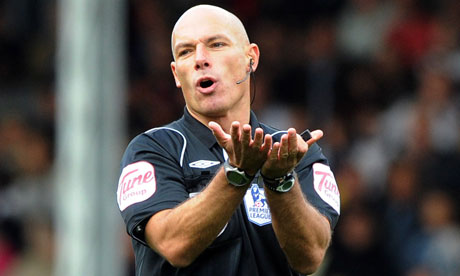
Third, the idea that the game should be played in the same manner at all levels is romantic and quaint, but is simply not how things are done. Consider that referees now routinely use communication systems (pictured sticking out of Howard Webb's ear to the left), in place since 2003. This technology is not available at all levels and its implemented has been seamlessly into top level matches with essentially no complaints. Of course, referee communications systems are but one of many examples of how the top level game is different than as played elsewhere (e.g., consider the extra referees discussed above.) Platini's argument is easily shown to be empirically incorrect.

To sum, the game would benefit from goal line technology, which actually is a minor innovation compared to the technologies that have been deployed to assist referees in sports such as tennis, American football, basketball, rugby and hockey. For soccer, where goals matter immensely, the implementation of goal line technology is a matter of improving the performance of the officials with no arguments that I can see against it that make much sense.

Monday, February 27, 2012

Call for Papers on Sport Governance EASM 2012

At the 2012 meeting of the European Association for Sport Management (EASM) to be held in Aalborg, Denmark in September, Jean-Loup Chappelet, Tracy Taylor and I are convening a workshop on the governance of international and national sport organizations. You can see all of the details below. Paper abstracts for the workshop are due March 26th, and we are looking to accept 9-12 papers, the best of which will be assembling in a special journal issue.

We welcome high-quality papers from academics, journalists, practitioners and others -- the submission portal is here. Our contact information is below if you have any questions.
Governance of international and national sport organisations

Background: Governance has become an increasingly important theme for international and national sport in recent decades because of actual and perceived problems of corruption, lack of transparency and unaccountability within the ranks of many international and national sport bodies. In the last ten years, scholars (Foster, Henry, Katwala…), sport organisations (such as IOC, FIFA, UCI, Dutch NOC…), and some governmental and intergovernmental organisations such as the Council of Europe and the UK parliament have proposed guidelines for improved governance of this growing sector. We propose a workshop on the governance of international and national sports organisations.

Theme: The workshop papers will focus on sub-themes such as:
  • Evaluations of individual sport organisation governance (IOC, FIFA, national sport organisations, etc.): Present and future
  • Relationships between local, national and supranational sport organisations: how much autonomy? How much oversight? 
  • Comparison of existing sport governance frameworks: Towards minimum requirements? 
  • Comparison of governance regimes of other non-governmental organisations beyond sport 
  • Role of intergovernmental organisations at European and/or world level 
  • Monitoring of sport governance at national or international level: Need for a Global Governance index?
Keywords: Governance, sport autonomy, transparency, organisational democracy, accountability

Format: Each participant will present their research with Power Point or in a short paper and time will be made available for questions and discussion. The Power Point presentation or short paper should be sent to the session conveners at least two weeks before the conference.

Abstracts are to be submitted for the EASM conference according to the procedure outlined by the scientific committee. Please indicate that the paper is for consideration for inclusion in the Governance of international sport workshop.

Between 9-12 papers will be accepted and form the basis for a one day (three or four session) workshop. Each paper will be presented, commented and discussed within a time frame of 30 minutes at the workshop. The best papers may be published in an edited book or in a special issue of a sport science or international politics journal (ESMQ, IJSPP, Sport in Society, SMJ…).

Conveners: From 3 continents:

Jean-Loup Chappelet, professor of public management at the Swiss graduate School of Public Administration (IDHEAP) at the University of Lausanne, Switzerland. Jean-Loup has published extensively on governance in the Olympic System, Jean-Loup.Chappelet@idheap.unil.ch

Roger Pielke, professor of environmental studies at the Center for Science and Technology Policy Research at the University of Colorado at Boulder, USA. Roger is an expert of football governance at national and international level, rpielkejr@gmail.com

Tracy Taylor, professor of sport management at UTS Business, the business school of the University Technology Sydney, Australia, with a particular focus on human resource management and executive leadership development. Tracy is the Editor of Sport Management Review, Tracy.Taylor@uts.edu.au

Saturday, February 25, 2012

How "Ball Possession" is Measured in Football

When you are watching a football match every once in a while you'll see flashed up on the screen a statistic showing how much "ball possession" each team has had. Opta explains how this statistic is computed:
[T]here are several data providers out there in the UK and across the world monitoring games, from TV companies themselves for live games, to specialists like Opta.

Each has their own method of working out possession. Some use calculations based on the data, but most use a “chess clock” approach where each team has a button which is hit when they are in possession. Some do this in the broadcast truck, others have analysts who call it out and inputters who hit the buttons.

Opta used this method originally, but the problem we found with a chess clock approach for time is that you are reliant on the person logging the data remembering to hit the button and the person doing it usually has other tasks to perform and other data to log.

Missing a couple of switches obviously skews the possession figures and it’s impossible to go back and change it. It may not sound much but one minute where the clock is wrong can affect the possession figures by two to three percentage points.

Opta now record possession in a football match by means of an automated calculation based on the number of passes that a team has in a game. We have two analysts, each monitoring one of the teams and they log each event in a game, totalling between 1600 and 2000 events per match.

Each of these events has a timecode plus an xy co-ordinate and the collection system is rigorously monitored by our team of checkers.

During the game, the passes for each team are totalled up and then each team’s total is divided by the game total to produce a percentage figure which shows the percentage of the game that each team has accrued in possession of the ball.
For Opta "ball possession" means percentage of completed passes, and is not a measure of time, though Opta does claim that the two are very closely related.

Friday, February 24, 2012

Rules for Referee-Spectator Interactions


The video above from last Saturday's NC State-UNC basketball game shows referee Mark Hess tossing out two spectators who happened to be former NC State stars players Tom Guliotta and  Chris Corchiani. The ejections prompted a host of reactions including this from NC State head coachMark Gottfried:
"I'm disappointed quite frankly in the ACC because not only did he throw out two of North Carolina State's greats, he threw out two of the ACC's greats," Gottfried said. "The league is supporting an official rather than supporting former great players. The former great players, in my opinion, were embarrassed and wronged when they shouldn't have been. I don't think you can have rabbit ears like that if you're a referee and start throwing people out. I was disappointed in the whole thing."
The Atlantic Coast Conference has backed the referee, but issued a reprimand for not following procedure: he had a police officer escort the two fans off the court rather than officials from the home team.

The incident raises the broader question of referee-spectator interactions. We are generally accustomed to thinking of referees as responsible for governance of action on the court. But the reality is that most big-time sporting events, not just frenzied college basketball games, see interactions between spectators and referees. Most of the time this interaction comes in the form of abuse hurled at the referee from spectators.  On a football field (US, soccer, rugby or Aussie) the officials are at a healthy distance from fans, but do have to deal with the occasional pitch invasion, object launched onto the field or even racial or other forms of abuse.

Being a referee is a difficult job. Here is how one referee describes the role in an essay about the NC State controversy:
Let there be no confusion: it takes an absolutely supreme amount of confidence to do the jobs that high-D1 basketball officials do. Imagine what it would be like to talk to Coach K or Roy Williams one-on-one about basketball. Now imagine the mental and emotional toughness it would take for you to stand your ground with either of those two men when he says you’re wrong about something. Now imagine he’s not just saying you’re wrong, but that he’s yelling it. At you. Along with nine- or twenty-one thousand of his best friends. Now turn around (he’s still yelling at you) and go make split-second decisions about the movements of elite athletes trying to pummel each other. And make those decisions accurately.

You have to be arrogant as hell to even try.
No doubt there are guidelines in each relevant sport that govern referee-spectator interactions, but as demonstrated in the case of NC State, these guidelines are rather imprecise and rarely invoked, hence the wide range of opinions on the appropriateness of the referee's action in this case. The referee explained his decision as follows:
They were ejected for excessive demonstration on several calls as they came right up to the scorer’s table. The policeman at the end of the FSU bench was warned that their continual excessive demonstration that incited the crowd would result in ejection.
The same basketball referee quoted above provides a cogent explanation for the factors that a referee must consider in making a judgment about fan behavior:
As most university ticket managers will tell you, not all fans are created equal. At least, not all seat-privileges are. For example, there are different standards of decorum for those seated behind the home bench versus those in the student section. It’s also not uncommon for schools to have a couple of rows of seats reserved behind the visitors’ section. The conventional practice is that people who acquire those tickets are told in no uncertain terms that their primary responsibility is to provide a buffer between the visiting fans and the more spirited of home fans. These ticket holders are typically given strict instructions that they are not to negatively engage, much less taunt the visiting fans, even in the slightest. The enforcement mechanism tends to be that if the ticket office learns that a fan in that section hasn’t lived up to the standard, the violator loses eligibility for those tickets in the future.

Schools aren’t required to do that kind of thing (though I expect that virtually all do), but it’s just plain common sense from a PR standpoint. Along the same lines, any school that fails to set standards and expectations for those holding tickets directly behind its scorer’s table is asking for trouble. Fans seated there should be informed (and in most cases probably are) that clear channels of communication simply must be maintained between the officials and the staff at the table, and that sitting in that area implies a sharing of the responsibility to insure that part of the game. Does that mean people in the front row shouldn’t be allowed to cheer? That those spectators shouldn’t be able to make any noise at all for fear of distracting a scorer or referee? That they should never be allowed to loudly criticize a referee or a call? Of course not. But it must be acknowledged that fans sitting in that area are capable of impacting the administration of a game in ways that fans anywhere else in the arena simply are not. As such, when it comes to fan conduct no one should be surprised that the definitions of “extreme” and “excessive” (the most important words in the relevant part of Rule 10) aren’t necessarily the same for everyone for every fan in the gym.
Referee-spectator interactions provide a fine example of where the governance in the game overlaps with the governance of the game. In the case of Mark Hess, he now has become part of the story and a personality in the game, which for both referees and for sport, is an outcome surely to be avoided.

Thursday, February 23, 2012

Mark Pieth on What Happens Next

Last week the Guardian reported some comments by Mark Pieth as to what should be expected from the FIFA good governance committee, whose initial results are now expected in April.  Here is an excerpt:
The committee overseeing reform at Fifa will decide in April whether it will conduct an investigation into the widespread allegations of past corruption at the highest levels of world football's governing body. Mark Pieth, appointed by Fifa to chair the new independent governance committee, said it would examine how Fifa responds to his committee's reform recommendations when the organisation's decision-making executive committee next meets, in Zurich on 29 and 30 March.

"We will decide then, after that meeting at the end of March, whether there should be an investigation into the more serious allegations of the past," Pieth told the Guardian. "We want to see Fifa's responses to our recommendations for future reform and other issues, including how seriously they deal with allegations themselves. If we are not satisfied with the response, all options are open to us, including setting up a commission with specialist investigators."
Pieth's turnabout on the issue of whether the past matters is in line with recommendations made by Transparency International and also a set of journalists who protested the scope of the committee's investigation.

But here is the fundamental problem with his approach: The FIFA committee only has standing because it is a body of FIFA. If FIFA decides to shut it down after the initial report, then there is no recourse. There is no other body with formal standing in a position to investigate FIFA (aside from the Swiss legal system under which FIFA is incorporated). Thus, all of Pieth's leverage exists right now, while he is the chair of the committee. He should recognize that while he may say in public that "all actions are open to us" at the same time all options are open to FIFA as well, and in this instance FIFA holds the trump card.

Kicking the can down the road on whether or not to investigate FIFA's past has a predictable outcome. Let's see what happens in April.

Tuesday, February 21, 2012

Wonky Definitions of Governance of and in Sport

Here is a conceptual distinction that I find quite useful, drawing on some wonkish literature of the policy sciences.

The governance of sport refers to decisions that are made at the constitutive level, specifically (from p. 205 in Lasswell and McDougal 1991) :
[C]onstitutive decisions ... establish and maintain the community's most comprehensive process of authoritative decision. These are the decisions, it may be recalled, that establish and characterize authoritative decision makers, state and specify basic community policies, establish appropriate institutional structures, allocate bases of power to the different institutional structures, authorize procedures for the making of different types of decision, and secure the performance of all the different types of decisions necessary to clarifying and securing common interest and effectuating community policy.
In contrast, governance in sport refers to decisions that are made within the constitutive frameworks, and can be simply thought of as decisions related to what happens on the pitch, court, ice, etc.

Most attention is paid to the governance in sport, understandably -- Should Torres be included on the Euro 2012? Who should manage England? Is a 4-4-2 preferable to a 3-5-1-1? These are decisions that involve the implementation of sport. However, the implementation of sport is only possible because of the larger constitutive processes. Every sports fan cares deeply about governance in sport, but what they may not know is the critical importance which sport depends upon effective mechanisms of governance of sport.

Sunday, February 19, 2012

Why are College Football Games on Saturdays?

Why are college football games played on Saturdays, and NFL games on Sundays? Why, politics and money, of course. Specifically, the Sports Broadcasting Act of 1961 (SBA) created an anti-trust exemption for professional football broadcasting, which lifted the exemption on Friday evenings and Saturdays.

From the Tulane Sports Law Blog:
While section 1291 of the SBA exempts the NFL and other professional leagues from antitrust attack when pooling their broadcast rights, section 1293 takes away that protection in certain circumstances.vi Section 1293 was designed to protect college football gate receipts from the potentially devastating effects of competing for crowds against televised professional football games.

The SBA prevents NFL broadcasts from competing with college football attendance by removing the antitrust exemption granted in section 1291 when the NFL broadcasts games at times when college games are typically played. If the NFL and its broadcast partners were to televise any of the games sold in the pooled packages during the prohibited time frame, they would risk treble damages in the event those pooled packages are held to be in violation of antitrust laws.

Specifically, the antitrust exemption granted in section 1291 does not apply to any professional football game televised (1) between the hours of 6 pm Friday and 12 am Sunday, (2) beginning on the second Friday in September and ending on the second Saturday in December.

The first Saturday game played by the NFL for the 2011 season is on December 17th. It is the third Saturday in December.

Thus, while not a direct prohibition, the risk of treble damages is more than enough to keep the NFL at bay-not to mention that in today's marketplace it would not make much business sense to try and compete with college football broadcasts. After all, over the last 50 years, the football fan has become accustomed to watching college games on Saturday and professional games on Sunday.
College football is far, far from an amateur sport conducted among self-organized clubs and associations. It is big business with Congressional protection.

Rare Footage of Original Hoosiers Released


Yahoo Sports reports on newly released footage of the 1954 Indiana state high school championship basketball game that inspired the movie Hoosiers:
Of all the great movies involving American sports, few are more ingrained in the nation's culture psyche than 'Hoosiers'. The film gave Indiana high school basketball a national profile, it romanticized how tournament basketball can lionize the little guy and set the stage for much of the popular mythology that engulfs America each March during the NCAA Tournament.

Now, rarely seen footage of the final minutes of the famous game that inspired the movie has been put online, thanks to the Indiana High School Athletic Association. As first brought to Prep Rally's attention by Jeff Eisenberg of our fabulous brotherly college basketball blog, The Dagger, the final three minutes of the 1954 state title game between Muncie (Ind.) Central High and Milan (Ind.) High was re-released by the IHSA over the past week, showing us just what Bobby Plump (or Jimmy Chitwood in 'Hoosiers' parlance) and his teammates looked like while pulling off one of the most famous upsets in American sports history.

There's no code to bring the video on to sites outside the IHSAA portal, but you can see the entire closing sequence right here.
Yahho reminds us that Milan High School, which won the game, had only 162 students, while Muncie had 10 times that many. Below is A. O Scott's NYT review of the movie:

Friday, February 17, 2012

FC Sion's (Legal) Losing Streak Continues

FC Sion has hit upon a run of bad form on the jurisprudential pitches of Europe. Here is a round-up
For is part, FC Sion asserts that they will press (at least some of) these issues via appeal in higher judicial settings.

FC Sion is rapidly seeing its legal options winnowed and the further it pushes its various cases up the judicial hierarchy the more authoritative and lasting will be the resulting decisions. For now, it looks pretty conclusive that the various FC Sion challenges to the authority of Lex Sportiva will have the effect of strengthening and delineating sports governance mechanisms in relation to national and European laws. They might not see it this way, but the European associations will have FC Sion to thank should the challenges to Lex Sportiva help to strengthen their mechanisms of governance.

Thursday, February 16, 2012

Open Books for You, Open Books for Me?

Explosive and troubling allegations out of Trinidad & Tobago:
Funds donated for earthquake-hit Haiti that never made it to the Caribbean island were paid into a bank account controlled by the former Fifa vice-president Jack Warner, the Trinidad & Tobago Football Federation (TTFF) claimed on Thursday.

Around £440,000 of emergency aid money has gone missing since it was donated two years ago and Fifa has frozen funding to the TTFF until it explains what has happened.

In 2010 Warner was special adviser to his country's federation and the cash from Fifa ($250,000) and the South Korean FA ($500,000) was paid into a TTFF account it claims only he controlled.

It is claimed the TTFF "surrendered their authority" to Warner, who resigned from football last year after being accused of bribery and he has refused to explain what happened to the money.

A TTFF statement said: "The TTFF acknowledges it is aware of funds made available by both Fifa and the Korean football federation for the football victims of Haiti's devastating earthquake in 2010.

"However, we are unable to confirm the quantum of funds received, as these monies did not go into the account used by the TTFF administration for its day-to-day operations, but instead to the TTFF's LOC (local organising committee) account as was requested by Mr Jack Warner, the former vice-president of Fifa and special adviser to the TTFF."
 The situation puts FIFA in a bit of a spot -- will they demand financial accountability from the TTFF? If so, will FIFA then offer the same?

Tuesday, February 14, 2012

Nationalism in Football, Who Knew?

FIFA is shocked, shocked:
Soccer’s governing body FIFA has questioned the Argentine FA over reports that the country’s championship could be renamed after the General Belgrano battleship sunk during the Falklands conflict with Britain in 1982.

AFA has been warned that the potential name change for the Clausura championship, second of two tournaments in the season, which began last weekend, could breach FIFA statutes.

However, an AFA spokesman said the championship had not been given that name and the issue would probably be discussed at the body’s weekly executive committee meeting late on Tuesday.

FIFA earlier issued a statement on the matter.

“FIFA contacted the Argentine FA (AFA) with regards to a potential change of name of the Liga de Primera Division. According to media reports, the league was set to be named after ‘Crucero General Belgrano’,” said FIFA.
FIFA has walked right into a mess here. You may recall not long ago England's desire to recognize its military, including those who participated in the Falklands War against Argentina, by wearing a poppy on their uniforms during a recent friendly against Spain. England protested vociferously, with interventions by David Cameron and Prince William, and FIFA ultimately relented.

At the time, John Leicester summed up the situation well :
England 1, FIFA 0. And at what cost to football?

With help from Prince William and well-timed indignation from Prime Minister David Cameron, England won this time. It bent FIFA’s arm so that its players can wear a symbol — a red poppy — during a football match this weekend, to remember the dead from the past century of wars Britain fought in.

But the begrudging ‘If you insist’ from FIFA sets an unnecessary and perhaps risky precedent.

Post-poppy, what’s next? North Korea demanding that its footballers keep their lapel pins honouring dictators Kim Jong Il and Kim Il Sung when they play?

Could China now request that its team be allowed to commemorate Japan’s 1937 slaughter of at least 150,000 people known as the “Rape of Nanking?”

Can Japan have a dove of peace or other symbol to remember the atomic bombings of Hiroshima and Nagasaki?

The list could run on and on.

There are 200 or so countries under the FIFA umbrella, and each and every one of them has political and social issues, special days of historical importance, perceived injustices and long-held grudges, and nationally recognized symbols that are as dear to their hearts as the poppy is to those Britons who wear it ahead of Remembrance Day on Nov. 11 in tribute to soldiers killed from World War I onward.
Is FIFA now surprised to find other national soccer federations wanting to honor their military via symbolic acts? It will be interesting to see how this one develops.

Monday, February 13, 2012

Racism in European Football

In the aftermath of the latest Suarez/Evra theatrics, Simon Kuper of the FT reports that British PM David Cameron will hold a summit on discrimination in sport. Kuper also suggests that the UK is not necessarily where the biggest problems lie:
Many other leagues give racism less attention. Italy’s football authorities, for example, have often been slow to acknowledge or condemn racist abuse heaped on the black Italian footballer Mario Balotelli. In 2009, after Juventus fans chanted “There are no black Italians” at Balotelli, Italy’s under-21 manager Pierluigi Casiraghi said: “It’s his personality that’s irritating. It’s not racism.” Italy’s then manager Marcello Lippi said “cases of racism in football don’t exist in Italy”, historian Simon Martin has written in his book Sport Italia. Mr Martin says: “So much here is like Britain in the 1970s and 1980s. Italy needs to look at Britain. There is quite a lot to be learned from the British example.”

In Spanish football too, racism often goes unpunished. Fans are not the only culprits. Luis Aragones remained coach of Spain’s national team after calling Thierry Henry a “black shit” in 2004. Here, too, some in authority seem reluctant to tackle racism. After Real Madrid accused Barcelona’s Sergio Busquets of racism last year (he was later cleared), Barcelona’s vice-president Josep Maria Bartomeu said his own club would not report any racist incidents on the field. He explained, “I don’t know what Señor Busquets said and what they were talking about, but they are things that happen all the time in football.”

Laurent Blanc remained France’s manager despite having participated in a meeting at the French federation to discuss limiting the number of black youngsters entering football academies. Talking about supposedly over-physical and uncreative black footballers, Blanc had said: “The Spaniards told me, ‘We don’t have a problem. We don’t have any black players.’”

In the Netherlands last month, nobody was punished after Feyenoord fans chanted, “Hamas, Hamas, Jews to the gas chamber” at Ajax Amsterdam’s team bus. Indeed, the chant is a hardy perennial of Dutch football. And in eastern Europe, said the international footballers’ trade union Fifpro last week, “Players are still regularly the victim of racist incidents, committed either by spectators or clubs.” In the Czech Republic, 37 per cent of players polled by Fifpro reported having experienced racism or other discrimination. 

Why We Watch: Zambia v. Ivory Coast

Why We Watch: Phil M

Richard Nixon and the NFL Blackout Policy

Newly released tapes show President Nixon in 1972 seeking to negotiate with NFL commissioner Pete Rozelle to lift its legislatively-supported restriction on TV blackouts for home playoff games in exchange for his support for continuing the regular season blackout. The AP reports:
The president was a serious fan and in the early 1970s, he shared the anger of Washington residents who couldn't watch Redskins games on TV, former aides recalled. The Redskins routinely sold out and the NFL blackout policy left no way for Washington fans without tickets to watch home games. In October 1972, Nixon's Justice Department had even told Congress it was time for some modification of the blackout policy "in the public interest."

By December it was clear the NFL would black out that season's playoff games, including the first-round Redskins-Green Bay Packers game in Washington.

In a Dec. 19, 1972, telephone call just days before that game, Nixon told Attorney General Richard G. Kleindienst to relay this message to NFL commissioner Pete Rozelle: "If you make the move, for these playoff games, we will block any — any — legislation to stop anything else. I will fight it personally and veto any — any — legislation. You can tell him that I will veto it. And we'll sustain the veto. … Go all out on it and tell him he's got the president's personal commitment. I'm for pro football all the way, and I think it's not in pro football's interest to allow this to build up because before you know it, they'll have the damn Congress go all the way. We don't want Congress to go all the way."

Nixon told his attorney general that the NFL "should have absolute protection on all regular-season games" and that "if we can get the playoff games, believe me, it would be the greatest achievement we've ever done."

As Kleindienst began to outline what he would tell Rozelle, Nixon interrupted him.

"But let me say, that I want us to get some publicity out of this," the president said. "I just don't want to do this to accomplish it."

"I understand that," Kleindienst responded. "And that's what I'm going to tell him. That without putting your neck on the line …"

"Oh, I don't mind my neck on the line at all," Nixon said.

"Now see if you can work that out and tell him this would be the greatest move he could ever make," Nixon said at the end of the call. "He'd be a hero to the nation."

Incredibly, the next day Rozelle rebuffed the attorney general.
Television rights for professional sports have long been restricted by Congress as part of the general anti-trust exemption given to professional sports.

Wednesday, February 8, 2012

A Fairy Tale in Wellington

American footballer Alex Smith is having a great run in the A-League:
As Australia’s A-League season enters the final stretch, the Wellington Phoenix’s American midfielder Alex Smith is enjoying a remarkable comeback while aiming to lead the New Zealand-based club to its first championship.
Smith is living a  bit of a fairy-tale story:

In 2005, after completing a strong sophomore season at Southern Methodist University in Dallas, Smith went to England to train with professional clubs. He intended to return to college for his junior year but, to his surprise, the N.C.A.A. ruled that he had lost his eligibility during his trip to England.

Smith ended up signing with Dallas of Major League Soccer in 2005, but did not stay with the club. As a young man, Smith had lost his focus on soccer and simply quit the game. He then packed his bags and moved to Australia for no other reason than it was a place he enjoyed once on a vacation. At the time, soccer was the last thing on his mind.

It was not long, however, that soccer would work its way back into Smith’s life.

“I got done with college and didn’t really want to get into the corporate America world,” Smith said. “I was just over the whole business of soccer. I just packed my bags and took off. I didn’t know anybody. I had a bit of money saved up and didn’t plan it. I started playing again by juggling around a little with a ball just to get in shape. I ended up meeting a few people, and that’s what led to everything.”

In 2010 Smith was back to playing competitive soccer when he joined for Fraser Park in the New South Wales Super League, a minor league in Australia. Shortly after, Smith was on the move to Sydney Olympic, another N.S.W. Super League team where he became one of the team’s best players in early 2011.
Following Yanks abroad is no longer an easy task, but this website (where the author of the piece excerpted above writes) helps.

Monday, February 6, 2012

Contador Guilty of Doping

I'm not sure which is more troubling, that Alberto Contador was found guilty of doping or this statistic:
Only two Tour de France winners since 1995 — Carlos Sastre in 2008 and Cadel Evans last year — have not become embroiled in controversies involving performance-enhancing drugs.
The joker in the picture above, who had simulated a syringe application on Contador, apparently gets the last laugh.

Friday, February 3, 2012

Friday Linkage and a Rugby Documentary


RUGBY: LIFEBLOOD OF NEW ZEALAND from 100distrib on Vimeo.
I watched the documentary above earlier this week on an Air New Zealand flight from Auckland to Sydney, enjoy!  Some various links that went unblogged this week: